
Water Treatment Systems Market Outlook: Size, Share, Trends, Growth Analysis, Competitive Landscape & Forecast, 2026-2033

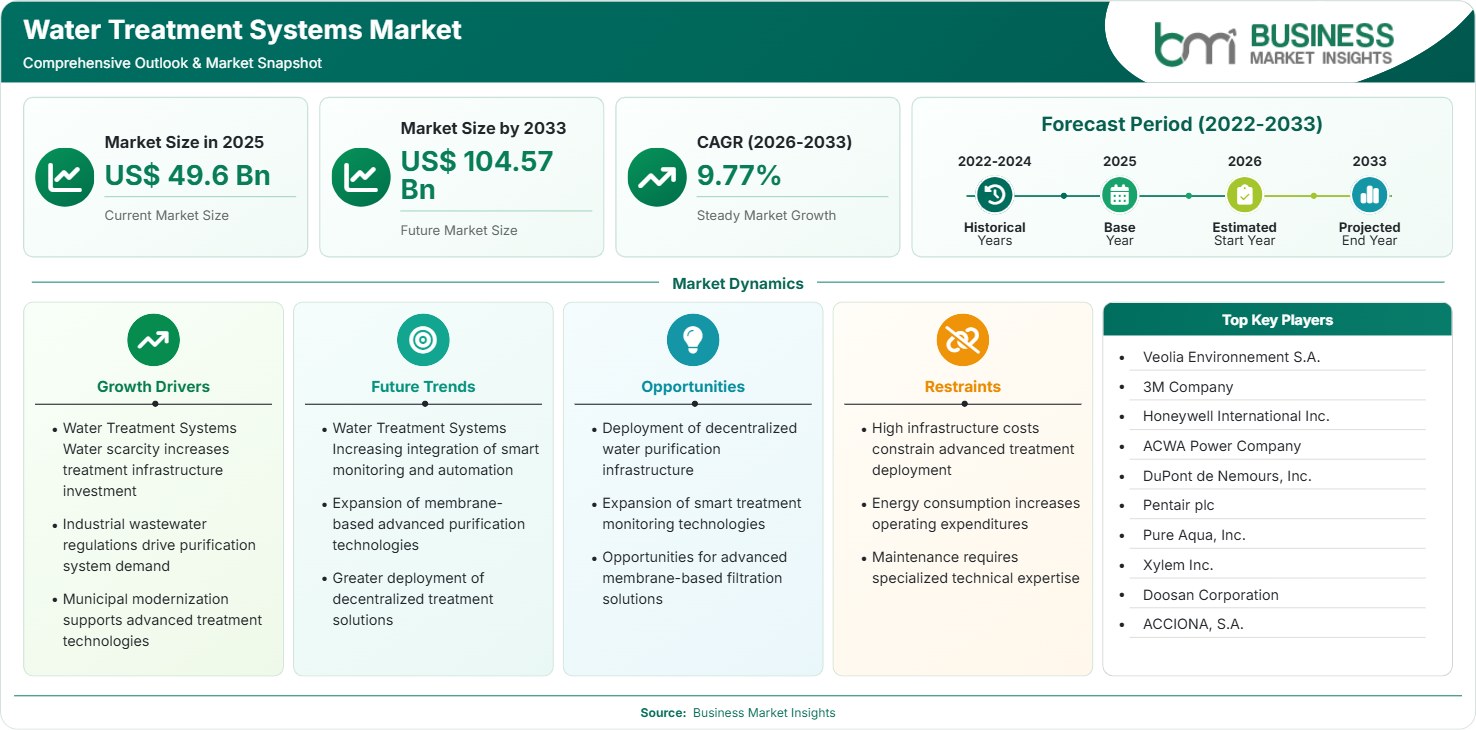
The Water Treatment Systems Market size was valued at US$ 49.6 Billion in 2025 and is projected to reach US$ 104.57 Billion by 2033, growing at a CAGR of 9.77% during 2026–2033, driven by water scarcity, reuse mandates, urbanization, industrial demand, and digital treatment technologies.

Report Coverage
  • Installation: Point-of-Use, Point-of-Entry
  • Technology: Reverse Osmosis Systems, Distillation Systems, Disinfection Methods, Filtration Methods
  • Application: Residential, Commercial
US$ 49.6 Bn Market size in 2025
US$ 104.57 Bn Market Size by 2033
9.77% CAGR, 2026 - 2033
2026-2033 Forecast Period

AI Overview

Water Treatment Systems Market Summary

  • North America: North America holds a 27%–30% share in 2025, growing at a CAGR of 8.2%–8.8%, influenced by aging infrastructure, contaminant regulation, industrial reuse, advanced membranes, decentralized systems, and data-center water demand. US demand remains resilient, supported by utility modernization and industrial investment, with a 2026–2033 CAGR of 8.1%–8.7%.
  • Fastest Growing Region: Asia Pacific holds a 31%–34% Water Treatment Systems Market share in 2025, expanding at a CAGR of 10.8%–11.6%, supported by urbanization, industrialization, desalination, municipal infrastructure investment, water stress, semiconductor manufacturing, and decentralized treatment adoption.
  • Leading Segment: Reverse Osmosis Systems holds a 34%–38% share in 2025, advancing at a CAGR of 10.0%–10.7%, supported by desalination, industrial reuse, membrane efficiency improvements, compact designs, higher recovery, and broader commercial deployment.
  • High Growth Segment: Commercial applications hold a 43%–47% share in 2025, advancing at a CAGR of 10.2%–11.0%, supported by hospitality, healthcare, foodservice, offices, manufacturing, compliance requirements, decentralized treatment, and dependable process-water demand.
  • Key Market Opportunity: Expansion of water reuse, desalination, semiconductor manufacturing, data centers, and decentralized treatment creates investment opportunities where digital monitoring and energy-efficient technologies improve lifecycle economics.
  • Major Market Players: Veolia Environnement S.A.; 3M Company; Honeywell International Inc.; ACWA Power Company; DuPont de Nemours, Inc.; Pentair plc; Pure Aqua, Inc.; Xylem Inc.; Doosan Corporation; ACCIONA, S.A.
Strategic Insights

Water Treatment Systems Market: Strategic Insights

Water Treatment Systems Market Strategic Framework
FREE PDF
Request your free sample
Request free sample
Stakeholder View

Key Takeaways

  • Supply chains are shifting toward integrated ecosystems combining membranes, pumps, sensors, controls, chemicals, engineering services, and lifecycle maintenance rather than standalone equipment.
  • Commercial facilities offer strong upside because hospitals, hospitality properties, foodservice operators, offices, and industrial sites increasingly require reliable decentralized treatment and documented water quality.
  • Innovation is moving toward lower-pressure membranes, higher recovery, advanced pretreatment, AI-assisted operation, modular architecture, and treatment configurations designed around reuse.
  • Asia Pacific provides the strongest regional investment case as municipal deficits, industrial expansion, semiconductor fabrication, urbanization, and water stress create simultaneous demand.
  • Investment increasingly favors companies combining treatment technology with recurring services, digital platforms, infrastructure concessions, and long-term operating contracts.
  • Data centers represent an emerging demand pool because cooling systems require dependable water management, while reclaimed water can reduce pressure on potable supplies.
Geographic Outlook

Water Treatment Systems Market Regional Highlights

North America Water Treatment Systems Market

North America accounts for a 27%–30% share in 2025 and is projected to expand at a CAGR of 8.2%–8.8% through 2033. Aging municipal assets, industrial reuse, contaminant regulation, and drought resilience support modernization spending. The regional Water Treatment Systems Market share benefits from established service networks and sophisticated industrial buyers. The US remains the principal demand center, while Canada contributes through municipal upgrades, mining, food processing, and resource-sector applications.

  • Utility modernization is shifting procurement toward integrated treatment, controls, remote diagnostics, and long-term service contracts that improve asset utilization.
  • PFAS and emerging-contaminant concerns are strengthening demand for activated carbon, membranes, ion exchange, and hybrid treatment configurations.
  • Data-center expansion is creating localized demand for reclaimed water, cooling-water treatment, filtration, and monitoring solutions in constrained locations.
  • Industrial reuse is gaining traction as manufacturers seek predictable supplies, lower discharge volumes, and resilience against drought-related disruptions.

US Water Treatment Systems Market

The US represents 78%–82% of North American demand in 2025 and is projected to grow at a CAGR of 8.1%–8.7%. Federal and state contaminant requirements, utility replacement needs, industrial reshoring, and data-center construction reinforce investment. The domestic Water Treatment Systems Market trend combines fragmented municipal procurement with sophisticated industrial buyers. Commercial demand is supported by healthcare, hospitality, foodservice, and institutional facilities. Suppliers increasingly compete through performance guarantees, monitoring platforms, consumables, and maintenance agreements.

  • Municipal systems are prioritizing contaminant removal, resilience, leakage reduction, and asset renewal, creating sustained technology procurement opportunities.
  • Advanced manufacturing increases requirements for high-purity process water, wastewater recovery, pretreatment, and dependable treatment performance.
  • Commercial customers increasingly favor compact systems with automated controls, service contracts, remote alerts, and modular expansion capabilities.

Europe Water Treatment Systems Market

Europe holds a 24%–27% share in 2025 and is projected to grow at a CAGR of 8.8%–9.4%. Water efficiency policies, industrial discharge standards, drought exposure, reuse initiatives, and aging networks support demand. Germany and the United Kingdom remain leading markets, while Spain and Italy offer higher-growth opportunities at 9.2%–10.0% and 9.0%–9.8%, respectively. The regional Water Treatment Systems Market share is increasingly influenced by circular-water strategies, energy efficiency, contaminant management, and digitalized utility operations.

  • Germany combines industrial water intensity with stringent environmental standards, supporting advanced filtration, membrane treatment, wastewater recovery, and process-water optimization.
  • Spain and Italy benefit from drought exposure and water constraints, encouraging desalination, reuse, leakage management, and decentralized treatment.
  • The United Kingdom is strengthening wastewater infrastructure, increasing opportunities for advanced filtration, nutrient removal, and operational technologies.
  • European buyers increasingly evaluate energy, chemical consumption, recovery rates, and residual management alongside conventional water-quality specifications.

Asia Pacific Water Treatment Systems Market

·         Data-center expansion creates a specialized opportunity because cooling infrastructure can impose material water requirements while facilities cluster in water-stressed locations. Treatment suppliers can capture value through reclaimed-water production, cooling-water conditioning, filtration, monitoring, and closed-loop optimization. Water Treatment Systems Market Forecasts should therefore consider data centers as a distinct commercial demand catalyst, particularly in North America, Europe, and Asia Pacific. China combines municipal demand with industrial requirements, supporting large-scale filtration, membrane treatment, reuse, and digital plant modernization.

  • India presents strong opportunities from urbanization, industrial corridors, municipal treatment expansion, water stress, and packaged decentralized systems.
  • South Korea and Taiwan benefit from semiconductor investment, increasing demand for ultrapure water, advanced filtration, reverse osmosis, and resource recovery.
  • Southeast Asian markets are expanding treatment capacity as manufacturing, tourism, urban populations, and water-quality requirements rise.

Rest of World Water Treatment Systems Market

South and Central America are supported by municipal sanitation expansion, mining, food processing, and water-stressed urban centers. Brazil, Mexico, Chile, and Peru remain important markets, while Colombia offers infrastructure opportunities. Treatment procurement increasingly incorporates concessions, engineering partnerships, and long-term operations contracts.

The Middle East and Africa are driven by desalination, industrial diversification, municipal water security, and resource constraints. Saudi Arabia, the United Arab Emirates, and South Africa remain leading markets, while Egypt and Morocco offer high-growth opportunities at 10.5%–11.5%. The regional Water Treatment Systems Market share is increasingly tied to non-conventional water supplies.

  • Saudi Arabia and the United Arab Emirates emphasize desalination, reverse osmosis efficiency, renewable-energy integration, and long-term water infrastructure.
  • Brazil and Mexico combine municipal requirements with industrial and agricultural water needs, creating opportunities for reuse and decentralized infrastructure.
  • Mining regions in Chile and Peru increasingly require seawater desalination and water recycling to secure production and manage environmental constraints.
  • African markets provide opportunities for modular treatment, distributed drinking-water systems, and public-private infrastructure models where centralized networks remain incomplete.
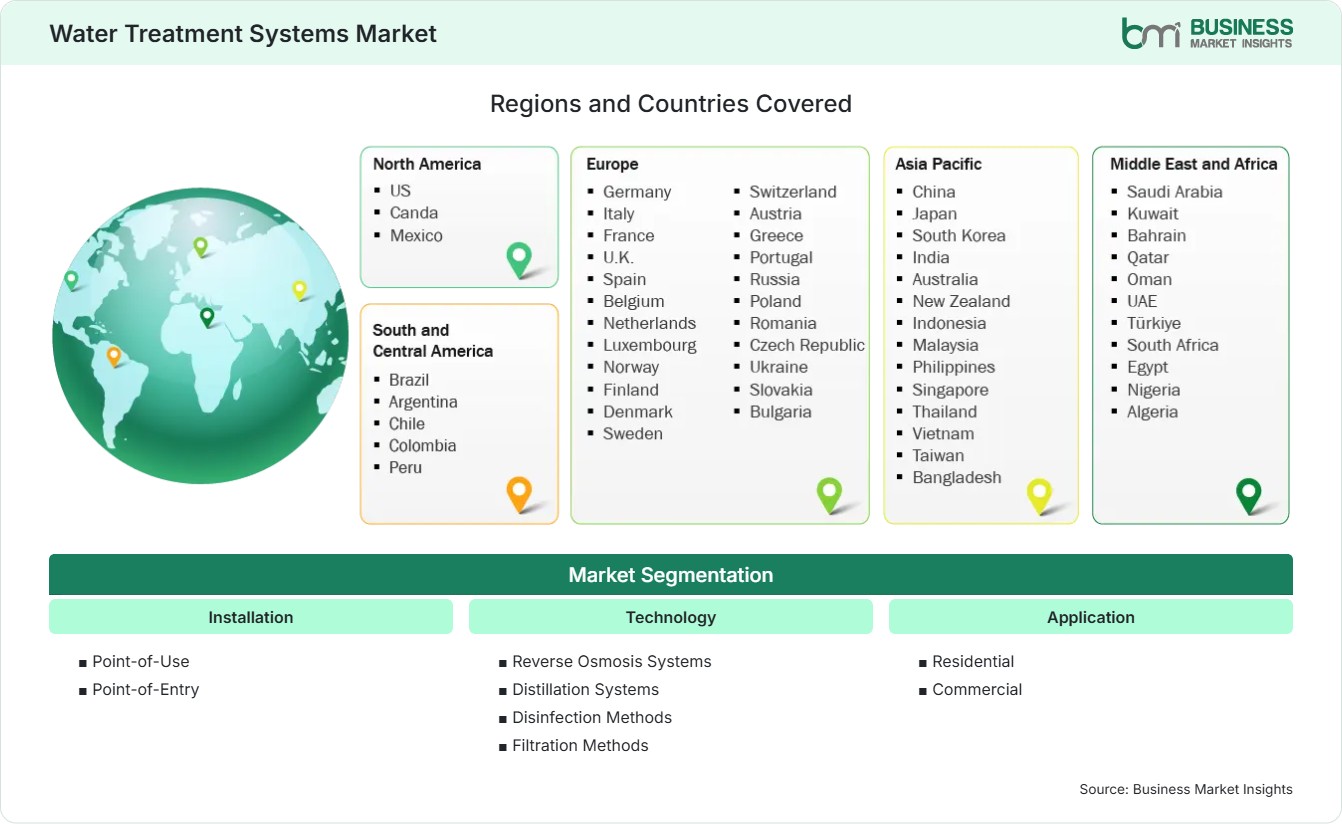
Global Market Geography
FREE PDF
Request your free sample
Request free sample
Segment Analysis

Water Treatment Systems Market Segmentation

Installation

Installation remains divided between decentralized household equipment and building-level systems. Point-of-use solutions prioritize drinking-water quality and compact footprints, while point-of-entry systems treat broader building supplies. The segment benefits from water-quality concerns, installation economics, maintenance requirements, and regulatory expectations. Commercial deployment supports higher-capacity systems and recurring service revenues. The Water Treatment Systems Market scope therefore spans both targeted household purification and comprehensive building treatment.

  • Point-of-Use: Compact filtration, reverse osmosis, and disinfection equipment treats water at consumption points, supporting households and small commercial sites requiring targeted quality improvement.
  • Point-of-Entry: Whole-building treatment addresses incoming water quality across multiple outlets, making it attractive for residences, hospitality properties, healthcare facilities, and commercial buildings.

Technology

Technology represents the core engineering layer, with reverse osmosis, distillation, disinfection, and filtration serving different feedwater and purity requirements. Reverse osmosis systems lead adoption because membrane performance suits desalination, industrial reuse, and commercial purification. Hybrid configurations increasingly combine pretreatment, membranes, polishing, sensors, and automation. Technology selection depends on contaminants, recovery targets, energy costs, footprint, and lifecycle maintenance.

  • Reverse Osmosis Systems: Membrane separation removes dissolved salts and contaminants efficiently, supporting desalination, industrial process water, commercial purification, and high-recovery reuse.
  • Distillation Systems: Thermal separation remains relevant for high-purity applications and challenging feed streams where steam availability or stringent purity requirements influence process design.
  • Disinfection Methods: Ultraviolet, ozone, chlorination, and related methods provide microbial control across drinking-water, industrial, commercial, and decentralized systems.
  • Filtration Methods: Media, cartridge, membrane, and specialty filtration remove suspended solids and targeted contaminants, providing essential pretreatment and polishing across treatment trains.

Application

Demand for applications varies based on water quality specifications, operating capacity, and buying preferences. In residential units, customer convenience, economy, compactness, and confidence take priority, while commercial units prioritize reliability, capacity, compliance, operational costs, and uninterrupted service delivery. Commercial applications account for 43%–47% of the market share by 2025 and are growing at a CAGR of 10.2%–11.0%, making them the higher-growth application segment.

  • Residential: Household systems address drinking-water quality through point-of-use and point-of-entry technologies, with adoption influenced by contamination concerns, convenience, replacement cycles, and installation simplicity.
  • Commercial: Commercial facilities require higher throughput and dependable operation, supporting integrated treatment, automated monitoring, maintenance contracts, reuse, and customized systems.
Market Forces

Water Treatment Systems Market Dynamics

Key Market Drivers

Rising Water Stress and Security Requirements

Water scarcity is converting treatment from a compliance expense into a continuity investment. Population concentration, drought, climate variability, and industrial expansion intensify competition for reliable supplies. Utilities and industrial users are investing in desalination, recycling, advanced filtration, and decentralized systems that reduce dependence on vulnerable sources. Water Treatment Systems Market growth is strongest where treatment creates additional usable supply rather than simply improving discharged water quality. The resulting Water Treatment Systems trends favor higher recovery, lower energy consumption, modular deployment, and digital controls. This shift also changes procurement priorities, with operators increasingly assessing water availability, resilience, maintenance requirements, and lifecycle performance alongside conventional treatment specifications.

Industrial Water Reuse and Circularity

Water recovery is increasingly viewed by the industrial market as a productivity and risk-mitigation tool. Industrial processes such as semiconductor manufacturing, pharmaceuticals, food processing, mining, chemicals, and high-end manufacturing need reliable water quality but face increasing restrictions on discharges. Water can be recovered from concentrated streams via membrane processes, while polishing systems allow the process to be repeated. High-recovery RO systems are expanding the range of applications for industrial reuse and resource recovery. This development increases opportunities for growth in the Water Treatment Systems Market by enabling applications beyond potable water treatment. Purchasers will increasingly evaluate water recovery, chemical usage, energy usage, waste disposal, and process stability.

Digitalization and Predictive Operations

Water treatment plants are becoming increasingly data-driven, as operators try to detect fouling, contamination, equipment deterioration, and process instabilities at an early stage. Sensing devices, SCADA systems, cloud services, machine learning, and remote diagnostics turn operational data into maintenance and optimization information. Intelligent solutions can predict turbidity, salinity changes, biological events, and other operational hazards. This aligns with the Water Treatment Systems Market trends of predictive maintenance, automation, minimizing downtime, and monitoring lifecycle performance. The benefits of such solutions are most evident in commercial and municipal installations that are geographically dispersed and whose operations cannot be easily supervised. By offering both water treatment technology and analytical tools, vendors may create additional revenue streams.

Key Market Opportunities

Data Center and High-Purity Water Infrastructure

The growth of data centers presents a unique opportunity in this context, as cooling requires significant amounts of water in locations where it is scarce. Water treatment firms can leverage opportunities such as water recycling, cooling water treatment, filtration, monitoring, and closed-loop optimization. Water Treatment Systems Market Forecasts must then take into account the role of data centers as a commercial driver for the market, especially in North America, Europe, and the Asia-Pacific region. The opportunity is not only in selling hardware but also in the need for high reliability, monitoring, and redundancy. Suppliers capable of integrating treatment with digital controls can capture higher-value lifecycle contracts while helping technology operators manage water availability, quality, and operational resilience.

Desalination Expansion in Water-Stressed Economies

The process of desalination offers a sustainable option in coastal regions where the traditional supply of fresh water is insufficient to meet the demands of industry and the growing population. The reverse osmosis technique has enhanced its competitiveness due to lower energy consumption, improved membranes, larger plants, and optimization processes. Desalination firms have been increasing production capacity using long-term infrastructure projects in water-scarce countries. This type of strategy can create opportunities for suppliers of membranes and pumps, pretreatment companies, engineers, operators, and technology companies. Good prospects will be characterized by offtake agreements, renewable energy sources, high recovery rates, proper brine management, and performance-based operations.

Decentralized Treatment and Water Reuse Platforms

Decentralized water treatment offers a solution in places where installing centralized water treatment plants is unaffordable, uneconomical, or overly vulnerable to disruptions. The modules can be used for residents, commercial property developers, isolated industrial zones, mines, health facilities, and temporary infrastructures. The commercial feasibility of such modules is further enhanced by including components such as filtration, reverse osmosis, disinfection, sensors, monitoring, and consumables. The smaller modules also generate periodic revenue from membrane and filter replacements, testing, maintenance, and digital subscription services. Suppliers who can offer standardized modular systems with flexible configurations can reduce project durations and engineering fees.

Market Restraints and Challenges

High Capital and Lifecycle Cost Complexity

Factor: The application of the most advanced treatment technology can require substantial capital expenditures on membranes, pumps, pretreatment, instrumentation and controls, civil works, power production, and residual handling, particularly in desalination plants and industrial recovery processes. Impact: Long payback periods might become a barrier to investment due to insufficient tariffs, rates, or municipal funding that do not properly value water. Life cycle cost also depends on feedwater quality, energy costs, membrane costs, chemicals, manpower, and disposal costs. These factors complicate comparisons between projects and may give well-established companies an advantage in finance, engineering, and service support. Small companies could put off upgrading despite increased treatment needs.

Residuals, Energy Use, and Regulatory Complexity

Factor: Treatment methods produce concentrated brine, sludge, used media, and other by-products, while both membrane and thermal technologies have significant energy use and require specialized controls. Impact: Restrictions on disposal, energy costs, environmental regulations, and contamination regulations may increase complexity and costs. Reverse Osmosis reduces energy use compared to many thermal processes, but still relies on electricity due to the high pressures involved, and the disposal of the concentrates poses challenges. Regulation also varies between regions, making the standardization of equipment and international deployment difficult. Plant operators have to find the right balance among water production, fouling, concentrate concentration, chemicals, and regulation.

Company Analysis

Competitive Landscape

Competitive Water Treatment Systems Market analysis indicates a market where environmental-service companies, membrane specialists, automation providers, pump manufacturers, desalination developers, and decentralized-system suppliers compete through differentiated technology and lifecycle capabilities.

Company Name

Overview

Products and Services relevant to this market

Veolia Environnement S.A.

Global environmental-services provider with extensive municipal, industrial, desalination, reuse, and water-management capabilities.

Water treatment, desalination, wastewater reuse, filtration, digital services, engineering, operations, and maintenance.

3M Company

Diversified technology company with filtration expertise serving industrial, commercial, healthcare, and residential applications.

Filtration media, cartridge systems, purification components, and specialized filtration solutions.

Honeywell International Inc.

Industrial technology provider supporting treatment facilities through process control, monitoring, cybersecurity, and optimization.

SCADA, automation, controls, cybersecurity, instrumentation, and digital plant management.

ACWA Power Company

Infrastructure developer and operator with major desalination capabilities across water-stressed markets.

Seawater reverse osmosis, desalination development, engineering, financing, plant operation, and infrastructure management.

DuPont de Nemours, Inc.

Advanced materials and membrane technology supplier serving municipal, industrial, commercial, and residential treatment.

Reverse osmosis membranes, ultrafiltration, membrane bioreactors, ion exchange, and design technologies.

Pentair plc

Water technology company serving residential, commercial, industrial, and institutional customers.

Filtration, pumps, water conditioning, purification, monitoring, and commercial treatment equipment.

Pure Aqua, Inc.

Specialist supplier providing engineered and packaged systems for diverse feedwater requirements.

Reverse osmosis, desalination, filtration, softening, ultrafiltration, wastewater treatment, and packaged systems.

Xylem Inc.

Global water technology company focused on transport, treatment, measurement, digitalization, and efficiency.

Pumps, treatment technologies, metering, analytics, ultraviolet systems, biological treatment, and monitoring.

Doosan Corporation

Diversified industrial company with engineering capabilities supporting large-scale water infrastructure.

Desalination systems, infrastructure engineering, plant construction, process technologies, and project execution.

ACCIONA, S.A.

Infrastructure company with integrated water-cycle expertise spanning treatment, desalination, reuse, and operations.

Reverse osmosis desalination, drinking-water treatment, wastewater treatment, reuse, construction, and operations.

Trust & Transparency

Research Methodology

The market analysis combines proprietary research with secondary data from government agencies, company disclosures, regulatory filings, industry databases and expert interviews. Market estimates are validated through data triangulation, cross-market benchmarking and analyst review.

View Full Research Methodology

Questions Answered

Frequently Asked Questions

What does the Water Treatment Systems Market Report help investors evaluate?

Investors can assess demand drivers, technology positioning, regional opportunities, competitive structures, application growth, capital requirements, regulatory exposure, and recurring service potential. These factors help distinguish equipment-led opportunities from higher-value infrastructure and lifecycle-service models.

Why are water reuse systems becoming more important?

Reuse provides an additional water source without equivalent expansion of freshwater abstraction. Industrial and commercial users can reduce discharge volumes, improve supply resilience, and limit exposure to drought or allocation restrictions by treating wastewater to application-specific quality levels.

How are AI tools changing plant operations?

AI-enabled platforms can analyze operating data to identify abnormal conditions, anticipate water-quality events, support membrane cleaning decisions, and improve maintenance timing. Their value increases when facilities have reliable sensors, consistent operating records, and defined intervention protocols.

What determines the cost of a treatment system?

Capital cost depends on capacity, feedwater characteristics, treatment objectives, automation, civil works, and redundancy. Operating economics are influenced by electricity, chemicals, membrane replacement, labor, maintenance, residual disposal, and water recovery.

Which treatment technology is best for desalination?

Reverse osmosis is generally the leading choice for modern seawater desalination because it provides high-quality freshwater with lower energy requirements than conventional thermal approaches. Suitability depends on feedwater salinity, pretreatment, recovery targets, electricity availability, brine management, and plant scale.

Access the Full Water Treatment Systems Market Report

Get segment-level forecasts, regional estimates, competitive benchmarking, company profiles and downloadable Excel datasets.

Access the full Water Treatment Systems Market Report
350 pages PDF & Excel | 2026-10-05
Similar Research

Related Market Reports