
Digital Signage Market Outlook: Size, Share, Trends, Growth Analysis, Competitive Landscape & Forecast, 2026-2033

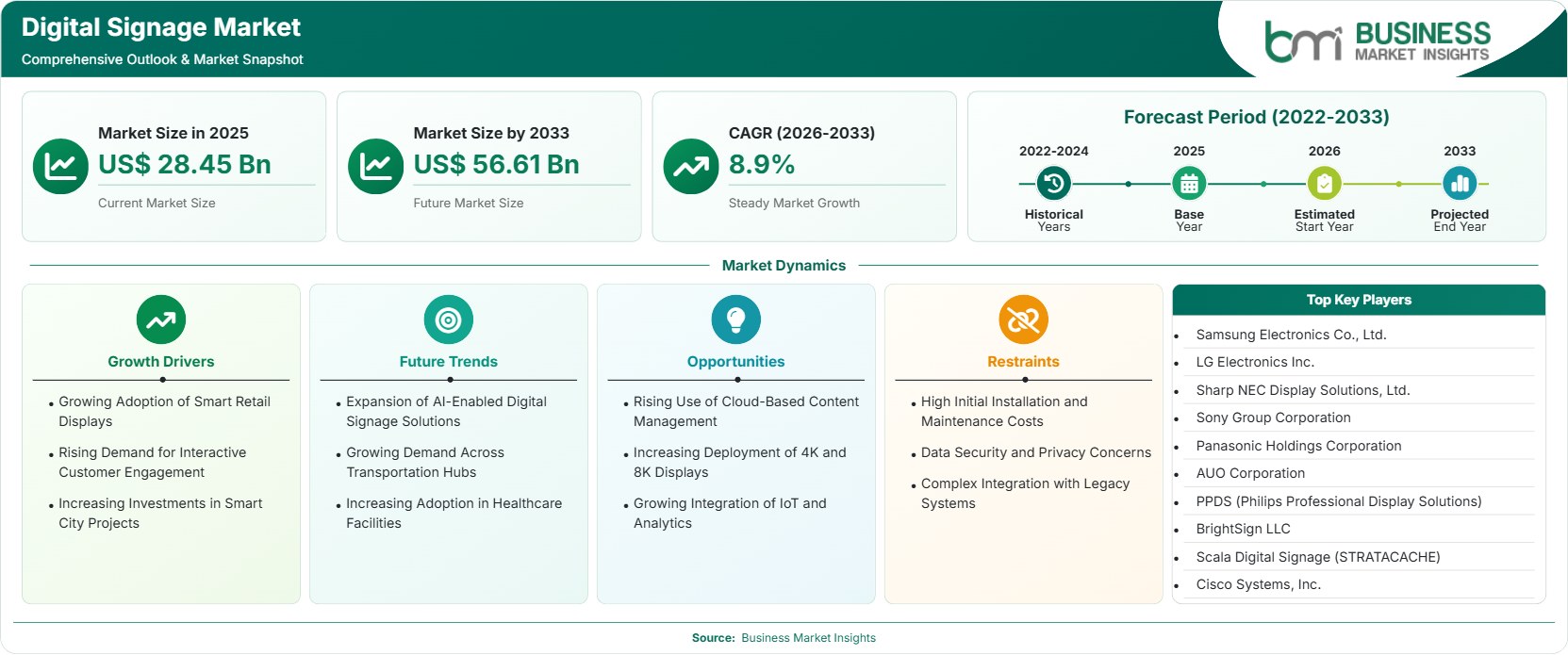
The Digital Signage Market size was valued at US$ 28.45 Billion in 2025 and is projected to reach US$ 56.61 Billion by 2033, growing at a CAGR of 8.9% during 2026–2033. Market expansion is driven by the growing adoption of smart retail displays, increasing demand for interactive customer engagement, and rising investments in smart city projects, while cloud-based content management, 4K and 8K displays, and IoT integration continue creating new growth opportunities.

Report Coverage
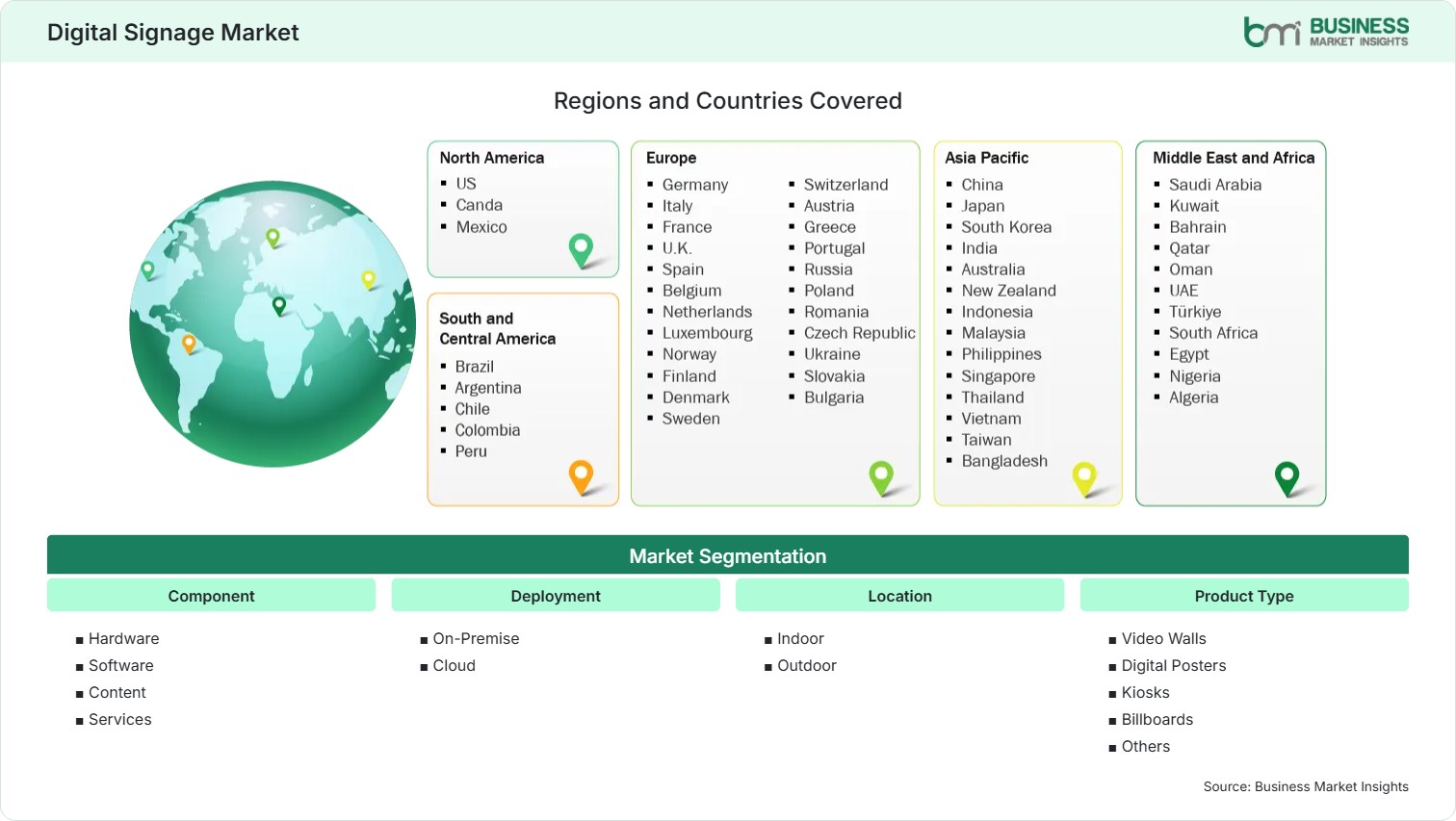
  • Component: Hardware, Software, Content, and Services
  • Deployment: On-Premise, Cloud
  • Location: Indoor, Outdoor
  • Product Type: Video Walls, Digital Posters, Kiosks, Billboards, Others
  • Industry Vertical: Retail, Corporate, Hospitality, Transportation, Education, Healthcare, Sports and Entertainment, Others
US$ 28.45 Bn Market size in 2025
US$ 56.61 Bn Market Size by 2033
8.9% CAGR, 2026 - 2033
2026-2033 Forecast Period

AI Overview

Digital Signage Market Summary

  • North America Region: North America accounts for 34%–36% of the market in 2025 and is projected to grow at a CAGR of 8.4%–8.8% during 2026–2033. Strong adoption across retail, transportation, and corporate sectors, combined with smart infrastructure investments, continues supporting regional leadership. The United States contributes 28%–30% of global revenue and is expected to register a CAGR of 8.3%–8.7% through 2033.
  • Fastest Growing Region: Asia Pacific represents 29%–31% of market revenue in 2025 and is projected to expand at a CAGR of 9.8%–10.3% during the forecast period. Smart city initiatives, retail modernization, and commercial infrastructure development continue accelerating regional demand.
  • Leading Segment: Hardware accounts for 47%–50% of market revenue in 2025 and is projected to grow at a CAGR of 8.6%–9.0% during 2026–2033. Continuous innovation in display technologies and LED solutions sustains segment leadership.
  • High Growth Segment: Cloud Deployment represents 37%–40% of market revenue in 2025 and is anticipated to register a CAGR of 10.4%–10.9% throughout the forecast period. Remote content management and scalable deployment capabilities continue driving adoption.
  • Key Market Opportunity: Expanding integration of artificial intelligence, cloud-based content management, IoT-enabled displays, and advanced analytics is creating significant opportunities for digital signage solution providers.
  • Major Market Players: Samsung Electronics Co., Ltd., LG Electronics Inc., Sharp NEC Display Solutions, Ltd., Sony Group Corporation, Panasonic Holdings Corporation, AUO Corporation, PPDS (TP Vision Europe B.V.), Leyard Optoelectronic Co., Ltd., Daktronics, Inc., and Barco NV.
Strategic Insights

Digital Signage Market: Strategic Insights

Digital Signage Market Strategic Framework
FREE PDF
Request your free sample
Request free sample
Stakeholder View

Key Takeaways

  • Digital signage providers are increasingly integrating AI, IoT, cloud platforms, and audience analytics to deliver intelligent, personalized communication experiences.
  • Retail and transportation sectors continue offering the strongest long-term growth opportunities through expanding investments in customer engagement technologies and smart infrastructure.
  • Product innovation focuses on MicroLED displays, interactive touchscreens, cloud content management, predictive analytics, and energy-efficient display technologies.
  • Asia Pacific presents highly attractive investment opportunities due to rapid urbanization, commercial infrastructure development, and government-led smart city initiatives.
  • Strategic collaborations between display manufacturers, software developers, and cloud platform providers continue accelerating integrated digital signage ecosystem development.
  • Organizations investing in centralized cloud management, AI-enabled analytics, and immersive visual technologies are expected to strengthen long-term competitive advantage.
Geographic Outlook

Digital Signage Market Regional Highlights

North America Digital Signage Market

North America accounted for 34%–36% of the Digital Signage Market share in 2025 and is projected to expand at a CAGR of 8.4%–8.8% during 2026–2033. Strong retail modernization, transportation digitization, and corporate communication investments continue supporting regional demand for intelligent display technologies.

  • Retail chains increasingly deploy AI-powered displays to improve customer engagement and personalized advertising.
  • Transportation hubs continue expanding real-time passenger information systems using networked digital signage.
  • Healthcare providers adopt digital displays for patient communication, navigation, and operational efficiency.
  • Corporate workplaces increasingly integrate interactive displays supporting hybrid collaboration and enterprise communication.

US Digital Signage Market

The United States represented 28%–30% of global market revenue in 2025 and is expected to register a CAGR of 8.3%–8.7% through 2033. Digital transformation across retail, education, healthcare, and transportation sectors continues strengthening market demand.

  • Retailers increasingly invest in interactive digital merchandising and AI-enabled advertising platforms.
  • Educational institutions deploy digital signage for campus communication and emergency notifications.
  • Airports expand intelligent display infrastructure supporting passenger experience and operational efficiency.
  • Enterprise organizations adopt cloud-managed digital communication platforms across multiple facilities.

Europe Digital Signage Market

Europe accounted for 24%–26% of global Digital Signage Market revenue in 2025 and is projected to grow at a CAGR of 8.6%–9.0% during the forecast period. Commercial digitalization, sustainability initiatives, and smart transportation investments continue driving regional adoption. Germany leads the market, while Spain records the fastest growth.

  • Germany remains the leading regional market through advanced commercial digital infrastructure.
  • Spain records strong adoption supported by tourism, hospitality, and retail modernization initiatives.
  • Smart transportation projects increase deployment of real-time passenger information displays.
  • Energy-efficient commercial displays gain popularity under regional sustainability regulations.

Asia Pacific Digital Signage Market

Asia Pacific accounted for 29%–31% of global revenue in 2025 and is projected to register the fastest CAGR of 9.8%–10.3% during 2026–2033. Expanding smart city projects, retail digitalization, and commercial infrastructure investments continue accelerating market growth.

  • China leads regional demand through large-scale smart city and commercial display deployments.
  • India records the fastest regional growth driven by retail expansion and digital infrastructure investment.
  • Japan continues adopting advanced display technologies across transportation and corporate sectors.
  • South Korea strengthens demand through innovation in display manufacturing and smart commercial applications.
  • Southeast Asia experiences increasing adoption across hospitality, education, and public infrastructure.

Rest of World Digital Signage Market

The Rest of the World accounted for 10%–12% of global market revenue in 2025 and is expected to expand at a CAGR of 9.0%–9.4% during the forecast period.

South & Central America continue investing in commercial modernization, while the Middle East & Africa strengthen smart infrastructure through digital communication systems deployed across transportation, retail, and public facilities.

  • Brazil leads regional adoption through retail modernization and commercial infrastructure development.
  • Mexico continues expanding digital display installations across transportation and education sectors.
  • United Arab Emirates invests heavily in smart city display infrastructure.
  • Saudi Arabia accelerates commercial digitalization through Vision 2030 initiatives.
  • South Africa continues expanding digital communication technologies across corporate and public sectors.
Global Market Geography
FREE PDF
Request your free sample
Request free sample
Segment Analysis

Digital Signage Market Segmentation

Component

The Component segment represents the foundation of the market, as organizations increasingly invest in integrated hardware, software, content, and managed services to deliver engaging visual communication. The segment accounted for 100% of the market and is projected to grow at a CAGR of 8.9% during 2026–2033. The Digital Signage Market scope continues expanding with AI-enabled content automation, cloud-based management platforms, remote device monitoring, and high-resolution display technologies that improve operational efficiency and customer engagement.

  • Hardware: Hardware remains the largest sub-segment owing to continuous demand for commercial displays, media players, LED panels, touchscreens, controllers, and supporting infrastructure across retail, transportation, education, and healthcare environments.
  • Software: Software adoption continues increasing through cloud-based content management systems, scheduling platforms, analytics dashboards, AI-powered personalization, remote monitoring, and centralized network management capabilities.
  • Content: Dynamic content solutions are gaining popularity as businesses increasingly utilize personalized advertising, interactive media, real-time information updates, promotional campaigns, and digital storytelling to maximize audience engagement.
  • Services: Professional services including installation, maintenance, consulting, content creation, system integration, and managed support continue expanding as organizations deploy increasingly sophisticated digital signage networks.

Deployment

Deployment models continue evolving as enterprises seek greater flexibility, scalability, and centralized content management capabilities. Cloud adoption is accelerating due to simplified software updates, lower infrastructure costs, and remote accessibility. The Market remains higher for on-premise installations among highly regulated industries, while current Digital Signage Market trends indicate cloud deployments will continue recording the fastest growth through the forecast period.

  • On-Premise: Organizations requiring greater control over network security, regulatory compliance, and internal infrastructure continue preferring on-premise deployment for mission-critical communication environments.
  • Cloud: Cloud deployment enables centralized content management, remote updates, AI-driven analytics, multi-location administration, and lower implementation complexity, making it increasingly attractive across enterprise applications.

Location

Location-based deployment strategies are becoming increasingly important as organizations optimize customer engagement across indoor and outdoor environments. Indoor installations continue accounting for the majority of deployments, while outdoor applications benefit from improvements in display durability, brightness, and weather resistance.

  • Indoor: Indoor installations dominate demand across retail stores, corporate offices, airports, hospitals, educational institutions, hotels, and entertainment venues requiring continuous audience engagement and operational communication.
  • Outdoor: Outdoor digital signage adoption continues expanding through smart city initiatives, transportation networks, roadside advertising, stadiums, and public information systems utilizing high-brightness, weather-resistant display technologies.

Product Type

Product innovation continues driving market expansion as organizations increasingly deploy specialized display solutions tailored to customer engagement, advertising, information dissemination, and operational communication. Advanced display technologies are improving image quality, reliability, and energy efficiency across commercial applications.

  • Video Walls: Video walls remain widely adopted for control rooms, retail environments, transportation hubs, and entertainment venues requiring immersive visual experiences and large-format digital communication.
  • Digital Posters: Digital posters offer flexible advertising solutions for retailers, restaurants, shopping malls, hotels, healthcare facilities, and educational institutions seeking dynamic promotional content.
  • Kiosks: Interactive kiosks continue expanding across self-service retail, banking, healthcare, transportation, hospitality, and government services through touchscreen-enabled customer engagement capabilities.
  • Billboards: Digital billboards provide advertisers with dynamic, remotely managed outdoor campaigns featuring real-time content updates, audience targeting, and improved operational flexibility.

Industry Vertical

Industry-specific adoption continues broadening as organizations leverage intelligent display technologies to enhance customer experiences, operational efficiency, and digital communication. Retail remains the largest revenue contributor, while healthcare, transportation, education, and corporate sectors continue expanding investments in connected display ecosystems.

  • Retail: Retailers increasingly deploy digital displays for promotional campaigns, personalized advertising, shelf-edge communication, interactive product discovery, and omnichannel customer engagement strategies.
  • Corporate: Corporate organizations utilize digital signage to improve internal communications, employee engagement, visitor management, meeting room scheduling, and workplace collaboration.
  • Hospitality: Hotels, restaurants, and entertainment venues implement intelligent display systems to enhance guest experiences, promotional activities, digital wayfinding, and operational communication.
  • Transportation: Airports, railway stations, metros, and bus terminals increasingly rely on digital signage for passenger information, scheduling updates, emergency alerts, and advertising revenue generation.
  • Education: Educational institutions deploy digital displays for campus announcements, classroom communication, emergency notifications, event promotion, and interactive learning environments.
  • Healthcare: Hospitals and healthcare facilities utilize digital signage for patient navigation, queue management, appointment information, health awareness campaigns, and operational efficiency.
  • Sports and Entertainment: Stadiums, arenas, cinemas, and event venues increasingly invest in large-format displays, interactive fan engagement platforms, sponsorship advertising, and immersive visual experiences.
Market Forces

Digital Signage Market Dynamics

Key Market Drivers

Growing Adoption of Smart Retail Displays

The adoption of intelligent digital signage by retailers is increasing to facilitate customer engagement, make personalized offers, and deliver an omnichannel shopping experience. AI-powered screens combined with computer vision technology, electronic shelf labeling systems, and real-time stock control can assist retailers in optimizing their merchandise and improving conversion rates. As per the report of the National Retail Federation (NRF), the digital transformation continues to be important for leading retailers due to the changes in consumer demands towards more interactive and data-based experiences. The Digital Signage Market growth will also receive a boost from the growing usage of self-service kiosks, digital menu boards, and advertising solutions in-store.

Rising Demand for Interactive Customer Engagement

Companies from the hospitality industry, healthcare institutions, transportation firms, educational institutions, and companies are now using interactive digital displays to enhance their communications. Touch screen enabled kiosks, wayfinding applications, QR codes, gesture recognition, and artificial intelligence-driven content personalization help companies create a better customer experience. The accessibility of commercial displays with high resolution together with cloud content management systems allows organizations to quickly update information and provide location-specific messages.

Increasing Investments in Smart City Projects

There is a widespread adoption of smart city technology by governments around the world in order to optimize the provision of services, enhance transportation processes and communication. Digital signage has become an important element of intelligent city infrastructure that can help in developing systems for passenger information, emergency announcements, traffic management, public safety communications and tourism services. In light of the latest Digital Signage Market trends, there is widespread adoption of connected screens that are equipped with IoT sensors, 5G connection and cloud-based analytics.

Key Market Opportunities

Rising Use of Cloud-Based Content Management

Content management systems in the cloud are changing the landscape of digital signage by allowing users to have their scheduling performed centrally, remotely updating their software, administrating multiple locations simultaneously, and performing real-time performance monitoring. Cloud solutions are becoming more popular owing to reduced cost of the infrastructure required, easier maintenance, and increased scalability. Digital Signage Market Forecasts show bright prospects for companies who offer cloud AI-driven solutions for customized content delivery and analytics.

Increasing Deployment of 4K and 8K Displays

The demand for UHD display technology keeps growing in premium retail, transport, corporate, hospitality, and entertainment settings. The development in resolution, colors, brightness, and efficiency allows organizations to provide customers with an immersive experience while increasing the efficacy of their advertisement. Companies that develop innovative Mini-LED, MicroLED, OLED, and 8K commercial displays will surely reap the benefits of growing demand for premium visual communication technology.

Growing Integration of IoT and Analytics

The integration of IoT connectivity, artificial intelligence, and advanced analytics is creating new opportunities across the digital signage ecosystem. Connected displays can collect audience insights, monitor device health, automate maintenance scheduling, and optimize content delivery based on demographics, environmental conditions, and user behavior. These capabilities enable businesses to improve return on investment while delivering highly targeted communication strategies across retail, transportation, healthcare, and enterprise applications.

Market Restraints and Challenges

High Initial Installation and Maintenance Costs

Factor: Deployment on a large scale with digital signage involves substantial capital outlay with regard to commercial displays, media players, network, software licenses, installation services, and maintenance. Impact: High capital outlay might cause delays in the adoption of digital signage solutions among SMEs despite its long-term benefits. Firms tend to pursue a phased approach to strike a balance between costs of investment and business results. In response, vendors have been providing subscription-based software and managed cloud services with less upfront capital outlay.

Data Security and Privacy Concerns

Factor: Digital signage networks have started to depend more on cloud systems, remote management software, Internet of Things (IoT), and customer analytics data, exposing their cybersecurity and privacy vulnerabilities. The organizations should spend money on the creation of secure network infrastructure, use encryption, manage identities, update software, and comply with regulations in order to protect their digital signage infrastructure against cyber-attacks. Impact: It is expected that vendors focusing on secure cloud systems and zero-trust architecture will increase customer’s trust.

Company Analysis

Competitive Landscape

Digital Signage Market Analysis indicates that the key players in the market are enhancing their dominance through advanced display technology, partnerships, software, and managed service expansions. The continued investment in MicroLED, OLED, 4K/8K screens, and cloud native solutions is contributing to competition in retail, transport, healthcare, education, hospitality, and smart cities.

Company Name

Overview

Products and Services Relevant to this Market

Samsung Electronics Co., Ltd.

Global leader in commercial display technologies with extensive digital signage solutions across enterprise and public infrastructure markets.

LED displays, video walls, smart signage, interactive displays, cloud management platforms, and integrated commercial display solutions.

LG Electronics Inc.

Leading manufacturer of premium commercial displays focusing on OLED innovation, AI integration, and enterprise display ecosystems.

OLED signage, LED displays, digital kiosks, video walls, display software, and smart commercial display solutions.

Sharp NEC Display Solutions, Ltd.

Provider of professional display technologies supporting mission-critical digital communication across commercial and public sectors.

Commercial displays, projectors, video walls, interactive displays, digital signage software, and visualization solutions.

Sony Group Corporation

Technology company delivering high-performance professional displays for retail, education, entertainment, and enterprise communication applications.

Professional BRAVIA displays, digital signage solutions, content management integration, and enterprise visualization technologies.

Panasonic Holdings Corporation

Global electronics manufacturer providing durable commercial display systems for transportation, corporate, education, and public environments.

Professional displays, interactive panels, display management solutions, AV technologies, and integrated signage systems.

AUO Corporation

Display technology company specializing in advanced LCD, MicroLED, and commercial display solutions for diverse industrial applications.

LCD panels, MicroLED displays, commercial screens, smart display technologies, and integrated visualization solutions.

PPDS (TP Vision Europe B.V.)

Provider of Philips professional display solutions focused on connected digital signage and enterprise visual communication.

Philips digital signage, professional TVs, interactive displays, cloud management software, and hospitality display solutions.

Leyard Optoelectronic Co., Ltd.

Global manufacturer specializing in fine-pitch LED displays, visualization technologies, and immersive digital communication platforms.

LED video walls, commercial displays, control room visualization, creative display systems, and digital signage solutions.

Daktronics, Inc.

Industry leader in large-format LED displays serving sports, transportation, commercial advertising, and public information markets.

Outdoor LED displays, scoreboards, transportation displays, digital billboards, video systems, and display management software.

Barco NV

Technology company delivering visualization and display solutions for enterprise, healthcare, entertainment, and mission-critical environments.

Video walls, visualization platforms, networked displays, collaboration technologies, and professional display management systems.

Industry Activity

Recent Developments

February 2026

Samsung Electronics Co., Ltd. expanded its commercial display offerings, led by the global launch of Samsung Spatial Signage, at Integrated Systems Europe (ISE) 2026 in Barcelona. The announcement includes new AI-powered content capabilities through Samsung VXT, new additions to Samsung’s supersized commercial display lineup.

September 2025

LG Electronics Inc. bringing its most advanced display technologies with its latest Transparent OLED Signage and ultra-premium Micro LED display. LG will deliver immersive digital experiences that seamlessly blend into the world’s most iconic venues.

February 2025

Samsung Electronics Co., Ltd. expanded its next-generation digital signage portfolio and introduced advanced display solutions designed for various commercial environments, including classrooms, corporate offices, museums, hotels, and retail spaces

January 2024

Sharp NEC Display Solutions, Ltd. introduced the new generation Sharp-branded MultiSync ME Series, designed to redefine versatility and functionality in professional environments.

Trust & Transparency

Research Methodology

The market analysis combines proprietary research with secondary data from government agencies, company disclosures, regulatory filings, industry databases and expert interviews. Market estimates are validated through data triangulation, cross-market benchmarking and analyst review.

View Full Research Methodology

Questions Answered

Frequently Asked Questions

What does the Market Report cover?

The Digital Signage Market Report provides comprehensive insights into market size, regional analysis, segmentation, competitive landscape, technology trends, growth drivers, opportunities, restraints, company profiles, and forecasts for 2026–2033.

Who are the major companies operating in the market?

Major companies include Samsung Electronics Co., Ltd., LG Electronics Inc., Sharp NEC Display Solutions, Ltd., Sony Group Corporation, Panasonic Holdings Corporation, AUO Corporation, PPDS (TP Vision Europe B.V.), Leyard Optoelectronic Co., Ltd., Daktronics, Inc., and Barco NV.

Which region is projected to witness the fastest growth?

Asia Pacific is expected to register the fastest growth during the forecast period, supported by smart city development, commercial infrastructure expansion, retail modernization, and increasing investments in digital transformation initiatives.

Which component dominates the market?

Hardware remains the leading component due to sustained demand for commercial displays, LED video walls, interactive kiosks, media players, and advanced display infrastructure across multiple industry verticals.

What is driving the Digital Signage Market?

The market is driven by increasing adoption of smart retail displays, rising demand for interactive customer engagement, expanding smart city investments, and growing deployment of cloud-based content management and AI-powered display technologies.

Access the Full Digital Signage Market Report

Get segment-level forecasts, regional estimates, competitive benchmarking, company profiles and downloadable Excel datasets.

Access the full Digital Signage Market Report
350 pages PDF & Excel | 2026-07-29