
Digital Asset Management (DAM) Market Outlook: Size, Share, Trends, Growth Analysis, Competitive Landscape & Forecast, 2026-2033

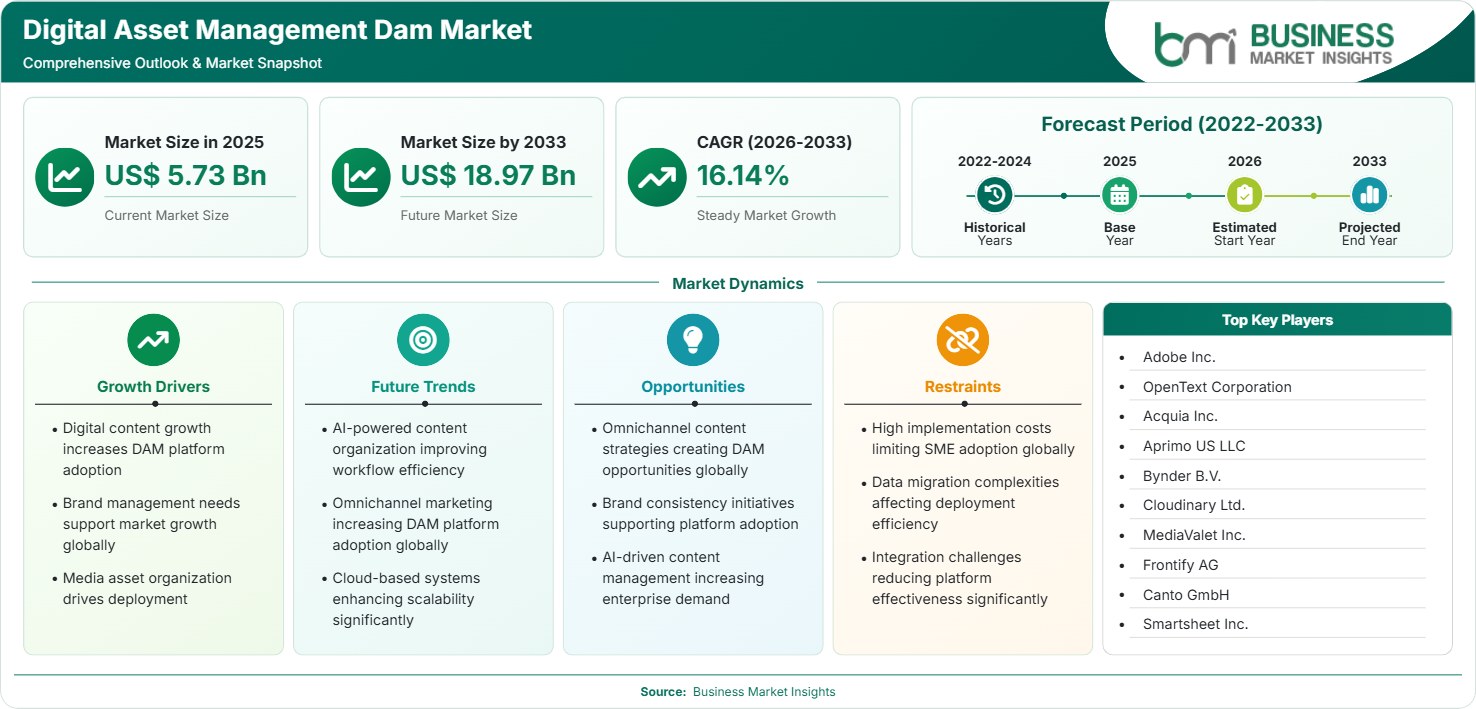
The Digital Asset Management (DAM) Market size was valued at US$ 5.73 Billion in 2025 and is projected to reach US$ 18.97 Billion by 2033, growing at a CAGR of 16.14% during 2026–2033, driven by AI-enabled asset discovery, cloud migration, omnichannel content demand, governance requirements, and expanding enterprise content volumes.

Report Coverage
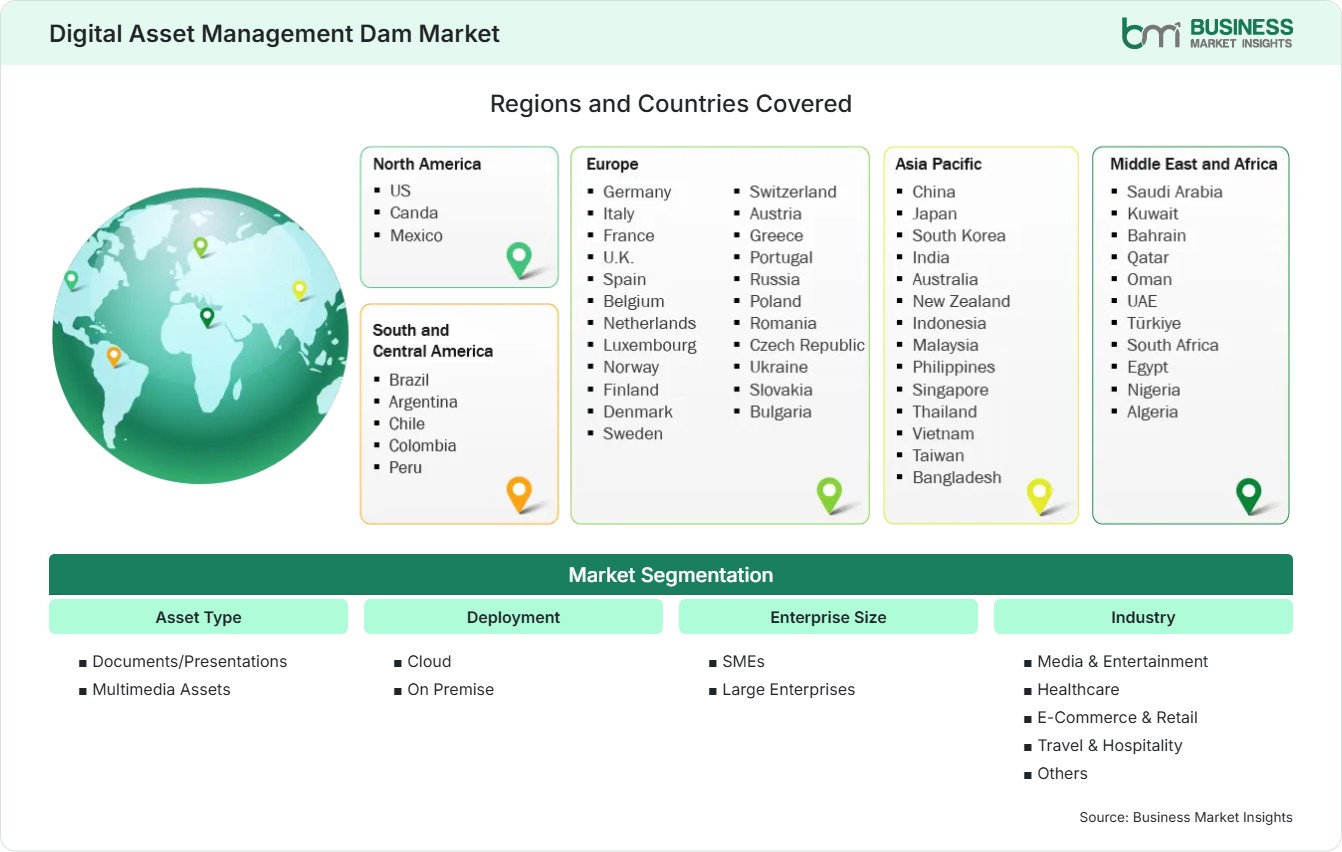
  • Asset Type: Documents/Presentations, Multimedia Assets
  • Deployment: Cloud, On Premise
  • Enterprise Size: SMEs, Large Enterprises
  • Industry: Media & Entertainment, Healthcare, E-Commerce & Retail, Travel & Hospitality, Others
US$ 5.73 Bn Market size in 2025
US$ 18.97 Bn Market Size by 2033
16.14% CAGR, 2026 - 2033
2026-2033 Forecast Period

AI Overview

Digital Asset Management (DAM) Market Summary

  • North America Region: North America holds a 38%–42% share in 2025, growing at a 15.20%–16.20% CAGR during 2026–2033, influenced by enterprise cloud migration, AI content workflows, mature marketing ecosystems, retail personalization, compliance modernization, and sustained investment in scalable asset governance platforms across industries.
  • Fastest Growing Region: Asia Pacific represents a 20%–24% DAM Market share in 2025, expanding at a 18.10%–19.30% CAGR during 2026–2033, supported by expanding ecommerce ecosystems, mobile content consumption, digital marketing investment, regional localization, cloud adoption, and increasing enterprise digitization across developing economies.
  • Leading Segment: Cloud deployment accounts for a 67%–71% share in 2025, advancing at a 17.00%–18.00% CAGR during 2026–2033, driven by scalable storage, distributed collaboration, faster deployment, lower infrastructure requirements, automated updates, integration capabilities, and growing preference for subscription-based enterprise software models.
  • High Growth Segment: Multimedia Assets represents a 58%–62% share in 2025, growing at a 17.40%–18.40% CAGR during 2026–2033, propelled by video commerce, social media content, streaming, personalization, high-resolution media, automated rendition generation, and increasing demand for centralized audiovisual governance.
  • Key Market Opportunity: AI-powered metadata enrichment, generative-content governance, rights automation, regional localization, and API-driven distribution create opportunities to convert repositories into intelligent content supply chains supporting faster campaign execution and measurable reuse.
  • Major Market Players: Adobe Inc.; OpenText Corporation; Acquia Inc.; Aprimo US LLC; Bynder B.V.; Cloudinary Ltd.; MediaValet Inc.; Frontify AG; Canto GmbH; Smartsheet Inc.
Strategic Insights

Digital Asset Management (DAM) Market: Strategic Insights

Digital Asset Management (DAM) Market Strategic Framework
FREE PDF
Request your free sample
Request free sample
Stakeholder View

Key Takeaways

  • The value chain is shifting from storage-focused repositories to connected content supply chains that link together creative production, metadata, approvals, rights management, distribution, and downstream customer-experience systems.
  • The greatest potential benefit comes from multimedia assets and cloud deployment since video, interactive media, e-commerce imagery, and distributed marketing processes require more scalable processing, discovery, collaboration, and controlled reuse.
  • AI is now being incorporated into all aspects of ingestion, metadata generation, semantic search, duplicate detection, content classification, rendition creation, rights validation, and workflow routing, so that the distinction between products is moving towards differences in the quality of automation and governance.
  • Asia Pacific has a compelling investment case since the growth of e-commerce, consumers' preference for mobile usage, the need for multilingual content, and enterprise digitization are all increasing the amount and complexity of assets that need to be centrally controlled.
  • The level of competition among vendors is now being determined by their expansion into platforms, their AI capabilities, the way their products integrate with workflows, and their other content-operations functions, which in turn is leading to more strategic partnerships, product acquisitions, and consolidation among specialist providers.
  • More businesses now need content provenance and the use of generative AI to be closely controlled, leading to a demand for platforms that are able to tell the difference between approved assets, synthetic content, licensed material, and restricted intellectual property, all within a single governance framework.
Geographic Outlook

Digital Asset Management (DAM) Market Regional Highlights

North America Digital Asset Management Market

North America holds a 38%–42% Digital Asset Management Market share in 2025 and is projected to expand at a 15.20%–16.20% CAGR during 2026–2033. Strong enterprise software maturity, high marketing technology penetration, ecommerce scale, and widespread cloud adoption support demand.

  • The generation of metadata with the help of AI is now becoming a basic requirement for businesses as they manage larger libraries of images, videos, presentations, and documents across various business units.
  • Retail and e-commerce companies are increasing their investments in DAM to coordinate product imagery, promotional videos, seasonal campaigns, marketplace content, and localized creative materials.
  • Financial, medical, and technological organizations place importance on permissions, auditability, retention, and rights management since content governance is becoming more closely linked with privacy and regulatory controls.
  • Cloud-based procurement is still expanding since distributed teams need secure collaboration through the browser without having to maintain a lot of local infrastructure.

US Digital Asset Management Market

The US represents approximately 80%–84% of the North American Digital Asset Management Market demand in 2025, with a 15.40%–16.40% CAGR during 2026–2033. The market benefits from large technology budgets, mature marketing operations, extensive ecommerce activity, and strong adoption of cloud software.

  • The ecosystems associated with enterprise software promote integration among asset repositories, creative applications, customer-experience platforms, commerce systems, and marketing automation tools.
  • US retailers are now requiring the use of structured product-content management in order to coordinate imagery, videos, specifications, campaigns, and marketplace distribution across a number of digital channels.
  • As the volume of video and multimedia production continues to rise, media organizations place a priority on quick retrieval, version control, rights management, and automated distribution.

Europe Digital Asset Management Market

Europe accounts for a 25%–29% Digital Asset Management Market share in 2025 and is forecast to grow at a 14.60%–15.60% CAGR during 2026–2033. Germany, the UK, and France are leading markets, while Spain, Italy, and the Netherlands provide additional growth opportunities. GDPR-driven governance, brand consistency, multilingual publishing, and increasing cloud adoption support demand.

  • Germany has strong requirements when it comes to industrial branding, together with an advanced uptake of enterprise software, which enables the deployment of DAM in the manufacturing, healthcare, retail, and professional services sectors.
  • France gains the advantages of its luxury, media, retail, and consumer-brand sectors, all of which require a systematic management of photography, video, packaging visuals, campaigns, and creative content tailored to different markets.
  • British companies place a strong emphasis on integrations, workflow automation, and content governance as their distributed marketing teams place greater reliance on cloud-based collaboration environments.
  • European organizations are now assessing AI features together with concerns regarding privacy, intellectual property rights, transparency, and data residency.

Asia Pacific Digital Asset Management Market

Asia Pacific represents a 20%–24% Digital Asset Management Market share in 2025 and records the fastest regional expansion at an 18.10%–19.30% CAGR during 2026–2033. China, Japan, South Korea, India, Singapore, and Australia form the principal demand centers.

  • There is a growing demand for scalable content repositories and automated localization due to India's expanding e-commerce, digital advertising, technology services, and consumer-brand activities.
  • China meets its substantial multimedia needs through e-commerce, social media platforms, consumer brands, and digital advertising, even though the methods used differ depending on the enterprise's infrastructure and regulatory requirements.
  • Both Japan and South Korea place importance on quality control, structured metadata, brand consistency, and integration with existing enterprise technology environments.
  • Cloud-first companies find Southeast Asian markets appealing since the widespread use of distributed teams and the fast growth of digital commerce support subscription-based platforms.

Rest of World Digital Asset Management Market

The rest of the world accounts for a 10%–14% Digital Asset Management Market share in 2025 and is expected to grow at a 15.00%–16.20% CAGR during 2026–2033. South and Central America benefit from e-commerce, digital marketing, and regional content localization, with Brazil and Mexico leading demand. Brazil is positioned around a 15.30%–16.40% CAGR as consumer brands expand digital channels.

  • As the regional brands in Brazil and Mexico expand their multilingual campaigns over marketplaces, social channels, websites, and their physical retail networks, they need centralized asset governance.
  • In the Gulf region, investment is being made in advanced digital experiences covering the sectors of tourism, aviation, hospitality, retail, and government communications, which is leading to a greater need for controlled multimedia repositories.
  • South Africa serves as a regional hub for media, financial services, retail, and consumer brands that are looking for structured content management and collaborative publishing capabilities.
  • The decision to adopt is still affected by the level of maturity of the cloud infrastructure, by local data requirements, by the availability of integration options, and by the presence of implementation partners.
Global Market Geography
FREE PDF
Request your free sample
Request free sample
Segment Analysis

Digital Asset Management (DAM) Market Segmentation

Asset Type

Asset Type remains differentiated between Document/Presentations and Multimedia Assets, with multimedia content holding a 58%–62% Digital Asset Management Market share in 2025 and the overall segment advancing at a 17.40%–18.40% CAGR during 2026–2034.

  • Document/Presentations: Enterprise documents, presentations, reports, templates, and business collateral require version control, permissions, approval workflows, and rapid retrieval, supporting adoption across corporate communications and sales operations.
  • Multimedia Assets: Images, videos, audio, animations, and rich media require high-capacity storage, automated metadata, previews, transformations, rights controls, and omnichannel delivery, making this category central to modern content operations.

Deployment

Deployment is divided between Cloud and On-Premise models, with cloud platforms representing a 67%–71% Digital Asset Management Market share in 2025 and advancing at a 17.00%–18.00% CAGR during 2026–2034.

  • Cloud: SaaS and cloud-native environments reduce infrastructure management, support distributed collaboration, enable scalable storage, and simplify integration with commerce, marketing, analytics, and customer-experience platforms.
  • On Premise: Organizations with strict data-control, integration, legacy infrastructure, or residency requirements continue using locally managed deployments, particularly within regulated industries and complex enterprise environments.

Enterprise Size

Enterprise Size comprises Small & Medium Enterprise and Large Enterprise, with large organizations holding a 63%–67% Digital Asset Management Market share in 2025 and expanding at a 15.60%–16.60% CAGR during 2026–2034. Larger asset volumes and complex approval structures support deeper adoption, while SaaS democratizes access for smaller organizations.

  • Small & Medium Enterprise: SMEs increasingly adopt affordable cloud DAM platforms to centralize brand assets, reduce duplicate content creation, improve collaboration, and establish consistent publishing without major infrastructure investment.
  • Large Enterprise: Large enterprises require advanced permissions, workflow orchestration, metadata governance, integrations, audit trails, multilingual publishing, and scalable repositories supporting thousands of users and extensive global content libraries.

Industry

Industry demand spans Media & Entertainment, Healthcare, E-Commerce & Retail, Travel & Hospitality, and Others, with E-Commerce & Retail demonstrating strong adoption as brands manage product visuals, promotional media, and marketplace content. The segment reflects the expanding Digital Asset Management Market scope across customer-facing and internal workflows.

  • Media & Entertainment: High-volume video, image, audio, licensing, and archival requirements make centralized discovery, rights governance, version control, and rapid distribution essential for production-intensive organizations.
  • Healthcare: Healthcare organizations use controlled repositories for educational content, clinical communications, marketing materials, research assets, and regulated documents requiring permissions, auditability, and lifecycle management.
  • E-Commerce & Retail: Product imagery, videos, promotional campaigns, seasonal materials, and marketplace content require centralized governance, automated transformations, localization, and rapid syndication across digital channels.
  • Travel & Hospitality: Hotels, airlines, tourism organizations, and destination marketers manage extensive photography, videos, promotional campaigns, property content, and localized assets requiring consistent brand presentation.
  • Others: Technology, manufacturing, financial services, education, and professional services use DAM to manage corporate communications, sales materials, technical documentation, events, and brand resources.
Market Forces

Digital Asset Management (DAM) Market Dynamics

Key Market Drivers

AI-Powered Metadata and Semantic Discovery Accelerate Asset Utilization

AI-driven metadata generation is changing how organizations organize and retrieve large content libraries. Computer vision, natural-language processing, similarity search, and automated classification reduce dependence on manual tagging while improving retrieval precision. Adobe’s current cloud asset environment, for example, uses AI-assisted enrichment, smart tags, renditions, and discovery capabilities across managed content workflows. These capabilities support Digital Asset Management Market growth by increasing the productivity of creative and marketing teams. The strongest adoption occurs where thousands or millions of assets must be located quickly across brands, geographies, campaigns, and product categories.

Cloud Collaboration Expands Across Distributed Content Teams

Cloud deployment is becoming more popular since marketing, creative, commerce, and communications teams are increasingly working across different countries, agencies, and hybrid work environments. Cloud-native repositories offer centralized access and, at the same time, decrease reliance on local infrastructure and the need for long upgrade periods. Nowadays, modern platforms link repositories to commerce, creative, workflow, analytics, and customer-experience applications via APIs. Adobe's cloud architecture focuses on scalable ingestion, processing, and distribution, and its continuous releases enable the functionality to develop without requiring traditional infrastructure upgrades.

Omnichannel Content Volumes Increase Requirements for Centralized Governance

The number of different versions of assets that organizations have to produce and manage is growing due to digital commerce, social media, mobile applications, connected experiences, and personalized advertising. A single campaign may call for several resolutions, languages, formats, channels, and different versions for various audiences. As a result, DAM platforms are increasingly acting as points of operational control rather than simply serving as passive stores. Features such as automated generation of renditions, tracking of versions, approval workflows, rights management, and integration with publishing tools help to cut down on duplication and speed up reuse. Multimedia assets are especially important since video and high-resolution images need more storage, processing, previewing, and delivery capabilities.

Key Market Opportunities

AI Governance for Generative and Synthetic Content

Generative AI is creating a new governance category for enterprise content teams. Organizations need to identify AI-generated assets, establish approval rules, document provenance, control permitted usage, and distinguish synthetic content from licensed or human-created materials. Adobe’s 2026 Experience Manager release introduced C2PA-related metadata capabilities for asset renditions, reflecting the growing importance of content authenticity and AI labeling. This creates opportunities for vendors to develop provenance dashboards, automated compliance checks, rights intelligence, AI-content labels, and policy-driven distribution controls. Digital Asset Management Market Forecasts increasingly depend on how effectively platforms address these governance requirements.

Product Content Syndication Across Commerce Ecosystems

Retailers and manufacturers increasingly need to distribute approved product imagery, videos, specifications, packaging content, and promotional assets across websites, marketplaces, social channels, mobile applications, and partner portals. DAM platforms can become central content sources connecting creative production with product information and commerce environments. Canto, for example, announced DAM-for-products capabilities with Shopify and Amazon integrations in March 2026, illustrating how vendors are extending beyond repository functionality into product-content activation. Digital Asset Management Market Trends highlights that Similar functionality can reduce manual duplication and improve consistency across channels.

Regional Localization and Content Supply Chain Automation

Because of the existence of multilingual markets, there is a need for organized localization workflows that coordinate source materials, the translated text, regional approvals, legal requirements, and versions tailored to specific channels. The Asia Pacific, Europe, and Latin America regions in particular offer very attractive possibilities since companies are increasingly carrying out operations in several languages and among multiple consumer markets. DAM systems can automate routing based on geography, product category, language, rights status, or campaign stage. Further reductions in turnaround times can be achieved through integration with translation, creative production, commerce, and marketing systems.

Market Restraints and Challenges

Integration Complexity and Legacy Technology Constraints

The presence of legacy content repositories, independent marketing systems, proprietary databases, and specific creative workflows in enterprise environments makes it difficult to implement a DAM. As a result, integration projects may lead to longer deployment times, higher implementation costs, and a lower-than-expected level of immediate productivity from centralized asset management. Companies that have complex architectures might need to make use of middleware, develop custom APIs, obtain migration services, carry out metadata mapping, and provide extensive user training before they can fully adopt the system.

Content Rights, Security, and Governance Requirements

The fact is that digital assets may include copyrighted images, licensed media, personal information, confidential material, and brand-sensitive content, which is governed by contractual or regulatory restrictions. The effect of inadequate permissions, incorrect metadata, or uncontrolled distribution is that it can lead to financial, legal, and reputational risks. For this reason, enterprises need granular access controls, approval procedures, audit trails, retention policies, alerts regarding the expiry of rights, and secure methods of sharing with external parties.

Company Analysis

Competitive Landscape

The competitive environment combines enterprise experience platforms, specialized DAM vendors, visual-media infrastructure providers, and brand-management specialists. Digital Asset Management Market analysis increasingly centers on AI capabilities, cloud architecture, integration depth, governance, workflow automation, and the ability to connect stored assets with downstream customer experiences.

Company Name

Overview

Products and Services relevant to this market

Adobe Inc.

Enterprise software provider with a broad content and experience ecosystem serving global brands and large distributed organizations.

Adobe Experience Manager Assets, cloud DAM, Dynamic Media, AI-assisted metadata, asset processing, delivery, governance, and Experience Cloud integrations.

OpenText Corporation

Enterprise information-management provider with extensive capabilities spanning content, records, governance, and digital experience environments.

OpenText Digital Asset Management, content lifecycle management, metadata, governance, workflow, publishing, and enterprise integrations.

Acquia Inc.

Digital experience company offering cloud-based content and asset management capabilities for organizations managing complex digital experiences.

Acquia DAM, asset storage, search, metadata, permissions, brand portals, content workflows, and integrations with digital experience platforms.

Aprimo US LLC

Content operations specialist focused on connecting DAM with marketing workflows, planning, governance, and operational processes.

Aprimo DAM, AI-powered asset management, content operations, workflow, approvals, governance, planning, and marketing integrations.

Bynder B.V.

Cloud DAM specialist serving brands seeking centralized content management, brand consistency, collaboration, and digital distribution.

Bynder DAM, asset libraries, portals, AI search, metadata, brand management, workflow, templates, and content distribution capabilities.

Cloudinary Ltd.

Visual media technology provider focused on managing, transforming, optimizing, and delivering image and video assets at scale.

Cloudinary DAM, media transformation, image and video management, optimization, AI capabilities, APIs, delivery, and developer integrations.

MediaValet Inc.

Cloud DAM provider emphasizing enterprise asset organization, collaboration, distribution, and scalable content governance.

MediaValet DAM, AI-assisted search, metadata, portals, collaboration, rights management, workflow, and integrations.

Frontify AG

Swiss brand-management SaaS provider combining brand governance, digital asset management, collaboration, and brand guidelines.

Frontify DAM, brand portals, guidelines, templates, creative collaboration, asset governance, and brand-management workflows.

Canto GmbH

DAM provider serving teams that need accessible asset organization, collaboration, sharing, and increasingly AI-enabled workflows.

Canto DAM, asset libraries, AI search, portals, collaboration, product-content workflows, integrations, and asset distribution.

Smartsheet Inc.

Work-management technology provider offering Brandfolder for structured digital asset organization and enterprise brand governance.

Brandfolder, DAM, asset portals, metadata, permissions, workflows, analytics, brand governance, and integrations with enterprise work processes.

Trust & Transparency

Research Methodology

The market analysis combines proprietary research with secondary data from government agencies, company disclosures, regulatory filings, industry databases and expert interviews. Market estimates are validated through data triangulation, cross-market benchmarking and analyst review.

View Full Research Methodology

Questions Answered

Frequently Asked Questions

What should enterprises evaluate before selecting a DAM platform?

Organizations should evaluate metadata flexibility, AI search, security, rights management, integration capabilities, API maturity, workflow automation, scalability, deployment options, governance, localization, user experience, migration requirements, and total implementation cost rather than comparing storage capacity alone.

Which industries can obtain the fastest operational benefits from DAM adoption?

The Digital Asset Management Market Report highlights that E-commerce and retail can realize rapid benefits because product imagery and promotional media must be reused across numerous channels. Media, hospitality, healthcare, and consumer brands also benefit where asset volumes, approval requirements, localization, and rights controls create significant workflow complexity.

Why are multimedia assets becoming more important to enterprise DAM strategies?

Video, high-resolution imagery, animation, and interactive media require greater storage, processing, transformation, preview, and delivery capabilities. Their increasing role in e-commerce, social media, advertising, and customer experiences makes multimedia governance a central enterprise requirement.

How is generative AI changing digital asset management?

Generative AI is expanding DAM functionality from search and classification toward content creation, automated tagging, enrichment, moderation, provenance, and workflow decisions. Enterprises increasingly need controls that identify AI-generated material, manage approvals, and protect intellectual property.

What differentiates enterprise DAM platforms from basic cloud storage?

Enterprise DAM platforms combine storage with metadata, permissions, version control, rights management, workflows, approvals, search, analytics, and publishing integrations. Their value comes from governing the complete content lifecycle and enabling approved assets to move efficiently across teams and channels.

Access the Full Digital Asset Management (DAM) Market Report

Get segment-level forecasts, regional estimates, competitive benchmarking, company profiles and downloadable Excel datasets.

Access the full Digital Asset Management (DAM) Market Report
350 pages PDF & Excel | 2026-10-22
Similar Research

Related Market Reports