
Asset Tracking Market Outlook: Size, Share, Trends, Growth Analysis, Competitive Landscape & Forecast, 2026-2033

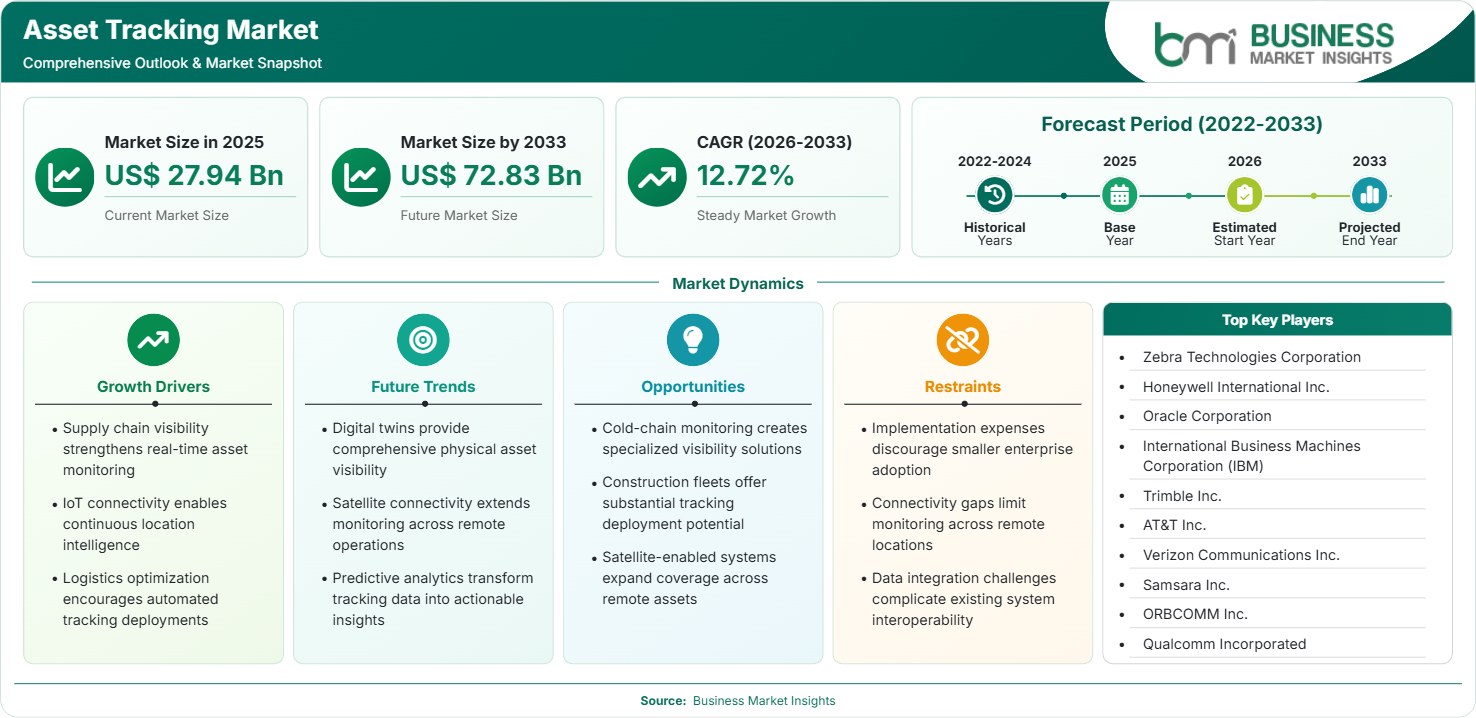
The Asset Tracking Market size was valued at US$ 27.94 Billion in 2025 and is projected to reach US$ 72.83 Billion by 2033, growing at a CAGR of 12.72% during 2026–2033. Key drivers include IoT-enabled visibility, supply chain digitalization, fleet optimization, asset utilization improvement, and Industry 4.0 adoption, while opportunities emerge from AI analytics, cloud platforms, healthcare monitoring, and smart logistics ecosystems.

Report Coverage
  • Component: Hardware, Software
  • Technology: Radio Frequency Identification, Global Positioning System, Barcode, M2M/IoT, Others
  • Deployment: Cloud, On-premise
  • Enterprise Type: Small & Mid-sized Enterprises, Large Enterprises
  • Industry: Transportation & Logistics, Aviation, Healthcare, Manufacturing, Food and Beverages, Retail & E-commerce, Government, Others
US$ 27.94 Bn Market size in 2025
US$ 72.83 Bn Market Size by 2033
12.72% CAGR, 2026 - 2033
2026-2033 Forecast Period

AI Overview

Asset Tracking Market Summary

  • North America Region: North America holds a market share of 36%–39% in 2025, growing at a CAGR of 11.5%–12.5% during 2026–2033. Demand is supported by logistics digitization, connected fleets, warehouse automation, theft prevention initiatives, enterprise IoT investments, predictive maintenance adoption, cloud integration, regulatory compliance requirements, stronger data visibility, and operational efficiency programs. Brief US market analysis: The US dominates regional demand through large logistics networks, with a CAGR of 11.8%–12.8% through 2033.
  • Fastest Growing Region: Asia Pacific accounts for 27%–30% share in 2025 and expands at 14.5%–15.5% CAGR. Manufacturing expansion, e-commerce scale, smart port initiatives, industrial automation, digital supply chains, infrastructure modernization, mobile connectivity growth, asset security requirements, cloud adoption, and government-backed digital transformation agendas fuel growth.
  • Leading Segment: Hardware represents a 55%–58% share in 2025 and advances at 11.5%–12.5% CAGR. Adoption benefits from declining sensor costs, RFID deployments, GPS-enabled monitoring, asset visibility requirements, industrial digitization, warehouse automation, maintenance optimization, security improvements, fleet tracking expansion, and broader IoT infrastructure investments.
  • High Growth Segment: Cloud deployment captures 62%–65% share in 2025 and grows at 14.0%–15.0% CAGR. Expansion reflects subscription models, remote asset monitoring, enterprise scalability, centralized analytics, lower implementation costs, integration flexibility, real-time intelligence, software innovation, predictive capabilities, and multi-location operational management.
  • Key Market Opportunity: AI-enabled asset intelligence platforms are creating significant value through predictive maintenance, utilization optimization, anomaly detection, inventory accuracy enhancement, operational automation, sustainability monitoring, and decision-support capabilities across asset-intensive industries worldwide.
  • Major Market Players: Zebra Technologies Corporation, Honeywell International Inc., Oracle Corporation, International Business Machines Corporation (IBM), Trimble Inc., AT&T Inc., Verizon Communications Inc., Samsara Inc., ORBCOMM Inc., Qualcomm Incorporated.
Strategic Insights

Asset Tracking Market: Strategic Insights

Asset Tracking Market Strategic Framework
FREE PDF
Request your free sample
Request free sample
Stakeholder View

Key Takeaways

  • The value chain is becoming increasingly software-centric as hardware providers expand into analytics, cloud management, and lifecycle monitoring services.
  • Asset-intensive industries including transportation, healthcare, and manufacturing offer the strongest upside due to growing demand for real-time visibility and utilization optimization.
  • Innovation is shifting toward AI-driven asset intelligence, battery-efficient sensors, hybrid connectivity architectures, and predictive maintenance capabilities.
  • Asia Pacific presents a compelling investment case supported by industrialization, e-commerce growth, smart manufacturing, and logistics modernization initiatives.
  • Strategic acquisitions increasingly focus on IoT software, telematics, and analytics capabilities to strengthen digital asset management ecosystems.
  • Sustainability reporting and resource optimization objectives are encouraging organizations to implement tracking solutions that improve utilization while reducing waste.
Geographic Outlook

Asset Tracking Market Regional Highlights

North America Asset Tracking Market

North America accounted for approximately 36%–39% of global revenue in 2025 and is projected to record a CAGR of 11.5%–12.5% through 2033. Strong adoption across logistics, retail, healthcare, and manufacturing supports demand. The region benefits from mature cloud infrastructure, widespread IoT deployment, extensive fleet operations, and advanced warehouse automation. Asset Tracking Market share remains highest in this region due to early technology adoption, strong enterprise spending, and increasing operational efficiency requirements.

  • Large logistics operators are adopting AI-enabled visibility platforms to strengthen supply chain resilience and improve inventory management.
  • Healthcare providers are expanding connected equipment monitoring to enhance utilization and reduce equipment loss.
  • Retailers increasingly deploy RFID-enabled inventory systems that improve stock accuracy and omnichannel fulfillment performance.
  • Industrial organizations invest in predictive maintenance applications connected to enterprise asset management platforms.
  • Regulatory and cybersecurity requirements are encouraging adoption of secure cloud-based monitoring architectures.

US Asset Tracking Market

The US contributes roughly 78%–82% of North American demand and is expected to expand at 11.8%–12.8% CAGR. Strong logistics infrastructure, e-commerce leadership, and enterprise technology spending support market development. Transportation fleets, warehouses, hospitals, and manufacturing plants collectively represent significant adoption centers. Advanced telematics deployment continues strengthening operational intelligence and asset visibility.

  • Fleet operators increasingly integrate telematics, satellite tracking, and maintenance analytics within unified platforms.
  • Distribution centers deploy RFID and autonomous inventory solutions to reduce manual processes.
  • Government agencies utilize monitoring technologies for equipment accountability and resource management.
  • Industrial enterprises prioritize asset utilization optimization and downtime reduction initiatives.

Europe Asset Tracking Market

Europe is projected to account for 24% – 27% of the market by 2025 and is expected to demonstrate a CAGR of 11.8% – 12.8%. The driving factors include demand for supply chain traceability, sustainability, and industrial automation. Germany remains the leader in the region, while growth in Eastern Europe is faster. Asset monitoring adoption continues to accelerate within manufacturing, transportation, and healthcare sectors.

  • Germany leads regional implementation supported by Industry 4.0 investments and manufacturing digitization.
  • France and the UK continue expanding cloud-based monitoring deployments across logistics networks.
  • Sustainability initiatives encourage optimized equipment utilization and lifecycle management programs.
  • Pharmaceutical traceability requirements drive increased demand for connected monitoring technologies.
  • Poland demonstrates high-growth potential with CAGR exceeding regional averages due to industrial modernization.

Asia Pacific Asset Tracking Market

Asia Pacific holds 27%–30% market share in 2025 and records the fastest CAGR of 14.5%–15.5% of the Asset Tracking Market through 2033. Rapid urbanization, manufacturing expansion, rising e-commerce activity, and digital transformation strategies create favorable conditions. China leads regional demand, while India emerges as the fastest-growing national market through increasing infrastructure and logistics investments.

  • China continues investing heavily in smart manufacturing and warehouse automation capabilities.
  • India benefits from logistics modernization, digital commerce, and transportation infrastructure upgrades.
  • Southeast Asian economies adopt cloud-enabled asset visibility platforms supporting export-oriented industries.
  • Smart port programs improve container tracking and supply-chain transparency across regional trade networks.
  • Manufacturing organizations deploy connected equipment monitoring to improve operational efficiency.

Rest of World Asset Tracking Market

Rest of World holds 9%-12% market share in 2025 and is projected to grow at a CAGR of 12.8%-13.8%. South and Central America benefit from improvements in logistics and expansion in the retail sector. The Middle East and Africa will see growth due to smart city projects, diversified industries, and transportation developments. More demand is coming from energy, mining, logistics, and government infrastructure.

  • Brazil leads Latin American adoption through transportation digitization and expanding retail networks.
  • Mexico benefits from manufacturing supply chains integrated with global trade corridors.
  • UAE accelerates deployment through smart infrastructure and logistics hub development.
  • Saudi Arabia invests in industrial diversification and connected asset management systems.
  • Mining operators across Africa increasingly adopt remote monitoring technologies for operational visibility.
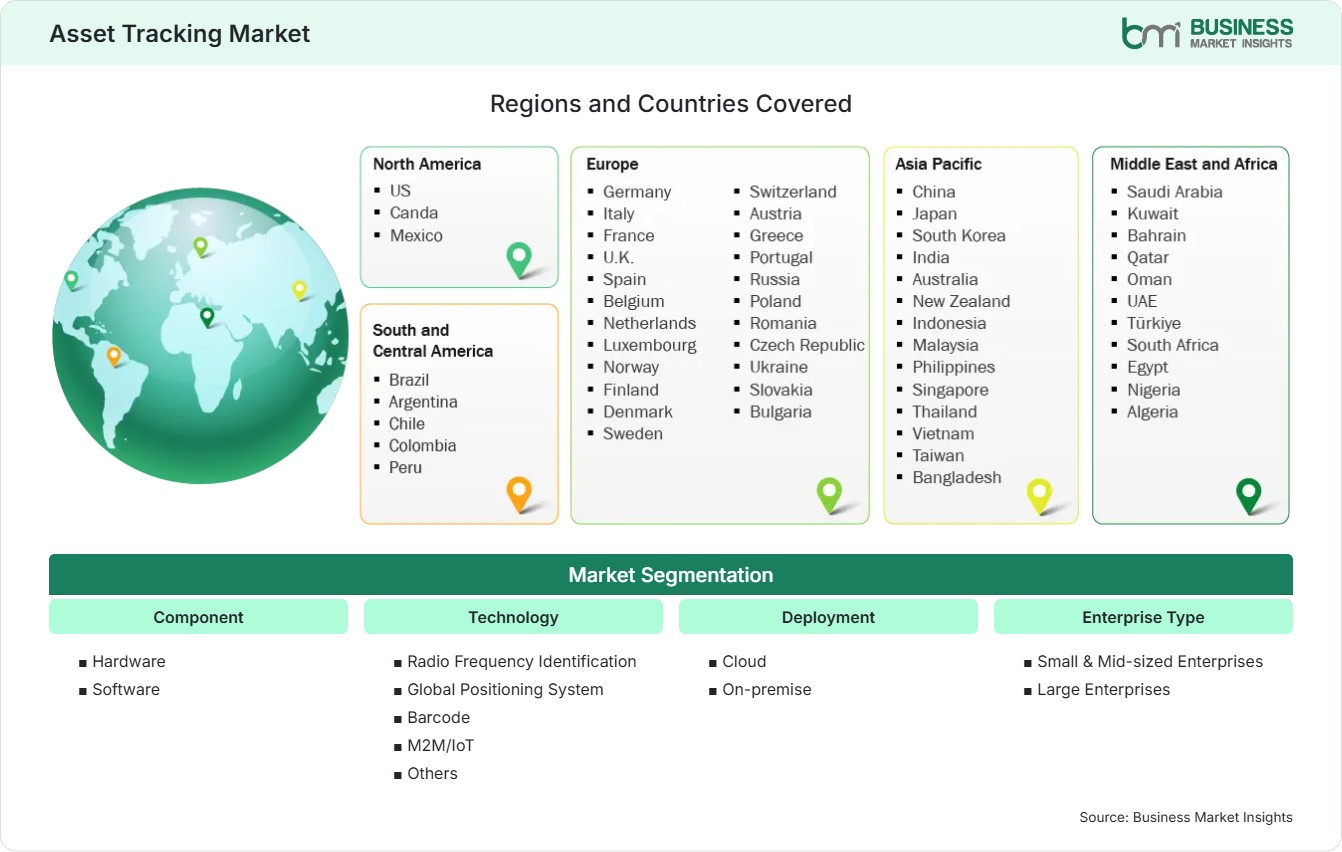
Global Market Geography
FREE PDF
Request your free sample
Request free sample
Segment Analysis

Asset Tracking Market Segmentation

Component

Component Segmentation is headed by hardware, which holds 55%-58% market share in 2025, while the overall market segment records a 11.5%-12.5% CAGR. The demand is influenced by the deployment of sensors, RFID readers, GPS units, and tracking system ecosystems. The scope of the Asset Tracking Market is continuously growing as enterprises integrate hardware with intelligent software systems.

  • Hardware: Core adoption is supported by RFID tags, GPS trackers, sensors, gateways, and monitoring devices deployed across logistics, manufacturing, and healthcare environments.
  • Software: Demand rises from analytics, reporting, utilization management, predictive maintenance, workflow automation, and centralized asset visibility applications.

Technology

Technology adoption will remain diversified in the coming years as companies seek visibility, efficiency, and compliance. This market will grow at a 13.0%-14.0% CAGR, driven by increasing expenditure on connected infrastructure and digital asset monitoring solutions.

  • Radio Frequency Identification (RFID): Widely used for inventory management, warehouse operations, retail visibility, and asset authentication across complex enterprise environments.
  • Global Positioning System (GPS): Essential for fleet management, equipment tracking, route optimization, and security-focused monitoring applications.
  • Barcode: Maintains relevance through cost-effective identification, inventory tracking, and workflow management requirements.
  • M2M/IoT: Fast-growing technology enabling real-time connectivity, predictive analytics, remote monitoring, and intelligent automation capabilities.

Deployment

Deployment trends favor cloud environments, which maintain a 62%–65% share in 2025 and advance at 14.0%–15.0% CAGR. Enterprises prioritize flexibility, analytics integration, and scalability.

  • Cloud: Supports centralized management, remote access, seamless upgrades, data analytics, and subscription-based deployment models.
  • On-premises: Preferred within security-sensitive sectors requiring direct infrastructure control and customized integration environments.

Enterprise Type

Large businesses continue to be the dominant adopters, even as digital technologies become more widely available to smaller companies. The growth in the market indicates an increased understanding of the importance of utilization optimization and visibility.

  • Small & Mid-sized Enterprises (SMEs): Adoption strengthens through affordable cloud offerings, lower setup requirements, and subscription pricing structures.
  • Large Enterprises: Continue investing in enterprise-wide deployments integrating logistics, maintenance, inventory, and analytics capabilities.

Industry

Transportation and logistics is the largest application segment, contributing 28%-31% to the market with a CAGR of 13.5%-14.5%. The Asset Tracking Market trends are leaning towards real-time supply chain intelligence.

  • Transportation & Logistics: Strong demand arises from fleet visibility, route planning, shipment monitoring, and inventory control applications.
  • Aviation: Airports and carriers utilize monitoring technologies to improve baggage, cargo, and equipment management.
  • Healthcare: Connected tracking improves medical equipment utilization, compliance management, and patient care support.
  • Manufacturing: Adoption supports predictive maintenance, equipment monitoring, and production efficiency enhancement.
  • Food and Beverages: Traceability and compliance requirements drive increasing deployment across cold chain operations.
  • Retail & E-commerce: Organizations implement visibility tools to improve inventory accuracy and fulfillment speed.
  • Government: Agencies deploy tracking systems for equipment accountability, infrastructure monitoring, and resource optimization.
Market Forces

Asset Tracking Market Dynamics

Key Market Drivers

Expansion of IoT-Connected Industrial Assets

There is an increase in the number of connected industrial assets due to the need for asset visibility, predictive maintenance, and operational optimization. Industrial facilities, transportation fleets, warehousing centers, and health care facilities are incorporating IoT sensors into their assets to minimize idle time and optimize resource use. The Asset Tracking market growth is greatly aided by decreasing costs and greater availability of sensors and low-power connectivity solutions. Real-time data collection is used for maintenance scheduling, tracking, and exception handling. There is a growing preference for monitoring ecosystems that can combine all of these functions.

Supply Chain Visibility and Resilience Requirements

There is greater complexity arising from global supply chains as organizations source from multiple countries and have specific delivery expectations. There is a need for transparency regarding logistics, equipment utilization, and shipments. Connected visibility helps reduce losses, reduce theft, improve planning efficiency, and boost customer service performance. More and more transport companies adopt real-time tracking data in their workflow systems. The digitization of logistics continues to drive investment in freight, warehousing, and inventory management. The ability to proactively manage disruptions through continuous visibility remains a major contributor to adoption across industrial sectors.

Cloud Analytics and AI Integration

The combination of cloud computing, machine learning, and analytics is changing how enterprise asset management works. Companies are now more focused on predictions than merely knowing where assets are. Modern systems use analysis of utilization, maintenance, route optimization, and asset movement to support data-driven decision-making. Asset Tracking Market trends indicate a growing shift towards software-based ecosystems that deliver useful analytics. AI-based monitoring enables better planning and helps companies achieve their sustainability goals by optimizing resource use. These capabilities elevate return on investment and strengthen long-term enterprise adoption.

Key Market Opportunities

AI-Driven Predictive Asset Intelligence Platforms

There is great commercial potential for predictive asset intelligence as businesses move beyond monitoring to proactively manage their operations. Predictive algorithms can detect machine breakdowns, usage inefficiencies, inventory deficiencies, and other abnormal asset behavior before they cause problems. Providers of such technology solutions can enjoy more profitable recurring revenue models. According to the Asset Tracking Market Forecasts, there is a growing demand among enterprises for decision-making solutions that translate operational information into real results. As sensor deployment expands, predictive intelligence platforms are expected to become a core layer of enterprise management.

Healthcare Asset Digitization Programs

Healthcare enterprises continue to invest in equipment connectivity solutions to improve equipment utilization, enhance loss prevention, and improve patient care delivery. Hospitals have thousands of mobile assets ranging from pumps and monitors to wheelchairs and diagnostic equipment. Better visibility enhances equipment availability and facilitates compliance and maintenance needs. The growing need to leverage capital investments is driving the adoption of these technologies. Vendors who can provide healthcare analytics, compliance, and interoperability are likely to grow strongly across developed and emerging healthcare systems.

Smart Infrastructure and Public Sector Deployments

Governments are now making greater use of connected monitoring systems within their transportation networks, utilities, public properties, and infrastructure. Smart city programs need constant information about the location, usage, maintenance, and functioning of equipment. Intelligence for asset management helps government bodies operate more effectively and improve their performance. Developing countries planning to upgrade their infrastructure generate new demand. Digital transformation of the public sector offers vendors many opportunities for future growth.

Market Restraints and Challenges

High Initial Deployment Costs

Factor: Larger rollouts may require investment in sensor units, readers, gateways, communication infrastructure, software, and integration services. Impact: Firms with tight budgets might delay their implementation even though there could be operational advantages. Small and medium enterprises are especially prone to upfront capital costs. A more complicated deployment environment also means a higher total cost of ownership. While subscription-based pricing can lower the barrier to entry, implementation costs are among the biggest obstacles for cost-sensitive industries. The vendors need to prove the ROI to expedite purchase decisions and overcome budget constraints.

Cybersecurity and Data Privacy Concerns

Factor: Interconnected monitoring systems produce massive amounts of data regarding location, operation, and usage that get communicated through networks and cloud-based infrastructure. Impact: Cybersecurity issues may delay implementation, especially in sectors such as government, healthcare, and critical infrastructure. Corporations should have adequate tools for encryption, access security, authentication, and compliance to respond to any security threats that may arise. Cybersecurity threats will result in reputational and operational problems for the corporation implementing the technology. With more technology deployment, there is an increased need for better security among technology providers.

Company Analysis

Competitive Landscape

Asset Tracking Market analysis indicates competition is increasingly centered on integrated hardware, connectivity, analytics, and cloud ecosystem capabilities.

Company Name

Overview

Products and Services relevant to this market

Zebra Technologies Corporation

Global leader in enterprise visibility, mobility, and intelligent asset management solutions.

RFID systems, barcode technologies, asset tracking software, inventory visibility platforms.

Honeywell International Inc.

Diversified technology company serving industrial, logistics, and warehouse markets.

Sensors, RFID solutions, automation technologies, tracking and monitoring platforms.

Oracle Corporation

Enterprise software provider supporting asset lifecycle and supply chain management.

Cloud applications, asset management software, analytics, IoT integration solutions.

International Business Machines Corporation (IBM)

Technology company focused on AI, cloud, and industrial transformation initiatives.

Asset management platforms, analytics, IoT services, enterprise software solutions.

Trimble Inc.

Major provider of positioning and operational technology solutions.

GPS systems, fleet tracking, telematics, asset visibility and monitoring tools.

AT&T Inc.

Telecommunications provider enabling connected asset deployments.

IoT connectivity, monitoring solutions, enterprise mobility and network services.

Verizon Communications Inc.

Connectivity and telematics specialist supporting enterprise visibility programs.

Asset tracking connectivity, fleet solutions, IoT network services.

Samsara Inc.

Fast-growing operational intelligence technology provider.

Connected sensors, fleet monitoring, equipment tracking, analytics software.

ORBCOMM Inc.

Global IoT company focused on industrial asset visibility.

Satellite tracking, telematics, monitoring devices, logistics intelligence platforms.

Qualcomm Incorporated

Semiconductor and wireless technology company supporting IoT ecosystems.

Connectivity chipsets, location technologies, edge computing and IoT solutions.

Trust & Transparency

Research Methodology

The market analysis combines proprietary research with secondary data from government agencies, company disclosures, regulatory filings, industry databases and expert interviews. Market estimates are validated through data triangulation, cross-market benchmarking and analyst review.

View Full Research Methodology

Questions Answered

Frequently Asked Questions

What does the Asset Tracking Market Report typically evaluate?

The Market Report evaluates technology adoption, competitive positioning, regional demand patterns, industry use cases, deployment models, investment trends, and future growth opportunities.

Which region offers the strongest long-term expansion potential?

Asia Pacific presents the strongest opportunity due to industrialization, e-commerce growth, logistics modernization, infrastructure investment, and increasing adoption of connected technologies.

How does AI improve asset tracking performance?

AI analyzes utilization patterns, predicts maintenance needs, identifies inefficiencies, detects anomalies, and supports data-driven operational decisions using real-time asset intelligence.

Why is cloud deployment growing faster than on-premises deployment?

Cloud platforms offer scalability, lower implementation costs, centralized monitoring, remote accessibility, and faster software upgrades, making them attractive across distributed enterprise environments.

What industries generate the highest demand for asset tracking solutions?

Transportation and logistics currently account for the largest demand, followed by manufacturing, healthcare, retail, aviation, and government operations that require real-time visibility and utilization management.

Access the Full Asset Tracking Market Report

Get segment-level forecasts, regional estimates, competitive benchmarking, company profiles and downloadable Excel datasets.

Access the full Asset Tracking Market Report
350 pages PDF & Excel | 2026-09-17
Similar Research

Related Market Reports