
Green Technology and Sustainability Market Outlook: Size, Share, Trends, Growth Analysis, Competitive Landscape & Forecast, 2026-2033

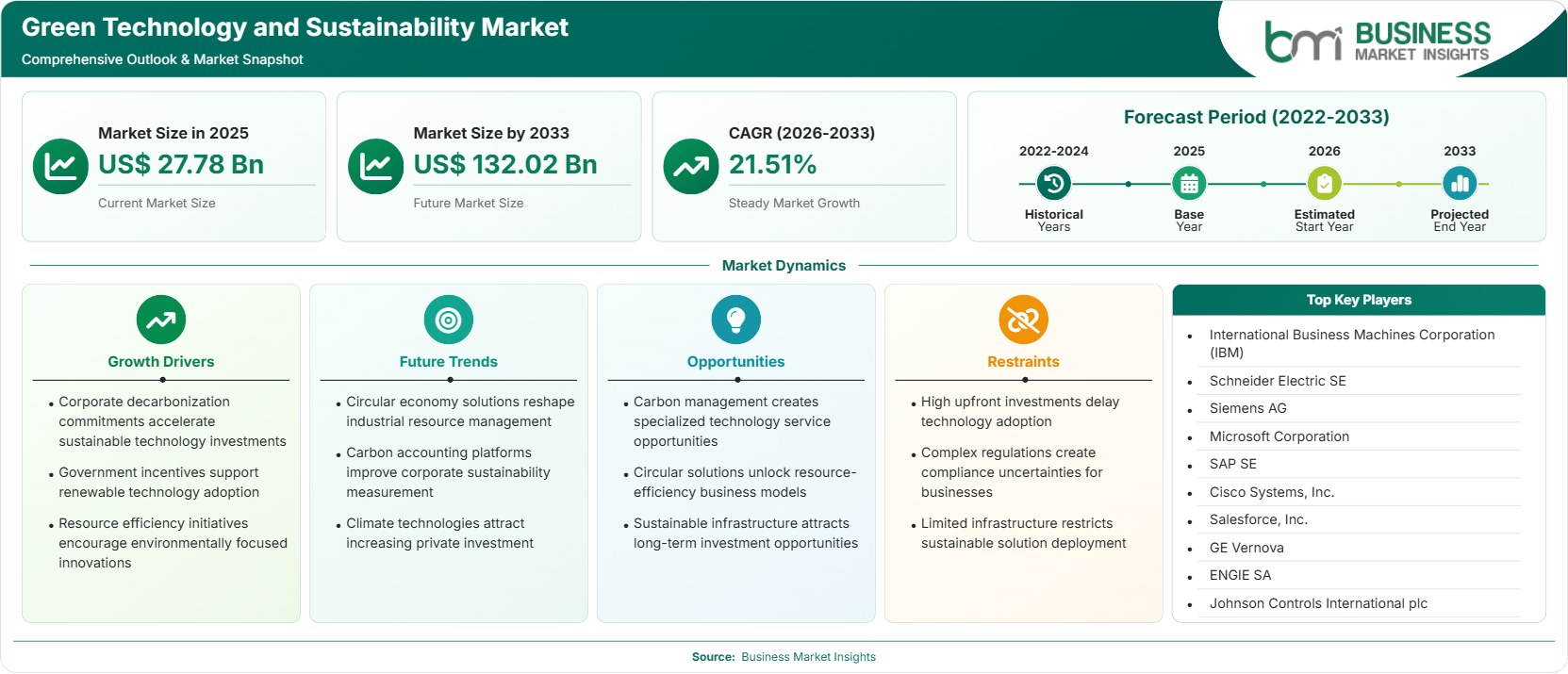
The Green Technology and Sustainability Market size was valued at US$ 27.78 Billion in 2025 and is projected to reach US$ 132.02 Billion by 2033, growing at a CAGR of 21.51% during 2026–2033. Key drivers include ESG compliance requirements, enterprise decarbonization programs, AI-enabled sustainability management, renewable infrastructure investments, smart resource monitoring, and expanding climate-tech funding opportunities.

Report Coverage
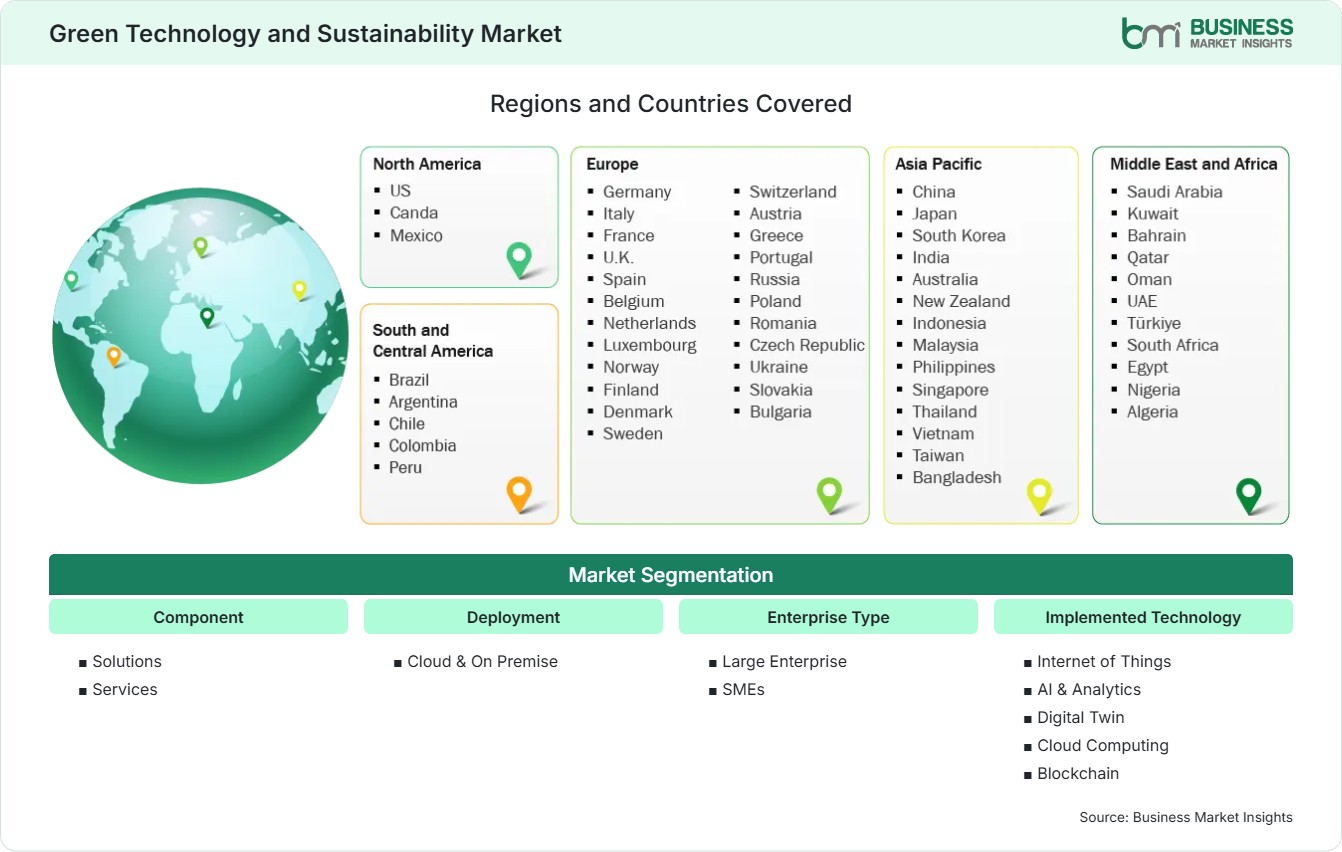
  • Component: Solutions, Services
  • Deployment: Cloud & On Premise
  • Enterprise Type: Large Enterprise, SMEs
  • Implemented Technology: Internet of Things, AI & Analytics, Digital Twin, Cloud Computing, Blockchain
  • Application: Air & Water Pollution Monitoring, Carbon Footprint Management, Crop Monitoring, Fire Detection, Forest Monitoring, Green Building, Soil Condition Monitoring, Sustainable Mining, Water Management, Weather Monitoring
US$ 27.78 Bn Market size in 2025
US$ 132.02 Bn Market Size by 2033
21.51% CAGR, 2026 - 2033
2026-2033 Forecast Period

AI Overview

Green Technology and Sustainability Market Summary

  • North America Region: North America holds a market share of 34%–37% in 2025, growing with a CAGR of 19%–22% during 2026–2033. Growth is supported by federal decarbonization incentives, ESG integration, smart infrastructure modernization, cloud sustainability platforms, corporate net-zero investments, industrial digitalization, energy efficiency mandates, climate reporting frameworks, and environmental monitoring deployment expansion. Brief US outlook: The US leads regional adoption through enterprise sustainability software investments and smart-grid modernization, advancing at 19.5%–22.5% CAGR.
  • Fastest Growing Region: Asia Pacific holds a Green Technology and Sustainability Market share of 25%–28% in 2025, growing with a CAGR of 23%–26% during 2026–2033. Expansion is fueled by urbanization, industrial automation, renewable deployments, smart agriculture initiatives, carbon reduction targets, digital transformation spending, environmental monitoring adoption, sustainability innovation programs, resource optimization projects, and climate resilience investments.
  • Leading Segment: Solutions accounts for 68%–72% share in 2025 and advances at 20%–23% CAGR. Adoption benefits from integrated sustainability management, emissions tracking, energy analytics, digital compliance capabilities, operational efficiency improvement, enterprise reporting automation, resource utilization optimization, scalable deployment architectures, and measurable environmental performance outcomes.
  • High Growth Segment: AI & Analytics represents 18%–22% of the Green Technology and Sustainability Market share in 2025 and expands at 24%–27% CAGR. Growth stems from predictive sustainability intelligence, automated emissions calculations, environmental risk assessment, operational optimization, climate forecasting enhancements, regulatory reporting efficiency, machine-learning integration, real-time monitoring capabilities, and enterprise decision support improvements.
  • Key Market Opportunity: Expanding digital platforms linking emissions management, resource monitoring, renewable energy optimization, and ESG reporting provide organizations with scalable pathways to achieve measurable sustainability goals across global operations.
  • Major Market Players: International Business Machines Corporation (IBM), Schneider Electric SE, Siemens AG, Microsoft Corporation, SAP SE, Cisco Systems, Inc., Salesforce, Inc., GE Vernova, ENGIE SA, Johnson Controls International plc.
Strategic Insights

Green Technology and Sustainability Market: Strategic Insights

Green Technology and Sustainability Market Strategic Framework
FREE PDF
Request your free sample
Request free sample
Stakeholder View

Key Takeaways

  • Sustainability value chains are increasingly converging around cloud platforms, sensor networks, analytics providers, environmental consultants, and compliance specialists, creating integrated ecosystems rather than isolated technology deployments.
  • Carbon footprint management, green building operations, intelligent water management, and crop-monitoring solutions offer some of the strongest commercialization opportunities as organizations pursue measurable sustainability outcomes.
  • Artificial intelligence is shifting environmental management from retrospective reporting toward predictive optimization, enabling automated recommendations for energy efficiency, emissions reduction, and resource conservation.
  • Asia Pacific presents a compelling investment proposition because of rapid industrialization, smart-city spending, renewable energy deployment, and expanding government sustainability mandates.
  • Strategic acquisitions continue targeting ESG software, energy analytics, carbon accounting platforms, and environmental monitoring capabilities as technology vendors seek broader sustainability portfolios.
  • Cross-sector collaboration among utilities, industrial enterprises, governments, and software providers is becoming a major differentiator in scaling environmental intelligence initiatives globally.
Geographic Outlook

Green Technology and Sustainability Market Regional Highlights

North America Green Technology and Sustainability Market

North America accounts for about 34%-37% of the Green Technology and Sustainability Market share in 2025 and is estimated to grow at a CAGR of 19%-22% through 2033. The reasons behind regional dominance include stringent environmental regulations, corporate sustainability goals, advanced IT infrastructure, and substantial clean energy investments. Both public and private companies have begun using AI-powered resource management technologies, emissions management software, and sustainable industrial platforms.

  • Large enterprises accelerate ESG reporting investments by integrating operational data with sustainability performance measurement systems, improving regulatory compliance and enabling continuous environmental optimization initiatives.
  • Renewable energy deployment and grid modernization programs increase deployment of digital monitoring technologies supporting emissions reduction, energy efficiency, and asset performance improvement objectives.
  • Corporate decarbonization strategies encourage adoption of carbon accounting tools, lifecycle assessment solutions, and sustainability analytics platforms across diversified industry verticals.
  • Environmental monitoring applications expand across air-quality management, water conservation, and industrial compliance programs, strengthening demand for connected sustainability technologies.

US Green Technology and Sustainability Market

The US accounts for 75%-79% of the total regional demand and is expected to see a CAGR of 19.5%-22.5%. The drivers of market growth include federal climate policies, investments in renewables, corporate sustainability policies, and technological advancements. Venture capital investments continue to back climate technology. Demand is currently focused on utilities, manufacturing, tech services, transport, and commercial infrastructure.

  • Smart-building deployments increasingly combine IoT devices, analytics engines, and automation systems to improve energy performance and sustainability outcomes.
  • Industrial organizations implement predictive maintenance and emissions monitoring solutions to reduce operational costs while supporting environmental reporting objectives.
  • Sustainability software adoption rises as organizations respond to evolving climate disclosure requirements and stakeholder transparency expectations.
  • Renewable-energy integration programs drive investment in intelligent monitoring, forecasting, and optimization technologies supporting grid resilience.

Europe Green Technology and Sustainability Market

The Europe region holds a market share of 28%-31% and is projected to grow at a CAGR of 20%–23% in the Green Technology and Sustainability Market from 2025 to 2033. Europe is experiencing strong growth due to the implementation of the European Green Deal, corporate sustainability laws, and circular economy projects, which are driving high demand for sustainability solutions. Germany is leading the region, but Eastern European regions have high growth rates.

  • Germany remains the leading national market, supported by industrial sustainability programs and digital manufacturing investments, with growth around 19%–22%.
  • Poland demonstrates high-growth potential with increasing renewable deployments and sustainability infrastructure modernization, expanding at approximately 22%–25%.
  • Carbon accounting and emissions verification solutions gain traction amid stricter environmental disclosure obligations and climate-transition planning requirements.
  • Smart-city initiatives foster demand for environmental monitoring, intelligent transportation systems, and connected resource-management technologies.

Asia Pacific Green Technology and Sustainability Market

The Asia Pacific region is estimated to contribute between 25% and 28% of revenues over the forecast period and continues to be the leading region, growing at a CAGR of 23%-26%. Urbanization, manufacturing, resource efficiency, and renewable energy drive the demand. China is the largest market within the region, whereas India has one of the fastest growth rates. Government sustainability programs increasingly promote the adoption of intelligent environmental management systems across public and private sectors.

  • China continues leading adoption through smart-city projects, industrial modernization, and large-scale renewable deployment programs supporting digital sustainability initiatives.
  • India exhibits accelerated growth between 24%–27%, benefiting from climate-focused infrastructure development and expanding environmental technology investments.
  • Agricultural digitization creates opportunities for crop monitoring, soil optimization, and intelligent water-management applications utilizing connected technologies.
  • Industrial organizations deploy sustainability analytics solutions to improve resource efficiency and strengthen environmental performance management capabilities.

Rest of World Green Technology and Sustainability Market

The Rest of World region accounts for 8%–11% of market revenue in 2025 and is projected to grow at a 20%–24% CAGR of the Green Technology and Sustainability Market through 2033. South and Central America benefit from renewable energy expansion and agricultural sustainability initiatives. Meanwhile, Middle Eastern and African economies are increasing investments in smart infrastructure, water conservation technologies, and environmental monitoring systems to support long-term sustainability goals.

  • Brazil remains the leading Latin American market, supported by renewable energy programs and digital agriculture adoption with growth near 20%–23%.
  • Saudi Arabia demonstrates strong potential through sustainability-focused smart-city developments and environmental technology investments, advancing around 22%–25%.
  • Water-management and conservation technologies witness increased deployment in resource-constrained locations across the Middle East and Africa.
  • Climate resilience programs support adoption of weather monitoring, wildfire detection, and environmental intelligence platforms across emerging economies.
Global Market Geography
FREE PDF
Request your free sample
Request free sample
Segment Analysis

Green Technology and Sustainability Market Segmentation

Component

Component-based solutions remain dominant, accounting for 68%–72% market share by 2025, with a CAGR of 20%–23%. Companies value scalable solutions for software, analytics, monitoring, and reporting, which make sustainability management easier. Services remain important due to implementation, consulting, integration, and optimization activities. The scope of the Green Technology and Sustainability Market continues to grow as companies integrate their environmental and digital strategies.

  • Solutions: Provide emissions tracking, energy management, environmental monitoring, compliance automation, and resource optimization capabilities used across enterprise sustainability and operational performance programs.
  • Services: Support deployment, integration, consulting, training, and managed operations, enabling organizations to maximize sustainability platform effectiveness and regulatory compliance outcomes.

Deployment

Cloud deployment accounts for 61%–65% of the total market in 2025, growing at a 22%–25% CAGR owing to the benefits of scalability, data access, and rapid implementation. On-premises deployment is suitable for firms that need greater control over their operations and data, as well as to meet regulatory requirements. Hybrid deployment strategies continue to emerge across regulated sectors.

  • Cloud: Enables centralized sustainability data management, continuous updates, advanced analytics accessibility, and simplified multi-site environmental performance monitoring.
  • On-Premise: Preferred by organizations prioritizing control, security customization, and integration with legacy operational infrastructure environments.

Enterprise Type

Large enterprises hold 64%-68% market share and have a 20%-23% CAGR in the Green Technology and Sustainability market due to their commitment to the ESG framework and adherence to ESG standards. SMEs are increasingly using modular sustainability solutions due to improved affordability and broader stakeholder requirements expanding across supply chains.

  • Large Enterprise: Deploy integrated sustainability platforms supporting multi-location reporting, emissions management, regulatory compliance, and operational optimization.
  • SMEs: Embrace cloud-based environmental management solutions to enhance efficiency, transparency, and sustainability performance at manageable implementation costs.

Implemented Technology

IoT leads implementation with a 28%–32% share and growth of 21%–24% CAGR, supported by sensing and monitoring capabilities. AI platforms achieve the fastest adoption rates through predictive sustainability intelligence and automation.

  • Internet of Things: Delivers continuous environmental data collection across industrial, commercial, agricultural, and infrastructure environments, supporting sustainability management.
  • AI & Analytics: Enables predictive insights, optimization recommendations, risk assessment, and advanced sustainability reporting across operations.
  • Digital Twin: Supports simulation-driven environmental performance improvement and efficient infrastructure management strategies.
  • Cloud Computing: Facilitates scalable sustainability data processing, collaboration, monitoring, and enterprise-wide reporting capabilities.
  • Blockchain: Improves transparency, traceability, carbon-credit verification, and sustainable supply-chain documentation processes.

Application

The market for green buildings has a 24%-28% share in 2025 and is growing at a 21%-24% CAGR. Firms use sustainability technology to handle emissions, resources, infrastructure, efficiency, and their environmental impact within the ecosystem.

  • Air & Water Pollution Monitoring: Enables real-time environmental measurement and compliance management through connected monitoring technologies.
  • Carbon Footprint Management: Supports emissions tracking, reduction planning, reporting automation, and sustainability performance benchmarking.
  • Crop Monitoring: Enhances agricultural productivity and resource efficiency through analytics-driven monitoring capabilities.
  • Fire Detection: Improves environmental protection and response readiness using intelligent sensing and monitoring networks.
  • Forest Monitoring: Supports conservation initiatives through remote monitoring, analytics, and environmental intelligence tools.
  • Green Building: Optimizes energy consumption, occupant comfort, and operational sustainability through connected infrastructure technologies.
  • Soil Condition Monitoring: Enables precision agriculture and resource conservation through continuous environmental assessment.
  • Sustainable Mining: Improves operational efficiency, environmental stewardship, and regulatory compliance across resource extraction activities.
  • Water Management: Supports conservation, distribution optimization, quality monitoring, and long-term resource sustainability objectives.
  • Weather Monitoring: Provides environmental intelligence supporting planning, forecasting, resilience, and risk mitigation strategies.
Market Forces

Green Technology and Sustainability Market Dynamics

Key Market Drivers

Expansion of ESG Reporting and Environmental Regulations

Climate information disclosure, GHG emissions reporting, and sustainability reporting have become more frequent through government regulation. The need for the Corporate Sustainability Reporting Directive and other new reporting models is prompting enterprises to use digital sustainability platforms. There is an ever-growing need for corporations to demonstrate their environmental impact to their investors, customers, and business partners using quantifiable metrics. This results in the greater use of carbon accounting, environmental monitoring, and automation of reporting processes. As regulatory complexities grow, there is an increasing need to consolidate environmental information from different sources.

Rapid Adoption of AI, IoT, and Environmental Analytics

Connectivity among sensors, intelligence, and learning has changed environmental management. Companies are increasingly using predictive analytics to conserve energy, maximize the effectiveness of their assets, and conserve resources. Sustainability platforms powered by AI enable real-time monitoring and faster decision-making. The falling prices of IoT hardware make it easier to implement solutions across industries, including buildings, manufacturing plants, utilities, and agriculture. The Green Technology and Sustainability Market trends indicate greater integration of operational technology and environmental intelligence. The ability to create sustainable intelligence from real-time data offers great value to companies with efficiency, compliance, and environmental goals.

Corporate Net-Zero and Decarbonization Commitments

Larger companies have been setting science-based targets and net-zero targets for themselves. Meeting such targets requires a system capable of measuring and reducing emissions. The concept of sustainability has gone from being a corporate social responsibility issue to a business priority. More money is being put into technology to manage emissions, integrate renewables, engage suppliers, and measure performance. Public sustainability targets set higher standards of accountability, thus motivating the company to adopt technology platforms that help it to report and improve performance. This transition underpins sustained demand for advanced sustainability technologies through the forecast period.

Key Market Opportunities

Integration of Sustainability Platforms Across Enterprise Operations

Companies look for integrated platforms that can integrate their environmental, operational, and financial data. There is a need for companies to develop integrated systems to integrate environmental, energy, and supply chain data. Enterprise integration is useful in decision-making and sustainable development goals. Companies that can provide scalability, industry-specific solutions, and analytics are poised to benefit from the growing demand for these capabilities. The Green Technology and Sustainability Market Forecasts show promise for digital sustainability ecosystems within businesses, moving beyond fragmented deployments toward comprehensive environmental intelligence strategies that serve multiple business functions.

Smart Agriculture and Resource Efficiency Applications

The agricultural industry is under increasing pressure to achieve higher productivity without harming the environment. Various technologies that provide crop monitoring, soil analysis, weather information, and precision irrigation have ample scope for growth. Increasingly, governments and agricultural organizations are investing in technologies that will help conserve water and allocate resources. The sustainability-based approach to agriculture is compatible with goals for food security and adaptation to climate change. Companies offering solutions in monitoring and analysis technologies for agriculture will have an advantage due to increasing demand from both emerging and advanced nations.

Growth of Green Buildings and Sustainable Infrastructure

There is an increasing trend in commercial and public infrastructure projects in which environmental performance is considered throughout the entire lifecycle of these assets. Advanced building technologies, digital twins, energy management software, and environmental monitoring systems enable operators to optimize operations and reduce their carbon footprint. Various certification programs and regulations help accelerate this trend. Urbanization trends, infrastructure modernization programs, and smart cities programs offer significant business potential in this sector. Companies that can integrate OT technology and sustainability intelligence solutions will enjoy significant growth in this area.

Market Restraints and Challenges

High Implementation Costs and Integration Complexity

Factor: The comprehensive implementation of sustainability practices may require significant spending on sensors, software applications, integration services, analytical frameworks, and employee training. Impact: The high cost of initial implementation may delay adoption, especially for smaller organizations with limited funds. The problems related to integrating environmental systems will be even greater if they are to be integrated with existing enterprise systems. Problems with data standardization will make data collection and reporting less efficient. Even though the long-run cost savings will outweigh the expenses, the payback period may be long.

Data Quality, Standardization and Measurement Challenges

Factor: Sustainability Reporting relies on obtaining accurate environmental data from various types of assets, facilities, suppliers, and systems. Impact: Discrepancies in approaches and fragmentation in datasets can diminish trust in sustainability performance and decision-making. It is difficult for organizations to create uniform measurement standards globally. Data related to emissions from suppliers is particularly difficult to collect accurately. The regulatory demands for organizations keep changing, adding to the complexity of reporting. Solving the issues at hand will require stronger governance structures, interoperability, and improved data management systems. Without these improvements, organizations may experience reduced efficiency and slower sustainability program maturity.

Company Analysis

Competitive Landscape

Green Technology and Sustainability Market analysis reveals competition centered on sustainability software, industrial automation, cloud services, environmental intelligence, carbon accounting, and digital infrastructure solutions.

Company Name

Overview

Products and Services relevant to this market

International Business Machines Corporation (IBM)

Global technology provider delivering AI, cloud, and sustainability intelligence solutions for enterprises pursuing environmental performance optimization.

Environmental data management, ESG reporting tools, AI analytics, asset optimization solutions, and sustainability consulting services.

Schneider Electric SE

Energy management and automation leader focused on digital sustainability and resource efficiency solutions worldwide.

EcoStruxure platform, energy monitoring, carbon management tools, digital twins, and sustainability advisory services.

Siemens AG

Industrial technology company integrating automation, software, and sustainability capabilities across infrastructure and manufacturing sectors.

Building technologies, industrial automation, environmental monitoring, digital twin solutions, and energy optimization platforms.

Microsoft Corporation

Cloud and software provider enabling enterprise sustainability management through integrated digital platforms.

Microsoft Cloud for Sustainability, analytics, ESG reporting, AI tools, and environmental data management services.

SAP SE

Enterprise software provider supporting sustainability integration across operational and business processes.

Sustainability Control Tower, carbon accounting, ESG reporting, and supply-chain transparency solutions.

Cisco Systems, Inc.

Networking technology company advancing energy-efficient and intelligent infrastructure ecosystems.

Smart infrastructure connectivity, environmental monitoring networks, analytics, and operational efficiency solutions.

Salesforce, Inc.

Cloud software company supporting environmental accountability and sustainability management initiatives.

Net Zero Cloud, emissions tracking, ESG reporting, and sustainability performance management tools.

GE Vernova

Industrial technology provider focused on energy transition, asset management, and digital sustainability initiatives.

Grid technologies, asset performance analytics, environmental monitoring, and industrial efficiency solutions.

ENGIE SA

Global energy and infrastructure company driving decarbonization and sustainable energy transformation.

Energy services, renewable integration, carbon management, and sustainability consulting offerings.

Johnson Controls International plc

Building solutions provider emphasizing energy efficiency, automation, and sustainable operations.

Smart building systems, energy management platforms, facility optimization, and environmental performance solutions.

Trust & Transparency

Research Methodology

The market analysis combines proprietary research with secondary data from government agencies, company disclosures, regulatory filings, industry databases and expert interviews. Market estimates are validated through data triangulation, cross-market benchmarking and analyst review.

View Full Research Methodology

Questions Answered

Frequently Asked Questions

Why is this Green Technology and Sustainability Market Report important for stakeholders?

The report provides insights into growth drivers, regional opportunities, technology adoption patterns, competitive positioning, and strategic investment areas shaping long-term market development.

What industries generate the greatest demand for these solutions?

Utilities, manufacturing, commercial real estate, agriculture, transportation, and public infrastructure sectors account for significant demand because of their environmental impact and operational complexity.

How are AI technologies influencing sustainability programs?

AI improves emissions forecasting, resource optimization, predictive maintenance, environmental risk assessment, and automated reporting, enabling organizations to make faster and more informed sustainability decisions.

What application area offers the strongest commercial potential?

Carbon footprint management, green building optimization, and water management applications present strong commercial opportunities due to rising compliance obligations and measurable operational benefits.

What factors are accelerating adoption of sustainability technologies?

Regulatory compliance requirements, enterprise net-zero commitments, investor expectations, cloud adoption, and growing availability of AI-powered monitoring solutions are driving technology implementation across industries.

Access the Full Green Technology and Sustainability Market Report

Get segment-level forecasts, regional estimates, competitive benchmarking, company profiles and downloadable Excel datasets.

Access the full Green Technology and Sustainability Market Report
350 pages PDF & Excel | 2026-09-16
Similar Research

Related Market Reports