
Cloud Enterprise Content Management Market Outlook: Size, Share, Trends, Growth Analysis, Competitive Landscape & Forecast, 2026-2033

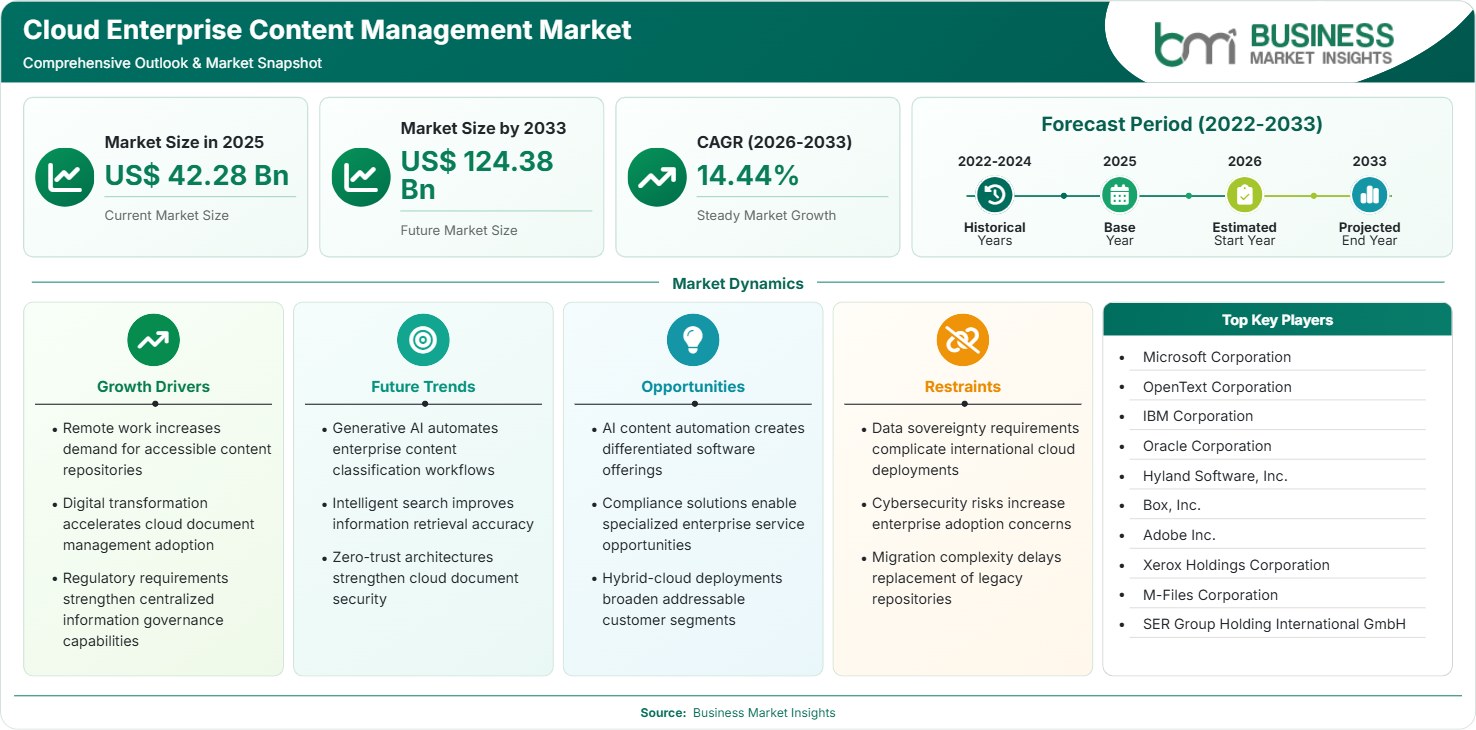
The Cloud Enterprise Content Management Market size was valued at US$ 42.28 Billion in 2025 and is projected to reach US$ 124.38 Billion by 2033, growing at a CAGR of 14.44% during 2026–2033, driven by AI-enabled content automation, compliance modernization, cloud migration initiatives, remote collaboration demand, and expanding opportunities across regulated industries and digital-first enterprises.

Report Coverage
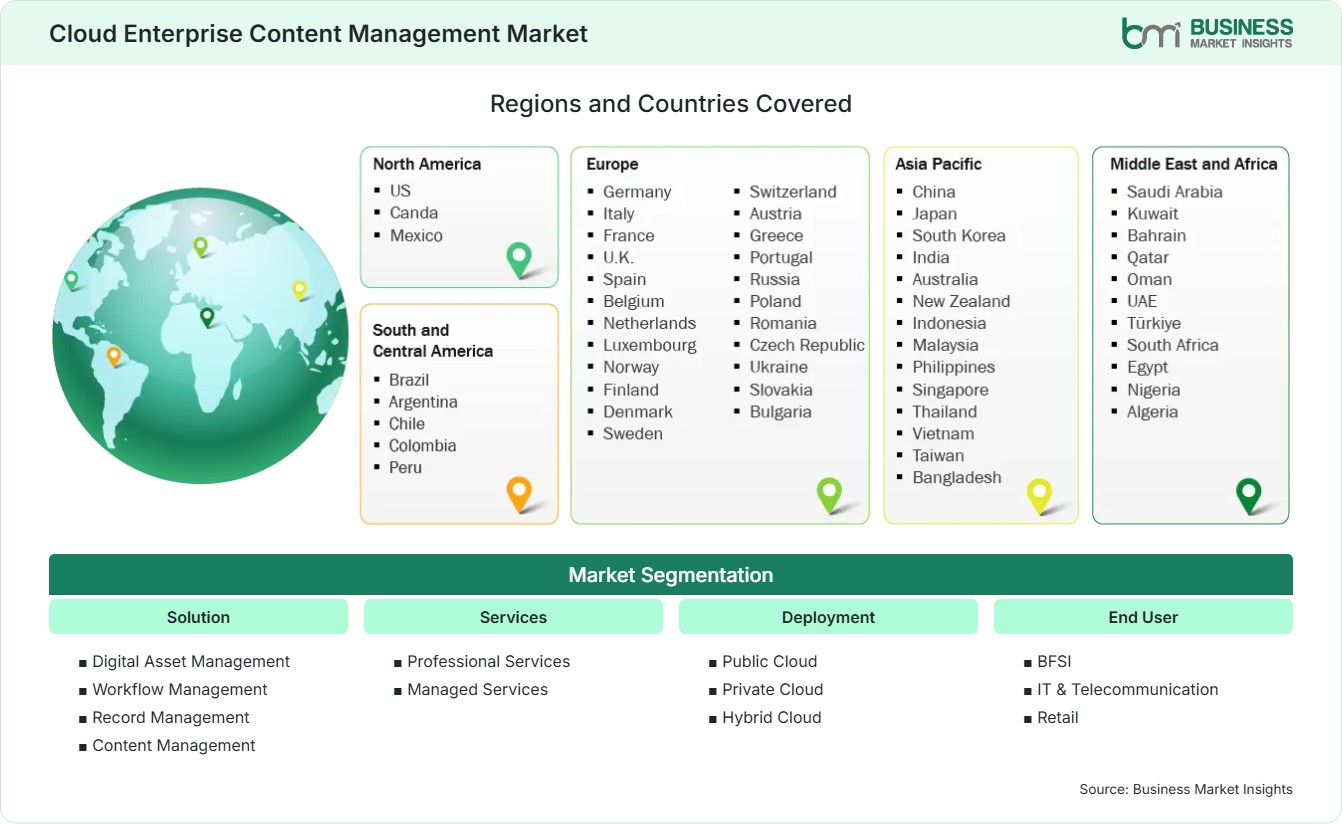
  • Solution: Digital Asset Management, Workflow Management, Record Management, Content Management
  • Services: Professional Services, Managed Services
  • Deployment: Public Cloud, Private Cloud, Hybrid Cloud
  • End User: BFSI, IT & Telecommunication, Retail
US$ 42.28 Bn Market size in 2025
US$ 124.38 Bn Market Size by 2033
14.44% CAGR, 2026 - 2033
2026-2033 Forecast Period

AI Overview

Cloud Enterprise Content Management Market Summary

  • North America Region: Holds a market share of 38%–41% in 2025 and is projected to grow at a CAGR of 13.2%–14.0% during 2026–2033. Growth is supported by enterprise cloud transformation, AI-based document intelligence, regulatory compliance initiatives, workflow automation demand, hybrid work adoption, advanced cybersecurity investments, content governance modernization, and digital workplace expansion.
    U.S. market benefits from large enterprise migration strategies, growing at 13.5%–14.3% CAGR through 2033.
  • Fastest Growing Region: Asia Pacific accounts for 24%–27% share in 2025 and is expected to expand at 16.2%–17.4% CAGR during 2026–2033. Growth is fueled by digitalization programs, cloud-first policies, rising SME adoption, AI integration initiatives, expanding telecom infrastructure, enterprise modernization investments, and accelerating demand for scalable content platforms.
  • Leading Segment: Solution segment represents 67%–70% share in 2025 and advances at 14.0%–14.8% CAGR through 2033. Demand reflects increasing deployment of content governance tools, automated workflows, digital asset repositories, document intelligence applications, records compliance, enterprise collaboration requirements, and operational efficiency programs.
  • High Growth Segment: Hybrid Cloud accounts for 30%–33% share in 2025 and records 15.8%–16.8% CAGR during 2026–2033. Growth stems from security flexibility, regulatory requirements, workload portability, multi-cloud strategies, legacy integration needs, cost optimization goals, and enterprise resilience initiatives.
  • Key Market Opportunity: AI-powered content intelligence platforms enabling document classification, contextual search, metadata extraction, governance automation, and regulated workflow orchestration across multinational enterprises create substantial long-term monetization opportunities for technology providers.
  • Major Market Players: Microsoft Corporation, OpenText Corporation, IBM Corporation, Oracle Corporation, Hyland Software, Inc., Box, Inc., Adobe Inc., Xerox Holdings Corporation, M-Files Corporation, and SER Group Holding International GmbH.
Strategic Insights

Cloud Enterprise Content Management Market: Strategic Insights

Cloud Enterprise Content Management Market Strategic Framework
FREE PDF
Request your free sample
Request free sample
Stakeholder View

Key Takeaways

  • The ecosystem is moving toward integrated platforms that combine content management, workflow automation, security, analytics, AI, and compliance management within a single cloud environments.
  • The sectors of financial services, telecommunications, and retail offer the greatest potential because of the rising volume of documents and the growing need for digital customer engagement.
  • The key areas of innovation are generative AI, intelligent document processing, semantic search, automated metadata extraction, and contextual knowledge management.
  • India, Southeast Asia, and the Gulf Cooperation Council present attractive opportunities for expansion due to growing business spending on cloud services and digital transformation plans.
  • Strategic acquisitions are now focusing on AI, workflow automation, records governance, and information intelligence capabilities to enhance platform differentiation.
  • Hybrid operating models are still prompting businesses to focus on content architectures that are scalable to support workforce mobility and ensure secure collaboration across functions.
Geographic Outlook

Cloud Enterprise Content Management Market Regional Highlights

North America Cloud Enterprise Content Management Market

North America represented approximately 38%–41% of global revenue in 2025 and is forecast to expand at 13.2%–14.0% CAGR through 2033. The region benefits from mature cloud infrastructure, extensive SaaS adoption, and strong enterprise compliance requirements. The Cloud Enterprise Content Management Market share remains highest here due to significant investments across banking, healthcare, government, and technology sectors. AI-enabled content orchestration, information governance modernization, and cybersecurity integration continue strengthening regional adoption patterns.

  • Large companies are increasingly combining their scattered repositories into single content platforms which support governance and operational visibility.
  • Financial institutions place a high priority on automated retention management, being ready for audits, and setting up digital customer onboarding procedures.
  • Healthcare providers are expanding their cloud content projects to achieve electronic record interoperability and to meet compliance requirements.
  • The faster enterprises carry out AI deployments, the greater the demand becomes for searchable, governed, and contextual information repositories.
  • Public sector digitization programs support spending on secure document lifecycle management.

US Cloud Enterprise Content Management Market

The U.S. accounted for nearly 76%–79% of North American Cloud Enterprise Content Management Market revenue in 2025 and advances at 13.5%–14.3% CAGR. Large-scale AI adoption, high cloud maturity levels, and stringent governance demands encourage enterprise investment. Organizations increasingly connect content systems to automation, analytics, cybersecurity, and knowledge management platforms. Strong technology vendor presence further supports innovation and platform adoption across major industry verticals.

  • The use of generative AI calls for enterprise content to be properly governed to improve decision-making and enterprise search.
  • Banking institutions undertake the modernisation of the outdated repositories that support customer onboarding and compliance operations.
  • Projects involving the management of healthcare content place importance on interoperability, privacy controls, and workflow automation.
  • Technology companies adopt intelligent knowledge platforms to streamline distributed workforce collaboration.

Europe Cloud Enterprise Content Management Market

Europe held 27%–30% Cloud Enterprise Content Management Market share during 2025 and is expected to achieve 13.8%–14.6% CAGR through 2033. Data sovereignty regulations, GDPR compliance needs, and industrial digitalization support adoption. Germany remains the leading market with an estimated 14.0%–14.8% CAGR, while Central and Eastern European economies demonstrate faster implementation trajectories. Organizations increasingly adopt cloud-native governance frameworks supporting secure content usage.

  • Strong compliance environments promote investment in records management and digital governance.
  • Manufacturing companies connect their content platforms with their ERP and operational systems.
  • Germany is leading the way in regional spending due to its industrial digital transformation initiatives.
  • The growth in Poland and the Czech Republic is above average and is due to enterprise modernization.
  • The need for secure collaboration environments arises from cross-border business operations.

Asia Pacific Cloud Enterprise Content Management Market

Asia Pacific accounted for 24%–27% share in 2025 and records the fastest growth at 16.2%–17.4% CAGR. The region benefits from rapid cloud migration, expanding digital economies, and government-backed transformation initiatives. China, Japan, and India lead demand, while Southeast Asia displays the strongest acceleration. Enterprise modernization and the increasing Cloud Enterprise Content Management Market growth trajectory support significant long-term investment opportunities.

  • India sees strong demand across BFSI, telecom, and public-sector digitalization.
  • China continues to roll out cloud systems across its manufacturing and service sectors.
  • Japan places an emphasis on governance, automation, and the optimization of the content lifecycle.
  • Southeast Asian organizations increasingly adopt SaaS-based information platforms.
  • When small and medium-sized businesses start using cloud services, they can reach more customers and find more business opportunities.

Rest of World Cloud Enterprise Content Management Market

The rest of the world represented 8%–11% of the Cloud Enterprise Content Management Market revenue in 2025 and is projected to grow at 14.5%–15.5% CAGR. South and Central America benefit from expanding enterprise digitization programs, while the Middle East and Africa gain momentum through government technology investments. Brazil leads Latin America, whereas the UAE and Saudi Arabia emerge as regional growth centers. Enterprise cloud readiness continues improving steadily.

  • The Gulf states make heavy investments in digital government and in the content ecosystems of smart cities.
  • Brazil is the biggest Latin American country in terms of adopting adoption within both the financial and public sectors.
  • Saudi Arabia gains from national digital transformation programs.
  • Regulatory modernization encourages cloud adoption throughout multiple industries.
  • Demand for managed services remains high among companies without in-house expertise.
Global Market Geography
FREE PDF
Request your free sample
Request free sample
Segment Analysis

Cloud Enterprise Content Management Market Segmentation

Solution

The Solution segment accounted for 67%–70% market share in 2025 and is expected to grow at 14.0%–14.8% CAGR. The Cloud Enterprise Content Management Market scope continues expanding as enterprises prioritize content governance, document intelligence, workflow optimization, and digital collaboration technologies. AI integration remains a major adoption catalyst.

  • Digital Asset Management: Supports centralized storage, retrieval, and governance of digital media assets, improving brand consistency, content accessibility, and operational productivity.
  • Workflow Management: Automates document-centric processes, reducing manual intervention while enhancing visibility, compliance execution, and process standardization.
  • Record Management: Enables secure retention, audit readiness, regulatory compliance, and lifecycle oversight for critical business records.
  • Content Management: Improves information accessibility, collaboration, version control, and enterprise knowledge utilization across departments.

Services

Services represented approximately 30%–33% Cloud Enterprise Content Management Market share in 2025 and continue expanding as enterprises seek implementation expertise, migration support, optimization services, and managed operations. Growing platform complexity and compliance requirements support demand for specialized professional and operational capabilities.

  • Professional Services: Include consulting, integration, system migration, customization, governance setup, and user training initiatives supporting successful deployments.
  • Managed Services: Deliver continuous monitoring, administration, optimization, security management, and performance enhancement for enterprise content environments.

Deployment

Deployment preferences increasingly reflect enterprise requirements for flexibility, security, regulatory compliance, and workload management. The Cloud Enterprise Content Management Market trends indicate growing adoption of multi-cloud and hybrid architectures as organizations seek balanced control and scalability.

  • Public Cloud: Provides scalability, cost efficiency, rapid deployment, and accessibility benefits critical for distributed enterprises.
  • Private Cloud: Supports organizations requiring enhanced control, security assurance, and strict regulatory compliance capabilities.
  • Hybrid Cloud: Combines flexibility and governance, enabling organizations to manage sensitive information while leveraging cloud scalability.

End User

End-user adoption reflects the increasing importance of secure information management and digital process automation. Content-intensive industries continue allocating resources toward modern cloud-native platforms, improving operational efficiency and compliance readiness.

  • BFSI: Relies on content systems for onboarding, lending, claims processing, compliance management, and audit preparedness.
  • IT & Telecommunication: Utilizes content platforms to support project documentation, service delivery, collaboration, and knowledge management.
  • Retail: Deploys solutions to manage product information, supplier documentation, contracts, and omnichannel content operations.
Market Forces

Cloud Enterprise Content Management Market Dynamics

Key Market Drivers

Rising Enterprise Demand for AI-Powered Content Automation

Increasingly, organizations are relying on classification techniques powered by AI, as well as on tools for extracting metadata and carrying out document intelligence, to cope with the rapid growth in the amount of information. The large amounts of unstructured data found in corporate content repositories tend to impede productivity and make it difficult to discover knowledge. Through the use of intelligent automation, not only are the costs associated with manual processing reduced, but compliance performance is also improved. Generative AI applications need to draw on reliable enterprise information sources if they are to achieve meaningful results. When companies link their content management platforms to AI ecosystems, their investment decisions tend to shift towards intelligent content architectures that provide scalability, governance, and operational efficiency in today's globally distributed workforces and complex business environments.

Expansion of Regulatory and Governance Requirements

The increasing regulatory requirements concerning data privacy, retention management, security measures, and auditability are still pushing more organisations to adopt such platforms. Since frameworks like GDPR and the various sector-specific compliance standards demand that companies keep visibility into and control over their enterprise information assets, modern platforms offer features such as policy enforcement, lifecycle management, and compliance reporting to meet these needs. Cloud-native governance tools not only enhance consistency but also lower the level of risk. Those organizations that operate in multiple jurisdictions are now more likely to choose centralized content controls, as these help strengthen supervision, simplify compliance administration, and improve transparency throughout the information lifecycle.

Acceleration of Digital Workplace Transformation

Since hybrid work environments call for secure access to information, collaborative workflows, and scalable digital operations, companies are still updating their old repositories to accommodate remote employees, distributed teams, and digital business models. Content platforms are becoming more integrated with productivity suites, workflow applications, customer relationship systems, and analytics environments. These features assist in ensuring operational continuity as well as improving the user experience. The increasing demand for seamless collaboration and real-time access to information remains a major driver of long-term adoption across many industries and among organizations of all sizes.

Key Market Opportunities

AI-Driven Knowledge Discovery Platforms

The integration of generative AI and semantic search technologies creates opportunities for vendors offering advanced knowledge discovery capabilities. Enterprises seek solutions capable of extracting actionable insights from vast repositories of contracts, correspondence, operational documents, and digital assets. Investment in intelligent retrieval technologies accelerates value creation by reducing search times and improving decision support. Cloud Enterprise Content Management Market Forecasts increasingly point toward higher spending on AI-ready content ecosystems enabling contextual information access, automated summarization, and enterprise-wide knowledge utilization.

Growth in Industry-Specific Content Platforms

Customized solutions designed for the financial services, healthcare, government, and telecommunications sectors have great commercial potential. The particular compliance requirements of each industry frequently cause difficulties when using general platforms. Companies that provide preset workflows, retention policies, audit controls, and integrations with specific industries are able to secure higher rates of adoption. The opportunities go beyond simply licensing software to include professional services, managed services, and ongoing optimization services, which support long-term customer relationships and generate recurring revenue.

Emergence of Sovereign and Regional Cloud Environments

The need to respect data sovereignty is promoting the creation of cloud-based solutions that are tailored to meet the governance requirements of different regions. It is becoming more common for governments and companies that are subject to regulation to require that information stay within certain jurisdictions. Vendor firms that can provide regional hosting options, adhere to local compliance standards, and set up secure environments for the exchange of information may see an increase in procurement from customers. This is especially clear in Europe, the Middle East, and some parts of the Asia-Pacific region, where regulatory supervision is still intensifying.

Market Restraints and Challenges

Complex Legacy System Integration Requirements

Factor: Many organizations continue operating multiple legacy repositories, line-of-business applications, and customized content management environments developed over several years. Impact: Integration complexity increases deployment timelines, implementation costs, and operational risks. Data migration projects often require extensive governance planning and process redesign. Inconsistent metadata structures and fragmented information architectures further complicate modernization initiatives. Enterprises frequently adopt phased migration strategies to minimize disruption, thereby slowing the overall pace of transformation. These challenges can delay return on investment and create hesitancy among organizations with highly customized legacy ecosystems.

Security Concerns and Data Residency Constraints

Factor: Organizations managing sensitive information remain cautious regarding cloud storage, cross-border data transfers, and third-party platform access. Impact: Security concerns can prolong procurement cycles and limit deployment scope. Industries handling confidential financial, healthcare, or government information often require stringent controls before approving migrations. Vendor compliance certifications reduce concerns, yet evolving cyber threats continue requiring significant investment. Data residency mandates across multiple jurisdictions create additional implementation complexity and operational costs, particularly for multinational enterprises managing geographically dispersed information assets.

Company Analysis

Competitive Landscape

The competitive environment reflects continuous innovation in AI, governance, automation, and cloud-native architecture. Current Cloud Enterprise Content Management Market analysis indicates increasing focus on intelligent content services and industry-specific capabilities.

Company Name

Overview

Products and Services relevant to this market

Microsoft Corporation

Global technology leader offering cloud productivity and information management solutions.

SharePoint, Microsoft Syntex, Microsoft 365 content governance and collaboration tools.

OpenText Corporation

Major information management provider serving enterprises worldwide.

OpenText Content Cloud, Core Content Management, records management solutions.

IBM Corporation

Enterprise software and AI provider focused on digital business operations.

Content services, workflow automation, governance, AI-enabled information management.

Oracle Corporation

Cloud applications and infrastructure vendor with enterprise content capabilities.

Oracle Content Management, document collaboration, governance and workflow services.

Hyland Software, Inc.

Specialist in intelligent content and process automation technologies.

OnBase, Alfresco, Content Innovation Cloud, intelligent document processing.

Box, Inc.

Cloud-native intelligent content management platform provider.

Box AI, workflow automation, collaboration, governance, document management.

Adobe Inc.

Digital experience and document technology company.

Adobe Experience Manager, Document Cloud, digital asset management solutions.

Xerox Holdings Corporation

Technology and business services provider specializing in workflow transformation.

Content management, capture, process automation, document lifecycle services.

M-Files Corporation

Metadata-driven information management specialist.

Intelligent information management, workflow automation, compliance solutions.

SER Group Holding International GmbH

Enterprise content and document management software provider.

Doxis platform, document intelligence, workflow management and governance.

Trust & Transparency

Research Methodology

The market analysis combines proprietary research with secondary data from government agencies, company disclosures, regulatory filings, industry databases and expert interviews. Market estimates are validated through data triangulation, cross-market benchmarking and analyst review.

View Full Research Methodology

Questions Answered

Frequently Asked Questions

Why should organizations evaluate a Cloud Enterprise Content Management Market Report?

A comprehensive report helps assess competitive positioning, technology shifts, investment priorities, regional opportunities, and adoption patterns influencing long-term strategic decisions.

What differentiates modern platforms from traditional ECM systems?

Modern solutions integrate AI, automation, analytics, collaboration, governance, and cloud-native scalability rather than acting solely as document repositories.

How does hybrid cloud deployment benefit organizations?

Hybrid environments allow sensitive information to remain under tighter control while enabling scalable cloud-based collaboration and processing capabilities.

Which industry generates the highest demand for cloud content solutions?

BFSI remains a leading adopter because of extensive documentation requirements, regulatory obligations, risk management processes, and customer onboarding workflows.

What factor is most strongly influencing enterprise adoption?

AI-driven automation combined with compliance requirements is encouraging enterprises to modernize content environments and improve operational efficiency.

Access the Full Cloud Enterprise Content Management Market Report

Get segment-level forecasts, regional estimates, competitive benchmarking, company profiles and downloadable Excel datasets.

Access the full Cloud Enterprise Content Management Market Report
350 pages PDF & Excel | 2026-09-17
Similar Research

Related Market Reports