
Image Recognition Market Outlook: Size, Share, Trends, Growth Analysis, Competitive Landscape & Forecast, 2026-2033

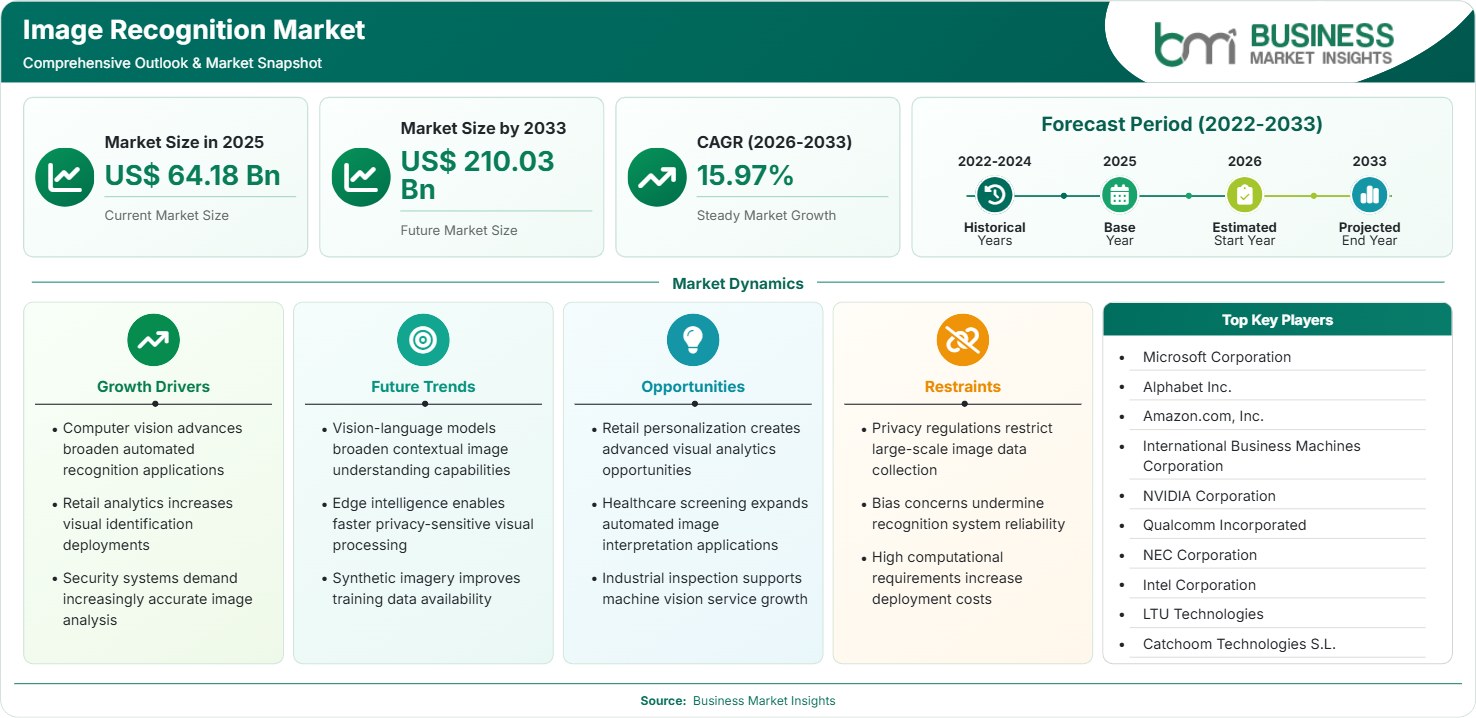
The Image Recognition Market size was valued at US$ 64.18 Billion in 2025 and is projected to reach US$ 210.03 Billion by 2033, growing at a CAGR of 15.97% during 2026–2033. Rising AI adoption, edge analytics deployment, visual commerce expansion, intelligent surveillance modernization, healthcare imaging advances, and multimodal learning innovations continue creating substantial revenue opportunities across enterprise and public-sector environments.

Report Coverage
  • Component: Hardware, Software, Services
  • Technology: Code Recognition, Facial Recognition, Object Recognition, Pattern Recognition, Optical Character Recognition
  • Application: Scanning and Imaging, Security and Surveillance, Image Search, Augmented Reality, Marketing and Advertising
  • Deployment: On-Premise, Cloud
  • End-user: BFSI, Media and Entertainment, Retail and E-commerce, IT and Telecom, Government, Healthcare, Transportation and Logistics, Others
US$ 64.18 Bn Market size in 2025
US$ 210.03 Bn Market Size by 2033
15.97% CAGR, 2026 - 2033
2026-2033 Forecast Period

AI Overview

Image Recognition Market Summary

  • North America Region: North America holds a 36%–39% share in 2025, growing at a CAGR of 14.2%–15.0% during 2026–2033. Demand is driven by cloud AI deployment, enterprise automation, defense modernization, healthcare imaging investment, retail analytics adoption, and autonomous vision applications expanding significantly across industries. The U.S. market benefits from large-scale AI spending, expanding cloud ecosystems, and an estimated 14.5%–15.3% CAGR.
  • Fastest Growing Region: Asia Pacific holds a 27%–30% share in 2025, growing at a CAGR of 17.8%–18.8% during 2026–2033. Expanding smart city projects, manufacturing automation, smartphone penetration, e-commerce growth, government digitalization initiatives, and AI startup funding accelerate regional technology adoption.
  • Leading Segment: Software holds a 46%–49% share in 2025, growing at a CAGR of 15.5%–16.4% during 2026–2033. Growth reflects scalable analytics platforms, cloud deployment preferences, enterprise AI integration, low implementation barriers, advanced model development, and recurring subscription revenues.
  • High Growth Segment: Cloud holds a 59%–62% share in 2025, growing at a CAGR of 17.2%–18.1% during 2026–2033. Organizations increasingly prefer scalable processing infrastructure, lower capital expenditure, rapid deployment capabilities, remote accessibility, continuous updates, and data-driven automation initiatives.
  • Key Market Opportunity: Expanding multimodal AI systems combining visual, text, and contextual intelligence create opportunities for industrial inspection, healthcare diagnostics, retail personalization, logistics automation, and public safety transformation initiatives globally.
  • Major Market Players: Microsoft Corporation, Alphabet Inc., Amazon.com, Inc., International Business Machines Corporation, NVIDIA Corporation, Qualcomm Incorporated, NEC Corporation, Intel Corporation, LTU Technologies, and Catchoom Technologies S.L.
Strategic Insights

Image Recognition Market: Strategic Insights

Image Recognition Market Strategic Framework
FREE PDF
Request your free sample
Request free sample
Stakeholder View

Key Takeaways

  • The ecosystem is becoming increasingly software-centric, with cloud providers, AI developers, semiconductor vendors, and systems integrators collaborating to create scalable visual analytics value chains.
  • Retail analytics, healthcare diagnostics, logistics automation, and smart surveillance applications present the strongest commercial upside due to measurable operational efficiency gains.
  • Transformer-based computer vision, multimodal AI, and edge AI models are accelerating innovation, enabling faster inference, richer contextual understanding, and lower deployment latency.
  • India, China, Indonesia, Saudi Arabia, and the United Arab Emirates offer compelling investment potential because of digitalization initiatives and expanding AI infrastructure spending.
  • Strategic acquisitions increasingly focus on vision analytics, AI platforms, and edge intelligence providers, reflecting enterprise demand for integrated visual understanding capabilities.
  • Demand for privacy-preserving analytics and federated learning models is encouraging vendors to redesign deployment architectures for greater regulatory compliance and trust.
Geographic Outlook

Image Recognition Market Regional Highlights

North America Image Recognition Market

North America represented approximately 36%–39% of global revenue in 2025 and is projected to expand at a CAGR of 14.2%–15.0% through 2033. The region benefits from mature cloud infrastructure, extensive AI investments, and early enterprise adoption. Image Recognition Market share remains highest in this region due to strong deployment across healthcare, retail, government, and financial services organizations. Continuous innovation from technology leaders and increasing investments in automation strengthen long-term commercial adoption opportunities.

  • AI-driven retail analytics platforms improve merchandising decisions, inventory visibility, and customer engagement while supporting omnichannel commerce strategies.
  • Healthcare providers implement advanced imaging solutions for disease detection, workflow optimization, and diagnostic support applications.
  • Federal agencies continue modernizing surveillance ecosystems through AI-powered video analytics and object identification capabilities.
  • Semiconductor innovation accelerates real-time processing performance for edge vision deployments across industrial environments.

US Image Recognition Market

The United States accounts for about 77%-81% of North America’s revenue and is forecast to grow at 14.5%-15.3% until 2033. High enterprise expenditure on AI solutions, high cloud adoption, and increasing demands for automated visual intelligence help maintain their dominant position. Technology companies and research firms facilitate commercial advancements and deploy applications in the healthcare, manufacturing, and government sectors.

  • Large enterprises increasingly integrate computer vision into customer analytics and operational intelligence programs.
  • Strong venture capital funding supports startup innovation in healthcare imaging and retail automation technologies.
  • Defense and homeland security investments expand demand for advanced recognition and monitoring solutions.
  • AI research partnerships accelerate commercialization of emerging multimodal vision technologies.

Europe Image Recognition Market

Europe accounted for 24%- 27% of global revenue in 2025 and is expected to grow at a CAGR of 13.8%-14.7% through 2033. Germany has been the dominant region in terms of technology usage, whereas Spain and Poland have fast-growing markets. The digitalization of enterprises, automation initiatives within industry, and intelligent transport systems facilitate growth.

  • Manufacturing companies deploy visual inspection systems to improve productivity and quality control outcomes.
  • Retailers increasingly adopt image-based customer analytics to personalize shopping experiences.
  • Germany remains the leading national market, supported by advanced industrial digitization programs.
  • Poland and Spain register strong adoption momentum through public and private AI investments.

Asia Pacific Image Recognition Market

The Asia-Pacific region accounted for 27%-30% of the market's total revenue share in 2025 and is expected to exhibit the highest CAGR of 17.8%-18.8 % during the forecast period from 2024 to 2033. China leads regional demand, while India has the greatest potential for growth. The growing investment in smart city projects, automation, and e-commerce is driving the adoption of these technologies.

  • China maintains leadership through extensive AI infrastructure and smart surveillance deployments.
  • India exhibits strong growth supported by digital transformation and startup ecosystem expansion.
  • E-commerce platforms increasingly utilize visual search and recommendation technologies.
  • Manufacturing facilities adopt automated inspection solutions for productivity enhancement.
  • Public transportation projects leverage intelligent monitoring and safety applications.

Rest of World Image Recognition Market

Rest of World represented 9%–12% of global demand during 2025 and is anticipated to achieve a CAGR of 15.8%–16.8% through 2033.

South and Central America benefit from expanding digital commerce and banking modernization projects. Brazil remains the largest regional market while Mexico demonstrates accelerating adoption.

Middle East and Africa growth is supported by smart city initiatives, public safety investments, and government digitalization strategies. Saudi Arabia and the UAE lead adoption momentum.

  • Smart city projects create sustained demand for surveillance and traffic management technologies.
  • Financial institutions adopt biometric recognition to strengthen authentication processes.
  • Logistics modernization improves visibility across transportation and warehousing networks.
  • Brazil remains the leading market, while Saudi Arabia records strong growth momentum.
  • Government digital transformation programs encourage deployment across public-sector applications.
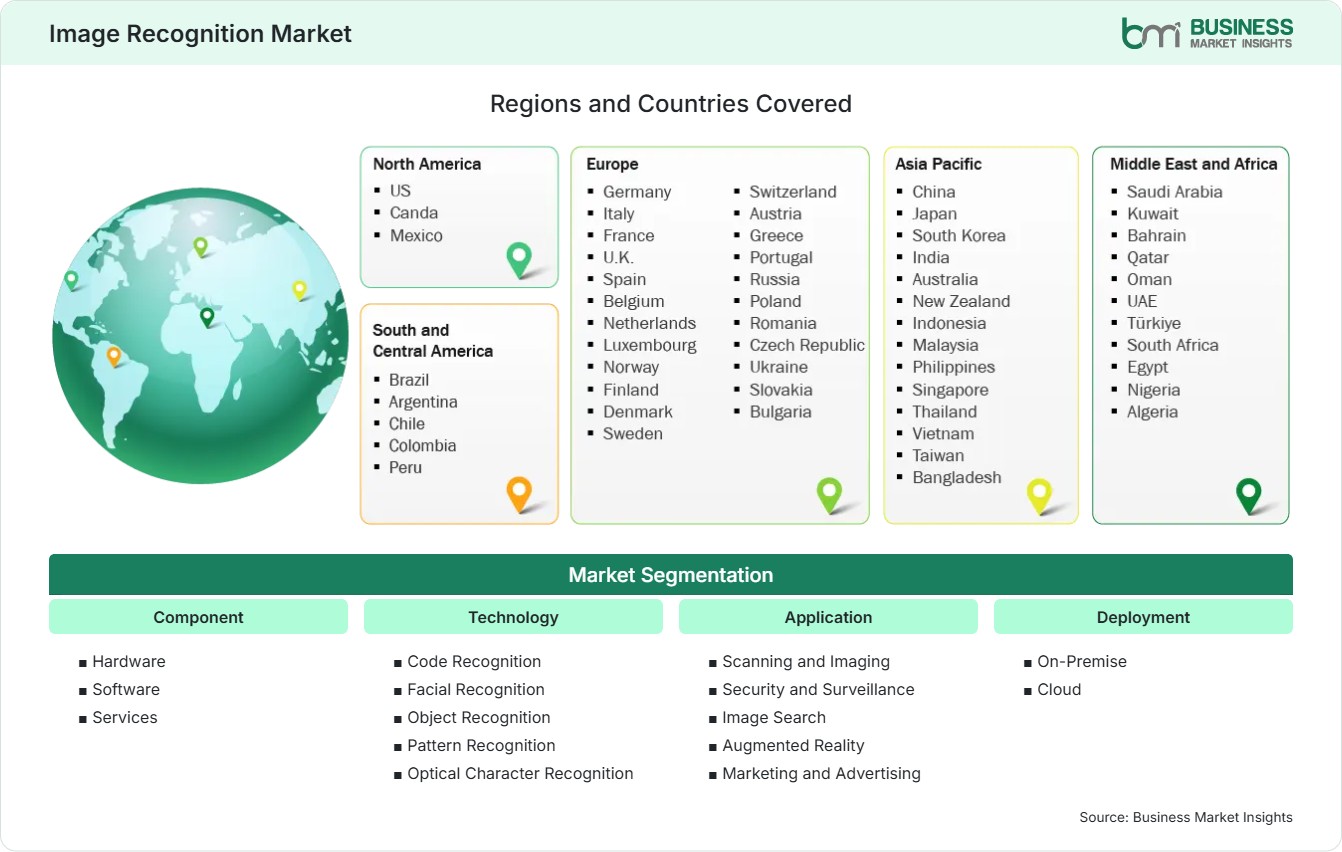
Global Market Geography
FREE PDF
Request your free sample
Request free sample
Segment Analysis

Image Recognition Market Segmentation

Component

The adoption of component segments is driven by software, which accounts for around 46%-49% market share in 2025 and is growing at a 15.5%-16.4% CAGR. The Scope of the Image Recognition Market continues to expand due to the emphasis on scalability, flexibility, and cost efficiency across analytics platforms and the hardware services segment.

  • Hardware: High-performance GPUs, edge processors, cameras, and sensors provide foundational infrastructure supporting real-time analytics, industrial automation, surveillance, and embedded vision applications.
  • Software: AI-powered recognition platforms deliver classification, detection, analytics, and intelligence capabilities through cloud and on-premises deployment models.
  • Services: Consulting, integration, maintenance, training, and managed support services help enterprises optimize deployment outcomes and operational value.

Technology

Technology adoption continues to evolve as organizations seek improved accuracy, contextual understanding, and operational efficiency. Advanced neural networks and multimodal AI capabilities are strengthening performance across commercial deployments.

  • Code Recognition: Supports inventory tracking, logistics automation, product authentication, and retail scanning applications.
  • Facial Recognition: Enables authentication, surveillance, access control, and customer identification across commercial and government environments.
  • Object Recognition: Powers autonomous systems, industrial inspection, smart cities, and retail analytics initiatives.
  • Pattern Recognition: Facilitates anomaly detection, quality assurance, and predictive operational intelligence.
  • Optical Character Recognition: Converts visual text into structured digital information supporting document processing workflows.

Application

Application demand is expanding across operational automation, customer engagement, and public safety initiatives. Scanning and imaging maintain leadership due to broad enterprise utilization and regulatory documentation requirements.

  • Scanning and Imaging: Widely deployed for digitization, healthcare imaging, and enterprise workflow automation requirements.
  • Security and Surveillance: Supports monitoring, threat detection, and situational awareness across critical infrastructure.
  • Image Search: Enhances content discovery, recommendation engines, and visual commerce experiences.
  • Augmented Reality: Enables immersive experiences within retail, education, gaming, and industrial training.
  • Marketing and Advertising: Improves consumer targeting and engagement through image-based analytics.

Deployment

Cloud remains the dominant deployment model with roughly 59%–62% share in 2025 and 17.2%–18.1% CAGR. Image Recognition Market trends increasingly favor scalable infrastructure, subscription-based services, and faster innovation cycles.

  • On-Premise: Preferred by organizations requiring stringent control, security, and compliance management.
  • Cloud: Delivers scalability, flexibility, lower upfront investment, and continuous AI enhancement capabilities.

End-user

Adoption broadens across multiple industries pursuing efficiency improvements, customer engagement optimization, and automated intelligence generation from visual data assets.

  • BFSI: Strengthens fraud prevention, identity verification, and customer onboarding processes.
  • Media and Entertainment: Enables content tagging, moderation, indexing, and recommendation systems.
  • Retail and E-commerce: Supports visual search, customer analytics, and merchandising optimization.
  • IT and Telecom: Enhances network monitoring and operational intelligence initiatives.
  • Government: Benefits surveillance, border security, and public administration modernization efforts.
  • Healthcare: Advances diagnostics, medical imaging analysis, and patient workflow optimization.
  • Transportation and Logistics: Improves asset tracking, route monitoring, and warehouse automation.
Market Forces

Image Recognition Market Dynamics

Key Market Drivers

Expansion of AI-Powered Enterprise Automation

Many organizations today have begun using computer vision-based applications for automated inspections, customer interactions, documentation, and process monitoring. The increasing use of artificial intelligence platforms by organizations is making visual analysis more accessible. Image Recognition Market growth is driven by the need to increase efficiency and cut costs. In manufacturing operations, automation in inspection helps reduce errors and maintain consistency. The retail industry uses visual analysis to study consumer behavior and optimize product placement. The banking industry uses image verification systems for improving their security and onboarding processes.

Rapid Growth of Digital Visual Data Generation

Smartphone cameras, smart city technology, industry-based sensors, and social media platforms constantly generate large visual datasets that require automated analysis. Businesses rely on gaining information from pictures and video streams in increasing numbers. The development of the Image Recognition Market depends on the need for accurate, fast processing capabilities. Visual intelligence helps transportation services in traffic monitoring and safety management. Diagnostics are being performed using advanced imaging by healthcare providers. The growing volume of digital content creates a need for scalable image recognition technologies capable of efficiently processing diverse visual formats.

Advancements in Edge Computing and AI Accelerators

Current processors, artificial intelligence hardware accelerators, graphics processing units (GPUs), and advanced edge computing frameworks enable higher inference speeds without relying solely on centralized cloud-based services. Such advancements have enabled real-time inference in manufacturing facilities, autonomy, retail settings, and public infrastructure. The benefits of low latency, increased privacy, and higher reliability contribute to the growing adoption of edge computing technology. Companies can reduce their bandwidth utilization while increasing their control over valuable data. Advancements in semiconductors have enabled more accurate and affordable implementation of recognition technology across various business and industrial settings.

Key Market Opportunities

Multimodal Intelligence Across Industry Workflows

The integration of image, video, language, and context data will create significant business opportunities for investors. Multimodal solutions provide more business insights than any visual recognition system alone. The combination of imaging with patient data helps in diagnostics in healthcare businesses. The use of video, along with operations data, helps logistics companies optimize their supply chain process. Image Recognition Market Forecasts indicate an increasing trend in enterprise interest in contextual decision support systems. This means that companies capable of combining multiple data modalities into intelligent systems will have good prospects in the future.

Visual Commerce and Personalized Retail Experiences

Shoppers are more demanding of a convenient experience through their visual searches and recommendations. Retailers use technology, such as image recognition, that allows consumers to identify products using images rather than keyword searches. Merchandising, personalized virtual product exploration, and advertisements generate income for the company. Recognition enables better analytics for inventory management and more effective consumer engagement tactics. The need for technology that offers convenience is high among retailers as online shopping continues to grow in developing countries. Platforms that are scalable and can be integrated into the commerce ecosystem could be profitable and generate recurring subscription revenues.

Smart Infrastructure and Public Safety Transformation

Globally, governments are focusing on the construction of smart cities and intelligent transportation systems. Visual analytics companies will gain substantial opportunities through these efforts. Recognition technologies are employed in traffic control, crowd surveillance, security operations, and infrastructure management. Urbanization drives the need for technologies capable of handling large volumes of visual data. The association of these technologies with the Internet of Things and edge computing helps to increase their efficiency. In the long run, investment by government organizations leads to the development of advanced recognition technologies for transportation, utilities, and civic administration applications.

Market Restraints and Challenges

Privacy Regulations and Data Governance Complexity

Factor: The growing number of international laws regulating the collection and use of biometrics, personal data, and surveillance technologies creates a compliance issue for both the technology supplier and the user of such technology within an organization. Impact: There will be higher costs for implementing technology, a longer approval process, and deployment restrictions. Organizations have to manage compliance, transparency, and consent. The differences between regulations across regions complicate matters for multinationals. Failure to meet compliance requirements will lead to reputational risk and financial sanctions for certain commercial technologies.

Accuracy Limitations and Bias Concerns

Factor: Recognition systems may exhibit varying performance levels across environments, image conditions, demographics, and use cases. Impact: The risk of loss of trust, higher verification requirements, and liability may affect the extent of implementation. Companies must make considerable efforts to train their algorithms to ensure satisfactory performance. Issues of bias and fairness become particularly relevant in use cases associated with identity recognition and surveillance systems. To address bias and fairness issues, companies need to make a sustained effort to create appropriate datasets and validation methods.

Company Analysis

Competitive Landscape

Image Recognition Market analysis indicates competition is centered on AI platforms, cloud infrastructure, edge processing capabilities, and industry-specific computer vision solutions.

Company Name

Overview

Products and Services relevant to this market

Microsoft Corporation

Global cloud and AI provider with extensive enterprise relationships and vision analytics capabilities.

Azure AI Vision, computer vision APIs, OCR, facial analysis, image classification services.

Alphabet Inc.

Technology leader offering advanced AI infrastructure and scalable vision platforms.

Google Cloud Vision AI, OCR, object detection, image labeling, multimodal analytics.

Amazon.com, Inc.

Major cloud provider serving enterprises with scalable recognition services.

Amazon Rekognition, facial analysis, video analytics, object recognition, content moderation.

International Business Machines Corporation

Enterprise technology company focused on AI-enabled business transformation.

AI analytics, document intelligence, image processing, enterprise automation services.

NVIDIA Corporation

Semiconductor and AI computing leader supporting vision workloads globally.

GPUs, edge AI hardware, vision development frameworks, accelerated computing solutions.

Qualcomm Incorporated

Wireless and edge computing specialist enabling embedded vision applications.

AI processors, mobile vision platforms, edge inference technologies.

NEC Corporation

Established provider of biometric and recognition solutions.

Facial recognition, surveillance analytics, public safety platforms.

Intel Corporation

Processor manufacturer supporting AI deployment across industries.

CPUs, AI accelerators, computer vision toolkits, edge computing solutions.

LTU Technologies

Specialist provider focused on visual recognition and image search.

Visual search engines, image matching, content recognition services.

Catchoom Technologies S.L.

Computer vision company specializing in recognition applications.

Mobile Image Recognition Market, augmented reality, visual search technologies.

Trust & Transparency

Research Methodology

The market analysis combines proprietary research with secondary data from government agencies, company disclosures, regulatory filings, industry databases and expert interviews. Market estimates are validated through data triangulation, cross-market benchmarking and analyst review.

View Full Research Methodology

Questions Answered

Frequently Asked Questions

Which technology area is expected to attract the strongest future investment?

Multimodal AI combining vision, language, and contextual analytics is expected to attract significant investment because it delivers deeper operational intelligence and broader enterprise applicability.

How does the Image Recognition Market Report support business planning?

The report provides market sizing, growth assessments, segment evaluation, competitive intelligence, technology trends, regional opportunities, and strategic insights that assist investment and expansion decisions.

What are the most common enterprise use cases?

Common applications include visual search, surveillance, identity verification, automated inspection, document digitization, customer analytics, quality control, and medical image interpretation.

How does cloud deployment influence adoption rates?

Cloud deployment reduces upfront infrastructure costs, simplifies scalability, enables continuous model updates, and accelerates implementation timelines, making advanced recognition capabilities accessible to organizations of all sizes.

What industries generate the highest demand for Image Recognition Market technologies?

Healthcare, retail, logistics, government, financial services, manufacturing, and transportation currently account for the highest commercial demand because visual intelligence directly improves efficiency, security, customer experience, and operational decision-making.

Access the Full Image Recognition Market Report

Get segment-level forecasts, regional estimates, competitive benchmarking, company profiles and downloadable Excel datasets.

Access the full Image Recognition Market Report
350 pages PDF & Excel | 2026-09-17
Similar Research

Related Market Reports