Detergent Chemicals Market Regional Highlights
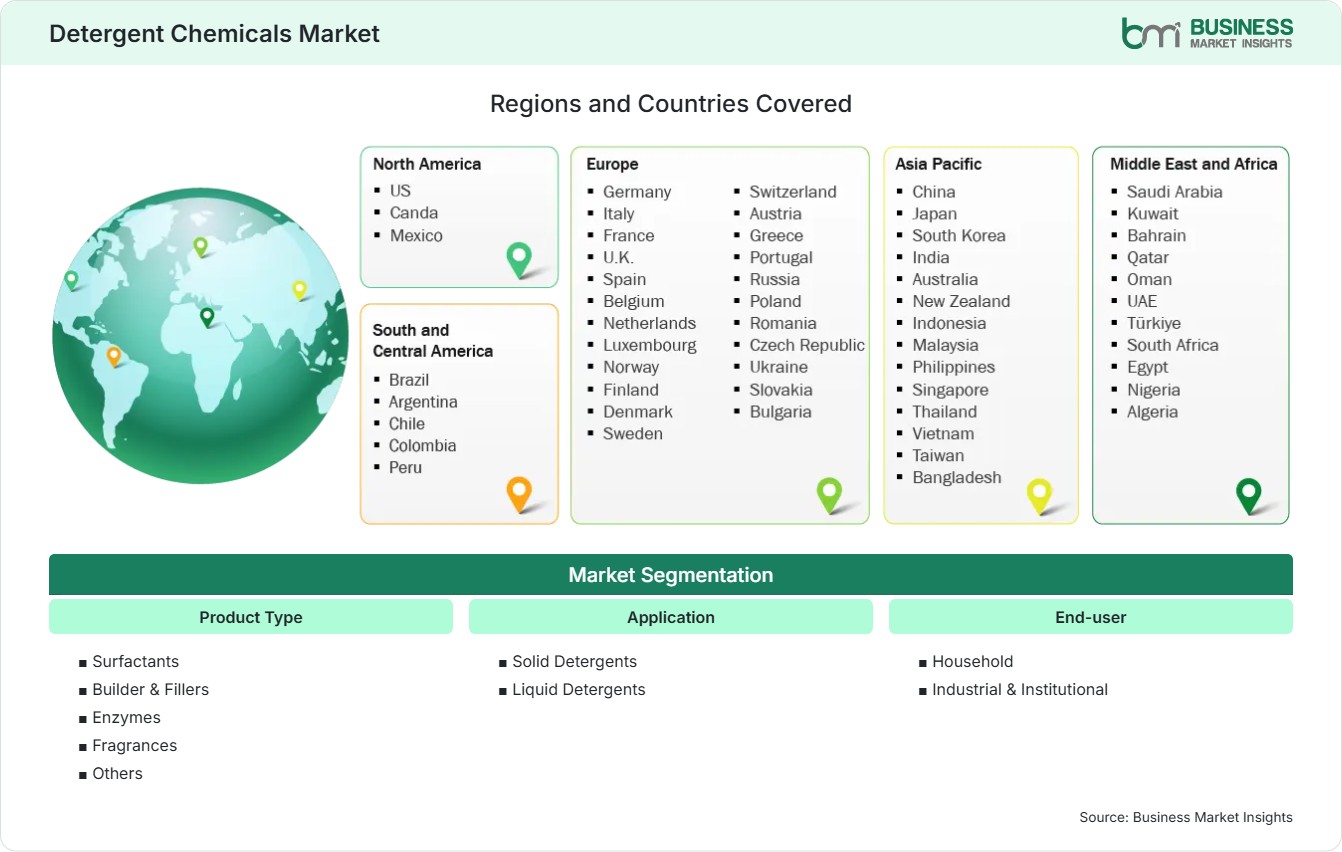
North America Detergent Chemicals Market
In North America, the Detergent Chemicals Market is estimated to account for 18%–20% of the market in 2025, with a CAGR of 4.3%–4.8% through 2033. North America is interested in premium, concentrated detergents with added enzymes and sustainable surfactants. The United States is the largest national market owing to the presence of laundry facilities and the prevalence of liquids. Canada adds its contribution in both the household and institutional segments. Efficient formulations, cold-water solubility, and renewable raw materials are preferred by producers.
- Concentrated liquids and unit-dose formats support demand for highly soluble surfactants, stabilizers, enzymes, polymers, and fragrance systems while reducing transportation intensity.
- Industrial and institutional cleaning provides a resilient demand base across healthcare, hospitality, food processing, education, and commercial laundry operations.
- Bio-based ingredient development is gaining traction as formulators seek lower-carbon alternatives without compromising detergency, stability, or sensory performance.
- Regional suppliers benefit from established technical centers and close collaboration with multinational detergent manufacturers during reformulation and product qualification.
US Detergent Chemicals Market
The US market share in North America will be between 87-92% in 2025, while the US market share growth rate is predicted to be between 4.4% and 4.9% per annum until 2033. Maturity in household penetration shifts the competitive focus from volume growth to performance differentiation. Liquid detergent, pod technology, perfume systems, stain removal enzymes, and fabric treatment technology create the demand for ingredients. Secondary-use market of institutional cleaning is highly important in the field of healthcare, hospitality, food service, and commercial operations.
- Premium laundry products encourage suppliers to develop enzyme combinations, fragrance-release systems, soil-release polymers, and surfactant blends that preserve performance at reduced dosage.
- US manufacturers increasingly evaluate renewable-carbon sourcing and biodegradability alongside conventional performance measures when qualifying new detergent ingredients.
- Institutional buyers place greater emphasis on cleaning efficacy, worker safety, dosing consistency, and concentrated products that reduce storage and handling requirements.
Europe Detergent Chemicals Market
The Europe market had a modeled 15% to 17% share of the Detergent Chemicals Market in 2025 and is expected to grow at a CAGR of 4.0% to 4.6% from 2025 to 2033. The major consumption/formulation countries are Germany, France, UK, Italy, and Spain. Germany serves as a major source of industrial and specialty chemicals. Regulatory demands have increased the reformulation of products based on factors such as biodegradability, phosphorus content, fragrance disclosure, and digital labeling. Regulation 2026/405 further emphasizes the same.
- Germany remains a major formulation and chemical manufacturing center, with suppliers competing through specialty surfactants, enzymes, polymers, and sustainable feedstocks.
- France and the United Kingdom provide strong opportunities for premium liquid detergents, concentrated products, and fragrance-enhanced fabric-care formulations.
- Italy and Spain benefit from household cleaning consumption and expanding interest in bio-based and lower-impact detergent ingredients.
- European formulators increasingly require ingredient documentation covering biodegradability, renewable carbon, allergen information, and regulatory conformity.
Asia Pacific Detergent Chemicals Market
The Asia Pacific region was estimated to account for a modeled share of 48%–52% in 2025 and is expected to grow at 5.5%–6.1% through 2033. Consumer populations, along with the development of detergent manufacturing processes in China, India, Japan, South Korea, Indonesia, and other ASEAN countries, drive the market. Large-scale manufacturing in China and chemicals, along with volumes offered by India due to urbanization and manufacturing, drive the market in the region.
- China remains the largest regional production ecosystem, supported by integrated chemical supply chains and large domestic detergent manufacturing capacity.
- India provides strong growth potential as urban households, automatic washing-machine adoption, premium laundry products, and modern retail expand.
- Indonesia and other ASEAN economies offer attractive opportunities as household consumption, packaged detergents, and local formulation capabilities expand.
- Japan and South Korea emphasize concentrated products, fabric care, enzyme technologies, and environmentally differentiated ingredients within mature consumer markets.
Rest of World Detergent Chemicals Market
South and Central America are expected to account for 7%-10% of the Detergent Chemicals Market. The Middle East and Africa region is expected to comprise 5%-7% of the market. Hence, the demand from the rest of the world would be 12%-16% with a growth rate of 5.0%-5.8%. The major countries in Latin America are Brazil and Mexico, while the major countries in the Middle East and Africa are Saudi Arabia, UAE, South Africa, and Turkey.
- Brazil benefits from a substantial domestic detergent industry and demand for cost-efficient surfactants, builders, fragrances, and performance additives.
- Mexico offers opportunities linked to household cleaning consumption, manufacturing integration, and proximity to North American formulation and supply networks.
- Saudi Arabia and the UAE are developing professional cleaning demand across hospitality, healthcare, commercial facilities, and large residential developments.
- South Africa provides a regional distribution and formulation base, while broader African markets offer longer-term volume opportunities through urban household formation.