Electronic Chemicals Market Outlook (2022-2033)

Historic Data: 2022-2024   |   Base Year: 2025   |   Forecast Period: 2026-2033
Report Content: Market Scope, Market Segmentation, Market Dynamics, and Competitive Analysis

Report Coverage:
  • Type (Electronic Gases, CMP Slurries, Photoresist and Ancillaries, Conductive Polymers, Low K Dielectrics, Wet Chemicals, Silicon Wafers, and Others)
  • Application (Semiconductors, Consumer Electronics, and Others)

No. of Pages: 411
Report Code: BMIPUB00033915
Category: Chemicals and Materials
Electronic Chemicals Market

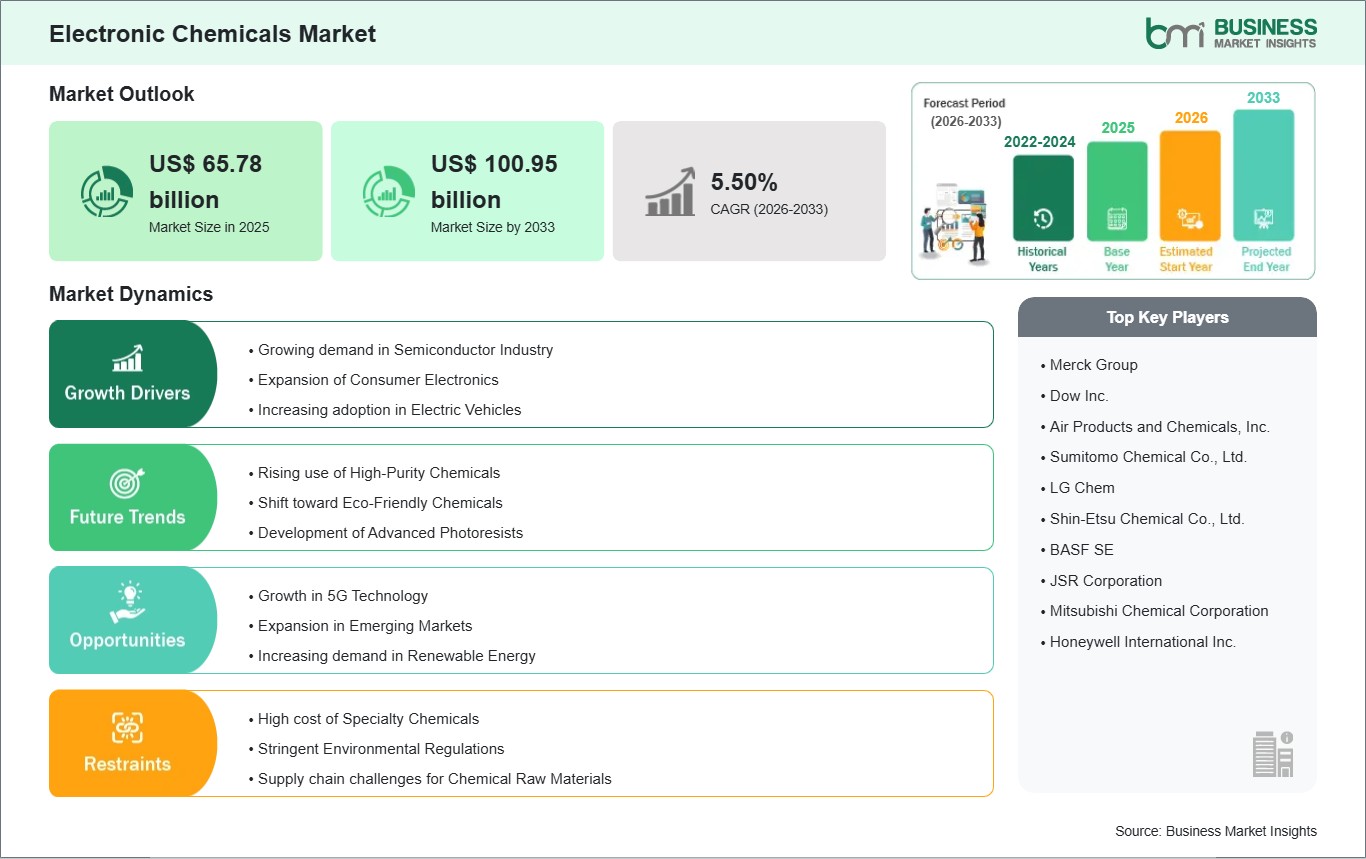
The Electronic Chemicals Market size is expected to reach US$ 100.95 billion by 2033 from US$ 65.78 billion in 2025. The market is estimated to record a CAGR of 5.50% from 2026 to 2033.

Executive Summary and Global Market Analysis:

The global market for electronic chemicals is an important part of the larger semiconductor and electronics manufacturing industry. These chemicals are crucial for the production, performance, and reliability of modern electronic components. They are specially made to assist with tasks like cleaning, etching, doping, deposition, and planarization during semiconductor fabrication and printed circuit board manufacturing. Electronic chemicals have extremely high purity levels to avoid contamination and ensure optimal performance in delicate electronic environments. They find use in integrated circuits, flat panel displays, photovoltaic cells, and advanced packaging technologies. As electronic devices become smaller, faster, and more powerful, the demand for high-performance electronic chemicals has risen significantly in sectors such as consumer electronics, automotive, telecommunications, healthcare, and renewable energy. Common types of electronic chemicals include wet chemicals, specialty gases, photoresists, CMP (chemical mechanical planarization) slurries, and conductive polymers. Each type serves a unique role in the electronics manufacturing process, enhancing precision, efficiency, and product quality. Producing these chemicals involves complex processes like synthesis, purification, and quality control to meet strict industry standards. Modern manufacturing techniques and controlled environments are needed to ensure consistency and eliminate impurities. Formulation adjustments and the use of additives allow manufacturers to customize chemical properties, such as reactivity, viscosity, and selectivity, for specific applications. New innovations aim to create ultra-high-purity chemicals, environmentally friendly formulas, and materials suited for next-generation semiconductor nodes and advanced display technologies. Electronic chemicals are essential for advancing cutting-edge technologies. In the semiconductor industry, they help produce smaller and more efficient chips for smartphones, computers, and data centers. In the automotive industry, especially with the growth of electric and autonomous vehicles, these chemicals are vital for making sensors, power devices, and control systems. Telecommunications infrastructure, which includes high-speed networks and advanced connectivity solutions, relies heavily on semiconductor components that use electronic chemicals. Renewable energy technologies like solar panels require these materials for efficient energy conversion and durability. Moreover, healthcare devices and industrial automation systems need high-precision electronics, increasing the demand for specialized chemicals. Market growth is fueled by the fast expansion of the semiconductor industry, greater use of advanced electronics, and the global trend towards digitalization. The rise of technologies like artificial intelligence, 5G communication, and the Internet of Things has greatly increased the need for high-quality electronic chemicals. Additionally, the growing focus on sustainable manufacturing practices and environmentally friendly materials is shaping product development and innovation. Government initiatives that support domestic semiconductor production and supply chain resilience are also helping the market grow. However, the industry faces challenges such as high production costs, tough regulatory needs, and the necessity for continuous technological upgrades. Supply chain issues and the difficulty of maintaining ultra-high purity levels can further hinder growth. Despite these obstacles, ongoing progress in chemical engineering, increased research and development spending, and strong demand from key end-use industries are likely to drive the market forward. Overall, the electronic chemicals market is well-prepared to support the evolution of modern electronics by supplying critical materials that make high-performance, reliable, and sustainable manufacturing processes possible across global industries.

Electronic Chemicals Market - Strategic Insights:

global-market-strategic-framework
Get more information on this report

Electronic Chemicals Market Segmentation Analysis:

Key segments that contributed to the derivation of the Electronic Chemicals market analysis are type and application.

  • By type, the Electronic Chemicals market is segmented into electronic gases, CMP slurries, photoresist and ancillaries, conductive polymers, low K dielectrics, wet chemicals, silicon wafers, and others. The wet chemicals segment dominated the market in 2025.
  • By application, the Electronic Chemicals market is segmented into semiconductors, consumer electronics, and others. The consumer electronics segment dominated the market in 2025.

Electronic Chemicals Market Drivers and Opportunities:

Rising Demand from Semiconductor Manufacturing, Electronics, and Electric Vehicles

The global market for electronic chemicals is growing quickly. This growth comes from increasing demand in semiconductor manufacturing, electronics, and the automotive sector. The rapid rise in consumer electronics like smartphones, laptops, and wearable devices has boosted the need for high-purity electronic chemicals used in chip making and circuit processing. These chemicals are crucial for ensuring precision, cleanliness, and performance in small electronic components. The rise of electric vehicles also plays a significant role, as electronic chemicals are key in producing power semiconductors, sensors, and battery management systems. They improve energy efficiency, reliability, and thermal stability in automotive electronics. Additionally, the growth of data centers and high-performance computing is driving semiconductor demand and increasing the use of specialty gases, photoresists, and wet chemicals. Industrial automation and smart technologies depend on advanced semiconductor devices, highlighting the importance of electronic chemicals for consistent performance and durability. Government initiatives that support semiconductor manufacturing, digital infrastructure, and local production are speeding up market growth. As electronic devices become smaller, more efficient, and more connected, the demand for electronic chemicals is expected to increase in both developed and emerging economies.

Technological Advancements and Shift Toward Sustainable Chemical Solutions

Technological advancements are important in shaping the global electronic chemicals market. Continuous innovation aims to improve chemical purity, process efficiency, and compatibility with advanced semiconductor nodes. The creation of ultra-high-purity wet chemicals, advanced photoresists, and specialty gases enables the production of smaller, faster, and more efficient electronic components. These innovations are essential for supporting new technologies like artificial intelligence, 5G communication, and the Internet of Things. The industry is also seeing a significant move toward environmentally friendly and low-toxicity chemical formulations due to stricter environmental regulations and sustainability goals. Manufacturers are investing in green chemistry practices, reducing waste, and using energy-efficient production methods to lessen environmental impact. Advances in chemical engineering and material science are improving the stability, selectivity, and performance of electronic chemicals, leading to better manufacturing results. Moreover, innovations in delivery systems and process integration help lower chemical usage while maintaining high precision. Ongoing research and development efforts seek to improve compatibility with new semiconductor architectures, expand process capabilities, and support further miniaturization. As industries focus on sustainability, efficiency, and high-performance materials, technological innovation will keep driving long-term growth in the electronic chemicals market.

Electronic Chemicals Market Size and Share Analysis:

The wet chemicals segment leads the market because it plays a vital role in cleaning, etching, and preparing surfaces during semiconductor fabrication. The rising demand for high-purity chemicals in advanced chip manufacturing and smaller electronics is pushing this segment's growth. Ongoing improvements in semiconductor processes heighten the need for precise and contamination-free wet chemical solutions.

The consumer electronics segment is the largest market segment due to the growing demand for smartphones, laptops, wearables, and smart home devices. Fast product innovation and shorter device replacement cycles are boosting semiconductor production, which in turn drives the use of electronic chemicals. Increasing global connectivity and digital trends further support steady demand in this segment.

Electronic Chemicals Market Report Highlights:

Report Attribute Details
Market size in 2025 US$ 65.78 billion
Market Size by 2033 US$ 100.95 billion
Global CAGR (2026 - 2033)5.50%
Historical Data 2022-2024
Forecast period 2026-2033
Segments Covered By Type
  • Electronic Gases
  • CMP Slurries
  • Photoresist and Ancillaries
  • Conductive Polymers
  • Low K Dielectrics
  • Wet Chemicals
  • Silicon Wafers
  • Others
By Application
  • Semiconductors
  • Consumer Electronics
  • Others
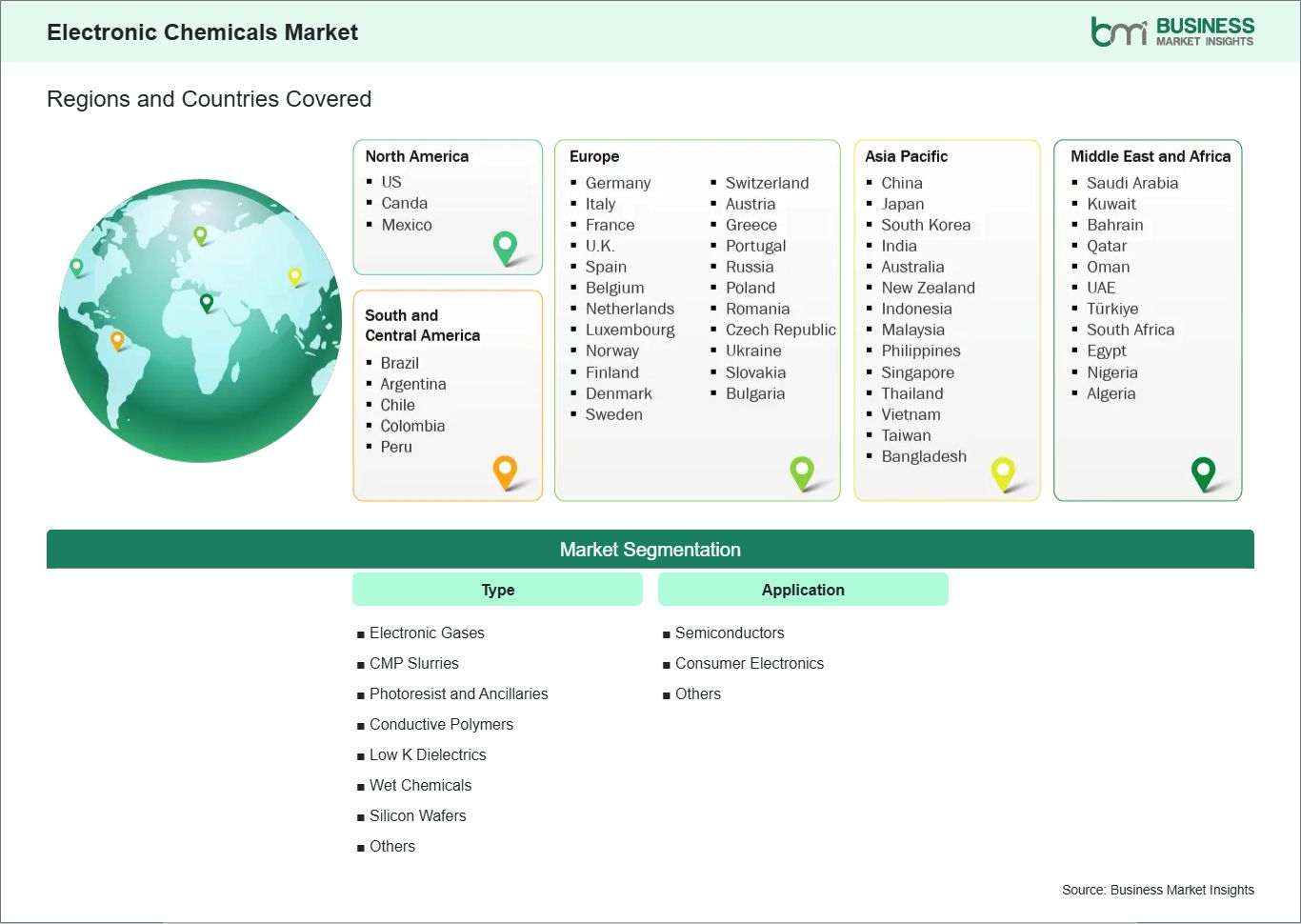
Regions and Countries Covered
North America US, Canada, Mexico
Europe Belgium, Austria, Finland, Denmark, Greece, Poland, Romania, Russia, Ukraine, Czech Republic, Slovakia, Bulgaria, Italy, Luxembourg, Germany, Switzerland, France, Netherlands, Norway, Portugal, Spain, Sweden, United Kingdom
Asia-Pacific Australia, China, India, Japan, South Korea, Indonesia, Malaysia, Philippines, Singapore, Thailand, Vietnam, Bangladesh, New Zealand, Taiwan
South and Central America Brazil, Argentina, Peru, Chile, Colombia
Middle East and Africa Bahrain, Kuwait, Oman, Qatar, Saudi Arabia, United Arab Emirates, Turkiye, South Africa, Egypt, Algeria, Nigeria
Market leaders and key company profiles
  • Merck Group
  • Dow Inc.
  • Air Products and Chemicals, Inc.
  • Sumitomo Chemical Co., Ltd.
  • LG Chem
  • Shin-Etsu Chemical Co., Ltd.
  • BASF SE
  • JSR Corporation
  • Mitsubishi Chemical Corporation
  • Honeywell International Inc.
Get more information on this report

Electronic Chemicals Market Report Coverage and Deliverables:

The "Electronic Chemicals Market Size and Forecast (2022 - 2033)" report provides a detailed analysis of the market covering below areas:

  • Electronic Chemicals market size and forecast at global, regional, and country levels for all the key market segments covered under the scope
  • Electronic Chemicals market trends, as well as market dynamics such as drivers, restraints, and key opportunities
  • Electronic Chemicals market analysis covering key market trends, global and regional framework, major players, regulations, and recent market developments
  • Industry landscape and competition analysis covering market concentration, heat map analysis, prominent players, and recent developments for the Electronic Chemicals market
  • Detailed company profiles, including SWOT analysis

Electronic Chemicals Market Geographic Insights:

The geographical scope of the Electronic Chemicals market report is divided into five regions: North America, Asia Pacific, Europe, Middle East & Africa, and South & Central America. The Electronic Chemicals market in the Asia Pacific is expected to grow significantly during the forecast period.

The Asia-Pacific Electronic Chemicals market is segmented into China, Japan, South Korea, India, Australia, New Zealand, Indonesia, Malaysia, the Philippines, Singapore, Thailand, Vietnam, Taiwan, Bangladesh, and the Rest of Asia.

The Asia-Pacific region is the fastest-growing market for electronic chemicals. This growth comes from rapid industrialization, strong semiconductor manufacturing, and a rising demand for high-performance electronic materials. Countries like China, Japan, India, South Korea, and Taiwan are seeing significant growth in consumer electronics, automotive electronics, and semiconductor fabrication industries. These sectors depend heavily on electronic chemicals, including wet chemicals, specialty gases, photoresists, and CMP slurries, to ensure precise and efficient manufacturing processes. The increasing demand for advanced chips and miniaturized components is driving the need for ultra-high-purity chemicals throughout the region. The growing adoption of electric vehicles also supports market growth. Electronic chemicals are critical for making power semiconductors, sensors, and battery management systems that ensure safety, efficiency, and reliability. Investments in semiconductor fabrication plants, electronics assembly units, and high-speed communication infrastructure are boosting the use of electronic chemicals as essential process materials. Rapid urbanization, rising disposable incomes, and expanding digital ecosystems are increasing the demand for smartphones, computers, and connected devices, which in turn drives the need for better semiconductor manufacturing. The growth of renewable energy technologies, such as solar photovoltaic systems, is also raising the use of electronic chemicals in wafer processing and cell production. The region enjoys a well-established manufacturing ecosystem, integrated supply chains, and cost-effective production capabilities. This allows for large-scale production and export of electronic chemicals. Governments across the region are enacting policies to strengthen domestic semiconductor industries, support digitalization, and promote modern manufacturing technologies. These efforts further stimulate market growth. Environmental regulations are encouraging the use of greener and safer chemical formulations, leading to less hazardous waste and lower emissions. Technological improvements, including the development of ultra-high-purity chemicals, advanced filtration systems, and precise chemical delivery methods, are boosting process efficiency and product performance. The availability of skilled labor, strong access to raw materials, and significant investments in research and development enhance the region's competitive edge. With ongoing industrial growth, policy support, and a strong emphasis on innovation and sustainability, the Asia-Pacific region is likely to remain a key hub for production, consumption, and technological progress in the global electronic chemicals market.

global-market-geography
Get more information on this report

Electronic Chemicals Market Research Report Guidance:

  • The report includes qualitative and quantitative data in the Electronic Chemicals market across type, application, and geography.
  • The report starts with the key takeaways (chapter 2), highlighting the key trends and outlook of the Electronic Chemicals market.
  • Chapter 3 includes the research methodology of the study.
  • Chapter 4 further includes ecosystem analysis.
  • Chapter 5 highlights the major industry dynamics in the Electronic Chemicals market, including factors that are driving the market, prevailing deterrents, potential opportunities, as well as future trends. Impact analysis of these drivers and restraints is also covered in this section.
  • Chapter 6 discusses the Electronic Chemicals market scenario, in terms of historical market revenues, and forecast till the year 2031.
  • Chapters 7 to 10 cover Electronic Chemicals market segments by type and application across North America, Europe, Asia Pacific, Middle East and Africa, and South and Central America. They cover the market revenue and forecast and factors driving the market.
  • Chapter 11 describes the competitive analysis along with the heat map analysis for the key players operating in the market.
  • Chapter 12 describes the industry landscape analysis. It provides detailed descriptions of business activities such as market initiatives, new developments, mergers, and joint ventures globally, along with a competitive landscape.
  • Chapter 13 provides detailed profiles of the major companies operating in the Electronic Chemicals market. Companies have been profiled on the basis of their key facts, business descriptions, products and services, financial overview, SWOT analysis, and key developments.
  • Chapter 14, i.e., the appendix is inclusive of a brief overview of the company, a list of abbreviations, and a disclaimer.

Electronic Chemicals Market News and Key Development:

The Electronic Chemicals market is evaluated by gathering qualitative and quantitative data post primary and secondary research, which includes important corporate publications, association data, and databases. A few of the key developments in the Electronic Chemicals market are:

  • In October 2025, BASF announced the construction of a state-of-the-art Electronic Grade Ammonium Hydroxide (NH4OH EG) plant in Ludwigshafen, Germany, in support of wafer cleaning, etching and other precision processes in semiconductor manufacturing. This critical ultra-pure chemical will support the growth and expansion of semiconductor companies in Europe, ensuring a robust local supply chain for the production of advanced chips.
  • In November 2025, Sumitomo Chemical entered into a definitive agreement to acquire 100% of the shares of Asia Union Electronic Chemical Corporation (“AUECC”), a Taiwanese semiconductor process chemicals company. The transaction is subject to customary closing conditions, including obtaining required regulatory approvals. The acquisition of AUECC will enable Sumitomo Chemical to strengthen its global footprint and establish its first manufacturing base for semiconductor process chemicals in Taiwan and a second base in the United States, alongside its Texas site, further accelerating the expansion of its semiconductor process chemicals business worldwide.

Key Sources Referred:

  • World Bank - Global Trade Indicators
  • World Trade Organization (WTO)
  • International Trade Administration (ITA)
  • Company website
  • Company annual reports
  • Company investor presentations
The List of Companies - Electronic Chemicals Market
  • Merck Group
  • Dow Inc.
  • Air Products and Chemicals, Inc.
  • Sumitomo Chemical Co., Ltd.
  • LG Chem
  • Shin-Etsu Chemical Co., Ltd.
  • BASF SE
  • JSR Corporation
  • Mitsubishi Chemical Corporation
  • Honeywell International Inc.
Frequently Asked Questions
How big is the Electronic Chemicals Market?

The Electronic Chemicals Market is valued at US$ 65.78 billion in 2025, it is projected to reach US$ 100.95 billion by 2033.

What is the CAGR for Electronic Chemicals Market by (2026 - 2033)?

As per our report Electronic Chemicals Market, the market size is valued at US$ 65.78 billion in 2025, projecting it to reach US$ 100.95 billion by 2033. This translates to a CAGR of approximately 5.50% during the forecast period.

What segments are covered in this report?

The Electronic Chemicals Market report typically cover these key segments-

  • Type (Electronic Gases, CMP Slurries, Photoresist and Ancillaries, Conductive Polymers, Low K Dielectrics, Wet Chemicals, Silicon Wafers, and Others)
  • Application (Semiconductors, Consumer Electronics, and Others)

What is the historic period, base year, and forecast period taken for Electronic Chemicals Market?

The historic period, base year, and forecast period can vary slightly depending on the specific market research report. However, for the Electronic Chemicals Market report:

  • Historic Period : 2022-2024
  • Base Year : 2025
  • Forecast Period : 2026-2033
  • Who are the major players in Electronic Chemicals Market?

    The Electronic Chemicals Market is populated by several key players, each contributing to its growth and innovation. Some of the major players include:

  • Merck Group
  • Dow Inc.
  • Air Products and Chemicals, Inc.
  • Sumitomo Chemical Co., Ltd.
  • LG Chem
  • Shin-Etsu Chemical Co., Ltd.
  • BASF SE
  • JSR Corporation
  • Mitsubishi Chemical Corporation
  • Honeywell International Inc.
  • Who should buy this report?

    The Electronic Chemicals Market report is valuable for diverse stakeholders, including:

    • Investors: Provides insights for investment decisions pertaining to market growth, companies, or industry insights. Helps assess market attractiveness and potential returns.
    • Industry Players: Offers competitive intelligence, market sizing, and trend analysis to inform strategic planning, product development, and sales strategies.
    • Suppliers and Manufacturers: Helps understand market demand for components, materials, and services related to concerned industry.
    • Researchers and Consultants: Provides data and analysis for academic research, consulting projects, and market studies.
    • Financial Institutions: Helps assess risks and opportunities associated with financing or investing in the concerned market.

    Essentially, anyone involved in or considering involvement in the Electronic Chemicals Market value chain can benefit from the information contained in a comprehensive market report.

    Available Report Formats

    pdf-format excel-format pptx-format
    Buy Now
    Sales Assistance
    +1 646 791 7070 (US & UK)
    Customization Form

    Please tell us your area of interest
    (Market Segments/ Regions and Countries/ Companies)