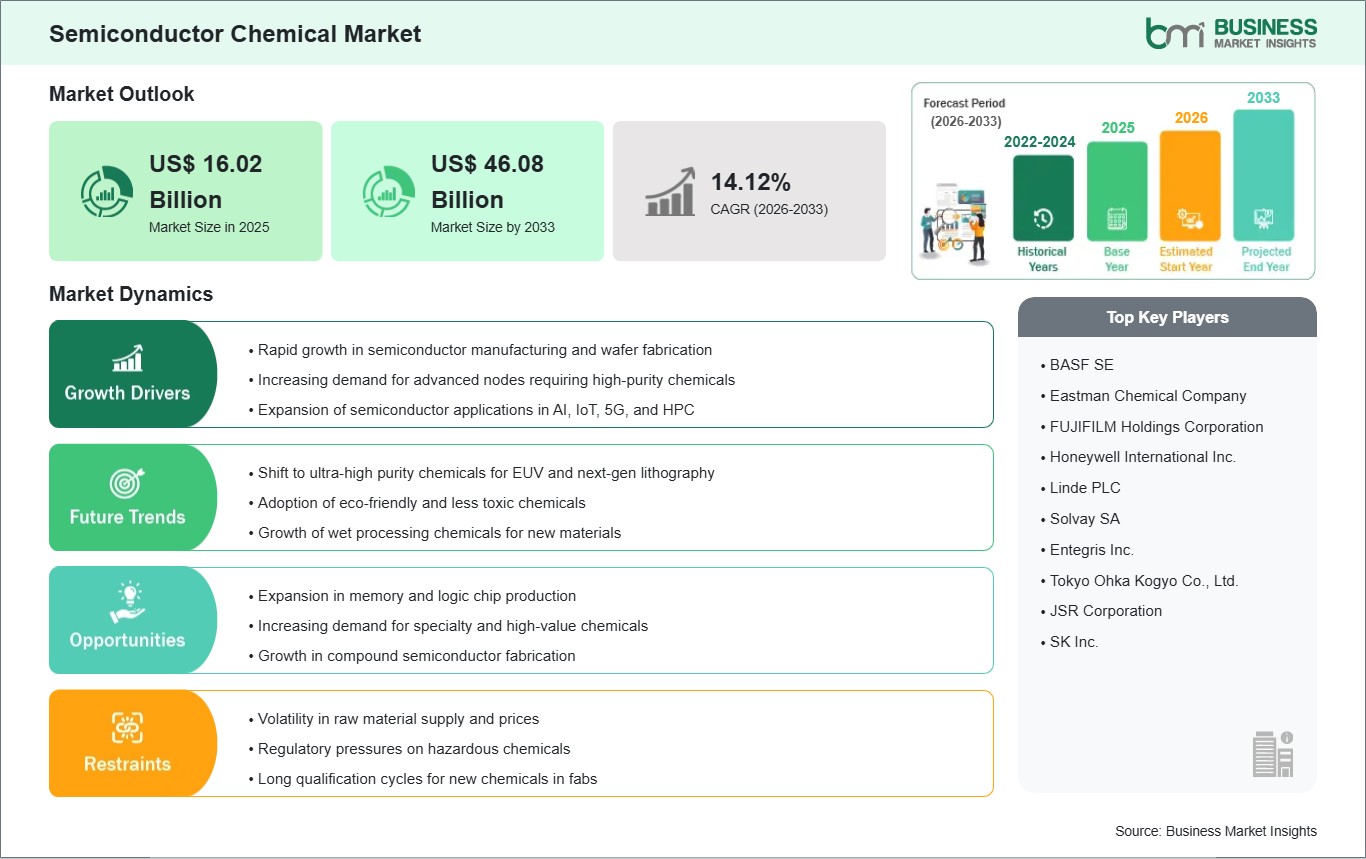
The Semiconductor Chemical Market size is expected to reach US$ 46.08 billion by 2033 from US$ 16.02 billion in 2025. The market is estimated to record a CAGR of 14.12% from 2026 to 2033.
The global semiconductor chemical market is a vital component in the semiconductor industry’s ecosystem, as it acts as a backbone in various processes like wafer fabrication, etching, cleaning, doping, and photoresist usage. The global semiconductor chemical market is mainly driven by the increasing need for miniaturized, faster, and energy-efficient semiconductor devices in various applications ranging from consumer electronics to automotive systems, data centers, and communication systems. Photoresists, etchants, developers, and cleaners are essential materials in maintaining precision in high-volume production of semiconductor devices.
The rapid growth of advanced technology like 5G networks, artificial intelligence, and IoT devices is fueling the growth of various types of semiconductor chemicals used in these applications due to their ability to enable complex circuit architectures and high-density integration. However, there are certain challenges in the global semiconductor chemical market, including high costs associated with high-purity specialty chemicals and environmental and safety regulations set by government authorities regarding chemical usage and disposal. Furthermore, the increasing sophistication in semiconductor nodes is a challenge in developing these types of chemicals, which may act as a hindrance for new players in the global semiconductor chemical market.
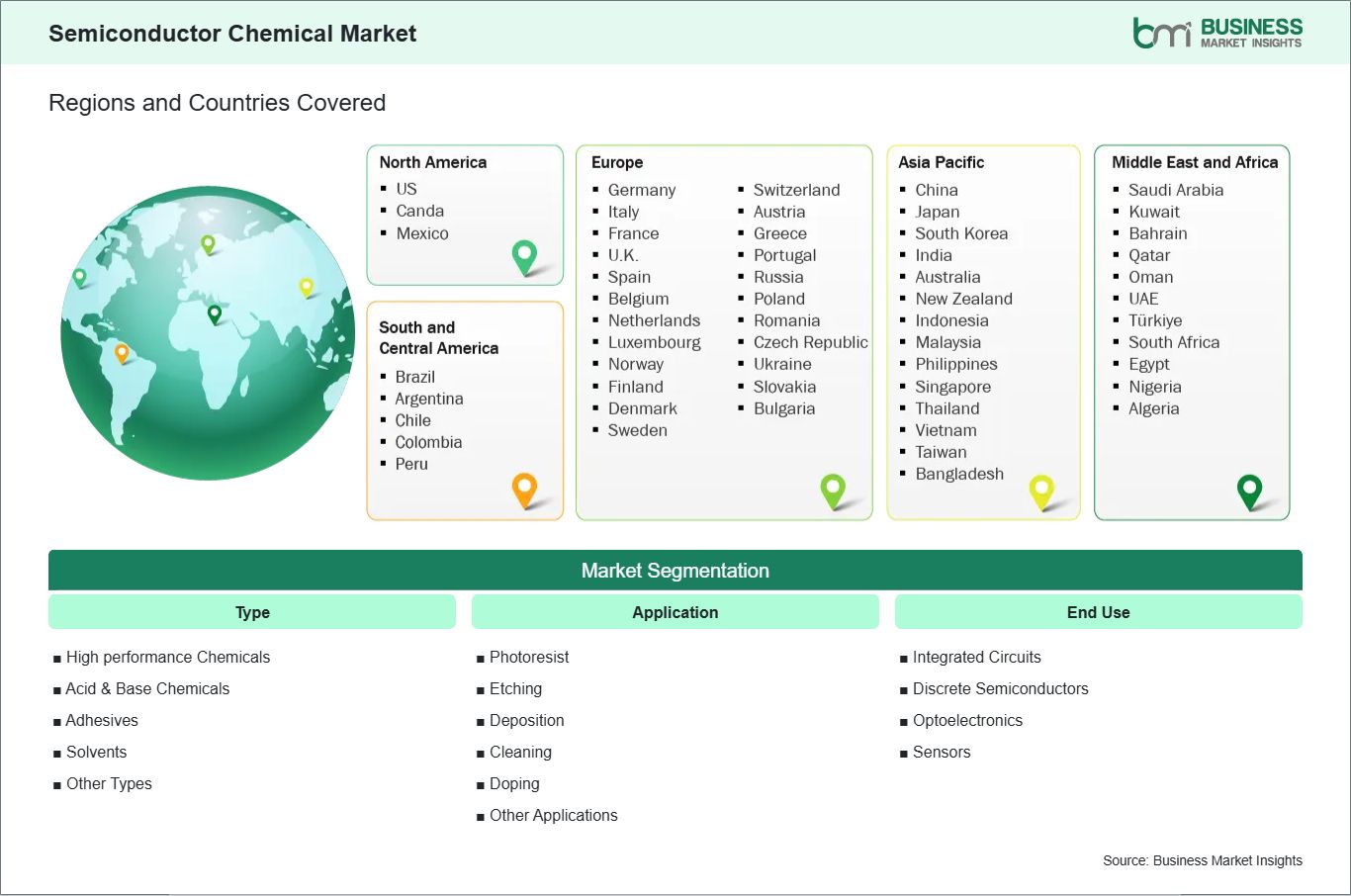
Key segments that contributed to the derivation of the semiconductor chemical market analysis are type, application, and end use.
The Western European market for semiconductors’ chemical segment is being driven by a robust growth rate in wafer fabrication and advanced chip manufacturing. Germany, the Netherlands, and Belgium have a substantial portion of the Western European semiconductor manufacturing infrastructure, including leading equipment and materials suppliers. Photoresists, etchants, and deposition precursors play an important role in these fabrication facilities, enabling precise patterning and achieving high-quality thin films. The growth in wafer fabrication, especially for specialty logic and power devices, is driving demand for high-quality chemicals that can meet stringent contamination control requirements.
The automotive and industrial segments in Western Europe have further expanded the market for chemicals. Electric vehicles, industrial automation, and renewable energy technologies require power semiconductors, which require advanced chemical processing during fabrication. The fabs in Western Europe have adopted advanced chemicals for specialized process technologies like atomic layer deposition and chemical mechanical planarization, which help in achieving better performance and longevity of the devices. The primary focus of these fabs is to use chemicals that help in achieving higher yields and fewer defect rates, which reflects the quality and excellence in European semiconductor fabrication.
Environmental and safety regulations have an impact on the market. The European fabs have to adhere to stringent regulations in handling chemicals and disposing of hazardous wastes. This has encouraged innovation in developing more efficient and environmentally friendly chemicals. The Western European market for advanced and high-quality chemicals in the semiconductor industry will continue to grow in line with the development of the wafer fabrication industry.
The growth in the manufacture of memory and logic chips in Western Europe is a significant driver for the semiconductor chemical market in this region. Although Europe has traditionally focused on logic chips and other specialized semiconductor devices, recent efforts to support the manufacture of memory chips are boosting demand for high-quality cleaning agents, dopants, and etchants used in DRAM and NAND Flash fabrication. Countries like Germany and the Netherlands have pilot facilities for memory chip fabrication and R&D, which demand high-quality semiconductor chemicals to ensure high yields and reliable device performance.
Similarly, the manufacture of logic chips, especially those used in the automotive, industrial, and telecommunication sectors, also requires semiconductor chemicals. Photoresist, developer, and deposition chemicals play an important role in the fabrication process. The complexity associated with chip designs, including the use of multiple layers in logic chip fabrication, has also contributed to the demand for semiconductor chemicals. The fabs in Europe focus on the use of semiconductor chemicals that ensure high chip density as well as high reliability during operation.
Moreover, the drive towards technological independence in the semiconductor sector in Europe also contributed to the growth of the semiconductor chemical market. The fabrication of semiconductor chemicals in-house reduces the reliance on external suppliers, especially those from countries with strong semiconductor industries. This growth is an important aspect of the semiconductor market in Europe, especially with the support for the expansion of memory chip fabrication facilities as well as logic chip fabrication facilities.

The global Semiconductor chemical market is experiencing steady growth, with market size and share analysis reflecting evolving treatment preferences and competitive dynamics among key players. The report evaluates important subsegments categorized within type, application, and end use highlighting their respective contributions to overall market performance.
By type, the high-performance chemical segment subsegment dominated the market in 2025 because they are critical for advanced process nodes, precision cleaning, and defect‑free etch/deposition. As semiconductor geometries shrink and yield requirements tighten, demand for ultra‑pure, high‑functionality chemicals rises faster than for general adhesives or solvents.
By application, the etching subsegment dominated the market in 2025 because the processes both wet and dry are central to defining device features at modern nodes (sub‑10 nm and beyond). With increasing complexity in patterning and multi‑layer structures (FinFETs, GAA), etch chemistries grow faster than other segments because they directly impact device performance, precision, and throughput.
By end use, the integrated circuits subsegment dominated the market in 2025 due to their volume production across logic, memory, and SoCs. As data‑center, AI, mobile, and HPC IC demand expands, IC fabs consume disproportionately more chemicals than discrete, optoelectronics, or sensor fabs, making ICs the dominant end‑use segment.
| Report Attribute | Details |
|---|---|
| Market size in 2025 | US$ 16.02 Billion |
| Market Size by 2033 | US$ 46.08 Billion |
| Global CAGR (2026 - 2033) | 14.12% |
| Historical Data | 2022-2024 |
| Forecast period | 2026-2033 |
| Segments Covered | By Type
|
|
Regions and Countries Covered
| |
| North America | US, Canada, Mexico |
| Europe | Belgium, Austria, Finland, Denmark, Greece, Poland, Romania, Russia, Ukraine, Czech Republic, Slovakia, Bulgaria, Italy, Luxembourg, Germany, Switzerland, France, Netherlands, Norway, Portugal, Spain, Sweden, United Kingdom |
| Asia-Pacific | Australia, China, India, Japan, South Korea, Indonesia, Malaysia, Philippines, Singapore, Thailand, Vietnam, Bangladesh, New Zealand, Taiwan |
| South and Central America | Brazil, Argentina, Peru, Chile, Colombia |
| Middle East and Africa | Bahrain, Kuwait, Oman, Qatar, Saudi Arabia, United Arab Emirates, Turkiye, South Africa, Egypt, Algeria, Nigeria |
| Market leaders and key company profiles |
|
The "Semiconductor chemical market Size and Forecast (2022 - 2033)" report provides a detailed analysis of the market covering below areas:
The geographical scope of the semiconductor chemical market report is divided into: North America, Asia Pacific, Europe, Middle East & Africa, and South & Central America. North America held the largest share in 2025.
The region of North America continues to hold the largest market share in the market for semiconductor chemicals, and this can be attributed to the presence of a robust semiconductor manufacturing infrastructure, which in turn has encouraged the presence of leading chemical suppliers and semiconductor companies. The region has access to extensive R&D infrastructure, which has helped to foster innovation in the area of high-purity and specialty chemical solutions, which can cater to the needs of advanced node and next-generation semiconductor devices.
The rise of cloud computing, aerospace, and automotive segments has helped to boost the demand for precision chemicals used in wafer fabrication and wafer packaging. The focus of the North American region on domestic semiconductor production has helped to boost the demand for domestic semiconductor chemicals. Moreover, the partnership of chemical suppliers, semiconductor foundries, and research organizations helps speed up the development of environmentally friendly and sustainable chemical alternatives. Though the market is good for industry, the manufacturers in North America are facing challenges due to the high cost of chemicals and the need for adhering to stringent environmental regulations. Innovation is the key in such cases.
The semiconductor chemical market is evaluated by gathering qualitative and quantitative data post primary and secondary research, which includes important corporate publications, association data, and databases. A few of the key developments in the Semiconductor chemical market are:
The Semiconductor Chemical Market is valued at US$ 16.02 Billion in 2025, it is projected to reach US$ 46.08 Billion by 2033.
As per our report Semiconductor Chemical Market, the market size is valued at US$ 16.02 Billion in 2025, projecting it to reach US$ 46.08 Billion by 2033. This translates to a CAGR of approximately 14.12% during the forecast period.
The Semiconductor Chemical Market report typically cover these key segments-
The historic period, base year, and forecast period can vary slightly depending on the specific market research report. However, for the Semiconductor Chemical Market report:
The Semiconductor Chemical Market is populated by several key players, each contributing to its growth and innovation. Some of the major players include:
The Semiconductor Chemical Market report is valuable for diverse stakeholders, including:
Essentially, anyone involved in or considering involvement in the Semiconductor Chemical Market value chain can benefit from the information contained in a comprehensive market report.
Please tell us your area of interest
(Market Segments/ Regions and Countries/ Companies)