
Personal Care Chemicals Market Outlook: Size, Share, Trends, Growth Analysis, Competitive Landscape & Forecast, 2026-2033

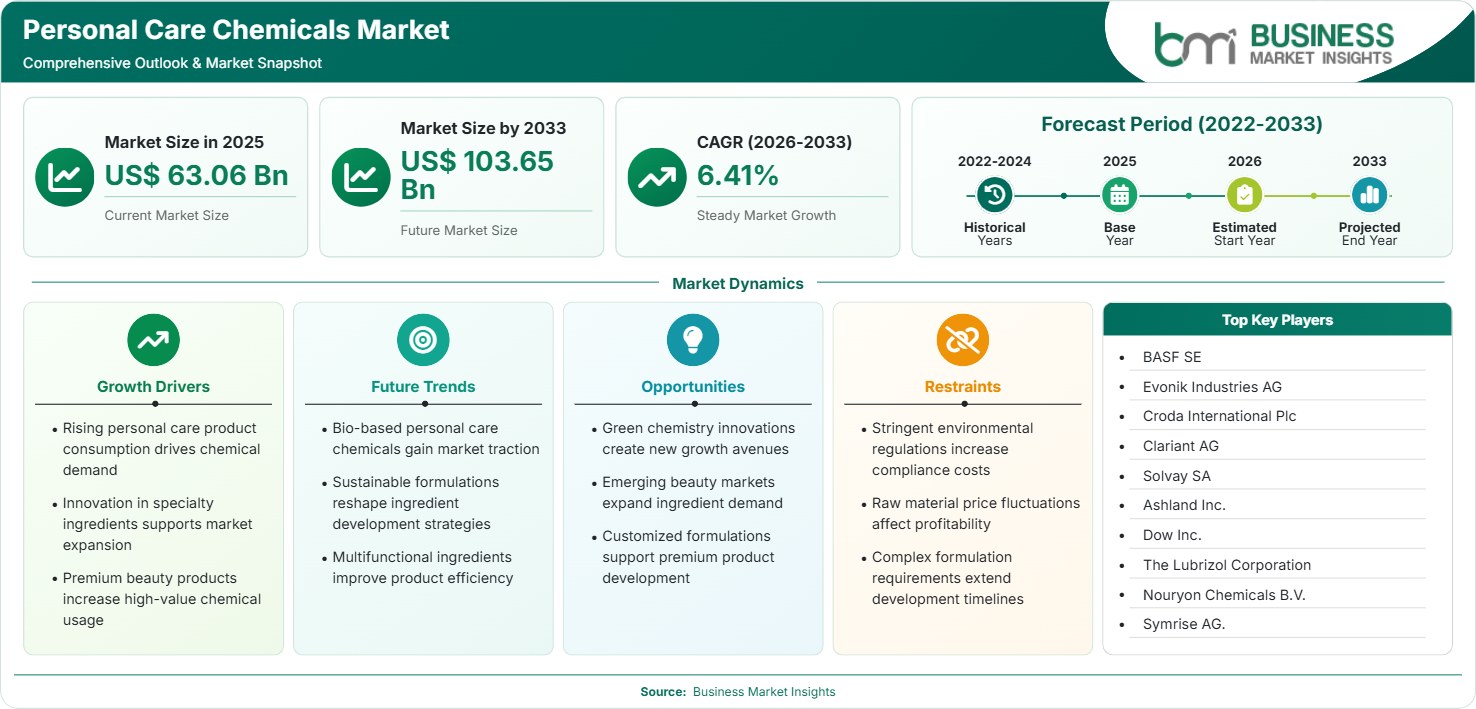
The Personal Care Chemicals Market size was valued at US$ 63.06 Billion in 2025 and is projected to reach US$ 103.65 Billion by 2033, growing at a CAGR of 6.41% during 2026–2033, driven by premium beauty demand, bio-based ingredient adoption, multifunctional formulations, emerging-market consumption, and sustainable chemistry innovation.

Report Coverage
  • Type: Surfactants, Emollients, Conditioning Polymers, Actives, Others
  • Application: Skin Care, Hair Care, Oral Care, Color Cosmetics, Others
US$ 63.06 Bn Market size in 2025
US$ 103.65 Bn Market Size by 2033
6.41% CAGR, 2026 - 2033
2026-2033 Forecast Period

AI Overview

Personal Care Chemicals Market Summary

  • North America Region: Holds a market share of 32%–35% in 2025, growing with a CAGR of 5.4%–5.8% during 2026–2033. Growth is supported by premium skincare demand, biotechnology ingredients, sustainable formulations, regulatory compliance investment, digital beauty expansion, dermatological product uptake, advanced manufacturing, clean-label innovation, and stronger consumer spending. The U.S. market benefits from premium beauty consumption and ingredient innovation, expanding at an estimated CAGR of 5.5%–5.9%.
  • Fastest Growing Region: Asia Pacific accounts for 29%–32% share in 2025 and advances at a CAGR of 7.4%–7.8%. Growth is supported by rising incomes, urbanization, local cosmetics manufacturing, e-commerce penetration, premiumization, skincare awareness, ingredient localization, export-oriented production, innovation partnerships, and expanding middle-class consumption.
  • Leading Segment: Skin Care represents 38%–41% share in 2025 and expands at 6.5%–6.9% CAGR. Demand stems from anti-aging products, moisturizing formulations, active ingredients, dermocosmetics adoption, premium positioning, biotechnology innovation, multifunctional benefits, wellness-driven purchasing behavior, consumer education, and stronger beauty spending.
  • High Growth Segment: Actives holds 17%–20% share in 2025 and grows at 7.8%–8.3% CAGR. Expansion is driven by efficacy-focused formulations, peptides, botanical extracts, microbiome solutions, anti-pollution ingredients, premium skincare applications, scientific validation, personalized beauty demand, biotechnology progress, and product differentiation.
  • Key Market Opportunity: Manufacturers investing in bio-based surfactants, fermentation-derived actives, circular feedstocks, transparent sourcing, and customized ingredient platforms can capture premium value from sustainability-focused beauty brands across developed and emerging economies.
  • Major Market Players: BASF SE, Evonik Industries AG, Croda International Plc, Clariant AG, Solvay SA, Ashland Inc., Dow Inc., The Lubrizol Corporation, Nouryon Chemicals B.V., Symrise AG.
Strategic Insights

Personal Care Chemicals Market: Strategic Insights

Personal Care Chemicals Market Strategic Framework
FREE PDF
Request your free sample
Request free sample
Stakeholder View

Key Takeaways

  • The industry value chain is increasingly integrated, with specialty ingredient producers collaborating closely with formulators, contract manufacturers, and global beauty brands to accelerate commercialization.
  • Highest upside exists in active ingredients and skincare applications, where scientific efficacy, premium positioning, and wellness-oriented consumption patterns support stronger margins.
  • Biotechnology, fermentation platforms, microbiome-focused formulations, and multifunctional ingredients are reshaping R&D priorities across global ingredient portfolios.
  • Asia Pacific offers the strongest investment potential due to expanding domestic cosmetics production, rising disposable income, and increasing penetration of premium beauty products.
  • Acquisitions targeting specialty actives, natural ingredient platforms, and sustainable chemistry assets continue strengthening portfolios and improving access to high-value formulation technologies.
  • Regulatory alignment around safety, transparency, and sustainability is creating competitive advantages for suppliers capable of providing validated performance and traceable sourcing.
Geographic Outlook

Personal Care Chemicals Market Regional Highlights

North America Personal Care Chemicals Market

North America accounts for approximately 32%–35% Personal Care Chemicals Market share in 2025 and is expected to expand at 5.4%–5.8% CAGR through 2033. Consumer preference for premium cosmetics, dermatologist-backed formulations, and sustainable ingredients supports regional demand. Major ingredient manufacturers maintain significant innovation centers across the region. Strong beauty and personal care spending, advanced regulatory frameworks, and growing adoption of biotechnology-derived ingredients continue supporting market expansion across skincare, haircare, and oral-care categories.

  • Premium skincare consumption supports increased demand for specialty actives, peptides, botanical extracts, and multifunctional ingredients across established and emerging brands.
  • Large-scale R&D investments enhance formulation performance while accelerating commercialization of bio-based and environmentally responsible raw materials.
  • Growing clean-beauty preferences encourage reformulation efforts focused on ingredient transparency, sustainability, and regulatory compliance.
  • E-commerce growth expands access to premium beauty products and drives higher ingredient utilization across diverse product categories.

US Personal Care Chemicals Market

The United States contributes roughly 73%–76% of regional share and grows at 5.5%–5.9% CAGR through 2033. Strong consumer spending, innovation-intensive beauty brands, and advanced ingredient manufacturing capabilities underpin demand. Adoption of efficacy-focused skincare, premium haircare, and science-backed wellness products supports ingredient innovation. Regulatory developments emphasizing transparency and product safety continue influencing formulation strategies across leading consumer brands and contract manufacturers.

  • Consumer preference for clinically validated skincare ingredients strengthens demand for advanced active compounds and formulation technologies.
  • Premiumization trends continue boosting ingredient value realization across luxury and masstige product categories.
  • Domestic innovation ecosystems encourage partnerships between manufacturers, biotechnology firms, and beauty brands.
  • Sustainable ingredient sourcing initiatives increasingly shape procurement and product-development decisions.

Europe Personal Care Chemicals Market

Europe represents 24%–27% market share in 2025 and expands at 5.8%–6.2% CAGR during the forecast period. Stringent sustainability expectations and advanced cosmetics manufacturing drive ingredient innovation. Germany remains the leading regional market, while Poland and Spain demonstrate stronger growth trajectories. Regulatory emphasis on environmentally responsible formulations encourages investment in renewable feedstocks, specialty actives, and low-impact production technologies across major manufacturing hubs.

  • Germany leads regional demand through strong industrial capabilities and extensive cosmetics production infrastructure.
  • France remains influential in premium beauty formulations requiring specialized ingredients and performance additives.
  • Poland advances at approximately 6.4%–6.8% CAGR due to manufacturing expansion and rising domestic consumption.
  • Sustainable chemistry investments accelerate adoption of renewable and biodegradable ingredient systems.
  • Advanced regulatory standards incentivize innovation in safer and traceable ingredient portfolios.

Asia Pacific Personal Care Chemicals Market

Asia Pacific holds 29%–32% share in 2025 and records the fastest expansion at 7.4%–7.8% CAGR. China remains the largest market while India demonstrates among the strongest growth rates. Expanding middle-class populations, rising urbanization, premium product adoption, and growing cosmetics exports support regional consumption. Increasing local manufacturing capabilities and government support for specialty chemicals investment continue strengthening regional competitiveness and the broader Personal Care Chemicals Market growth outlook.

  • China leads consumption through extensive cosmetics production and strong domestic beauty demand.
  • India grows around 8.0%–8.5% CAGR, supported by income growth and expanding organized retail channels.
  • South Korea influences innovation through advanced skincare concepts and ingredient development expertise.
  • Regional e-commerce adoption broadens access to premium and specialized beauty products.
  • Manufacturing localization improves supply resilience and reduces dependence on imported ingredient systems.

Rest of World Personal Care Chemicals Market

Rest of World accounts for 10%–13% share in 2025 and advances at 6.3%–6.7% CAGR. South and Central America benefit from increasing beauty product consumption and local manufacturing investment. Middle East and Africa markets are supported by premium personal care demand, tourism-related consumption, and expanding retail channels. Brazil remains the leading market, while Saudi Arabia and the UAE show stronger growth supported by premiumization and evolving consumer preferences.

  • Brazil dominates regional demand due to a mature beauty and personal care industry ecosystem.
  • Mexico benefits from manufacturing expansion and integration with broader consumer-product supply chains.
  • Saudi Arabia records accelerating demand for premium cosmetics and wellness-focused beauty products.
  • UAE growth is supported by luxury retail expansion and high per-capita beauty expenditure.
  • Localized production investments improve market accessibility and distribution efficiency.
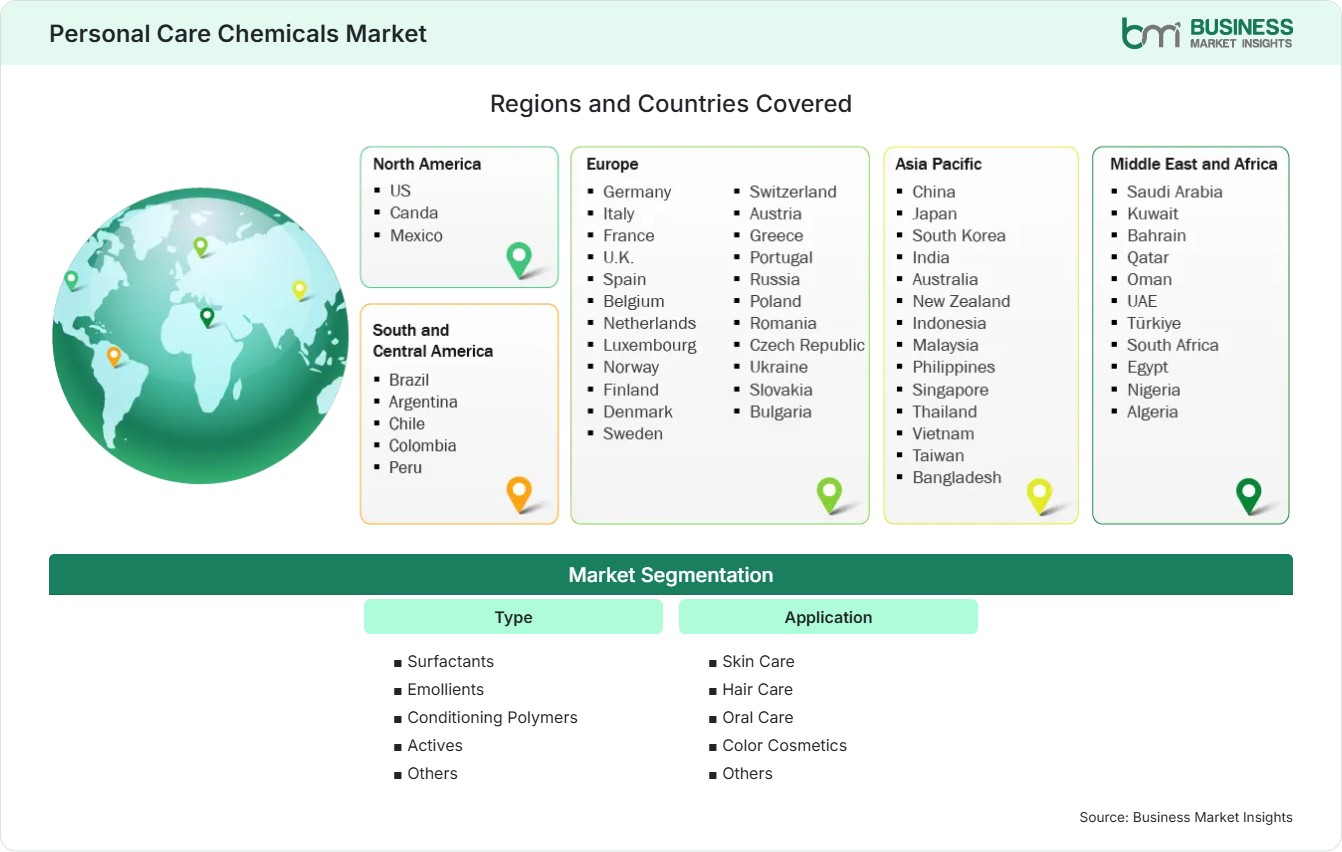
Global Market Geography
FREE PDF
Request your free sample
Request free sample
Segment Analysis

Personal Care Chemicals Market Segmentation

Type

Type segment held the core industry position, with Surfactants maintaining the largest share at approximately 29%–32% in 2025, while Actives represent the fastest-growing category at 7.8%–8.3% CAGR. Personal Care Chemicals Market scope continues expanding through biotechnology innovation, sustainable chemistry, performance enhancement, and growing demand for multifunctional ingredients across diverse beauty and hygiene formulations.

  • Surfactants: Essential cleansing ingredients widely used in shampoos, face washes, and oral-care products, benefiting from demand for mild formulations and sulfate-free alternatives.
  • Emollients: Maintain strong usage across moisturizing and skin-conditioning products, supported by premium skincare adoption and consumer preference for improved sensory experiences.
  • Conditioning Polymers: Increasingly utilized in advanced haircare systems to improve texture, manageability, protection, and product performance across premium formulations.
  • Actives: Expanding rapidly due to rising demand for efficacy-backed anti-aging, brightening, hydration, and microbiome-supporting ingredients.

Application

Application analysis indicates Skin Care accounted for 38%–41% share in 2025 and is projected to grow at 6.5%–6.9% CAGR. Personal Care Chemicals Market trends increasingly favor science-backed skincare products, premium beauty routines, preventative wellness solutions, and advanced ingredient systems delivering measurable benefits, supporting continued demand across developed and developing markets.

  • Skin Care: Dominates ingredient consumption due to anti-aging, hydration, barrier-repair, and cosmetic-enhancement product demand globally.
  • Hair Care: Benefits from premium shampoos, conditioners, scalp-care treatments, and ingredient-rich performance formulations.
  • Oral Care: Growth supported by advanced whitening, sensitivity management, and natural formulation developments.
  • Color Cosmetics: Increasing incorporation of skincare actives and multifunctional ingredients strengthens value creation opportunities.
Market Forces

Personal Care Chemicals Market Dynamics

Key Market Drivers

Growing Demand for Premium and Efficacy-Based Beauty Products

Consumers have become more inclined towards purchasing those products that give them proven effects on their skin and hair. Increasing spending on anti-aging products, skin-related formulations, and health-based cosmetic products is resulting in an increased need for innovative ingredients. Ingredient providers are working on expanding their active ingredient range using peptides, plant extracts, and bioengineered materials. Personal Care Chemicals Market growth is therefore increasingly linked to scientific validation, premium positioning, and consumer willingness to pay higher prices for efficacy.

Expansion of Sustainable and Bio-Based Ingredient Adoption

Sustainability efforts continue to be incorporated by international cosmetic companies in their raw materials and formulations. Biodegradable surfactants, renewable emollients, and lower-carbon ingredient systems are becoming increasingly attractive options. Both regulatory forces and environmental concerns encourage the use of green chemistry. Companies that can provide traceability and reduce their environmental impact have a competitive edge. Personal Care Chemicals Market trends increasingly reflect movement toward circularity, responsible sourcing, and environmentally optimized production models across developed and emerging economies.

Rapid Innovation in Biotechnology and Specialty Ingredients

Advancements in fermentation technologies, bioengineering, and precision formulation are enabling creation of differentiated active ingredients. Such advances contribute to increased effectiveness, stability, and sustainability as well as customization. The producers of cosmetic ingredients are collaborating more often with the cosmetics companies for quicker commercialization of innovations. Advanced active and multifunctional ingredients ensure the cosmetics are positioned in the premium market. There is an increase in investment into biotechnological platforms that boost innovation.

Key Market Opportunities

Commercialization of Personalized Beauty Solutions

Tailored solutions for skin and hair care products are unique in their ingredients’ makeup. Consumer insights and diagnostics are driving the demand for custom products. Ingredient companies that are agile enough to provide such solutions will be able to capitalize on high profit margins. Personal Care Chemicals Market Forecasts indicate increasing demand for targeted efficacy solutions as consumers seek products aligned with specific skin, scalp, and wellness conditions. This trend creates long-term opportunities for advanced ingredient developers.

High-Potential Growth in Emerging Consumer Markets

Expanding middle-class populations across India, Indonesia, Vietnam, Brazil, and Gulf economies are creating substantial demand for beauty and personal care products. Disposable income increases help drive premiumization and increased consumption of ingredients. Investments in local manufacturing increase availability while improving efficiency within the supply chain. International ingredient suppliers persist in increasing their presence within the region to capitalize on the growing opportunities in the region.

Advancement of Microbiome and Wellness-Focused Products

Consumer awareness regarding skin health, barrier protection, and holistic wellness continues reshaping product development priorities. Products containing ingredients for microbiome support, products that have an immune focus, and proven wellness solutions based on science are seeing more investment activity. Suppliers who use clinical evidence and their expertise in biotechnology should be able to capitalize on changing consumer needs. The reason being, these product areas hold promise for good growth.

Market Restraints and Challenges

Volatile Raw Material Costs and Feedstock Dependence

Factor: A great number of ingredients groups are very dependent on petrochemical derivatives, agricultural commodities, and specialty feedstocks from around the world. Hence, their prices are extremely susceptible to changes.

Impact: Fluctuations in crude oil and energy prices, crop production, and global trade conditions can affect manufacturing costs and the entire supply chain. Moreover, the disruption in logistics, transportation, and the availability of raw materials add another element of uncertainty regarding the cost factor. This is because the cost becomes a major challenge for manufacturers. As a result, procurement strategies become more complex, investment decisions may be delayed, and long-term planning across formulation-intensive product segments is often hindered

Complex Global Regulatory Compliance Requirements

Factor: Regulations on ingredients and final products vary significantly across countries and regions, posing major problems for manufacturers and supply companies. The requirements concerning safety of ingredients, product labeling, effects on the environment, sustainability reporting, and approval process typically demand rigorous testing and validation.

Impact: The implementation of compliance requirements increases costs and may prolong the time required to develop and market products. It is necessary to spend resources on the continuous improvement of expertise in regulatory requirements, quality management, and monitoring. Smaller suppliers usually have fewer resources to deal with compliance requirements. As a result, regulatory complexity continues to be one of the key market problems.

Company Analysis

Competitive Landscape

The Personal Care Chemicals Market analysis highlights a competitive environment characterized by specialty ingredient innovation, sustainability investment, biotechnology development, and strategic partnerships.

Company Name

Overview

Products and Services relevant to this market

BASF SE

Global chemical leader with extensive personal care ingredient and formulation expertise.

Surfactants, emollients, actives, UV filters, formulation support services.

Evonik Industries AG

Specialty chemicals company focused on high-performance beauty ingredients.

Actives, conditioning agents, delivery systems, sustainable ingredients.

Croda International Plc

Innovation-driven supplier serving beauty and personal care formulators worldwide.

Active ingredients, emulsifiers, botanical extracts, specialty lipids.

Clariant AG

Specialty chemical producer emphasizing sustainability and performance materials.

Surfactants, conditioning systems, preservatives, formulation ingredients.

Solvay SA

Global supplier supporting advanced and sustainable beauty formulations.

Mild surfactants, specialty polymers, functional ingredients.

Ashland Inc.

Focused on specialty additives and consumer market solutions.

Rheology modifiers, biofunctionals, preservation technologies, polymers.

Dow Inc.

Major materials science company serving personal care applications.

Silicones, conditioning ingredients, sensory-enhancing additives.

The Lubrizol Corporation

Specialty chemical innovator with strong beauty-care portfolio.

Polymers, emulsifiers, active delivery systems, skin-care ingredients.

Nouryon Chemicals B.V.

Global specialty chemicals supplier with sustainability-oriented solutions.

Surfactants, rheology modifiers, formulation-enhancement technologies.

Symrise AG

Fragrance and cosmetic ingredient specialist with global reach.

Cosmetic actives, botanical ingredients, functional beauty solutions.

Trust & Transparency

Research Methodology

The market analysis combines proprietary research with secondary data from government agencies, company disclosures, regulatory filings, industry databases and expert interviews. Market estimates are validated through data triangulation, cross-market benchmarking and analyst review.

View Full Research Methodology

Questions Answered

Frequently Asked Questions

What does a Personal Care Chemicals Market Report typically evaluate?

A comprehensive study examines market size, competitive positioning, regional demand patterns, regulatory developments, technology trends, segment performance, and strategic opportunities across the value chain.

How are sustainability goals affecting ingredient development?

Manufacturers increasingly prioritize biodegradable surfactants, renewable feedstocks, bio-based actives, and transparent sourcing to align with environmental targets and consumer expectations.

Which region offers the strongest long-term opportunity?

Asia Pacific offers the most attractive long-term opportunity due to expanding middle-class populations, rising cosmetics consumption, manufacturing investment, and digital retail growth.

What application segment generates the highest revenue?

Skin care remains the largest application category because of strong demand for anti-aging, moisturizing, brightening, and barrier-repair products across both developed and emerging markets.

What factors most influence demand for personal care chemicals?

Consumer preference for premium beauty products, clean-label formulations, efficacy-backed ingredients, sustainability requirements, and innovation in skincare and haircare applications are the main demand drivers.

Access the Full Personal Care Chemicals Market Report

Get segment-level forecasts, regional estimates, competitive benchmarking, company profiles and downloadable Excel datasets.

Access the full Personal Care Chemicals Market Report
350 pages PDF & Excel | 2026-08-31
Similar Research

Related Market Reports