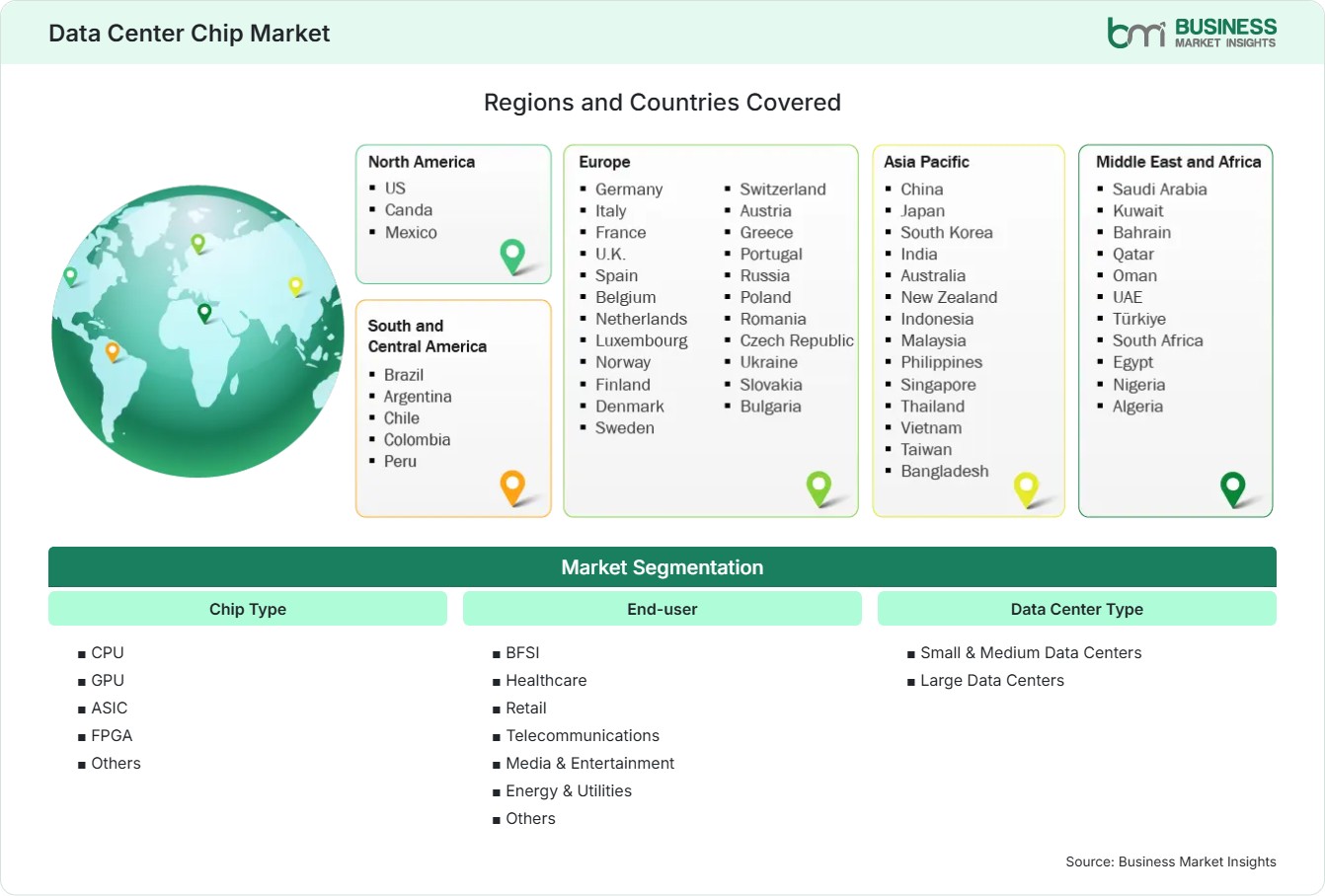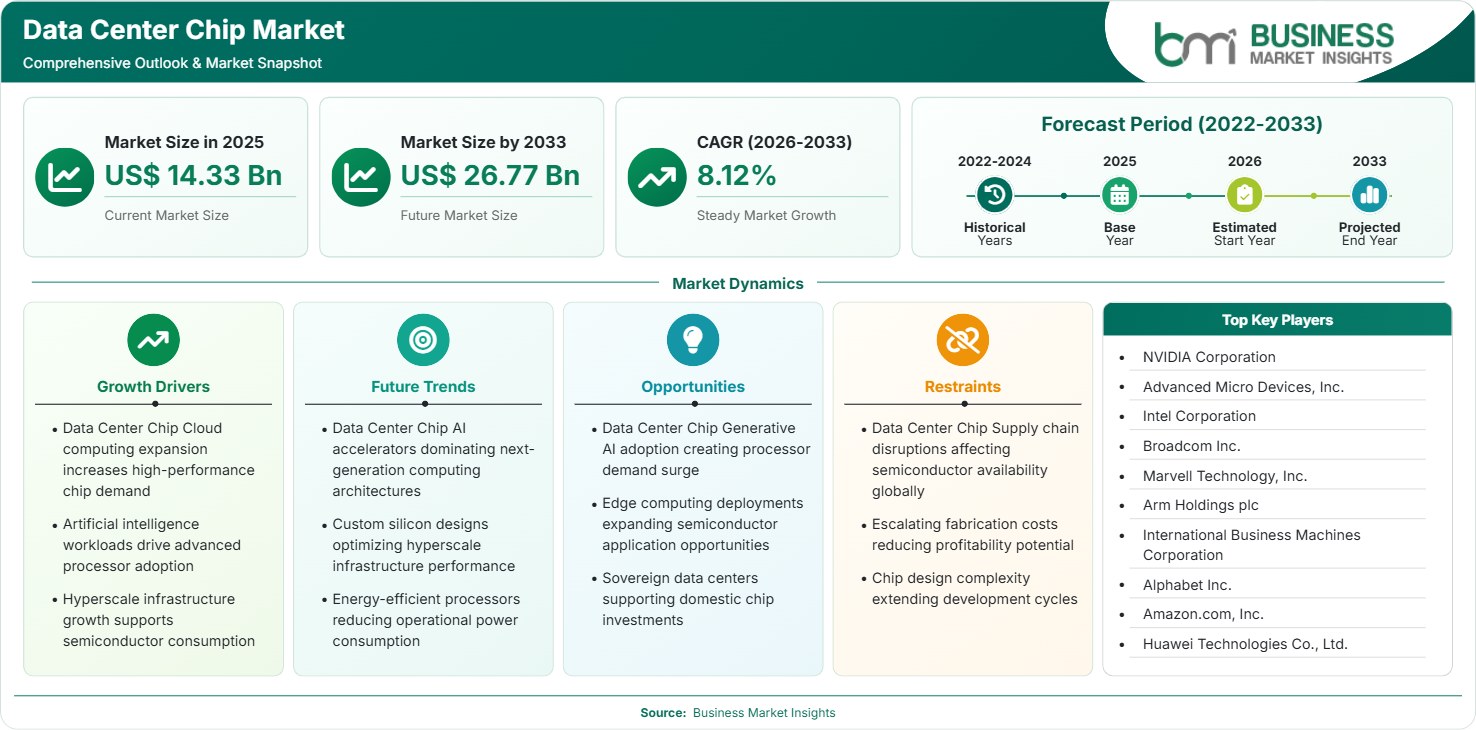
Data Center Chip Market Regional Highlights
North America Data Center Chip Market
North America accounted for a 32%–35% share in 2025 and is projected to expand at a CAGR of 7.4%–8.0% through 2033. The region benefits from hyperscale operators, semiconductor designers, cloud platforms, AI infrastructure investment, advanced networking ecosystems, and enterprise modernization. Data Center Chip Market growth increasingly depends on inference workloads and rack-scale deployment.
- Hyperscale operators are still expanding their infrastructure which makes heavy use of accelerators, thereby increasing the demand for GPUs, CPUs, ASICs, high-speed networking processors and other supporting chips. Investment in AI infrastructure is also leading to the development of custom architectures designed for specific workloads.
- The ability of semiconductor design to advance enables a quicker acceptance of heterogeneous architectures, and at the same time the software ecosystems are having an increasing influence on the choice of processor. Vendors who have well-developed development platforms can lessen the difficulty of deploying their solutions for cloud and enterprise customers.
- Power availability is turning into a constraint on infrastructure, with demand rising for processors and accelerators that provide higher performance per watt, and this is promoting architectural innovation in the area of specialized silicon, memory optimization, and the use of efficient interconnect technologies.
- The US semiconductor ecosystem is still at the heart of demand in the region, while Canada plays its part through its involvement in cloud infrastructure, telecommunications, research computing, and the deployment of specialised technologies. Coordinating the supply chains across borders continues to be of strategic importance.
US Data Center Chip Market
The US represents approximately 78%–82% of North American demand in 2025 and is expected to grow at a CAGR of 7.2%–7.9%. Cloud providers, AI developers, financial institutions, healthcare systems, and technology companies are driving processor deployment. Data Center Chip Market demand is reinforced by large-scale AI infrastructure programs and continuing investments in domestic semiconductor production.
- The demand for GPUs and custom accelerators is being increased by hyperscale AI clusters, although CPUs are still necessary for orchestration, databases, virtualization, networking, and for general-purpose workloads in both enterprise and cloud environments.
- The incentives offered to domestic semiconductor industries and the investments being made in manufacturing are helping to strengthen supply-chain resilience, even though advanced packaging, leading-edge fabrication, memory, and specialized equipment are still globally interconnected.
- The use of enterprise AI is causing demand for processors to go beyond that of the large-scale data centres, especially in the financial services, healthcare, retail, telecommunications, and professional services sectors which require inference, analytics, and automation infrastructure.
Europe Data Center Chip Market
Europe represented a 22%–25% share in 2025 and is forecast to grow at a CAGR of 7.0%–7.6%. Germany, the United Kingdom, France, and the Netherlands remain important infrastructure markets, while Poland and Spain provide expanding opportunities. Germany is expected to grow at approximately 7.4%–8.0%, while Poland is positioned around 8.0%–8.7%. Data Center Chip Market share is influenced by cloud migration, AI adoption, digital sovereignty, energy efficiency requirements, and increasing demand for localized computing capacity.
- Germany enjoys the advantages of industrial automation, automotive computing, enterprise digitisation, and the expansion of its cloud infrastructure. There is a growing demand for processors that are capable of supporting AI-enabled industrial applications and high-performance workloads.
- The UK is still a major market for technology and financial-services, with demand for CPUs, GPUs, accelerators, networking processors, and secure infrastructure used for regulated workloads.
- France is enhancing its own AI capabilities and those relating to its sovereignty, which is increasing the number of opportunities available to accelerators and for custom infrastructure. The digitisation of the public sector and the adoption of AI by businesses can expand demand beyond that of the huge data centres.
- Poland presents a growing opportunity in the field of infrastructure since cloud adoption and investment in data centres are expanding in Central Europe; its rate of growth is due to enterprise modernisation, the development of digital services, and improved regional connectivity.
Asia Pacific Data Center Chip Market
Asia Pacific held a 30%–34% share in 2025 and is projected to register a CAGR of 9.2%–10.0%, making it the fastest-growing regional market. China, Japan, South Korea, Singapore, India, and Australia form major demand centers. China is estimated at approximately 9.4%–10.1% growth, while India can reach 10.2%–11.0%. Data Center Chip Market growth reflects cloud expansion, AI infrastructure, semiconductor localization, advanced packaging, and digital-service adoption.
- By combining its large cloud demand with the development of semiconductor technologies at home, China is creating opportunities for CPUs, accelerators, ASICs, networking processors, and other specialised infrastructure that is designed to fit around its national technology ecosystems.
- India is seeing rapid development in its data centres together with progress in digital services, financial technology, telecommunications, and the use of enterprise AI. There is a growing demand for accelerator-enabled infrastructure used for inference and analytics.
- Japan enjoys the advantages of well-developed enterprise computing, telecommunications infrastructure, robotics, manufacturing automation, and high-performance computing; demand for heterogeneous systems, which combine conventional processors with specialized accelerators, is growing due to AI adoption.
- South Korea provides advanced capabilities in semiconductor manufacturing and in memory, thus reinforcing its position in the regional supply chain; there are downstream opportunities resulting from the expansion of data centres for processors, accelerators, packaging, and interconnect technologies.
Rest of World Data Center Chip Market
South and Central America represent an emerging infrastructure opportunity as cloud adoption, digital payments, telecommunications modernization, and enterprise digitization increase. Data Center Chip Market share remains smaller than North American, European, and Asia Pacific markets, but new cloud facilities can support gradual expansion.
The Middle East and Africa are developing through sovereign cloud programs, telecommunications investment, government digitization, and hyperscale partnerships. Saudi Arabia and the United Arab Emirates provide important opportunities, with growth ranges of approximately 8.2%–9.0% and 8.5%–9.3%, respectively. Data Center Chip Market growth is increasingly linked to localized AI infrastructure, smart-city applications, and enterprise cloud adoption.
- Brazil enjoys the advantages of digitising its financial services and the expansion of its cloud infrastructure, while telecommunications operators are increasingly needing higher-performance computing and networking systems in order to support data-intensive services.
- Saudi Arabia is carrying out major initiatives to build digital infrastructure, which is leading to a demand for accelerators, CPUs, networking silicon, and energy-efficient infrastructure capable of supporting AI and sovereign computing applications.
- The United Arab Emirates is combining its investment in cloud services with AI projects and the need for high-density infrastructure. It will be possible for specialised processors and accelerators to benefit from the growth in AI workloads and the development of regional digital-service platforms.
- South Africa is still a significant market for data centres in Africa due to its telecommunications connectivity, enterprise digitisation, financial services, and the uptake of cloud services, although energy availability continues to be an infrastructure issue.