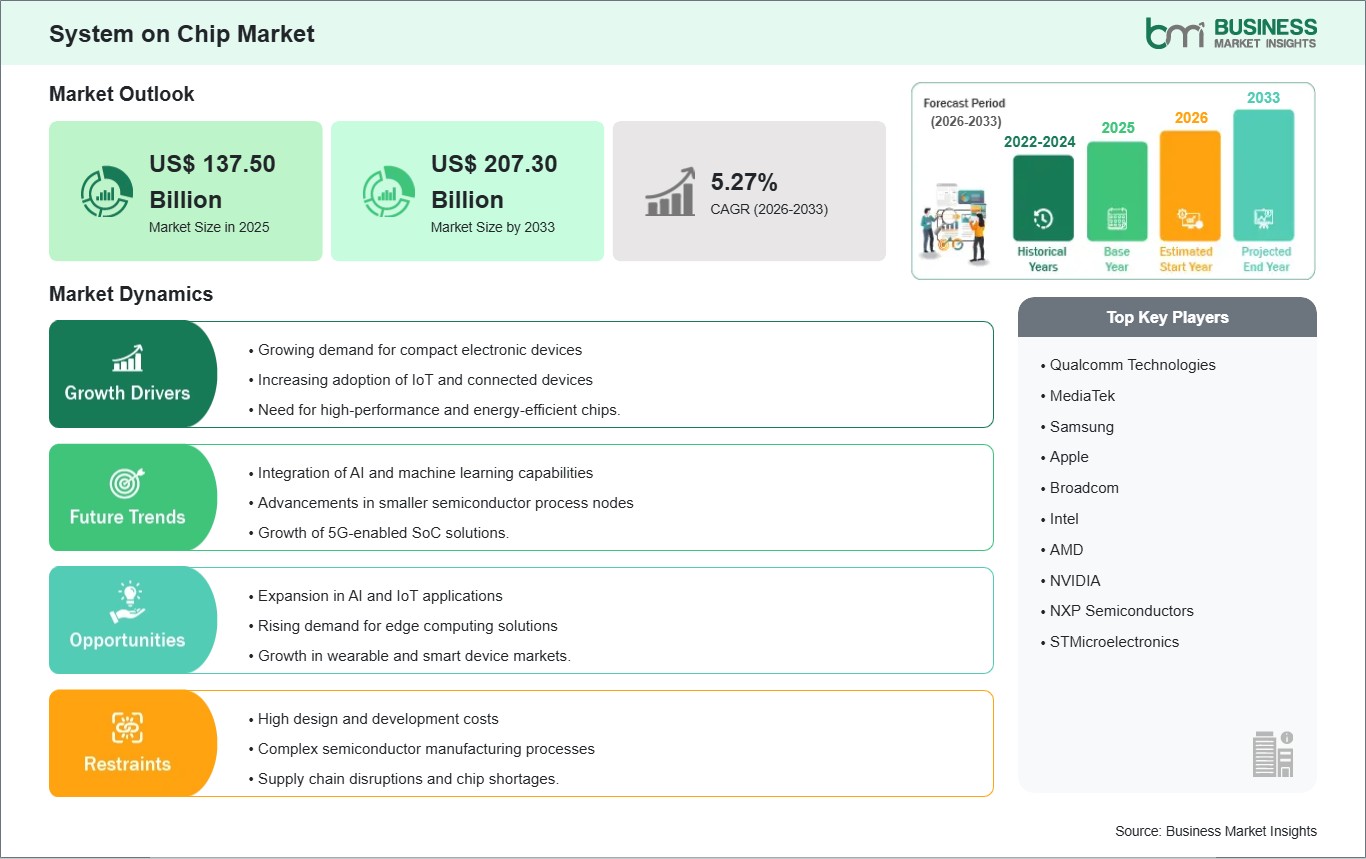
The System-on-Chip Market size is expected to reach US$ 207.3 billion by 2033 from US$ 137.5 billion in 2025. The market is estimated to record a CAGR of 5.27% from 2026 to 2033.
The System-on-Chip (SoC) market leads semiconductor research because it develops advanced technologies that create smaller devices that consume less power and integrate multiple functions into one system. SoCs now serve as critical enablers across consumer electronics, automotive systems, industrial IoT, and telecommunications, offering compact solutions that combine CPUs, GPUs, neural processing units, and connectivity modules on a single die. Recent research shows that AI and machine learning workloads drive changes in SoC architecture through the development of dedicated accelerators, which enable real-time edge inference. The industry is shifting towards low-power design solutions, which require improved transistor engineering and advanced packaging methods for wearable devices and battery-powered Internet of Things equipment.
The industry has begun to adopt modular IP cores together with platform-based development methods, which enable faster product development while keeping design flexibility. Automotive SoCs are developing toward domain-specific integration, which unifies multiple electronic control units into single chips to improve system reliability and decrease operational complexity. Manufacturers need to spend money on simulation-driven design tools and create strategic partnerships because they face issues with high engineering expenses, complicated verification processes and supply chain delays. The SoC market requires two main operations because it needs to create new technologies for upcoming applications while achieving production efficiency through precise performance, reliability, and energy-efficient operations.

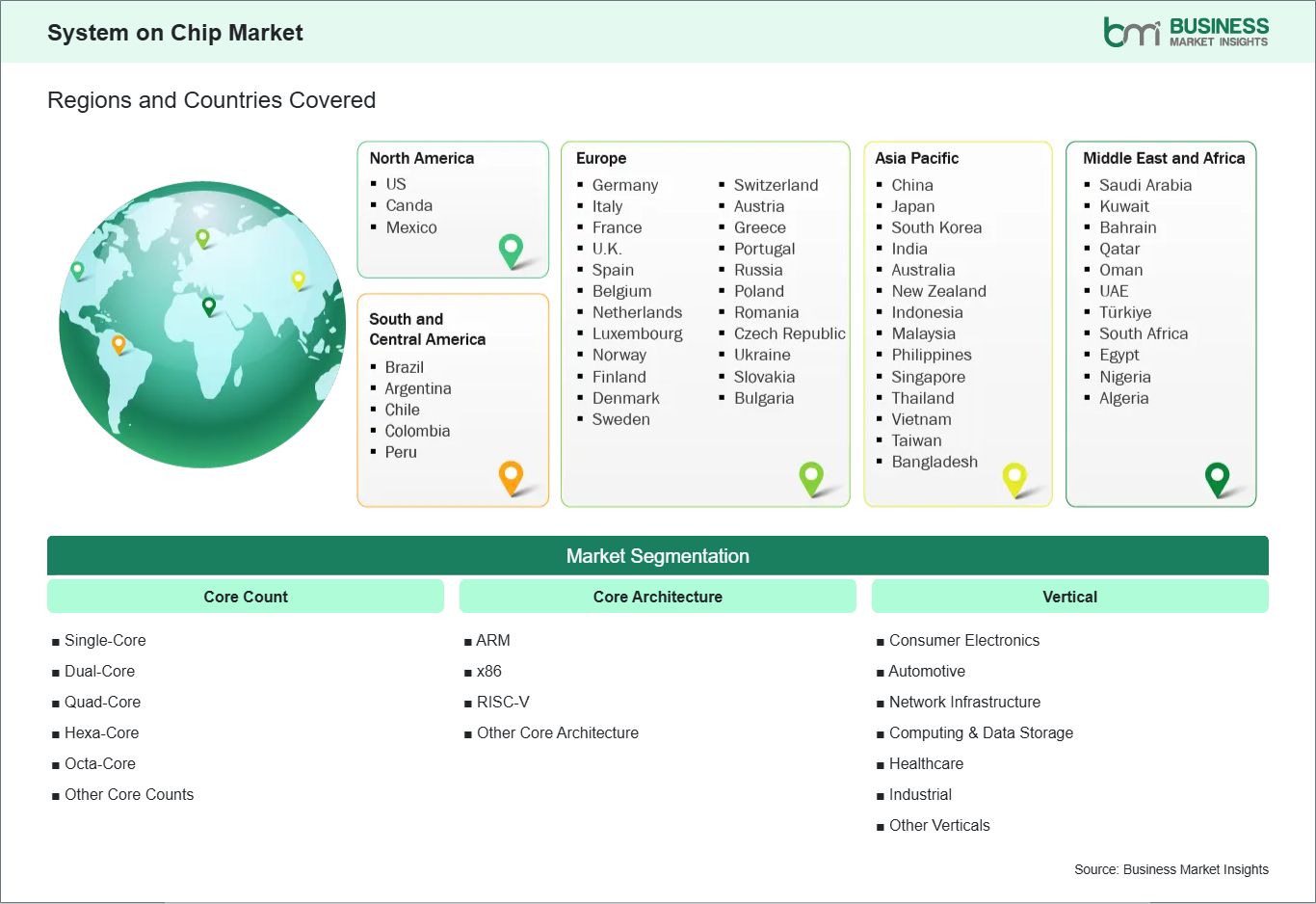
Key segments that contributed to the derivation of the SoC market analysis are core count, core architecture, and vertical.
The global System‑on‑Chip market is being driven by an increasing demand for compact electronic devices. The miniaturization of consumer electronics, including smartphones, tablets, wearables and laptops, requires highly integrated chips that combine multiple functions into a single silicon package. The SoC design and manufacturing industry is experiencing growth because companies are competing to produce devices that are smaller and lighter and consume less energy. Compact SoCs are used in both consumer electronics, industrial applications and automotive applications because these systems require space-saving designs that deliver dependable performance. SoCs enable embedded systems in electric vehicles and robotics, and automation to achieve their performance goals while using minimal energy. The demand for portable and convenient electronic devices drives chip architecture innovation, which enables the development of more functions to be included in a single SoC. The integration process decreases both device dimensions and manufacturing difficulties, which leads to sustained worldwide demand for compact SoCs.
The global SoC market is also expanding due to growing adoption of AI and IoT applications. SoCs with integrated AI accelerators enable edge computing, allowing devices to process data locally for faster response times and enhanced performance. This is crucial for applications such as smart homes, autonomous systems, and predictive maintenance in industrial IoT networks. IoT proliferation across industries, including healthcare, transportation, and energy, is creating demand for SoCs capable of handling multiple sensors, communication protocols, and security features. These chips allow real-time analytics and device connectivity while maintaining energy efficiency. Additionally, the integration of AI in SoCs supports machine learning workloads for intelligent automation, data processing, and decision-making. This drives SoC adoption across consumer, industrial, and enterprise applications globally, establishing AI- and IoT-enabled devices as a key growth segment in the market.
The System‑on‑Chip (SoC) Market demonstrates steady growth, with size and share analysis highlighting evolving trends and competitive dynamics among key players. The report examines subsegments categorized within core count, core architecture, and vertical, offering insights into their contribution to overall market performance.
By Core Count, the quad‑core subsegment dominated the market in 2025, driven by the need for higher processing power and multi‑tasking capabilities in modern electronic devices.
Based on Core Architecture, the ARM subsegment dominated the market in 2025, owing to its energy efficiency, scalability, and widespread adoption in mobile and embedded systems.
On the Basis of Vertical, the consumer electronics subsegment dominated the market in 2025, propelled by the growing demand for smartphones, tablets, wearable devices, and other smart gadgets.
| Report Attribute | Details |
|---|---|
| Market size in 2025 | US$ 137.50 Billion |
| Market Size by 2033 | US$ 207.30 Billion |
| Global CAGR (2026 - 2033) | 5.27% |
| Historical Data | 2022-2024 |
| Forecast period | 2026-2033 |
| Segments Covered | By Core Count
|
|
Regions and Countries Covered
| |
| North America | US, Canada, Mexico |
| Europe | Belgium, Austria, Finland, Denmark, Greece, Poland, Romania, Russia, Ukraine, Czech Republic, Slovakia, Bulgaria, Italy, Luxembourg, Germany, Switzerland, France, Netherlands, Norway, Portugal, Spain, Sweden, United Kingdom |
| Asia-Pacific | Australia, China, India, Japan, South Korea, Indonesia, Malaysia, Philippines, Singapore, Thailand, Vietnam, Bangladesh, New Zealand, Taiwan |
| South and Central America | Brazil, Argentina, Peru, Chile, Colombia |
| Middle East and Africa | Bahrain, Kuwait, Oman, Qatar, Saudi Arabia, United Arab Emirates, Turkiye, South Africa, Egypt, Algeria, Nigeria |
| Market leaders and key company profiles |
|
The "System‑on‑Chip Market Size and Forecast (2022 - 2033)" report provides a detailed analysis of the market covering below areas:
The geographical scope of the System‑on‑Chip Market report is divided into North America, Asia Pacific, Europe, Middle East & Africa, and South & Central America. North America held the largest share in 2025.
The global System‑on‑Chip market demonstrates distinct dynamics across regions, shaped by technological adoption, industrial priorities, and infrastructure development. North America leads in SoC design innovation, driven by strong R&D ecosystems, high adoption of AI and edge computing applications, and integration of SoCs into cloud infrastructure and autonomous systems.
Asia Pacific dominates production and manufacturing, with its robust electronics manufacturing ecosystem supporting mass deployment of mobile devices, IoT hardware, and telecommunication infrastructure, while rapid urbanization and digital transformation fuel demand for energy-efficient and multi-functional SoCs. Europe focuses on industrial automation, automotive electronics, and smart energy solutions, emphasizing functional safety, regulatory compliance, and domain-specific chip designs.
Middle East & Africa is emerging as a growth region for SoCs in telecommunications, smart city initiatives, and industrial monitoring, with rising investment in digital infrastructure creating new opportunities for low-power and cost-effective SoCs. South & Central America is witnessing gradual adoption of SoCs in automotive, consumer electronics, and industrial sectors, supported by localized manufacturing initiatives and increasing integration of connected devices.
Across all regions, the market is shaped by differing priorities: North America and Europe emphasize innovation and application-specific design, Asia Pacific leads in manufacturing scale, while Middle East, Africa, and South & Central America are focused on infrastructure-driven adoption, highlighting the global interdependence and strategic diversification within the SoC ecosystem.

The System‑on‑Chip Market is evaluated by gathering qualitative and quantitative data post primary and secondary research, which includes important corporate publications, association data, and databases. A few of the key developments in the spatial light Modulator market are:
The System‑on‑Chip Market is valued at US$ 137.50 Billion in 2025, it is projected to reach US$ 207.30 Billion by 2033.
As per our report System‑on‑Chip Market, the market size is valued at US$ 137.50 Billion in 2025, projecting it to reach US$ 207.30 Billion by 2033. This translates to a CAGR of approximately 5.27% during the forecast period.
The System‑on‑Chip Market report typically cover these key segments-
The historic period, base year, and forecast period can vary slightly depending on the specific market research report. However, for the System‑on‑Chip Market report:
The System‑on‑Chip Market is populated by several key players, each contributing to its growth and innovation. Some of the major players include:
The System‑on‑Chip Market report is valuable for diverse stakeholders, including:
Essentially, anyone involved in or considering involvement in the System‑on‑Chip Market value chain can benefit from the information contained in a comprehensive market report.
Please tell us your area of interest
(Market Segments/ Regions and Countries/ Companies)