
System on A Chip Market Outlook: Size, Share, Trends, Growth Analysis, Competitive Landscape & Forecast, 2026-2033

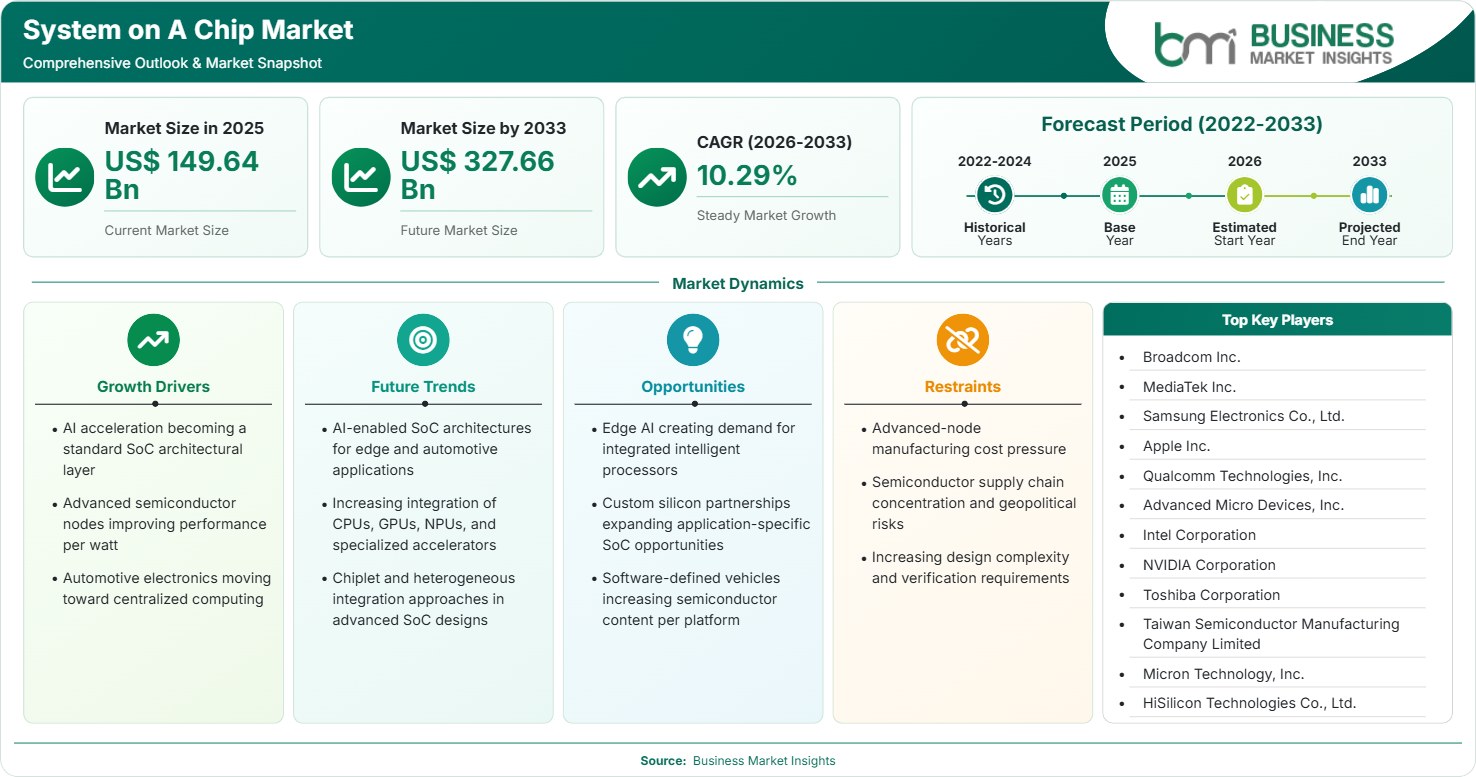
The System on A Chip Market size was valued at US$ 149.64 Billion in 2025 and is projected to reach US$ 327.66 Billion by 2033, growing at a CAGR of 10.29% during 2026–2033, driven by AI edge computing, connected vehicles, advanced smartphones, energy-efficient computing, and integrated semiconductor architectures.

Report Coverage
  • Core Count: Single-core, Dual-core, Quad-core, Hexa-core, Octa-core
  • Application: Consumer Electronics, Automotive, Network Infrastructure, Computing & Data Storage, Healthcare, Industrial
US$ 149.64 Bn Market size in 2025
US$ 327.66 Bn Market Size by 2033
10.29% CAGR, 2026 - 2033
2026-2033 Forecast Period

AI Overview

System on A Chip Market Summary

  • North America: North America holds a 30%–34% share in 2025, with a 9.2%–10.1% CAGR during 2026–2033, supported by AI infrastructure, hyperscale computing, automotive electronics, custom silicon, and semiconductor design investment. The US market remains technology-led, with a 9.4%–10.3% CAGR during 2026–2033, supported by AI PCs, cloud infrastructure, autonomous systems, and custom accelerators.
  • Fastest Growing Region: Asia Pacific accounts for a 36%–40% share in 2025 and is projected to register a 11.4%–12.4% CAGR during 2026–2033, driven by smartphone manufacturing, automotive electronics, semiconductor fabrication, edge AI, connected devices, and expanding advanced packaging capacity.
  • Leading Segment: Octa-core processors represent a 38%–42% share in 2025 and are projected to expand at a 10.7%–11.6% CAGR through 2033, benefiting from mobile AI, premium smartphones, gaming, multitasking, and increasingly sophisticated on-device computing workloads.
  • High Growth Segment: Automotive applications account for a 12%–15% share in 2025 and are projected to grow at a 13.2%–14.4% CAGR through 2033, supported by software-defined vehicles, ADAS, digital cockpits, electrification, sensor fusion, and centralized vehicle computing architectures.
  • Key Market Opportunity: The strongest opportunity lies in AI-enabled edge SoCs combining CPU, GPU, NPU, connectivity, security, and memory interfaces, reducing latency, energy consumption, bill-of-materials complexity, and dependence on cloud inference.
  • Major Market Players: Broadcom Inc., MediaTek Inc., Samsung Electronics Co., Ltd., Apple Inc., Qualcomm Technologies, Inc., Advanced Micro Devices, Inc., Intel Corporation, NVIDIA Corporation, Toshiba Corporation, Taiwan Semiconductor Manufacturing Company Limited, Micron Technology, Inc., HiSilicon Technologies Co., Ltd., Maxim Integrated Products, Inc., and NXP Semiconductors N.V.
Strategic Insights

System on A Chip Market: Strategic Insights

System on A Chip Market Strategic Framework
FREE PDF
Request your free sample
Request free sample
Stakeholder View

Key Takeaways

  • Market structure insight: Value is migrating toward integrated platforms rather than standalone processors as OEMs prioritize fewer components, lower power consumption, smaller footprints, faster development cycles, and software-hardware optimization.
  • Growth opportunity insight: Automotive and edge-computing deployments provide particularly attractive upside because AI inference, connectivity, sensing, safety, and graphics increasingly require coordinated processing within a single semiconductor platform.
  • Innovation trend: AI acceleration is becoming a core architectural element. Apple’s M4 demonstrates the direction, integrating CPU, GPU, and Neural Engine capabilities in a 3-nanometer SoC architecture.
  • Regional opportunity: Asia Pacific combines semiconductor manufacturing depth, smartphone production, electronics exports, and rapidly expanding automotive electronics, making it central to capacity expansion and advanced-node commercialization.
  • Investment and M&A trend: Strategic partnerships are increasingly focused on custom silicon and complete computing platforms. Broadcom’s 2025 collaboration with OpenAI targeted 10 gigawatts of custom AI accelerators, illustrating the scale of hyperscaler-driven silicon demand.
  • Strategic insight: Competitive differentiation is increasingly determined by software ecosystems, AI inference efficiency, memory bandwidth, connectivity, security, and lifecycle support rather than processor frequency alone.
Geographic Outlook

System on A Chip Market Regional Highlights

North America System on A Chip Market

North America holds a 30%–34% share in 2025 and is projected to register a 9.2%–10.1% CAGR through 2033. The region benefits from hyperscale AI infrastructure, semiconductor design expertise, automotive software development, and strong fabless ecosystems. The market share is supported by high-value applications rather than mass-volume manufacturing. The System on A Chip Market growth outlook remains tied to AI accelerators, edge inference, connected vehicles, data centers, and domestic semiconductor investment.

  • AI infrastructure is increasing demand for specialized computer architectures, networking silicon, and energy-efficient acceleration platforms across hyperscale and enterprise environments.
  • Automotive OEMs are integrating centralized compute, advanced driver assistance, infotainment, and connectivity into increasingly software-defined vehicle architectures.
  • Semiconductor policy initiatives are encouraging domestic capacity, supply-chain diversification, advanced packaging, and strategic investment in critical chip technologies.
  • Consumer computing is shifting toward AI PCs and heterogeneous architectures that combine general-purpose processing with dedicated neural acceleration.

US System on A Chip Market

The US represents approximately 72%–76% of North American System on A Chip Market demand in 2025 and is expected to grow at a 9.4%–10.3% CAGR through 2033. The market is supported by leading chip designers, cloud providers, AI developers, defense applications, automotive technology companies, and advanced computing research. Custom silicon is becoming strategically important as hyperscalers optimize workload-specific performance, energy efficiency, networking, and total ownership costs.

  • AI infrastructure remains a primary demand catalyst as developers seek specialized processors for training, inference, networking, and increasingly distributed computing workloads.
  • Automotive semiconductor adoption is expanding through digital cockpits, ADAS, automated driving, vehicle networking, and centralized domain computing platforms.
  • Domestic semiconductor incentives are strengthening investment rationales for advanced fabrication, packaging, research, and supply-chain resilience across critical technology categories.

Europe System on A Chip Market

Europe represents a 17%–20% System on A Chip Market share in 2025 and is forecast to expand at a 8.6%–9.5% CAGR through 2033. Germany remains the leading regional market, while France and the Netherlands provide strong semiconductor, automotive, and research capabilities. Automotive electronics, industrial automation, energy efficiency, and connected manufacturing support demand. Germany is projected at a 9.0%–9.8% CAGR, while France can achieve a 9.6%–10.5% CAGR as edge AI and industrial electronics expand.

  • Automotive suppliers are integrating compute, connectivity, sensing, and functional safety into scalable semiconductor architectures for next-generation vehicles.
  • Industrial automation is supporting demand for processors that deliver deterministic control, real-time analytics, machine vision, and low-latency edge inference.
  • European semiconductor initiatives are improving regional capabilities across fabrication, advanced packaging, research, and strategic technology supply chains.
  • The Netherlands remains important to the semiconductor ecosystem through equipment, research, and advanced manufacturing technologies supporting complex chip production.

Asia Pacific System on A Chip Market

Asia Pacific represents a 36%–40% market share in 2025 and is projected to register an 11.4%–12.4% CAGR, according to System on Chip Market Forecasts. China, Taiwan, South Korea, Japan, and India form important demand and supply centers. Taiwan remains dominant in advanced foundry manufacturing, South Korea in memory and consumer electronics, China in electronics scale, Japan in industrial technologies, and India in design and digital infrastructure.

  • Taiwan benefits from advanced foundry leadership, high-performance computing demand, smartphone production, and accelerating investment in advanced process technologies.
  • South Korea is supported by semiconductor manufacturing, smartphones, memory integration, displays, and increasing AI-enabled consumer electronics.
  • China offers extensive electronics manufacturing capacity and strong demand for mobile devices, industrial automation, automotive electronics, and connected infrastructure.
  • India is emerging as a design, electronics manufacturing, automotive technology, and digital infrastructure opportunity as semiconductor ecosystem investment expands.

Rest of World System on A Chip Market

South and Central America account for a 5%–7% System on A Chip Market share in 2025 and are projected to grow at a 8.1%–9.0% CAGR through 2033. Brazil remains the leading regional opportunity as automotive production, telecommunications, industrial automation, consumer electronics, and digital infrastructure expand. Mexico also provides an important electronics and automotive manufacturing base connected to North American supply chains.

The Middle East and Africa contribute a 7%–9% share and are expected to register a 9.0%–10.0% CAGR through 2033. The UAE and Saudi Arabia lead regional technology investment, while South Africa provides an established industrial and telecommunications ecosystem.

  • Brazil’s automotive and industrial base creates opportunities for embedded processors, connectivity chips, sensing, and edge intelligence.
  • Mexico benefits from electronics and automotive manufacturing integration with North American production networks and supply chains.
  • Gulf economies are investing in AI infrastructure, smart cities, telecommunications, and digital services requiring advanced compute platforms.
  • South Africa provides opportunities across telecommunications, industrial automation, security, healthcare technology, and connected infrastructure applications.
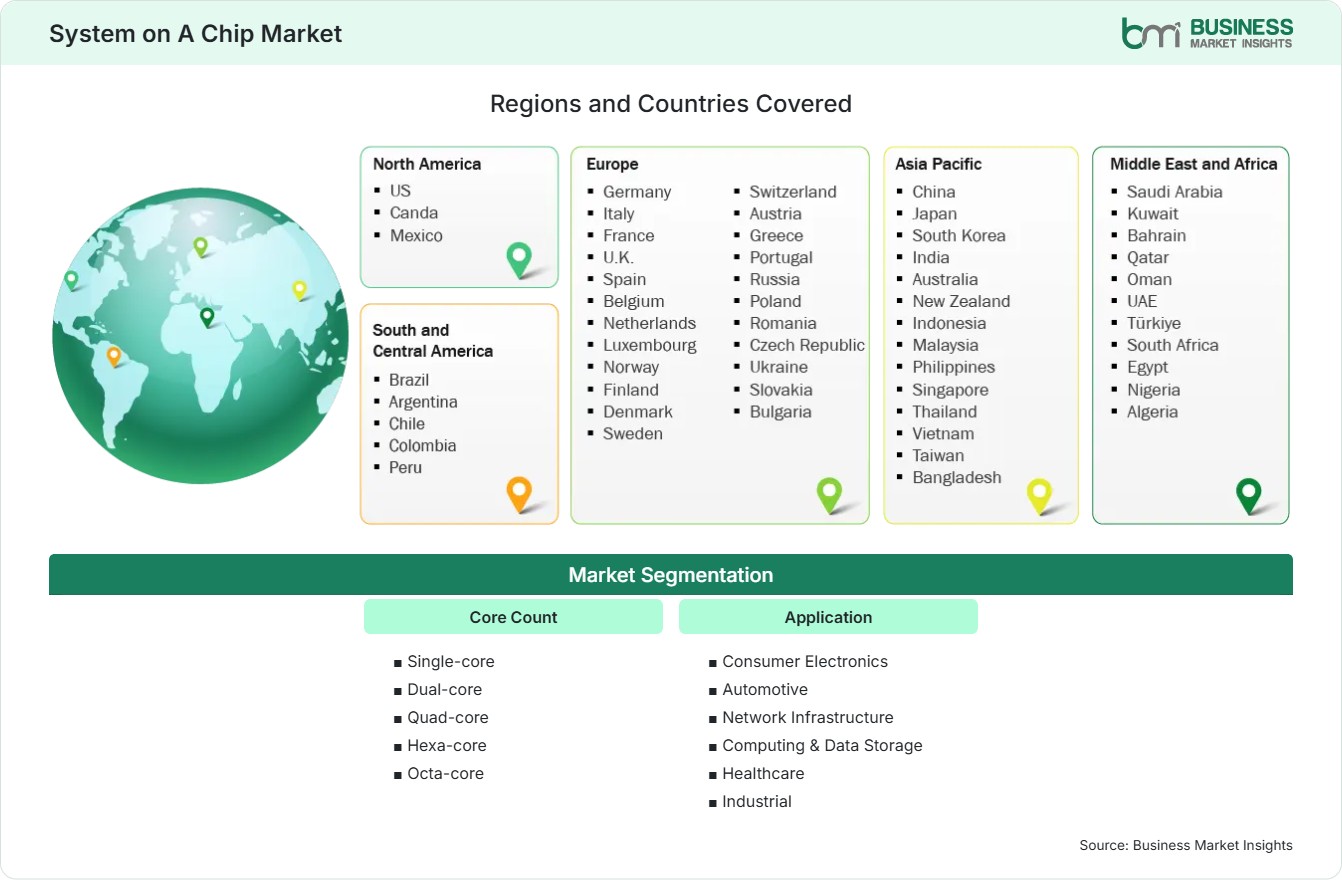
Global Market Geography
FREE PDF
Request your free sample
Request free sample
Segment Analysis

System on A Chip Market Segmentation

Core Count

The core-count segment is led by Octa-core architectures, representing a 38%–42% share in 2025 and a 10.7%–11.6% CAGR during 2026–2033. Demand is shaped by AI workloads, mobile multitasking, gaming, connectivity, energy efficiency, and increasingly heterogeneous processor designs. The System on A Chip Market scope is expanding as multiple compute cores combine with GPUs, NPUs, and specialized accelerators.

  • Single-core: Single-core designs remain relevant in cost-sensitive embedded systems, simple controllers, and low-complexity electronics where deterministic operation, low power, and minimal silicon area outweigh parallel processing requirements.
  • Dual-core: Dual-core architectures support balanced performance in connected devices, entry-level electronics, industrial controllers, and embedded systems requiring basic multitasking without the power and cost burden of larger processor configurations.
  • Quad-core: Quad-core SoCs provide a practical balance of responsiveness, energy efficiency, graphics, and application performance for mid-range consumer devices, embedded platforms, automotive interfaces, and connected equipment.
  • Hexa-core: Hexa-core designs address workloads requiring stronger parallel processing while maintaining controlled power consumption, supporting premium mobile devices, automotive applications, edge computing, and increasingly capable embedded platforms.
  • Octa-core: Octa-core architectures benefit from heterogeneous performance and efficiency cores, enabling demanding AI, graphics, multitasking, gaming, communications, and multimedia workloads across smartphones, PCs, and intelligent edge devices.

Application

Consumer Electronics leads applications with a 41%–45% System on A Chip Market share in 2025 and a 9.8%–10.7% CAGR during 2026–2033. Automotive is the fastest-growing application at a 13.2%–14.4% CAGR, supported by software-defined vehicles, ADAS, digital cockpits, and electrification. Integrated AI, connectivity, security, and compute capabilities are reshaping procurement priorities across device categories.

  • Consumer Electronics: Smartphones, tablets, wearables, smart TVs, gaming systems, and AI PCs demand increasingly integrated processors that improve performance, battery life, graphics, connectivity, and on-device intelligence.
  • Automotive: Automotive SoCs combine compute, AI acceleration, graphics, connectivity, safety, and sensor processing for ADAS, infotainment, digital cockpits, vehicle networking, and software-defined vehicle architectures.
  • Network Infrastructure: Networking SoCs enable high-throughput switching, routing, security, optical connectivity, and AI cluster interconnection, supporting hyperscale data centers, telecom networks, enterprise infrastructure, and edge deployments.
  • Computing & Data Storage: Computing platforms use integrated processors and accelerators to improve performance per watt across AI PCs, servers, storage systems, workstations, and specialized high-performance computing environments.
  • Healthcare: Healthcare applications use integrated computing for medical imaging, patient monitoring, diagnostics, portable devices, robotics, and intelligent equipment where low latency, security, reliability, and compact form factors matter.
  • Industrial: Industrial deployments require deterministic processing, machine vision, robotics, predictive maintenance, networking, and real-time control, creating demand for robust SoCs with integrated AI and connectivity capabilities.
Market Forces

System on A Chip Market Dynamics

Key Market Drivers

AI acceleration is becoming a standard SoC architectural layer

AI tasks are being moved from cloud computing to local inference, which will result in an increased need for SoCs that feature integrated neural processing in addition to CPUs and GPUs. For example, the M4 processor features a 16-core Neural Engine with a peak performance of 38 trillion operations per second, underscoring the growing importance of acceleration in high-end computing systems. The same applies to Qualcomm, which is working to expand its Edge AI capabilities in areas such as PCs, cars, smart homes, and enterprise computing systems. It means that the future market growth depends on TOPS per Watt, memory efficiency, software compatibility, and secure processing on devices. The System on A Chip Market trends increasingly favor purpose-built AI blocks over incremental CPU-only performance improvements.

Advanced semiconductor nodes improve performance per watt

Process scaling is driving demand for integrated architectures, as advanced nodes enable more computing resources within constrained power and thermal envelopes. According to TSMC, 3-nanometer technologies accounted for 24% of its wafer revenues in 2025, while 2-nanometer technologies were entering high-volume manufacturing in the fourth quarter of 2025. The smaller the node, the higher the transistor density, and more complex combinations can be designed: CPU cores, graphics engine, NPU, memory controller, security block, connectivity interface. In the case of mobility and edge applications, better performance per watt means higher power efficiency and allows running more sophisticated workloads for AI applications. In automotive and industrial applications, power efficiency enables continuous inference under thermal constraints.

Automotive electronics are moving toward centralized compute

Vehicle architecture is shifting from numerous independent electronic control units to centralized, domain-oriented computing platforms. This transition increases the requirement for SoCs capable of simultaneously handling infotainment, graphics, sensor processing, connectivity, AI inference, and safety-related workloads. Qualcomm’s collaboration with Hyundai Mobis on the Snapdragon Ride Flex SoC involves high-performance computing along with ADAS and infotainment features, whereas NXP’s i.MX 952 is integrated with an NPU to handle artificial intelligence-powered vision, human-machine interface, and cabin sensing applications. This approach helps cut down hardware redundancies and simplifies software management. The automotive OEMs, therefore, have an emphasis on scalable design, long product life cycles, functional safety, security, predictable performance, and flexible software frameworks.

Key Market Opportunities

Edge AI creates demand for integrated intelligent processors

Edge AI offers an important investment opportunity because enterprises increasingly require immediate inference without sending every workload to centralized cloud infrastructure. Local processing will minimize latency, maintain privacy, and restrict the need for data transmission. In this regard, Micron sees memory bandwidth and power as some of the most important considerations for edge AI computing, with the necessity to achieve the right balance between processing capability and memory architecture. Such an opportunity can be seized by semiconductor companies by bringing together NPUs, low-power memory interfaces, secure enclaves, image signal processors, connectivity, and accelerators on a single compact platform. Smart cameras, robots, health care devices, industrial sensors, autonomous systems, and smart appliances form many avenues of implementation.

Custom silicon partnerships expand the addressable opportunity

Hyperscaler demand is creating an opportunity for semiconductor companies that can co-design workload-specific silicon rather than relying solely on standardized processors. The Broadcom agreement with OpenAI in October 2025 entailed 10 gigawatts of customized AI accelerators and networking systems, with deployment plans from mid-2026 to 2029. Such an example indicates that large-scale developers of AI applications could shape the development of processors’ architectures, interconnections, packaging, and even entire systems. SoC platforms may be designed specifically to meet the requirements of particular AI applications with respect to inference efficiency, memory usage, networking, and power consumption. There may be opportunities for semiconductor suppliers with advanced design, high-speed interconnection, packaging, and software ecosystems.

Software-defined vehicles broaden semiconductor content per platform

Software-defined vehicles present a multi-year opportunity, as vehicle functionality is increasingly delivered via software updates and centralized computing. For instance, NXP’s S32N7 series incorporates computing, networking, AI, data processing, isolation, safety, and security capabilities on a scalable SoC platform. Such an architectural approach may help combine multiple vehicle applications and avoid platform fragmentation among automakers and Tier-1 suppliers. The investment opportunity is not limited only to processors but includes software development kits, virtualization, cybersecurity, functional safety tools, middleware, and life cycle management services. Scalable silicon platforms equipped with reusable software and broad interoperability with other platforms can minimize development costs for customers and facilitate platform adoption. Hence, automotive semiconductor content may grow as vehicles move to the world of centralized computing and software upgrades.

Market Restraints and Challenges

Advanced-node and packaging costs constrain profitability

Factor: Advanced semiconductor manufacturing requires expensive process development, wafer capacity, packaging infrastructure, verification, and specialized engineering resources. Impact: Moving from TSMC to 2-nanometer production shows how capital-intensive leading-edge process adoption and yield enhancement are. Also, shrinking processes increase design complexity, verification needs, reliance on intellectual property, and heat-dissipation challenges. For companies that do not have enough mass to adopt these technologies in niche applications, the problem can be especially acute. Therefore, many vendors opt to leverage platform reuse, differentiation via accelerators, heterogeneous integration, and multi-use architecture to share R&D expenses. This cost control is particularly critical in automotive and industrial markets with long qualification periods.

Supply-chain concentration creates operational exposure

Factor: Advanced SoC production depends on concentrated ecosystems spanning semiconductor fabrication, electronic design automation, advanced packaging, substrates, memory, and specialized manufacturing equipment. Impact: Disruptions in any of these key layers could delay the release of new products, necessitate higher inventory levels, and reduce supply security. TSMC's involvement in the state-of-the-art processing of leading processors for smartphones, HPC, automotive, and IoT underscores the significance of advanced foundries. Geopolitical barriers could also play an important role in accessing advanced technology, equipment, and foreign markets. Corporations are addressing this issue by adopting policies of diversification in sourcing, localization in manufacturing, and a commitment to higher capacities, higher inventories, and greater visibility within the supply chain. Nonetheless, replication of leading-edge manufacturing ecosystems is expensive and time-consuming.

Company Analysis

Competitive Landscape

The System on A Chip Market analysis indicates that competition is shifting toward integrated AI compute, energy efficiency, advanced process technology, automotive qualification, connectivity, and software ecosystems. Major companies are differentiating through proprietary architectures, custom silicon programs, advanced manufacturing partnerships, and application-specific platforms.

Company Name

Overview

Products and Services relevant to this market

Broadcom Inc.

Semiconductor and infrastructure technology provider with strong exposure to custom accelerators and high-speed connectivity.

Custom AI accelerators, networking silicon, Ethernet, PCIe, optical connectivity, switching, and infrastructure semiconductor platforms.

MediaTek Inc.

Fabless semiconductor company focused strongly on mobile, consumer, connectivity, and intelligent edge computing platforms.

Dimensity mobile SoCs, connectivity processors, multimedia platforms, automotive solutions, smart-device and edge AI technologies.

Samsung Electronics Co., Ltd.

Diversified electronics and semiconductor company with substantial processor, memory, and advanced manufacturing capabilities.

Exynos processors, mobile SoCs, AI computing technologies, semiconductor manufacturing, memory integration, and connected-device platforms.

Apple Inc.

Technology company designing proprietary silicon to tightly integrate hardware, operating systems, graphics, and machine learning.

Apple silicon SoCs, CPU and GPU architectures, Neural Engine, unified memory architectures, and AI-enabled computing platforms.

Qualcomm Technologies, Inc.

Semiconductor and wireless technology leader with broad mobile, automotive, PC, and edge AI capabilities.

Snapdragon mobile, PC, automotive, connectivity, AI, digital cockpit, ADAS, and edge computing SoC platforms.

Advanced Micro Devices, Inc.

High-performance semiconductor company expanding AI, embedded, computing, and adaptive processing capabilities.

Ryzen AI, embedded processors, adaptive SoCs, CPUs, GPUs, AI accelerators, and industrial computing platforms.

Intel Corporation

Integrated semiconductor company serving PCs, data centers, edge systems, networking, and AI computing.

Core Ultra processors, Xeon platforms, integrated graphics, AI accelerators, networking silicon, and edge computing solutions.

NVIDIA Corporation

Computing platform company specializing in accelerated computing, AI, graphics, and high-performance processing.

Grace Blackwell superchips, GPUs, AI accelerators, networking platforms, embedded computing, and AI development ecosystems.

Toshiba Corporation

Japanese technology group with semiconductor capabilities supporting industrial, automotive, power, and embedded applications.

Automotive and industrial processors, microcontrollers, power semiconductors, sensors, and embedded semiconductor technologies.

Taiwan Semiconductor Manufacturing Company Limited

Leading dedicated foundry supporting advanced semiconductor manufacturing for global chip designers.

Advanced-node wafer fabrication, 3-nanometer and 2-nanometer processes, specialty technologies, and advanced packaging services.

Micron Technology, Inc.

Memory and storage semiconductor company supporting AI, edge computing, automotive, and data-intensive applications.

DRAM, LPDDR, high-bandwidth memory, NAND, SSDs, and memory technologies supporting SoC-based computing platforms.

HiSilicon Technologies Co., Ltd.

Semiconductor design company associated with application processors, connectivity, and intelligent device technologies.

Kirin processors, networking chips, AI processors, connectivity solutions, and application-specific semiconductor platforms.

Maxim Integrated Products, Inc.

Analog and mixed-signal semiconductor company serving industrial, automotive, healthcare, and embedded systems.

Power management, signal conditioning, interface, sensing, and mixed-signal technologies supporting integrated electronic architectures.

NXP Semiconductors N.V.

Semiconductor supplier focused strongly on automotive, industrial, IoT, secure connectivity, and embedded computing.

i.MX applications processors, S32 automotive processors, edge AI, connectivity, security, and industrial SoC platforms.

Trust & Transparency

Research Methodology

The market analysis combines proprietary research with secondary data from government agencies, company disclosures, regulatory filings, industry databases and expert interviews. Market estimates are validated through data triangulation, cross-market benchmarking and analyst review.

View Full Research Methodology

Questions Answered

Frequently Asked Questions

Where can buyers find detailed industry intelligence?

The System on A Chip Market Report provides structured intelligence across core count, application, regional performance, competitive positioning, technology trends, strategic opportunities, and market forecasts to support investment and business planning.

How does advanced packaging affect processor competitiveness?

Advanced packaging enables closer integration of compute, memory, and high-speed interconnects. It can improve bandwidth and energy efficiency while allowing complex systems to be assembled from specialized components, making packaging capability increasingly important alongside transistor scaling.

Why are NPUs becoming important in processor design?

NPUs accelerate neural-network inference using architectures optimized for AI operations. Their integration allows devices to execute speech, vision, generative AI, and predictive workloads locally while reducing CPU and GPU utilization and improving energy efficiency.

What makes automotive SoCs different from consumer processors?

Automotive platforms require longer support periods, functional safety, cybersecurity, deterministic performance, thermal robustness, and qualification for harsh operating environments. They also increasingly combine ADAS, infotainment, connectivity, sensing, and vehicle control workloads.

What is driving demand for integrated processor architectures?

Demand is increasingly driven by AI inference, connectivity, graphics, cybersecurity, and energy efficiency. Integrating these functions into one platform can reduce component count, latency, board complexity, and power consumption while simplifying software optimization.

Access the Full System on A Chip Market Report

Get segment-level forecasts, regional estimates, competitive benchmarking, company profiles and downloadable Excel datasets.

Access the full System on A Chip Market Report
350 pages PDF & Excel | 2026-08-27