
Consumer Drone Market Outlook: Size, Share, Trends, Growth Analysis, Competitive Landscape & Forecast, 2026-2033

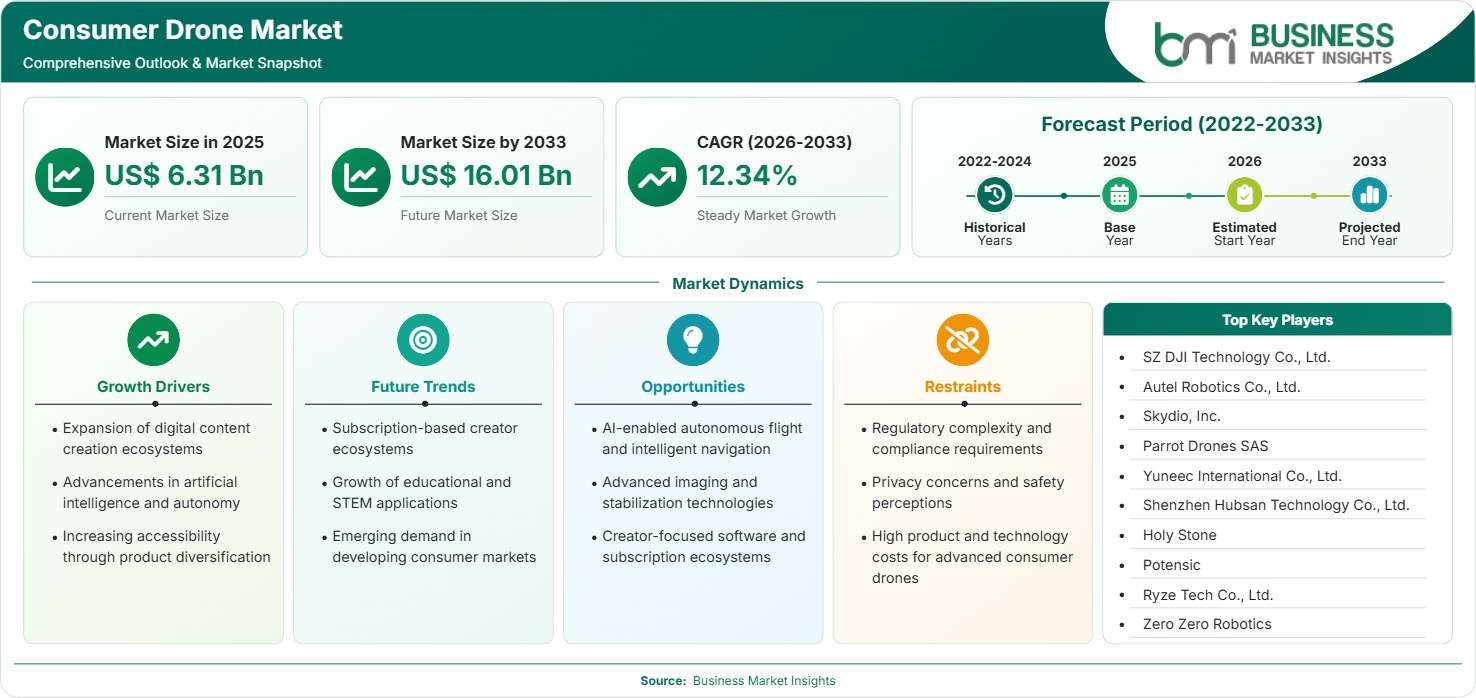
The Consumer Drone Market size was valued at US$ 6.31 Billion in 2025 and is projected to reach US$ 16.01 Billion by 2033, growing at a CAGR of 12.34% during 2026–2033, supported by advanced imaging systems, AI-enabled flight controls, recreational adoption, creator economy expansion, and widening educational applications across developed and emerging markets.

Report Coverage
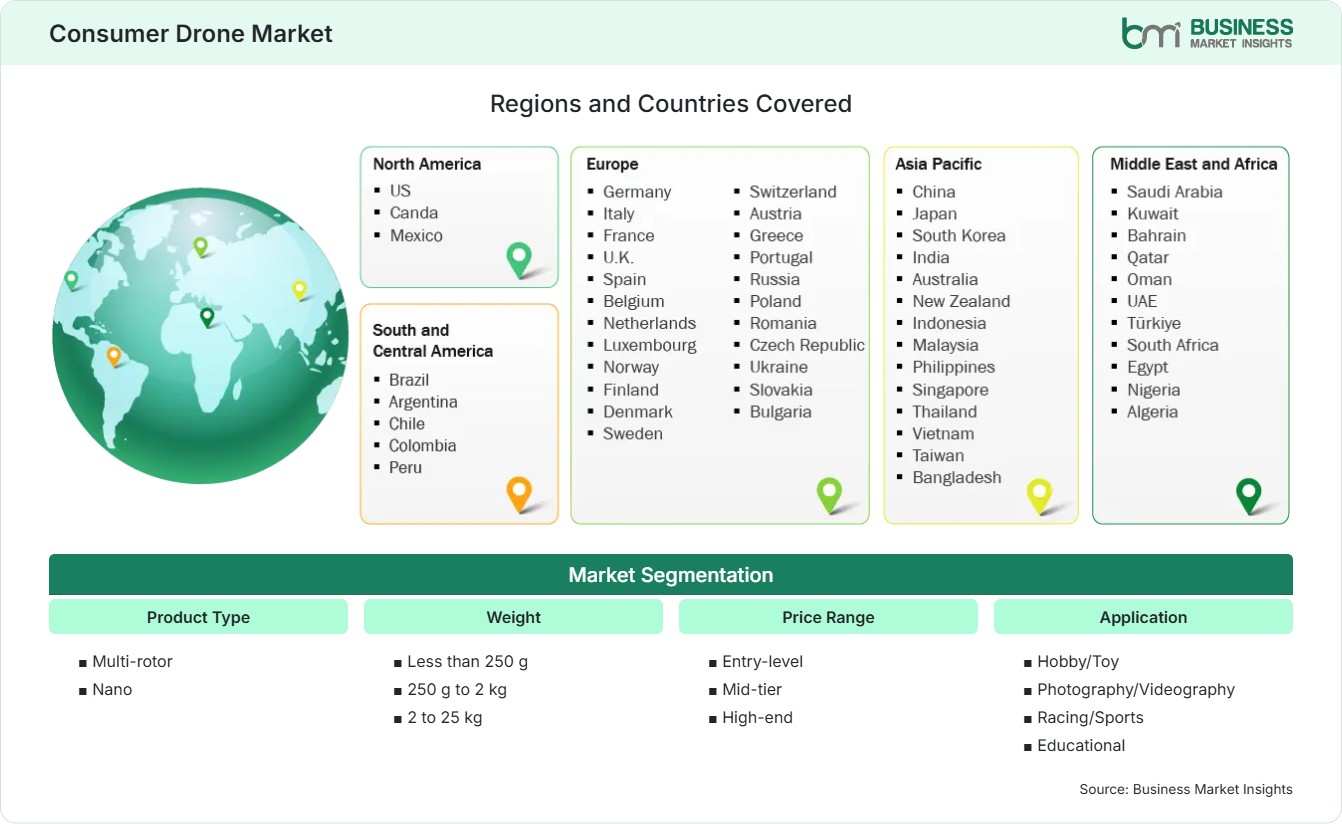
  • Product Type: Multi-rotor, Nano
  • Weight: Less than 250 g, 250 g to 2 kg, 2 to 25 kg
  • Price Range: Entry-level, Mid-tier, High-end
  • Application: Hobby/Toy, Photography/Videography, Racing/Sports, Educational
  • Technology: Manual/Remote Control, Autonomous
US$ 6.31 Bn Market size in 2025
US$ 16.01 Bn Market Size by 2033
12.34% CAGR, 2026 - 2033
2026-2033 Forecast Period

AI Overview

Consumer Drone Market Summary

  • North America Region: North America holds a market share of 34%–37% in 2025 and is expected to grow at a CAGR of 10.8%–11.6% during 2026–2033. Growing recreational registrations, premium product adoption, content-creation demand, AI-enabled navigation capabilities, supportive retail ecosystems, expanding drone sports participation, educational deployments, and accessory ecosystem development continue strengthening regional demand momentum. US market benefits from advanced consumer spending and creator economy expansion, recording a CAGR of 10.9%–11.7%.
  • Fastest Growing Region: Asia Pacific holds a market share of 28%–31% in 2025 and is projected to expand at a CAGR of 13.8%–14.6% during 2026–2033. Rising middle-class purchasing power, local manufacturing strength, expanding drone clubs, affordable technology availability, social-media content creation, educational initiatives, and e-commerce distribution channels collectively accelerate adoption rates.
  • Leading Segment: Photography/Videography accounts for 38%–42% share of the Consumer Drone Market in 2025 and advances at a CAGR of 12.6%–13.4%. High-resolution imaging, travel content creation, influencer marketing, tourism promotion, cinematic production accessibility, stabilization technologies, creative software integration, and growing recreational filming requirements sustain consistent category expansion globally.
  • High Growth Segment: Autonomous technology represents a 31%–35% share in 2025 and grows at 14.2%–15.0% CAGR. Automated flight paths, obstacle avoidance, AI-assisted tracking, improved consumer safety, simplified operation, smart return functionality, enhanced battery management, and software-driven upgrades increase user adoption considerably.
  • Key Market Opportunity: Integration of AI-powered autonomous functions with creator-focused services enables subscription revenues, simplified piloting experiences, improved safety standards, and broader consumer penetration beyond traditional hobbyist demographics globally.
  • Major Market Players: SZ DJI Technology Co., Ltd., Autel Robotics Co., Ltd., Skydio, Inc., Parrot Drones SAS, Yuneec International Co., Ltd., Shenzhen Hubsan Technology Co., Ltd., Holy Stone, Potensic, Ryze Tech Co., Ltd., and Zero Zero Robotics.
Strategic Insights

Consumer Drone Market: Strategic Insights

Consumer Drone Market Strategic Framework
FREE PDF
Request your free sample
Request free sample
Stakeholder View

Key Takeaways

  • The value chain is increasingly software-centric, with AI flight management, mapping applications, batteries, sensors, and cloud services contributing larger revenue shares than standalone hardware.
  • Photography and videography applications continue generating the strongest revenue opportunities due to sustained content-creation demand from creators, travelers, and small media producers.
  • Product innovation is shifting toward autonomous navigation, computer vision, object tracking, geofencing, and enhanced safety systems that lower the skill barrier for new users.
  • Asia Pacific presents a compelling investment case due to strong manufacturing ecosystems, improving affordability, growing digital-media engagement, and increasing recreational adoption.
  • Venture investment and strategic partnerships increasingly focus on AI, imaging software, autonomous flight functions, and premium accessories instead of hardware-only differentiation.
  • Educational applications are expanding steadily as schools and training institutions adopt drones for STEM curricula, coding education, and hands-on technology learning.
Geographic Outlook

Consumer Drone Market Regional Highlights

North America Consumer Drone Market

North America accounted for 34%–37% of the Consumer Drone Market share in 2025 and is expected to register a CAGR of 10.8%–11.6% through 2033. Strong consumer spending, extensive hobbyist communities, premium drone adoption, and mature retail networks sustain regional leadership. The region benefits from a large creator economy and widespread use of drones for recreation, photography, and educational activities. Product upgrades emphasizing AI functions and autonomous navigation are supporting replacement demand while enhancing user accessibility across different consumer groups.

  • Rising premium-drone sales are being driven by demand for high-resolution cameras, improved stabilization, and smart tracking capabilities among creators and travel enthusiasts.
  • Recreational registrations remain supported by extensive hobbyist communities, organized flying events, and increasing interest in aerial content production.
  • Retail and e-commerce channels continue expanding product accessibility while strengthening aftermarket sales of batteries, sensors, cases, and accessories.
  • Educational institutions are integrating drone programs into STEM curricula, supporting awareness and encouraging future consumer purchases.

US Consumer Drone Market

The United States contributes 78%–82% of North American revenue and is expected to grow at 10.9%–11.7% CAGR. Advanced consumer technology adoption, strong creator monetization ecosystems, and widespread participation in aerial photography support demand. Premium and autonomous categories are expanding steadily, helped by software-driven upgrades and growing familiarity with AI-enabled flight systems. Consumer interest remains concentrated around content creation, recreation, and technology-focused learning applications, creating sustained replacement and upgrade cycles across multiple demographic groups.

  • Strong purchasing power supports greater adoption of premium drones equipped with advanced cameras, obstacle avoidance systems, and intelligent flight modes.
  • Content creators increasingly rely on aerial footage for digital platforms, strengthening demand for imaging-focused models and related accessories.
  • Recreational use remains widespread because of favorable consumer awareness and extensive product availability through specialized retailers.
  • STEM and maker communities continue encouraging educational drone adoption among students, enthusiasts, and training organizations.

Europe Consumer Drone Market

Europe was estimated to have a 24%-27% share in 2025 and is predicted to grow at a CAGR of 11.5%-12.3%. There is better operational harmonization across several markets, which has led to increased consumer confidence. Germany leads in revenue generation, and Spain is showing rapid growth, with a CAGR that exceeds the regional average. The growth of tourism content creation, recreational flights, and the growing popularity of compact drones has contributed to market growth. Product demand increasingly favors lightweight, compliant, and camera-focused systems developed for ease of operation and improved consumer safety.

  • Germany remains the leading national market due to strong purchasing power and high technology adoption rates.
  • Spain is among the fastest-growing markets, supported by tourism, creator activity, and improving consumer awareness.
  • Lightweight models are gaining popularity because portability and regulatory compliance influence purchasing decisions.
  • Growing participation in recreational aerial imaging continues supporting replacement purchases across established consumer segments.

Asia Pacific Consumer Drone Market

Asia Pacific held a market share of 28%-31% in 2025 and is forecasted to show the highest growth rate with a CAGR of 13.8%-14.6%. China continues to be the largest market due to its manufacturing capabilities and product availability, whereas India shows tremendous growth driven by increased technological acceptance and digital content creation. Growth will be driven by high disposable incomes, the growing presence of e-commerce, and consumer electronics spending.

  • China leads regional demand through strong manufacturing ecosystems, product innovation, and wide availability of consumer-focused offerings.
  • India exhibits rapid growth due to increasing youth participation, creator-economy development, and affordable product access.
  • E-commerce channels are improving market reach across urban and semi-urban consumer segments.
  • Local production capabilities support competitive pricing and faster technology diffusion throughout the region.
  • Social-media content creation remains a major demand generator for imaging-enabled recreational platforms.

Rest of World Consumer Drone Market

Rest of World represented a 9%–12% share in 2025 and is projected to grow at 11.9%–12.7% CAGR. South and Central America benefit from increasing recreational technology spending and digital-content production. In the Middle East and Africa, premium consumer electronics adoption and interest in aerial photography are strengthening demand. Brazil leads regional revenue generation, while the United Arab Emirates records faster expansion supported by technology-focused consumer spending and innovation initiatives.

  • Brazil remains the largest market due to expanding consumer electronics adoption and creator-focused demand dynamics.
  • The United Arab Emirates demonstrates strong momentum supported by technology-oriented consumers and digital-content activities.
  • Expanding retail distribution and online sales channels are improving product accessibility across emerging economies.
  • Recreational flying communities are gradually strengthening market awareness and encouraging first-time purchases.
  • Content creation and tourism-related aerial imaging applications continue supporting premium product sales.
Global Market Geography
FREE PDF
Request your free sample
Request free sample
Segment Analysis

Consumer Drone Market Segmentation

Product Type

This segment accounted for approximately 100% market distribution, with multi-rotor products holding the dominant share of 68%–72% in 2025 and growing at 12.5%–13.3% CAGR. Consumer Drone Market scope within product categories is expanding as buyers prioritize ease of use, portability, flight stability, and camera integration.

  • Multi-rotor: Preferred for photography, recreation, and beginner applications due to stable flying characteristics, affordability, widespread availability, and compatibility with intelligent navigation systems.
  • Nano: Compact designs attract first-time users and indoor operators through affordability, portability, and simplified operating requirements.

Weight

Weight-based classifications affect ease of use, ease of transportation, and operational flexibility. Platforms below 250 g accounted for 41% to 45% of the market in 2025 and are expected to grow at a 13.0% to 13.8% CAGR due to portability and consumer convenience.

  • Less than 250 g: Popular among recreational users seeking lightweight designs, easier transportation, and convenient deployment for travel-focused applications.
  • 250 g to 2 kg: Balances flight endurance, imaging performance, and affordability, attracting mainstream buyers seeking enhanced operational capabilities.
  • 2 to 25 kg: Utilized by advanced enthusiasts requiring larger payload capacities, longer endurance, and specialized performance attributes.

Price Range

Pricing remains a critical purchase determinant. Mid-tier products generated 44%–48% share in 2025 and are expected to register 12.8%–13.6% CAGR as consumers seek advanced functionality without premium pricing.

  • Entry-level (Less than USD 100): Appeals to beginners requiring affordable access, basic controls, and introductory recreational experiences.
  • Mid-tier (USD 100-500): Offers balanced performance, camera quality, intelligent features, and value-oriented purchasing decisions.
  • High-end (More than USD 500): Targets enthusiasts and creators seeking professional imaging capabilities and sophisticated flight technologies.

Application

Application demand is shaped by evolving consumer lifestyles. Photography/Videography held 38%–42% of the Consumer Drone Market trends leadership in 2025 and is forecast to grow at 12.6%–13.4% CAGR through the assessment period.

  • Hobby/Toy: Supports broad consumer participation through accessible pricing, recreational experiences, and beginner-friendly functionality.
  • Photography/Videography: Benefits from creator-economy expansion, tourism activity, and growing demand for professional-looking aerial content.
  • Racing/Sports: Gains traction through organized events, enthusiast communities, and performance-focused hardware innovations.
  • Educational: Demand rises as institutions incorporate drones into STEM, robotics, and technology learning programs.

Technology

Technology adoption continues reshaping competitive positioning. Autonomous systems accounted for a 31%–35% share in 2025 and are anticipated to record 14.2%–15.0% CAGR, outperforming manual alternatives because of simplified operation and intelligent flight support.

  • Manual/Remote Control: Remains relevant among enthusiasts seeking direct piloting engagement and greater operational customization.
  • Autonomous: Expands rapidly through AI navigation, obstacle avoidance, automated tracking, and user-friendly flight experiences.
Market Forces

Consumer Drone Market Dynamics

Key Market Drivers

Expansion of Digital Content Creation Ecosystems

The expansion of creator platforms has continued to fuel demand for technologies that capture aerial imagery. Social media creators, vloggers, travel influencers, and independent filmmakers are now using high-definition aerial imagery in their production processes. The emergence of sophisticated imaging devices, stabilization techniques, and intelligent tracking devices has made production processes easier and improved image quality. The Consumer Drone Market growth is linked to the potential to earn revenue from it. The development of digital advertising, tourism promotion, and independent content production around the world has transformed the drone into a mass-produced tool.

Advancements in Artificial Intelligence and Autonomy

Features such as AI-powered navigation, obstacle detection, intelligent return-to-home capabilities, and autonomous object tracking have transformed the entire user experience. These features make it easier for users while also increasing flight safety. Any new customer can now shoot professional-quality videos without prior piloting experience. The distinction of any product from its competitors will not only depend on the hardware but also on the software. According to Consumer Drone Market Trends, autonomy will be the key driver of future sales, improving usability, reliability, and convenience across recreational and creator-focused applications.

Increasing Accessibility Through Product Diversification

There are also various price levels, sizes, and functionalities available to cater to different consumer groups today. While basic models appeal to newcomers, sophisticated models can be used by fans and even professionals. In addition, advancements in battery power, lightweight construction, and smartphone compatibility make them more accessible. An increasing presence on Internet shopping channels makes the product range more visible internationally. Constant functionality transfer between high-end and mid-level models supports future demand by offering greater value propositions to consumers and encouraging upgrade cycles.

Key Market Opportunities

Subscription-Based Creator Ecosystems

There is scope not just for hardware sales but also for editing software, cloud storage, content management, and training. With customers creating their own professional media more than ever before, the ecosystem model is growing in appeal. Companies that combine hardware sales with software subscription models can earn recurring revenue and enhance customer retention. The Consumer Drone Market Forecasts show that service-driven business models will be an increasingly vital point of differentiation, especially for premium brands and creator-oriented brands seeking higher customer lifetime value.

Growth of Educational and STEM Applications

Educational facilities are using drones in robotics, engineering, coding, geography, and environmental learning programs. Drone-based education enables learning technological skills while enabling interactivity in classrooms. The growing importance of digital literacy and innovation-oriented education provides an ideal setting for expansion. Drone manufacturers who develop educational packs, software, and learning tools will be able to tap into a growing market base while building long-term brand familiarity among future consumers.

Emerging Demand in Developing Consumer Markets

With the rapid proliferation of smartphones, improved internet connectivity, and increased spending power, favorable factors are coming into play for emerging countries. Consumers are becoming more involved in creating social media content, capturing moments while traveling, and participating in technology-based leisure activities. Affordable products, along with localization strategies, can help reach a larger market share. Companies that are investing in local tie-ups and regional marketing efforts will benefit from this trend, and tailored product positioning is likely to capture substantial growth opportunities throughout the forecast period.

Market Restraints and Challenges

Regulatory Complexity and Compliance Requirements

Variances in rules from one country to another pose great problems for both consumers and manufacturers. Difficult requirements such as drone registration, licensing, flight restrictions, and privacy policies tend to dissuade first-time customers and hinder market entry. Inconsistent interpretation of the evolving regulatory framework adds more uncertainty to the decision-making process for purchase. Manufacturers need to provide geofencing technology, compliance software, and regular software updates to enable their customers to fly their drones responsibly. All of these add to manufacturing costs and make cross-border sales and market growth difficult.

Privacy Concerns and Safety Perceptions

Issues regarding surveillance, data capture, and safety have continued to shape consumer perceptions towards drones. This trend might retard adoption despite improvements in technology and the reliability of drones. Any crashes, privacy breaches, or unsafe use will receive widespread media coverage, resulting in greater public skepticism. Manufacturers are working on improved obstacle avoidance technology, geofencing, and flight restrictions, as well as educating users. Building public confidence is important for securing consumer adoption beyond technophile enthusiasts.

Company Analysis

Competitive Landscape

Consumer Drone Market analysis highlights intense competition focused on AI functionality, imaging quality, autonomous flight capabilities, software ecosystems, and brand reputation.

Company Name

Overview

Products and Services relevant to this market

SZ DJI Technology Co., Ltd.

Global leader with broad consumer portfolio and strong imaging ecosystem.

Consumer drones, cameras, stabilization technologies, flight software, accessories.

Autel Robotics Co., Ltd.

Competes through imaging innovation and intelligent flight technologies.

EVO series drones, imaging systems, autonomous capabilities, accessories.

Skydio, Inc.

Known for advanced autonomy and computer-vision expertise.

AI-enabled drones, navigation software, tracking technologies.

Parrot Drones SAS

European drone specialist with consumer and professional capabilities.

Lightweight drones, imaging platforms, flight applications.

Yuneec International Co., Ltd.

Established UAV manufacturer serving recreational users worldwide.

Camera drones, recreational platforms, accessories and support services.

Shenzhen Hubsan Technology Co., Ltd.

Focuses on affordable and compact consumer offerings.

Recreational drones, mini drones, camera-equipped systems.

Holy Stone

Strong presence in beginner and mid-range categories.

Entry-level drones, educational products, recreational platforms.

Potensic

Consumer-focused supplier emphasizing value and portability.

Compact drones, creator-oriented products, accessories.

Ryze Tech Co., Ltd.

Recognized for educational and beginner-friendly solutions.

Small drones, coding-compatible platforms, learning applications.

Zero Zero Robotics

Innovation-led company focusing on portable imaging systems.

Foldable drones, autonomous imaging products, software tools.

Trust & Transparency

Research Methodology

The market analysis combines proprietary research with secondary data from government agencies, company disclosures, regulatory filings, industry databases and expert interviews. Market estimates are validated through data triangulation, cross-market benchmarking and analyst review.

View Full Research Methodology

Questions Answered

Frequently Asked Questions

Why are educational applications becoming important?

Educational institutions are using drones for coding, robotics, engineering, and STEM learning, creating long-term awareness and encouraging adoption among future consumer groups.

What does the Consumer Drone Market Report indicate about future competition?

The Market Report indicates competition will increasingly focus on software ecosystems, autonomous capabilities, creator services, and recurring revenue opportunities rather than hardware alone.

Which application generates the highest revenue?

Photography and videography remain the largest revenue-generating application due to creator economy growth, tourism content production, and increasing demand for professional-quality aerial footage.

How are AI technologies affecting industry development?

AI technologies improve obstacle avoidance, intelligent tracking, automated flight planning, and safety performance, making drones easier for new users and creators to operate.

What factors are influencing purchasing decisions in the market?

Consumers increasingly prioritize camera quality, autonomous flight functions, portability, battery performance, software integration, and overall ease of operation when selecting products.

Access the Full Consumer Drone Market Report

Get segment-level forecasts, regional estimates, competitive benchmarking, company profiles and downloadable Excel datasets.

Access the full Consumer Drone Market Report
350 pages PDF & Excel | 2026-09-02