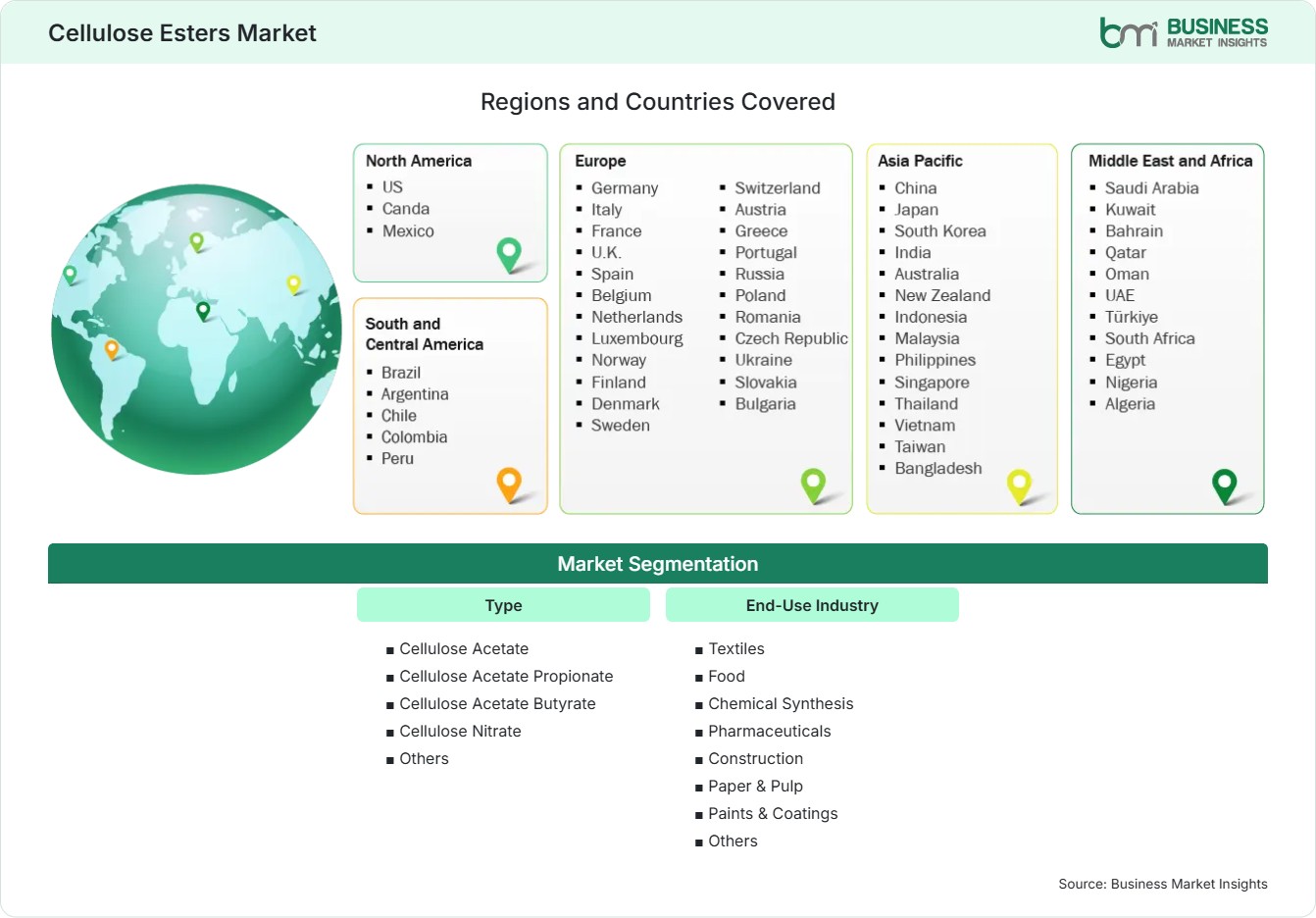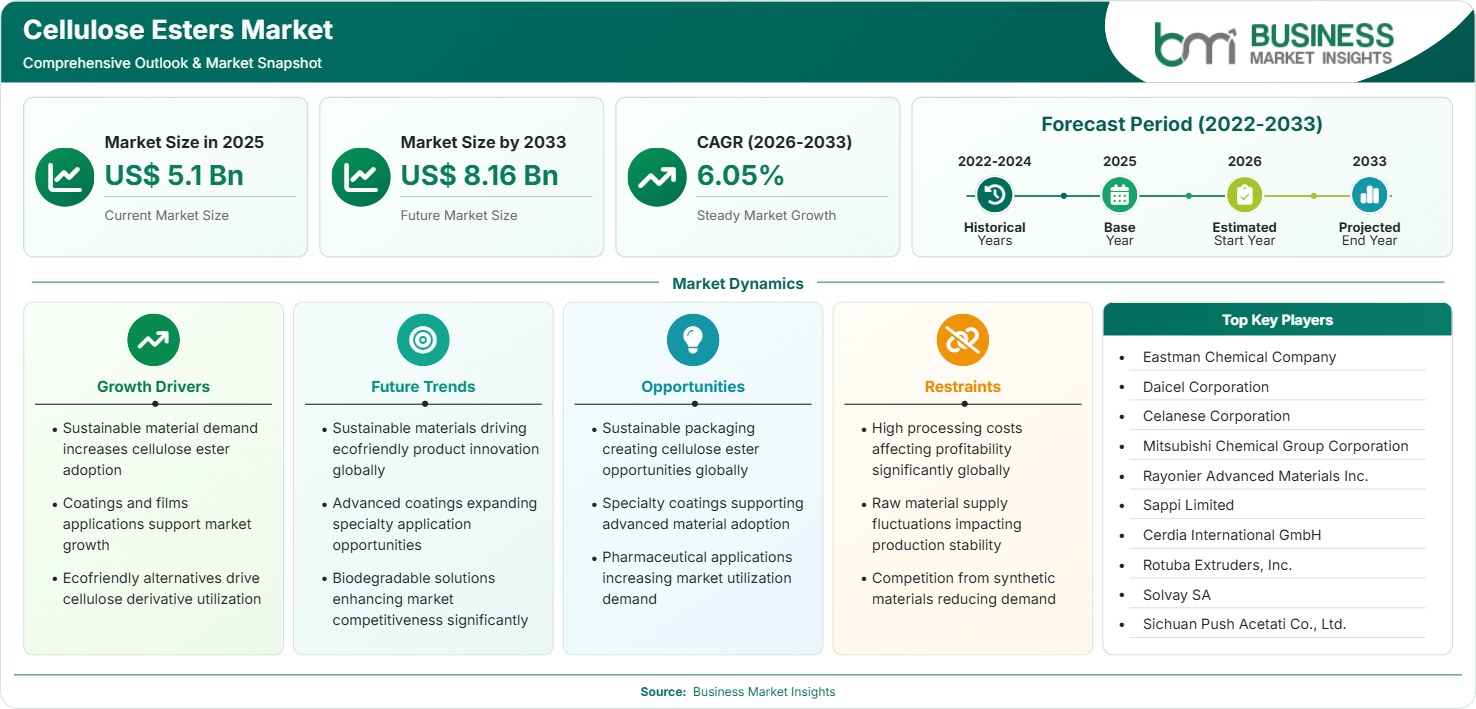
Cellulose Esters Market Regional Highlights
North America Cellulose Esters Market
The North American segment accounts for 20%-23% market share in 2025 and 5.3%-5.8% CAGR until 2033. The key advantages in this geographical region are the well-established infrastructure for specialty chemicals, pharmaceutical manufacturing, advanced coating, and food contact. Most of the demand in this geographical region is driven by the U.S., owing to technically challenging customers and a qualification system. Pulp and specialty processing in Canada and downstream manufacturing in Mexico drive the growth in this region. The Cellulose Esters Market in this region benefits from diversification of applications rather than from a particular end-use industry.
- Specialty coatings demand is linked to architectural, industrial, transportation, and packaging applications requiring film formation, adhesion, durability, and controlled solvent response.
- Pharmaceutical demand benefits from ongoing research into cellulose-derived controlled-release matrices, enteric systems, and functional excipients for increasingly complex formulations.
- Food-contact applications have regulatory pathways that support specified cellulose acetate uses, providing a defined route for compliant packaging and coating products.
- North American suppliers increasingly compete through technical services, formulation support, product consistency, and application development rather than commodity pricing alone.
US Cellulose Esters Market
The United States accounts for 72%-76% of North American demand in 2025 and is projected to grow at a 5.1%-5.6% CAGR between 2026 and 2033. The strength of the position in the market is due to chemical production integration, pharmaceutical buyers, coated formulation expertise, and packaging conversion. Eastman and Celanese have significant capacity for cellulose acetate, and specialty suppliers cater to custom formulations. Diversification from classic cellulose acetate use occurs through food-contact approval, pharmaceutical testing, and demand for renewable materials.
- Eastman reported a 2026 increase of US$0.25 per kilogram for cellulose ester polymers, citing oil-derived raw materials, energy, and logistics cost escalation.
- U.S. food-contact rules include specified cellulose acetate applications, giving qualified producers an established regulatory framework for selected packaging uses.
- Pharmaceutical R&D is expanding the technical role of cellulose acetate in controlled-release structures and advanced drug-delivery formats.
Europe Cellulose Esters Market
Europe holds a 21%–24% Cellulose Esters Market share in 2025 and records a 5.4%–5.9% CAGR through 2033. Downstream demand is driven by Germany, France, Italy, the United Kingdom, and the Netherlands, with applications in coatings, pharmaceuticals, packaging, textiles, and specialty chemicals. Germany and France are among the leading industrial markets, with Italy having a very strong textile and coatings market. Poland and several other Central European countries offer greater growth potential in manufacturing. Europeans buyers are increasingly favoring sustainably sourced materials.
- Germany maintains demand across industrial coatings, pharmaceuticals, specialty chemicals, and advanced manufacturing, supporting stable consumption of functional polymer materials.
- Italy offers textile and fashion applications where cellulose acetate fibers can combine drape, luster, comfort, and premium positioning with renewable feedstock narratives.
- European pharmaceutical manufacturers provide opportunities for specialty cellulose derivatives used in formulation, coating, and controlled-release technologies.
- Regulatory scrutiny encourages suppliers to document material composition, environmental attributes, and end-of-life behavior, increasing the value of traceable specialty grades.
Asia Pacific Cellulose Esters Market
Asia Pacific region has a market share of 39%–42% in 2025 and is projected to achieve the highest regional CAGR of 6.6%–7.1% through 2033. The leading consumer and producer is China. Japan has contributions in advanced cellulose chemistry and high-purity manufacturing. High-growth demand is provided by India in areas such as textiles, pharmaceuticals, packaging, and coating. South Korea and Southeast Asia offer specialty conversion. Cellulose Esters Market development profile encompasses concentration in manufacturing, growing domestic consumption, export-oriented textile production, and investments in local materials sourcing.
- China remains strategically important because textile, packaging, chemical, and pharmaceutical supply chains are concentrated across interconnected manufacturing clusters.
- Eastman and Huafon Chemical announced a strategic partnership for localized cellulose acetate yarn production and product innovation in China.
- India provides high-growth potential because expanding pharmaceutical, textile, packaging, and coatings industries create multiple demand channels rather than one dominant application.
- Japan retains importance in high-quality cellulose chemistry, specialty polymers, and precision applications requiring strict consistency and advanced technical support.
Rest of World Cellulose Esters Market
Rest of World Cellulose Esters Market has a market share of 13% - 16% in 2025 and a CAGR of 5.7% - 6.2% by 2033. South and Central America capitalize on pulp, packaging, coatings, and pharmaceutical applications. Brazil makes for the biggest regionally-based industrial activity, while Mexico benefits from manufacturing linkages. The Middle East and Africa have lower volumes, with diverse applications in coatings, packaging, construction, pharmaceuticals, and consumer goods.
- Brazil provides a combination of forestry resources, industrial manufacturing, coatings demand, and pharmaceutical production that supports cellulose-derived material consumption.
- Mexico benefits from proximity to North American manufacturing networks and demand from packaging, coatings, automotive, and consumer-product converters.
- Gulf economies offer opportunities for specialty coatings and construction-related formulations as industrial diversification expands beyond hydrocarbons.
- South Africa provides established pulp, paper, and specialty-material capabilities supporting selected cellulose-based applications and regional distribution.