Market Summary
Executive Summary and Global Market Analysis
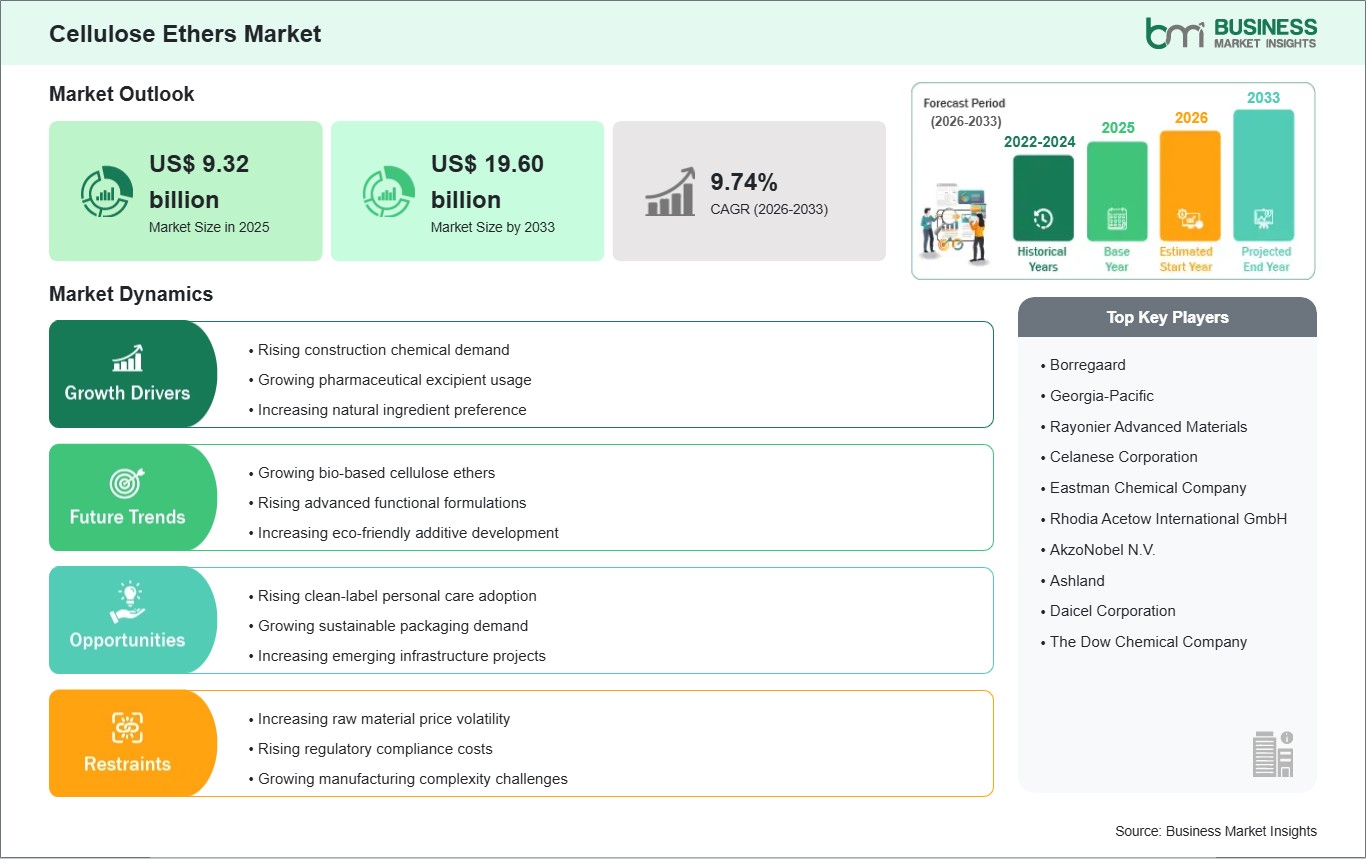
Cellulose ethers are water-soluble forms of cellulose made by chemically changing natural cellulose from wood pulp or cotton. Common types include methyl cellulose (MC), hydroxypropyl methylcellulose (HPMC), carboxymethyl cellulose (CMC), and hydroxyethyl cellulose (HEC). These compounds are used in many industries, including construction, pharmaceuticals, food and beverages, personal care, paints and coatings, and oil and gas. They provide benefits such as thickening, binding, stabilizing, forming films, and retaining water. In construction, they improve workability and adhesion in cement-based materials. In pharmaceuticals and food, they act as excipients, stabilizers, and texture modifiers.
Market growth comes from increased construction activity, especially in emerging economies, and greater demand for convenient and processed foods. The steady growth in the pharmaceutical sector and the rising use of cellulose ethers in controlled drug delivery systems further support market expansion. Additionally, the growing demand for personal care products and eco-friendly, bio-based additives adds to the positive market trend. Technological improvements and product innovation, along with rising investments in infrastructure development, are expected to drive long-term growth in the global cellulose ethers market.
Segment Analysis
Cellulose Ethers Market Segmentation
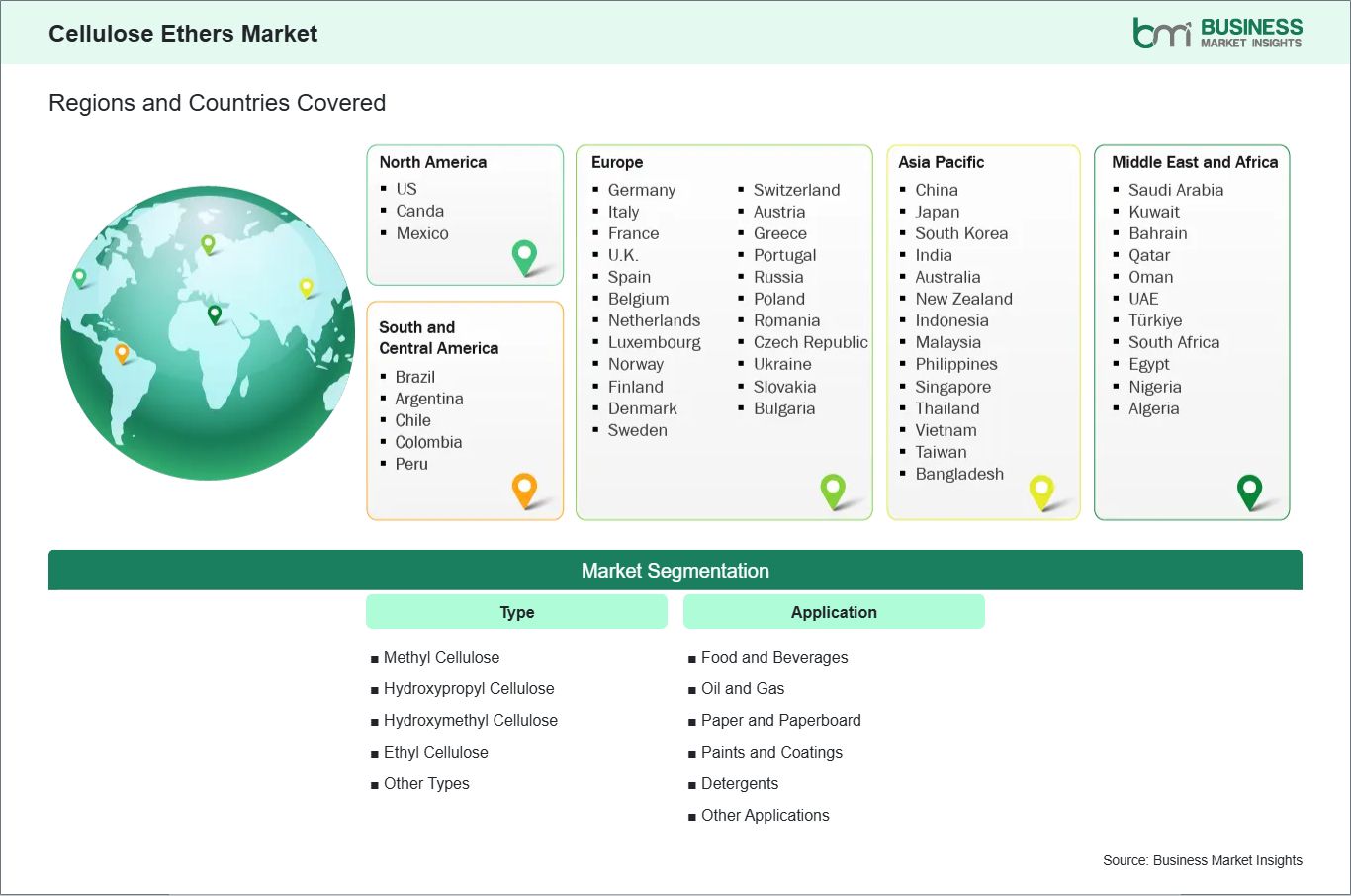
Key segments that contributed to the derivation of the cellulose ethers market analysis are type and application.
- By type, the cellulose ethers market is segmented into methyl cellulose, hydroxypropyl cellulose, hydroxymethyl cellulose, ethyl cellulose, and others. The methyl cellulose segment held the largest market share in 2025.
- By application, the cellulose ethers market is segmented into food and beverages, oil and gas, paper and paperboard, paints and coatings, detergents, and others. The paints and coatings segment held the largest market share in 2025.
Market Forces
Cellulose Ethers Market Drivers and Opportunities
Rising Demand from the Construction Industry
A main factor driving the cellulose ethers market is the ongoing growth of the global construction sector, especially in emerging economies. Rapid urbanization, population growth, and increased investments in infrastructure are boosting the demand for residential, commercial, and industrial construction projects. Cellulose ethers are commonly used in cement-based applications like tile adhesives, mortars, renders, and gypsum products because of their excellent water retention, improved workability, and strong adhesion properties.
These additives enhance consistency, prolong open time, and improve the overall performance of construction materials, making them vital in modern building practices. Furthermore, the rising use of dry-mix mortar technology and energy-efficient building standards is increasing demand. Government initiatives aimed at affordable housing, smart cities, and infrastructure improvement also play a role in the steady consumption of cellulose ethers in construction applications worldwide.
Expansion in Pharmaceutical and Controlled Drug Delivery Applications
A significant growth opportunity exists in the expanding pharmaceutical sector, especially in controlled and sustained drug delivery systems. Cellulose ethers like hydroxypropyl methylcellulose (HPMC) are widely used as excipients, film-forming agents, and release modifiers in oral solid dosage forms. As global healthcare spending rises, populations age, and chronic diseases become more common, the demand for better drug formulations continues to increase.
Pharmaceutical companies are investing in new delivery technologies that improve treatment effectiveness and patient compliance, creating more chances for high-performance cellulose ether grades. Additionally, the acceptance of cellulose-based excipients is growing because of their safety and compatibility with the body. The rise of generic drug production in developing markets and ongoing research into new formulations are expected to further strengthen long-term growth in pharmaceutical applications.
Size and Share Analysis
Cellulose Ethers Market Size and Share Analysis
The cellulose ethers market demonstrates steady growth, with size and share analysis revealing evolving trends and competitive positioning among key players. The report examines subsegments categorized within type and application, offering insights into their contribution to overall market performance. By application, the paints and coatings segment holds the largest market share. This dominance comes from the widespread use of cellulose ethers as thickeners, stabilizers, and water-retention agents in architectural and industrial coatings. These additives improve viscosity control, boost workability, prevent sagging, and ensure uniform film formation. Cellulose ethers are highly valued in water-based paints for their ability to enhance texture, suspension stability, and overall coating performance while supporting low-VOC formulations. The segment's growth is driven by increasing construction activities, rising demand for eco-friendly and high-performance coatings, and expanding infrastructure development in emerging economies. Ongoing innovations in decorative finishes, protective coatings, and sustainable building materials also encourage the use of cellulose ethers in this sector.
Report Coverage
Cellulose Ethers Market Report Coverage and Deliverables
The " Cellulose Ethers Market Size and Forecast (2022 - 2033)" report provides a detailed analysis of the market covering below areas:
- Cellulose ethers market size and forecast at global, regional, and country levels for all the key market segments covered under the scope
- Cellulose ethers market trends, as well as market dynamics such as drivers, restraints, and key opportunities
- Cellulose ethers market analysis covering key market trends, global and regional framework, major players, regulations, and recent market developments
- Industry landscape and competition analysis covering market concentration, heat map analysis, prominent players, and recent developments for the cellulose ethers market
- Detailed company profiles, including SWOT analysis
Geographic Insights
Cellulose Ethers Market Geographic Insights
The geographical scope of the cellulose ethers market report is divided into five regions: North America, Asia Pacific, Europe, the Middle East & Africa, and South & Central America. Asia Pacific holds a significant share of the cellulose ethers market. This is mainly due to rapid urbanization, large infrastructure projects, and strong growth in industries like construction, pharmaceuticals, food and beverages, and personal care. Countries such as China, India, and the nations in Southeast Asia are seeing steady investments in both residential and commercial construction. This boosts demand for cellulose ethers in cement-based products like tile adhesives, mortars, and renders.
Moreover, Asia-Pacific is a key manufacturing center for pharmaceuticals and processed foods. This further increases the use of cellulose ether products as excipients, stabilizers, and thickening agents. The region also enjoys lower production costs, access to raw materials, and growing industrial capacity, which attracts both local and international manufacturers. Government programs aimed at modernizing infrastructure, promoting affordable housing, and supporting industrial growth help to drive market expansion. Additionally, rising disposable incomes and changing consumer habits are raising the demand for packaged foods and personal care items. These factors solidify Asia-Pacific's position as the top regional market for cellulose ethers.
Industry Activity
Recent Developments
The cellulose ethers market is evaluated by gathering qualitative and quantitative data post-primary and secondary research, which includes important corporate publications, association data, and databases. A few of the key developments in the cellulose ethers market are:
- In January 2026, Univar Solutions and Ashland announced a partnership to distribute Ashland's cellulose ethers in the food and beverage sector throughout Europe, the Middle East, and Africa. This collaboration aims to improve access to functional ingredients for better texture, stability, and processing in applications like plant-based, vegan, and gluten-free products.
- In May 2025, Colorcon and ASHA Cellulose announced a multi-year partnership to develop and manufacture barrier membrane formulations for the pharmaceutical and nutraceutical industries. According to the agreement, Colorcon will be the exclusive representative for ASHA's ethyl cellulose-based products in Europe, the Middle East, Africa, Northeast Asia, and Southeast Asia.
Trust & Transparency
Research Methodology
The market analysis combines proprietary research with secondary data from government agencies, company disclosures, regulatory filings, industry databases and expert interviews. Market estimates are validated through data triangulation, cross-market benchmarking and analyst
review.
View Full Research Methodology
Key Sources Referred:
World Bank - Global Trade IndicatorsWorld Trade Organization (WTO)International Monetary Fund (IMF)International Trade Administration (ITA)Company WebsitesCompany Annual ReportsCompany Investor PresentationsInternational Council of Chemical Associations (ICCA)Society of Chemical Manufacturers and Affiliates (SOCMA)International Cellulose Network (ICN)American Chemistry Council (ACC)