Market Summary
Executive Summary and Global Market Analysis
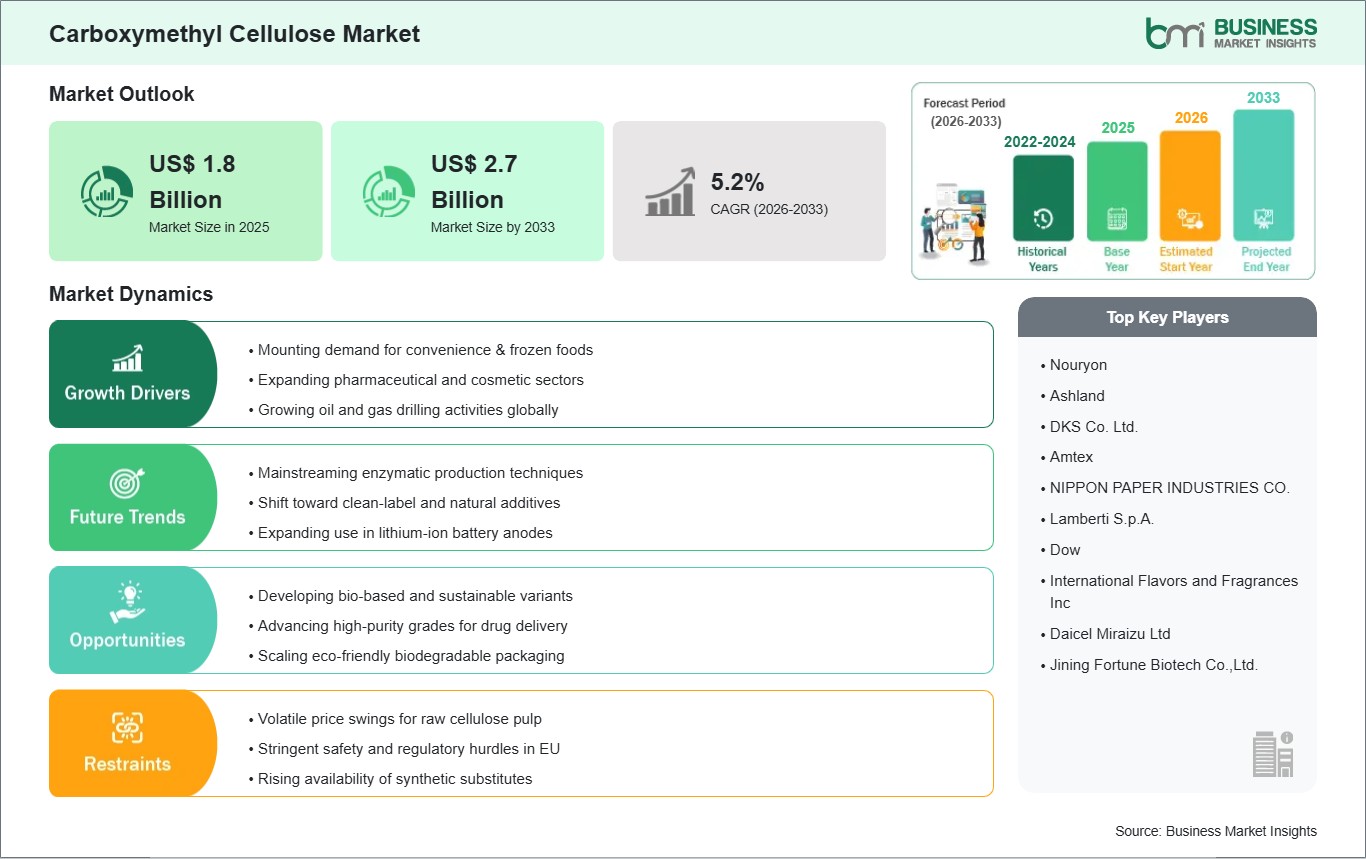
The Carboxymethyl Cellulose (CMC) Market is crucial as a versatile, water-soluble polymer used as a thickener, stabilizer, binder, and emulsifier across numerous industries. CMC is essential for key sectors: Food & Beverages, Pharmaceuticals, Personal Care, and Oil & Gas. CMC offers advantages including non-toxicity, high purity in specialized grades, and effectiveness as a viscosity modifier, particularly in gluten-free and low-fat food products. The market is fueled by the growing global consumption of processed and convenience foods, the increasing demand for high-purity pharmaceutical excipients and personal care products, and the need for rheology control agents in oil drilling fluids. The market is also driven by rising consumer preference for bio-based and sustainable additives.
However, several challenges restrain market growth: volatility in the price of raw materials (cellulose derived from wood pulp or cotton) directly impacts production costs and pricing strategies. The availability of alternative thickening agents (e.g., xanthan gum, guar gum) poses intense competition and limits market share expansion. Furthermore, the industry faces constraints due to stringent regulatory compliance requirements for high-purity food and pharmaceutical grades, requiring continuous testing and investment. Despite these hurdles, opportunities arise driven by the accelerating development of high-purity CMC for advanced drug delivery systems, the expansion into specialized applications of 3D printing pastes and bioplastics, and substantial market growth in the Asia-Pacific region due to rapid industrialization and consumer market expansion. Focusing on sustainable production methods is expected to open powerful new avenues for market expansion.
Segment Analysis
Carboxymethyl Cellulose Market Segmentation
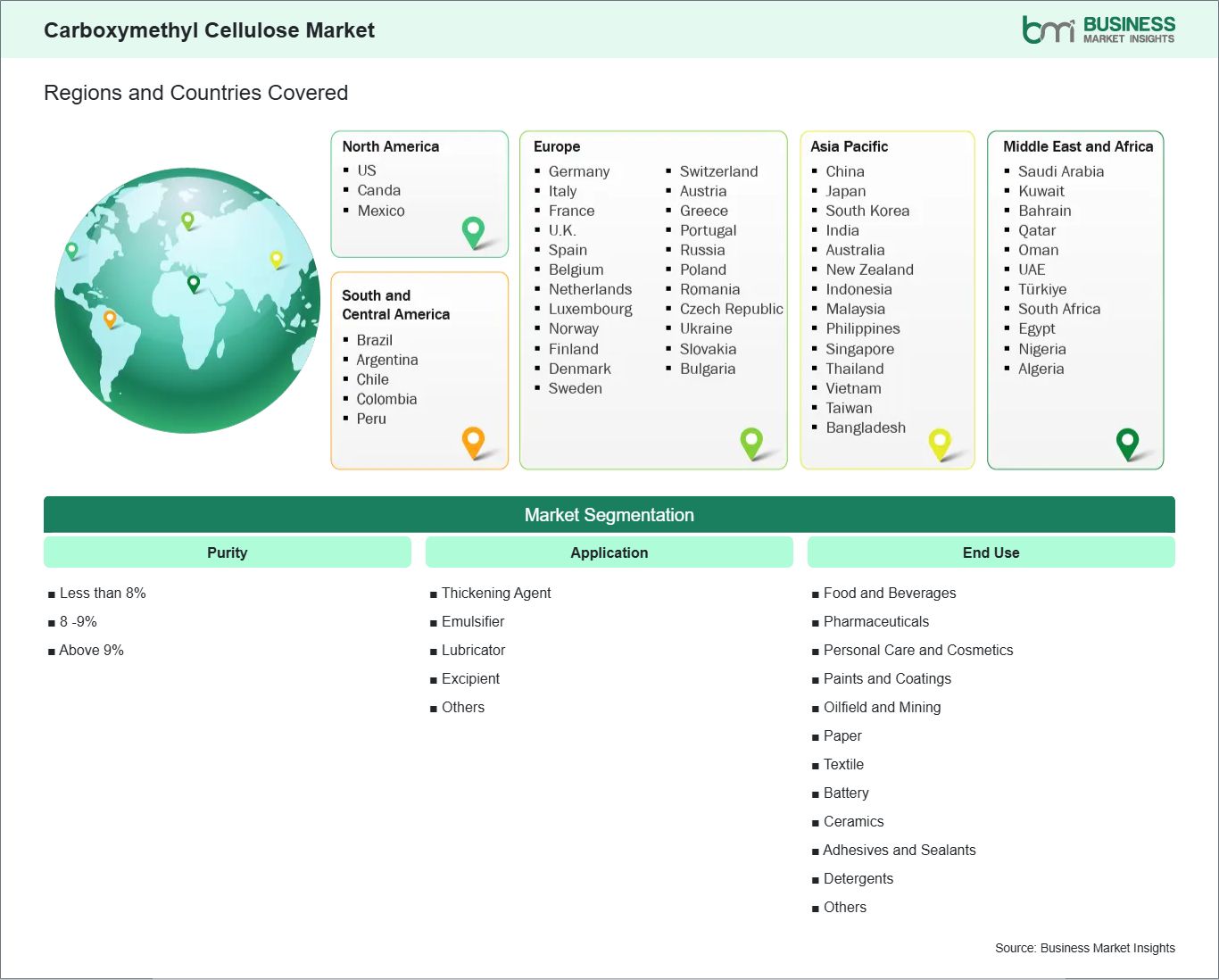
Key segments that contributed to the derivation of the Carboxymethyl Cellulose Market analysis are purity, application, and end use.
- By Purity, the market is segmented into Less than 80%, 80–90%, and Above 90%.
- By Application, the market is segmented into Thickening Agent, Emulsifier, Lubricator, Excipient, and Others.
- By End Use, the market is segmented into Food and Beverages, Pharmaceuticals, Personal Care and Cosmetics, Paints and Coatings, Oilfield and Mining, Paper, Textile, Battery, Ceramics, Adhesives and Sealants, Detergents, and Others.
Market Forces
Carboxymethyl Cellulose Market Drivers and Opportunities
Versatile Role in Food and Processed Products
The fundamental driver of the Carboxymethyl Cellulose (CMC) Market is its widespread adoption as a multi-functional additive across the growing global food, beverage, and personal care industries. CMC is a water-soluble polymer valued for its ability to act as a thickening agent, stabilizer, emulsifier, and moisture retainer. The continuous global expansion of the processed food and convenience food sectors is a major catalyst. CMC is indispensable in products like ice cream, sauces, dairy alternatives, and baked goods, where it improves texture, prevents ice crystal formation, and extends shelf life. Furthermore, its use in clean-label and 'free-from' food trends, such as gluten-free and low-fat formulations, is accelerating, as CMC helps restore the desired mouthfeel and stability often lost when removing fat or gluten. This versatility and its acceptance as a safe food additive (E466) secure its place as a critical ingredient across high-growth consumer packaged goods segments.
High-Purity Applications and Sustainability Focus
A significant high-value opportunity lies in the rising demand for high-purity and specialized grades of CMC and the overall market shift toward sustainable, bio-based industrial ingredients. The pharmaceutical and personal care sectors are increasingly demanding high-purity CMC for controlled-release drug delivery systems, tablet binding, and premium cosmetic formulations. This shift commands higher pricing and margin for manufacturers. Additionally, the broader market is recognizing CMC's environmental benefits: it is a cellulose derivative from natural, renewable sources (like wood pulp or cotton linters) and is biodegradable. This aligns perfectly with the global corporate and consumer push for sustainable, eco-friendly products, opening doors for its increased adoption as a preferred additive in industrial applications like detergents and sustainable packaging films, where it can replace less sustainable synthetic alternatives.
Size and Share Analysis
Carboxymethyl Cellulose Market Size and Share Analysis
The Carboxymethyl Cellulose Market demonstrates steady growth, with size and share analysis revealing evolving trends and competitive positioning among key players. The report further examines subsegments categorized within purity, application, and end use, offering insights into their contribution to overall market performance.
For instance, CMC with Purity Above 90% is typically mandated for use in pharmaceuticals, where it functions as an excipient and binder in tablet formulations. Stringent safety standards and the expanding global demand for effective drug delivery systems drive this highly-regulated, high-value segment. The Thickening Agent application is widely utilized across the Food and Beverages end-use sector, enhancing viscosity and texture in products like sauces, ice cream, and gluten-free goods. This key application benefits from the increasing global consumption of convenience and processed foods.
The Oilfield and Mining end-use sector relies on Technical Grade CMC (purity of 80–90%) for use as a lubricator and fluid-loss control additive in drilling muds. This segment's performance is closely tied to global energy exploration activities and the demand for cost-effective, high-performing industrial stabilizers.
Report Coverage
Carboxymethyl Cellulose Market Report Coverage and Deliverables
The "Carboxymethyl Cellulose Market Size and Forecast (2022 - 2033)" report provides a detailed analysis of the market covering below areas:
- Carboxymethyl Cellulose Market size and forecast at global, regional, and country levels for all the key market segments covered under the scope
- Carboxymethyl Cellulose Market trends, as well as market dynamics such as drivers, restraints, and key opportunities
- Carboxymethyl Cellulose Market analysis covering key market trends, global and regional framework, major players, regulations, and recent market developments
- Industry landscape and competition analysis covering market concentration, heat map analysis, prominent players, and recent developments for the Carboxymethyl Cellulose Market
- Detailed company profiles, including SWOT analysis
Geographic Insights
Carboxymethyl Cellulose Market Geographic Insights
The geographical scope of the Carboxymethyl Cellulose Market report is divided into five regions: North America, Asia Pacific, Europe, the Middle East & Africa, and South & Central America.
The Carboxymethyl Cellulose Market in Asia Pacific is subsegmented into China, Japan, South Korea, India, Australia, New Zealand, Indonesia, Malaysia, the Philippines, Singapore, Thailand, Vietnam, Taiwan, Bangladesh, and the Rest of Asia. The Asia-Pacific CMC market is driven by rapid industrialization and the massive expansion of key end-use sectors.
The region's dominance is further supported by the substantial demand for high-purity CMC in the rapidly expanding pharmaceutical sector and its essential function in oil and gas drilling fluids across Southeast Asia. Abundant access to raw materials (wood and cotton pulp) and the presence of a large manufacturing base solidify Asia-Pacific as the primary global hub for CMC production and consumption.
Industry Activity
Recent Developments
The Carboxymethyl Cellulose Market is evaluated by gathering qualitative and quantitative data post-primary and secondary research, which includes important corporate publications, association data, and databases. A few of the key developments in the Carboxymethyl Cellulose Market are:
- In April 2025, Ashland Global Specialty Chemicals Inc. completed the expansion of its pharmaceutical production facility in Brazil, enhancing its operations in Latin America, which utilizes high-purity CMC for drug formulations.
- In October 2025, Nouryon announced the launch of new ingredient solutions for use in laundry, dish detergent, and surface cleaning applications that deliver exceptional cleaning performance while using more sustainably sourced and produced ingredients. Finnfix® LD CMC (for liquid laundry detergent applications) is a liquid carboxymethyl cellulose (CMC) that helps remove stains and prevent their redeposition onto fabrics, even in cold washes. Finnfix LD scores 78% on the Renewable Carbon Index and is made from materials certified by the Forest Stewardship Council.
Trust & Transparency
Research Methodology
The market analysis combines proprietary research with secondary data from government agencies, company disclosures, regulatory filings, industry databases and expert interviews. Market estimates are validated through data triangulation, cross-market benchmarking and analyst
review.
View Full Research Methodology
Key Sources Referred:
World Bank - Global Trade IndicatorsWorld Trade Organization (WTO)International Trade Administration (ITA)Company WebsitesCompany Annual ReportsCompany Investor Presentations