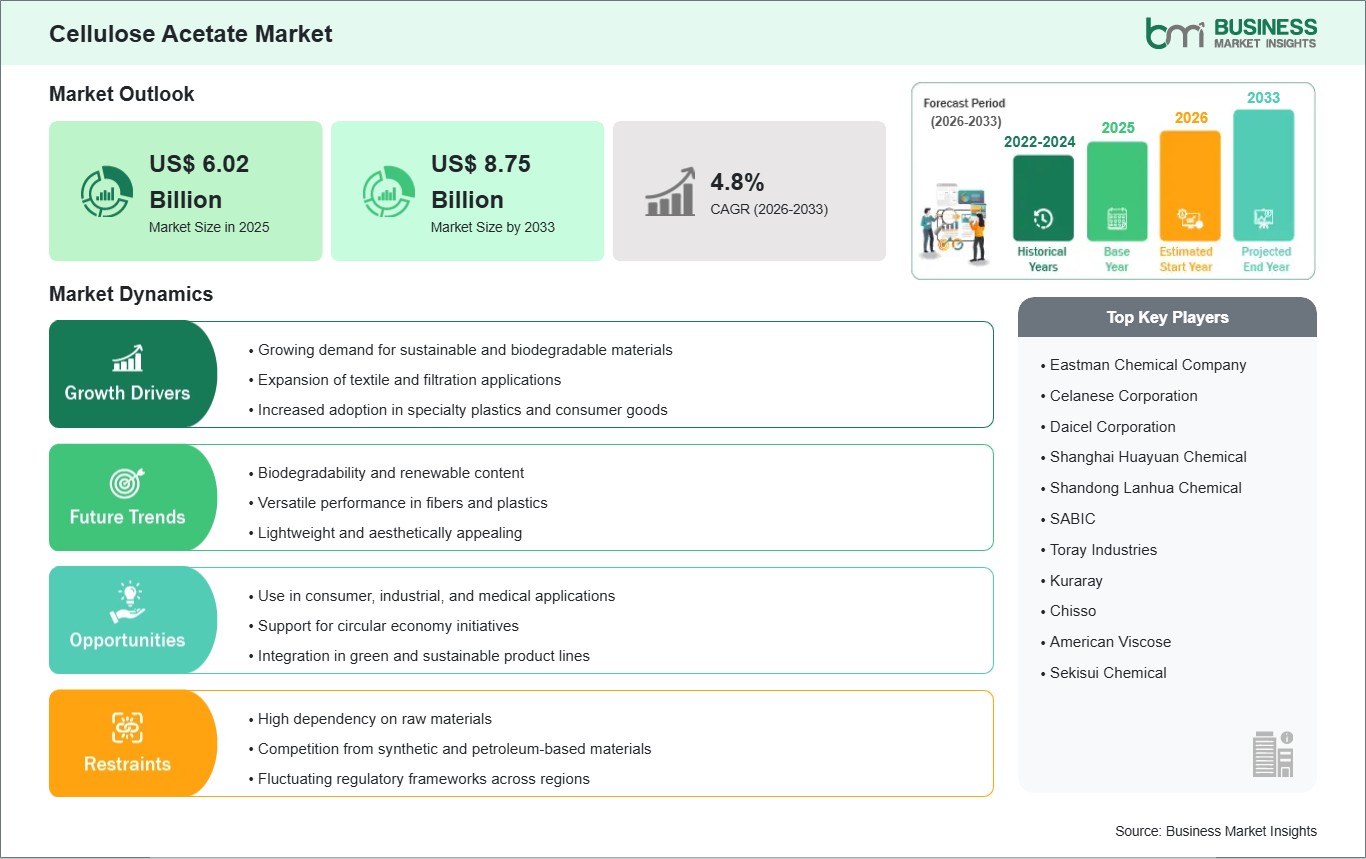
The Cellulose Acetate Market size is expected to reach US$ 8.75 billion by 2033 from US$ 6.02 billion in 2025. The market is estimated to record a CAGR of 4.8% from 2026 to 2033.
The global cellulose acetate market is witnessing steady growth driven by increasing demand for biodegradable and sustainable materials across multiple industries. Cellulose acetate, a derivative of natural cellulose, is widely used in fibers and plastics due to its versatility, biodegradability, and favorable mechanical properties. It finds applications in textiles, cigarette filters, films, and specialty plastics, making it a key material in both consumer and industrial sectors.
The growing focus on reducing environmental impact and replacing petroleum-based plastics is significantly contributing to market expansion. Cellulose acetate offers a renewable alternative with lower environmental footprint, aligning with global sustainability goals. Additionally, advancements in manufacturing processes are improving product quality, durability, and application range.
The demand for high-quality textile fibers and specialty plastics is further supporting market growth. Industries are increasingly adopting cellulose acetate due to its aesthetic appeal, lightweight nature, and ease of processing.

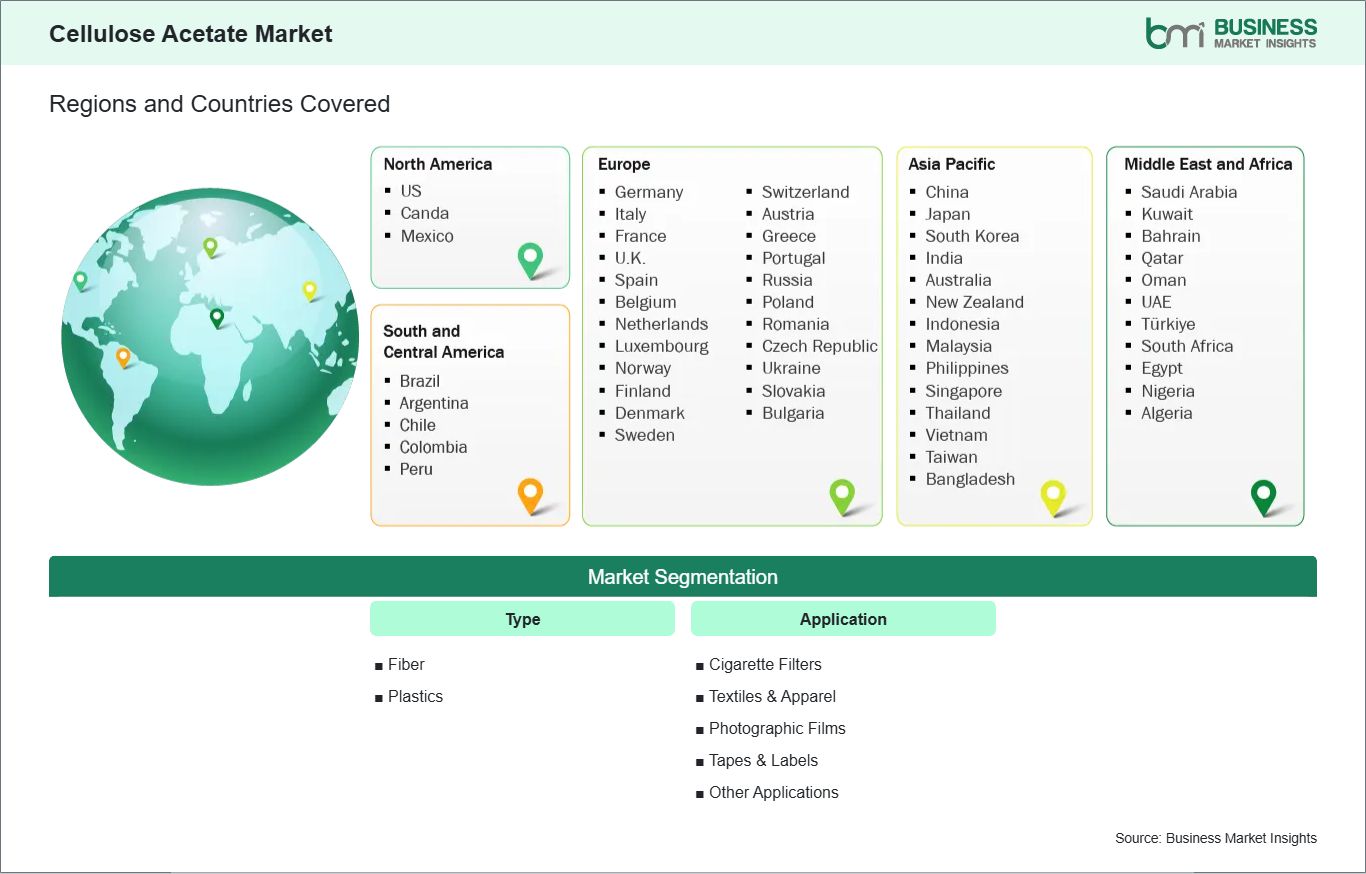
Key segments that contributed to the derivation of the cellulose acetate market analysis are type and application.
Increasingly, there is a global commitment to work towards sustainable and environmentally friendly policies that are altering the types of materials selected by companies in every industry. Likewise, cellulose acetate is positioned to be among the biggest beneficiaries of this global push towards sustainability.
Cellulose acetate is a biodegradable alternative to petroleum-based plastics; it comes from renewable resources such as wood pulp and cotton linters. Since many manufacturers are looking to decrease their carbon footprint and support a circular economy, cellulose acetate has become a sought-after input.
As concerns regarding plastic pollution continue to grow, cellulose acetate provides consumers with a sustainable solution for materials that meet performance needs while also being environmentally responsible.
Government and regulatory agencies are also helping to accelerate this trend by creating policy changes that limit single-use plastics while pushing for the increased use of bio-based materials. Increased regulation is putting pressure on all aspects of packaging, textiles, and consumer products. Cellulose acetate has a major share of the market for films, coatings, and molded products, where its use will continue to expand.
Moreover, cellulose acetate is biodegradable so it will not add to the long-term accumulation of waste. As the world's most pressing environmental issue continues to be plastic pollution, more consumers will find cellulose acetate to be an eco-friendly solution.
The consumer trend toward purchasing environmentally friendly products has also been a driver of this trend. Companies will continue to manufacture cellulose acetate-based products for use in packaging, eyewear frames, and other consumer goods to demonstrate a commitment to sustainability. The combination of versatility, renewable content, and performance-enhancing properties makes cellulose acetate one of the best options for sustainable products.
The textile and filtration industries represent significant growth opportunities for the cellulose acetate market. In textiles, cellulose acetate fibers are valued for their unique combination of softness, sheen, and draping qualities, making them ideal for apparel, home furnishings, and specialty fabrics. The fashion industry, with its constant demand for innovative and high-quality materials, has embraced acetate fibers to create garments that are both aesthetically appealing and comfortable. As global fashion markets expand, particularly in emerging economies, the demand for cellulose acetate fibers is expected to rise steadily.
Filtration applications remain a dominant segment, with cigarette filters accounting for a substantial share of cellulose acetate consumption. Despite growing awareness of health risks associated with smoking, tobacco consumption continues in many regions, sustaining demand for acetate-based filters due to their efficiency, cost-effectiveness, and widespread availability. Beyond cigarette filters, cellulose acetate is also finding applications in air and water filtration systems, where its structural properties contribute to effective contaminant removal.
The material’s versatility extends further into specialty applications such as photographic films, tapes, and coatings, where clarity, flexibility, and durability are essential. Innovations in these areas are broadening the scope of cellulose acetate, enabling its use in electronics, medical devices, and other high-performance applications. With industries seeking materials that combine functionality with sustainability, cellulose acetate is well-positioned to capture new opportunities. Its expanding role in textiles, filtration, and specialty products underscores its importance as a versatile material that bridges traditional and modern applications, ensuring continued market growth.

The Cellulose Acetate Market demonstrates steady growth, with size and share analysis highlighting evolving trends and competitive dynamics among key players. The report examines subsegments categorized within type and application, offering insights into their contribution to overall market performance.
Based on type, the fiber subsegment dominated the market in 2025, driven by its extensive use in textiles and cigarette filters.
In terms of application, the cigarette filters subsegment dominated the market in 2025, driven by widespread usage in the tobacco industry.
| Report Attribute | Details |
|---|---|
| Market size in 2025 | US$ 6.02 Billion |
| Market Size by 2033 | US$ 8.75 Billion |
| Global CAGR (2026 - 2033) | 4.8% |
| Historical Data | 2022-2024 |
| Forecast period | 2026-2033 |
| Segments Covered | By Type
|
|
Regions and Countries Covered
| |
| North America | US, Canada, Mexico |
| Europe | Belgium, Austria, Finland, Denmark, Greece, Poland, Romania, Russia, Ukraine, Czech Republic, Slovakia, Bulgaria, Italy, Luxembourg, Germany, Switzerland, France, Netherlands, Norway, Portugal, Spain, Sweden, United Kingdom |
| Asia-Pacific | Australia, China, India, Japan, South Korea, Indonesia, Malaysia, Philippines, Singapore, Thailand, Vietnam, Bangladesh, New Zealand, Taiwan |
| South and Central America | Brazil, Argentina, Peru, Chile, Colombia |
| Middle East and Africa | Bahrain, Kuwait, Oman, Qatar, Saudi Arabia, United Arab Emirates, Turkiye, South Africa, Egypt, Algeria, Nigeria |
| Market leaders and key company profiles |
|
The "Cellulose Acetate Market Size and Forecast (2022 - 2033)" report provides a detailed analysis of the market covering below areas:
The geographical scope of the Cellulose Acetate Market report is divided into North America, Asia Pacific, Europe, Middle East & Africa, and South & Central America. North America held the largest share in 2025.
North America is witnessing steady growth due to increasing adoption of sustainable materials and advancements in specialty plastics and filtration applications. Regulatory support for environmentally friendly materials is also contributing to market expansion.
Europe is experiencing significant growth, supported by stringent environmental regulations and a strong focus on sustainability. Countries such as Germany, France, and the UK are adopting bio-based materials in various industries, driving demand for cellulose acetate.
Asia Pacific is a key market driven by strong demand from textile manufacturing and cigarette production industries in countries such as China, India, and Southeast Asia. The region’s well-established supply chains and availability of raw materials are supporting market growth.
In the Middle East & Africa, the market is gradually expanding due to industrial development and increasing demand for consumer goods. Meanwhile, South & Central America is experiencing moderate growth, supported by rising textile and manufacturing activities.
Across all regions, sustainability initiatives, industrial growth, and technological advancements are shaping market dynamics.

The Cellulose Acetate Market is evaluated by gathering qualitative and quantitative data post primary and secondary research, which includes important corporate publications, association data, and databases. A few of the key developments in the cellulose acetate market are:
The Cellulose Acetate Market is valued at US$ 6.02 Billion in 2025, it is projected to reach US$ 8.75 Billion by 2033.
As per our report Cellulose Acetate Market, the market size is valued at US$ 6.02 Billion in 2025, projecting it to reach US$ 8.75 Billion by 2033. This translates to a CAGR of approximately 4.8% during the forecast period.
The Cellulose Acetate Market report typically cover these key segments-
The historic period, base year, and forecast period can vary slightly depending on the specific market research report. However, for the Cellulose Acetate Market report:
The Cellulose Acetate Market is populated by several key players, each contributing to its growth and innovation. Some of the major players include:
The Cellulose Acetate Market report is valuable for diverse stakeholders, including:
Essentially, anyone involved in or considering involvement in the Cellulose Acetate Market value chain can benefit from the information contained in a comprehensive market report.
Please tell us your area of interest
(Market Segments/ Regions and Countries/ Companies)