Market Summary
Executive Summary and Global Market Analysis
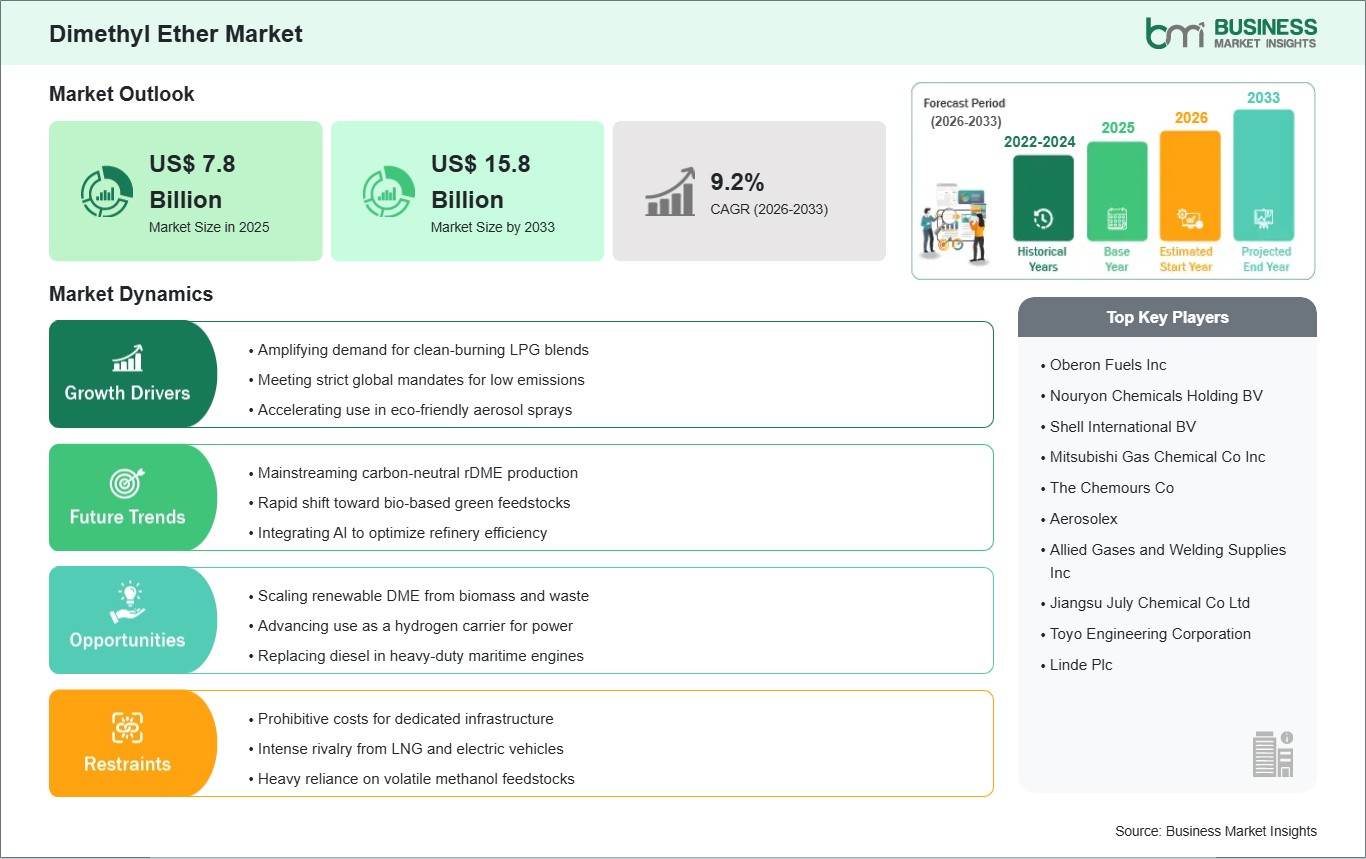
Dimethyl Ether (DME) is a versatile, clean-burning compound, positioning itself as a strategic alternative to traditional fuels and chemical intermediates. DME is vital for core applications: LPG blending, aerosol propellants, transportation fuel, and chemical synthesis. DME offers advantages including its low-soot, non-toxic combustion profile, high cetane number for diesel substitution, and seamless compatibility with existing LPG infrastructure (bottles, distribution). The market is fueled by stringent global mandates for lower vehicle and industrial emissions, the increasing necessity for cleaner household cooking fuels in developing economies, and the growing focus on bio-DME production from sustainable sources (biomass, waste).
However, a few challenges restrain market growth. Significant price volatility of feedstocks (methanol, natural gas) introduces cost uncertainty for manufacturers. Infrastructure limitations require substantial capital investment in specialized storage and distribution networks for large-scale transportation applications. Furthermore, the industry faces constraints due to intense competition from established energy sources such as traditional LPG, LNG, and green methanol. Despite these hurdles, opportunities arise by the accelerated adoption of DME-LPG blends (up to 20%) in the massive Asia-Pacific domestic market, the increasing use of DME as an eco-friendly aerosol propellant replacement, and the long-term potential for DME as a hydrogen carrier for future fuel cell logistics. The global policy push toward ultra-low-sulfur and carbon-neutral targets is expected to open new avenues for market expansion.
Segment Analysis
Dimethyl Ether Market Segmentation
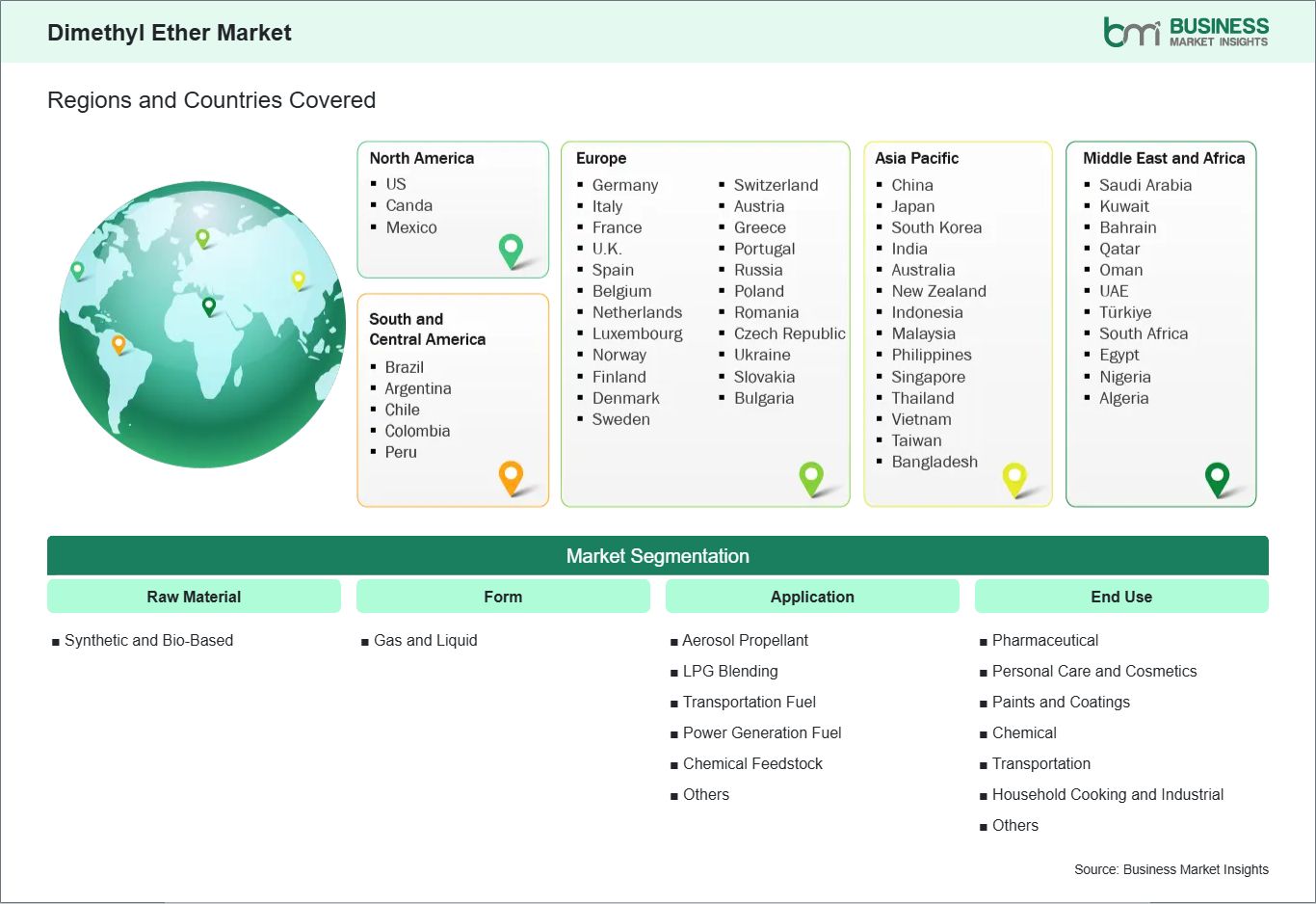
Key segments that contributed to the derivation of the Dimethyl Ether Market analysis are raw material, form, application, and end use.
- By Raw Material, the market is bifurcated into Synthetic and Bio-Based.
- By Form, the market is bifurcated into Gas and Liquid.
- By Application, the market is segmented into Aerosol Propellant, LPG Blending, Transportation Fuel, Power Generation Fuel, Chemical Feedstock, and Others.
- By End Use, the market is segmented into Pharmaceutical, Personal Care and Cosmetics, Paints and Coatings, Chemical, Transportation, Household Cooking and Industrial, and Others.
Market Forces
Dimethyl Ether Market Drivers and Opportunities
Demand for Clean Energy and LPG Substitution
The paramount driver for the Dimethyl Ether (DME) market is the global regulatory push for cleaner energy sources and its effectiveness as an immediate substitute and blending agent for Liquefied Petroleum Gas (LPG). DME is a clean-burning fuel that produces virtually no sulfur oxides or particulate matter, aligning perfectly with increasingly strict environmental emission standards worldwide. In developing and emerging economies, where domestic heating and cooking heavily rely on bottled LPG, DME's similar physical properties allow it to be seamlessly blended with LPG (up to 20%) using the existing infrastructure and appliances. This provides a cost-effective pathway to cleaner household energy and reduces reliance on imported fossil fuels, creating a massive, policy-backed demand, particularly in Asia Pacific.
Renewable DME and Hydrogen Carrier Role
A significant and transformative market opportunity lies in the accelerating development of Renewable DME (rDME) and its emerging role as a key hydrogen energy carrier. rDME is produced from sustainable, non-fossil feedstocks such as biomass, agricultural waste (like crop residue), or green hydrogen combined with captured carbon dioxide. This pathway allows DME to become a carbon-neutral or even carbon-negative fuel, making it highly attractive under long-term decarbonization commitments. Furthermore, DME is being actively researched as a dense, liquid carrier for hydrogen, which can be easily shipped and stored using existing infrastructure before being converted to hydrogen for fuel cells. This versatility beyond its direct fuel use establishes DME as a foundational component in the future circular carbon and hydrogen economies.
Size and Share Analysis
Dimethyl Ether Market Size and Share Analysis
The Dimethyl Ether Market demonstrates steady growth, with size and share analysis revealing evolving trends and competitive positioning among key players. The report further examines subsegments categorized within raw material, form, application, and end use, offering insights into their contribution to overall market performance.
For instance, the synthetic dimethyl ether segment holds a notable share of the market, primarily due to its extensive use in LPG blending. This application remains dominant, supported by DME’s clean-burning characteristics and its strong compatibility as a viable substitute for conventional LPG.
Meanwhile, bio-based DME is rapidly gaining momentum in the transportation fuel sector, where it serves as a clean-combustion alternative to diesel for specially engineered engines. Its significantly lower carbon footprint positions bio-based DME as a strategic enabler in advancing global sustainability goals, particularly within the transportation end-use industry.
Report Coverage
Dimethyl Ether Market Report Coverage and Deliverables
The "Dimethyl Ether Market Size and Forecast (2022 - 2033)" report provides a detailed analysis of the market covering below areas:
- Dimethyl Ether Market size and forecast at global, regional, and country levels for all the key market segments covered under the scope
- Dimethyl Ether Market trends, as well as market dynamics such as drivers, restraints, and key opportunities
- Dimethyl Ether Market analysis covering key market trends, global and regional framework, major players, regulations, and recent market developments
- Industry landscape and competition analysis covering market concentration, heat map analysis, prominent players, and recent developments for the Dimethyl Ether Market
- Detailed company profiles, including SWOT analysis
Geographic Insights
Dimethyl Ether Market Geographic Insights
The geographical scope of the Dimethyl Ether Market report is divided into five regions: North America, Asia Pacific, Europe, the Middle East & Africa, and South & Central America.
The Asia-Pacific Dimethyl Ether Market is segmented into China, Japan, South Korea, India, Australia, New Zealand, Indonesia, Malaysia, the Philippines, Singapore, Thailand, Vietnam, Taiwan, Bangladesh, and the Rest of Asia. The Asia-Pacific DME market is driven by the high demand for clean alternative fuels and the massive use of DME for LPG blending in household and industrial sectors. China dominates consumption, fueled by its large coal-to-DME production capacity. Growth is strongly supported by government policies in countries like Indonesia and India to reduce reliance on LPG imports and promote low-emission fuels in transportation and cooking. The region benefits from the low cost and high availability of feedstocks (coal and biomass), and the increasing adoption of DME as an aerosol propellant and chemical feedstock, solidifying its global market dominance.
Industry Activity
Recent Developments
The Dimethyl Ether Market is evaluated by gathering qualitative and quantitative data post-primary and secondary research, which includes important corporate publications, association data, and databases. A few of the key developments in the Dimethyl Ether Market are:
- In February 2025, the US EPA approved a Renewable Fuel Standard fuel pathway for Oberon Fuels Inc. that will allow the company to generate D3 cellulosic biofuel or D5 advanced biofuel renewable identification numbers (RINs) for the production of dimethyl ether (DME), a renewable diesel substitute, from waste-derived biogas at its facility in Gonzales County, Texas.
- In May 2024, Lummus Technology, a global provider of process technologies and value-driven energy solutions, announced the commercial availability of CDDMESM, a new renewable dimethyl ether (DME) technology that is enhanced through catalytic distillation (CD). The CDDME technology can process numerous types of methanol to produce renewable DME, which can then be blended to produce liquefied petroleum gas or used as a hydrogen carrier.
Trust & Transparency
Research Methodology
The market analysis combines proprietary research with secondary data from government agencies, company disclosures, regulatory filings, industry databases and expert interviews. Market estimates are validated through data triangulation, cross-market benchmarking and analyst
review.
View Full Research Methodology
Key Sources Referred:
World Bank - Global Trade IndicatorsWorld Trade Organization (WTO)International Monetary Fund (IMF)International Trade Administration (ITA)Company WebsitesCompany Annual ReportsCompany Investor Presentations