
Cell Analysis Market Outlook: Size, Share, Trends, Growth Analysis, Competitive Landscape & Forecast, 2026-2033

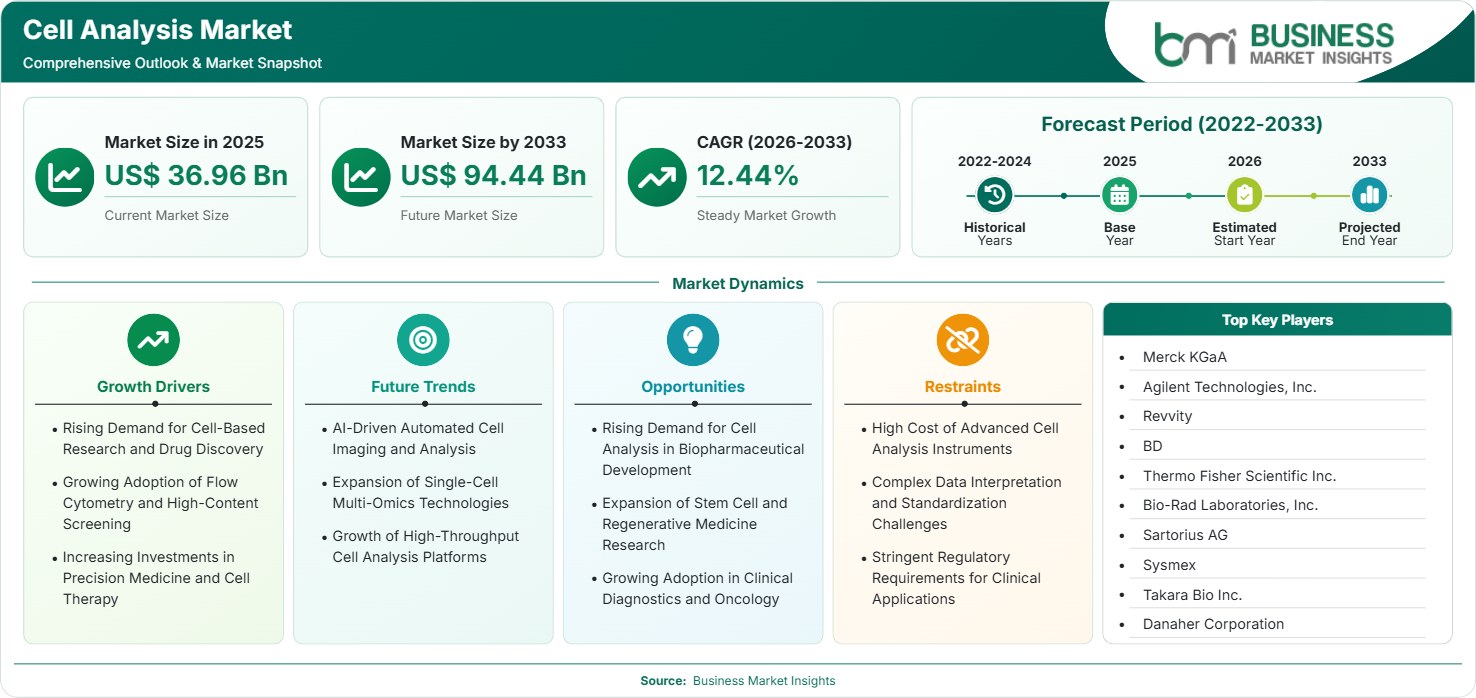
The Cell Analysis Market size was valued at US$ 36.96 Billion in 2025 and is projected to reach US$ 94.44 Billion by 2033, growing at a CAGR of 12.44% during 2026–2033. Rising investments in life science research, increasing adoption of precision medicine, growing demand for advanced cell-based diagnostics, and continuous advancements in single-cell analysis technologies are supporting market growth globally.

Report Coverage
  • Offerings: Product , Software & Services
  • Technique: Flow Cytometry, Cell Imaging, Single-Cell Analysis, Others
  • Application: Research, Disease Diagnostics, Others
  • End-user: Pharmaceutical & Biotechnology Companies, Diagnostic Laboratories, Others
US$ 36.96 Bn Market size in 2025
US$ 94.44 Bn Market Size by 2033
12.44% CAGR, 2026 - 2033
2026-2033 Forecast Period

AI Overview

Cell Analysis Market Summary

  • North America Region: North America holds a cell analysis market share of 39%–42% in 2025, growing with a CAGR of 11.8%–12.5% during 2026–2033. Strong biotechnology research infrastructure, increasing genomic research activities, and rising pharmaceutical R&D investments continue supporting regional leadership. The U.S. market is expected to register a CAGR of 12.0%–12.7%.
  • Fastest Growing Region: Asia Pacific accounts for 23%–26% share in 2025 and is projected to grow at a CAGR of 13.3%–14.0% through 2033. Expanding biotechnology sectors, increasing healthcare investments, and growing adoption of advanced analytical technologies continue driving regional growth.
  • Leading Segment: Products represent 67%–70% share in 2025 and are expected to grow at a CAGR of 12.5%–13.2% through 2033. Growing use of consumables, reagents, and analytical instruments across research and diagnostic applications continues supporting segment dominance.
  • High Growth Segment: Single-Cell Analysis accounts for 24%–27% share in 2025 and is forecast to grow at a CAGR of 13.8%–14.5% during 2026–2033. Increasing focus on precision biology, personalized medicine, and advanced biomarker discovery continues accelerating segment growth.
  • Key Market Opportunity: Expansion of single-cell genomics, cell-based therapies, biomarker discovery programs, and precision medicine initiatives is creating substantial growth opportunities.
  • Major Market Players: Merck KGaA, Agilent Technologies, Inc., Revvity, BD, Thermo Fisher Scientific Inc., Bio-Rad Laboratories, Inc., Sartorius AG, Sysmex, Takara Bio Inc., and Danaher Corporation.
Strategic Insights

Cell Analysis Market: Strategic Insights

Cell Analysis Market Strategic Framework
FREE PDF
Request your free sample
Request free sample
Stakeholder View

Key Takeaways

  • Cell analysis technologies remain critical for drug discovery, clinical diagnostics, and biomedical research activities.
  • Products continue dominating the cell analysis market due to recurring demand for consumables, reagents, and analytical instruments.
  • Single-cell analysis is emerging as one of the fastest-growing segments due to increasing applications in precision medicine and genomics.
  • Pharmaceutical and biotechnology companies remain the largest end-user segment due to extensive research and development activities.
  • Flow cytometry continues to maintain strong adoption across research, clinical, and diagnostic environments.
  • North America remains the leading market due to strong research infrastructure and biotechnology investment.
  • Asia Pacific is projected to experience the fastest growth owing to expanding healthcare and life science research capabilities.
  • Advances in cell therapies, personalized medicine, and biomarker development are expected to create significant future opportunities.
Geographic Outlook

Cell Analysis Market Regional Highlights

North America Cell Analysis Market

North America accounts for 39%–42% Cell Analysis Market share in 2025 and is projected to grow at a CAGR of 11.8%–12.5% through 2033. Strong biotechnology research capabilities, increasing pharmaceutical R&D expenditure, and widespread adoption of advanced analytical technologies continue supporting regional leadership. The region benefits from a highly developed life sciences ecosystem and substantial funding for biomedical innovation.

  • Pharmaceutical and biotechnology companies continue making significant investments in cell-based research programs to accelerate drug discovery and improve therapeutic development outcomes.
  • Academic research institutions are increasingly adopting advanced cell analysis platforms to support genomics, immunology, and translational medicine initiatives.
  • Growing adoption of precision medicine is driving demand for sophisticated cellular characterization tools capable of supporting individualized treatment approaches.
  • Government and private funding programs continue supporting innovation in cell and gene therapy research, creating demand for advanced analytical technologies.
  • Clinical laboratories are integrating next-generation cell analysis systems to improve diagnostic accuracy and support personalized healthcare applications.
  • Increasing focus on cancer research and immunotherapy development continues expanding utilization of cell analysis tools across research environments.

US Cell Analysis Market

The United States contributes approximately 86%–90% of North American revenue and is expected to register a CAGR of 12.0%–12.7% through 2033. Strong life sciences research funding, advanced healthcare infrastructure, and leadership in biotechnology innovation continue supporting cell analysis market dominance.

  • Biopharmaceutical companies are increasingly deploying advanced cell analysis technologies to improve clinical development and accelerate product commercialization timelines.
  • Research organizations continue expanding utilization of single-cell analysis platforms to support genomics research and biomarker discovery initiatives.
  • Growing investments in precision medicine programs are encouraging broader adoption of sophisticated cell characterization technologies.
  • Clinical laboratories are increasingly integrating automated cell analysis solutions to improve workflow efficiency and analytical accuracy.
  • Innovation in cell and gene therapy development remains a major contributor to growing demand for advanced cell analysis systems.

Europe Cell Analysis Market

Europe represents 25%–28% of global revenue in 2025 and is anticipated to expand at a CAGR of 12.0%–12.7% through 2033. Strong biomedical research activity, increasing investments in precision healthcare, and growing adoption of advanced diagnostic technologies continue supporting regional growth. Germany remains the leading market while Poland demonstrates stronger growth momentum.

  • Germany continues leading regional demand through extensive biotechnology research activities and strong adoption of advanced life science technologies.
  • Poland is among the fastest-growing markets and is estimated to register a CAGR of 13.2%–13.9% during the forecast period, supported by growing healthcare and research investments.
  • Academic institutions and research centers continue expanding utilization of flow cytometry and cell imaging systems to support biomedical innovation.
  • Increasing focus on personalized treatment strategies is driving adoption of cell analysis platforms for translational research applications.
  • Pharmaceutical companies are using advanced cellular analysis technologies to improve drug screening and therapeutic development efficiency.
  • Government-supported research initiatives continue encouraging broader implementation of advanced analytical tools across the life sciences sector.

Asia Pacific Cell Analysis Market

Asia Pacific accounts for 23%–26% of global revenue in 2025 and is expected to achieve the fastest CAGR of 13.3%–14.0% through 2033. Expanding biotechnology industries, growing healthcare expenditure, and increasing investments in biomedical research continue supporting strong regional growth. Rapid modernization of research infrastructure is creating substantial opportunities across the region.

  • China remains the largest regional cell analysis market due to extensive investments in biotechnology innovation, genomics research, and healthcare modernization programs.
  • India is projected to achieve approximately 14.1%–14.8% CAGR, supported by growing pharmaceutical research activities and expanding biotechnology capabilities.
  • Research institutions are increasingly adopting advanced cell analysis technologies to support regenerative medicine and precision healthcare initiatives.
  • Rising demand for biologics and cell-based therapies is creating sustained requirements for sophisticated cellular characterization solutions.
  • Governments across the region continue supporting life sciences innovation through funding programs, infrastructure development, and research incentives.
  • Expansion of pharmaceutical manufacturing and clinical research activities continues driving adoption of advanced cell analysis systems.

Rest of World Cell Analysis Market

Rest of World accounts for 7%–10% of global revenue in 2025 and is projected to expand at a CAGR of 11.9%–12.6% through 2033. Growing healthcare investments, improving research capabilities, and increasing adoption of advanced laboratory technologies continue supporting cell analysis market growth.

  • Brazil continues generating demand through expansion of biomedical research activities and modernization of laboratory infrastructure.
  • The UAE is witnessing increased investment in advanced healthcare technologies and life science research initiatives, supporting demand for cell analysis platforms.
  • Saudi Arabia is expected to achieve approximately 12.8%–13.5% CAGR through 2033, supported by healthcare transformation programs and biotechnology development strategies.
  • Diagnostic laboratories are increasingly implementing advanced cell analysis technologies to improve testing capabilities and research outcomes.
  • Expanding academic and clinical research activities continue supporting broader adoption of flow cytometry and cell imaging systems.
  • Investments in precision medicine and healthcare innovation are creating long-term growth opportunities across emerging markets.
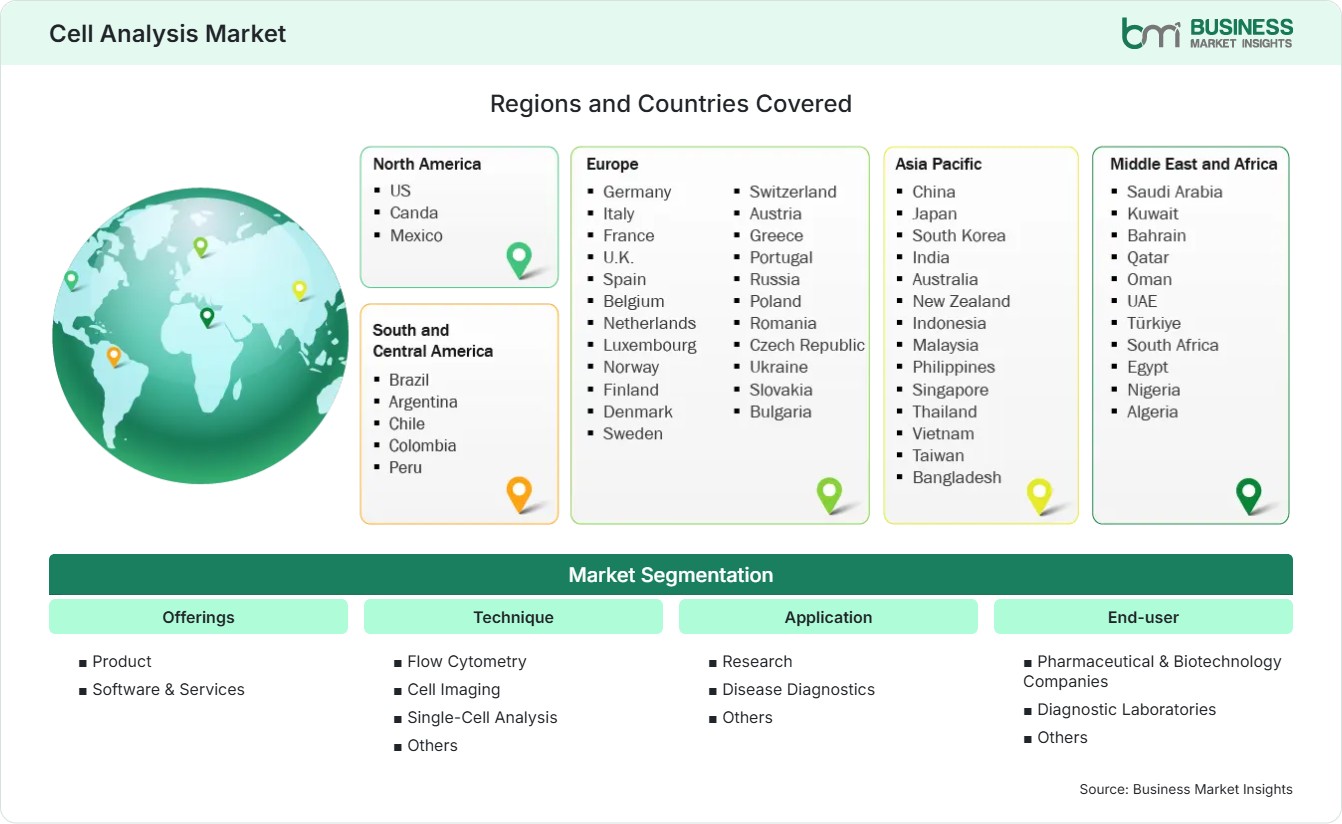
Global Market Geography
FREE PDF
Request your free sample
Request free sample
Segment Analysis

Cell Analysis Market Segmentation

Offerings

The offerings segment represents the core products, software platforms, and support services that enable advanced cellular characterization, analysis, and interpretation across research and clinical environments. The segment accounts for approximately 67%–70% share in 2025 and is projected to grow at a CAGR of 12.5%–13.2% through 2033. The expanding Cell Analysis Market scope is supported by increasing investments in life sciences research, growing adoption of cell-based assays, rising demand for precision medicine, and continuous technological advancements in cellular analytics.

  • Product (Consumables and Instruments): Products represent the dominant segment due to recurring demand for reagents, assay kits, antibodies, cell culture materials, flow cytometers, imaging systems, and cell sorting instruments. Continuous laboratory research activities and increasing adoption of advanced analytical systems continue driving segment growth.
  • Software & Services: Software and services are witnessing strong growth as research organizations increasingly require data management, analytical tools, workflow automation solutions, maintenance services, and cloud-enabled bioinformatics platforms to manage complex cellular datasets.

Technique

Technique selection significantly influences analytical accuracy, research efficiency, and application outcomes across cell biology and biomedical research. This segment accounts for approximately 31%–34% share in 2025 and is expected to register a CAGR of 12.9%–13.6% through 2033. Current Cell Analysis Market trends indicate growing utilization of advanced analytical methods for precision healthcare and translational research applications.

  • Flow Cytometry: Flow cytometry remains one of the largest segments due to its ability to rapidly analyze multiple cellular parameters, support immunophenotyping, and facilitate high-throughput cellular characterization across research and clinical settings.
  • Cell Imaging: Cell imaging technologies continue witnessing strong adoption because they enable detailed visualization of cellular structures, functions, and biological processes with high resolution and analytical precision.
  • Single-Cell Analysis: Single-cell analysis is the fastest-growing technique segment due to its ability to uncover cellular heterogeneity, support biomarker discovery, and advance precision medicine research.
  • Others: Additional techniques include cell counting, spectroscopy-based analysis, microfluidic approaches, molecular profiling, and emerging cellular analytics technologies.

Application

Application diversity continues expanding as cellular analysis becomes increasingly critical for understanding disease mechanisms, therapeutic responses, and biological processes. This segment accounts for approximately 56%–59% share in 2025 and is projected to grow at a CAGR of 12.6%–13.3% through 2033.

  • Research: Research remains the dominant application segment as academic institutions, biotechnology companies, and pharmaceutical organizations continue utilizing cell analysis technologies for drug discovery, genomics, immunology, and basic biological research.
  • Disease Diagnostics: Disease diagnostics continues witnessing increasing adoption due to growing use of cellular analysis tools in cancer detection, immune disorder assessment, infectious disease monitoring, and precision healthcare initiatives.
  • Others: Additional applications include toxicology studies, regenerative medicine, cell therapy development, agricultural biotechnology research, and industrial bioprocess monitoring.

End-user

End-user demand continues accelerating as organizations seek advanced analytical tools capable of supporting innovation, diagnosis, and therapeutic development. This segment accounts for approximately 42%–45% share in 2025 and is forecast to grow at a CAGR of 12.8%–13.5% through 2033.

  • Pharmaceutical & Biotechnology Companies: Pharmaceutical and biotechnology companies represent the leading segment due to extensive utilization of cell analysis technologies in drug discovery, biologics development, immunotherapy research, and clinical development programs.
  • Diagnostic Laboratories: Diagnostic laboratories increasingly rely on cell analysis systems to improve testing accuracy, disease monitoring capabilities, and personalized diagnostic solutions.
  • Others: Additional end users include academic research institutes, hospitals, government laboratories, contract research organizations, and regenerative medicine centers.
Market Forces

Cell Analysis Market Dynamics

Key Market Drivers

Rising Demand for Cell-Based Research and Drug Discovery

The area of cell-based research has emerged as an important pillar of contemporary biomedical and pharmaceutical sciences. Scientists today use sophisticated cell analysis technologies in order to study the mechanisms of the disease, find new targets for treatment, test drugs and develop better strategies for treatment. Pharmaceutical and biotech firms constantly increase research activities aimed at developing treatments for cancer, immune system disorders, neurologic conditions and rare diseases, thus generating a considerable need for sophisticated cell analysis solutions. Such technologies allow to analyze the functioning of cells more accurately, which makes the process of drug development more efficient.

Growing Adoption of Flow Cytometry and High-Content Screening

Flow cytometry and high-content screening technologies are becoming increasingly vital in research and clinical settings. The technologies provide for fast and precise cellular analysis as well as high-throughput processes needed for current scientific research. Scientists apply the technologies to study cells, look for biomarkers, observe immune responses, and conduct screening procedures. Advances in technology make the tools even more accurate and automated and allow for better multiplexing. Laboratories searching for new ways to analyze samples in an efficient and productive manner will see a growth in the use of such technologies.

Increasing Investments in Precision Medicine and Cell Therapy

Precision medicine and cell-based therapies are transforming healthcare by enabling more targeted and individualized treatment approaches. Cell analysis technologies play a critical role in identifying biomarkers, characterizing cellular responses, monitoring therapeutic effectiveness, and supporting patient stratification. Governments, healthcare providers, and life sciences companies continue investing heavily in precision healthcare initiatives and advanced therapeutic research. Growing clinical adoption of personalized treatments and regenerative medicine programs is substantially increasing demand for sophisticated cellular analysis solutions capable of delivering highly accurate and actionable insights.

Key Market Opportunities

Rising Demand for Cell Analysis in Biopharmaceutical Development

The biopharmaceutical firms are now employing cell analysis techniques in their processes in drug development and manufacturing. Analysis of the cellular properties, quality control operations, development of biologics and therapeutic validation process all require accurate analysis. With the expansion of the biologics market around the world, the need for advanced cell analysis solutions is projected to rise significantly. The increasing complexity of the modern therapeutics offers immense possibilities for technology firms.

Expansion of Stem Cell and Regenerative Medicine Research

Stem cell research and regenerative medicine continue emerging as highly promising areas within healthcare and biomedical science. Researchers increasingly depend on advanced cell analysis solutions to study stem cell differentiation, cellular functionality, tissue regeneration, and therapeutic efficacy. Growing public and private investment in regenerative medicine programs is accelerating scientific activity across this field. These developments are creating attractive long-term opportunities for manufacturers of cell analysis technologies and related solutions.

Growing Adoption in Clinical Diagnostics and Oncology

Clinical diagnostics and oncology applications continue expanding rapidly as healthcare providers seek more accurate and personalized disease management approaches. Cell analysis technologies assist clinicians in cancer diagnosis, treatment monitoring, biomarker identification, and disease progression assessment. Increasing prevalence of cancer and chronic diseases is strengthening demand for advanced diagnostic capabilities. Long-term Cell Analysis Market Forecasts remain favorable as personalized healthcare and precision oncology continue gaining momentum across global healthcare systems.

Market Restraints and Challenges

High Cost of Advanced Cell Analysis Instruments

Factor: Advanced cell analysis platforms such as flow cytometers, high-content imaging systems, cell sorters, and single-cell sequencing solutions often require substantial capital investment. Laboratories must also account for recurring expenses associated with reagents, software, maintenance contracts, calibration procedures, and skilled personnel.

Impact: High acquisition and operational costs can limit adoption among smaller laboratories, academic institutions, and budget-constrained healthcare facilities. These financial barriers may slow market penetration in certain regions despite increasing demand for advanced analytical capabilities.

Complex Data Interpretation and Standardization Challenges

Factor: Modern cell analysis technologies generate large volumes of highly complex biological data that require sophisticated analytical workflows and specialized expertise. Variability in methodologies, sample preparation procedures, and analytical standards can further complicate interpretation and comparison of results.

Impact: Data complexity and standardization challenges may increase training requirements, extend analysis timelines, and create barriers to broader adoption. Organizations often require significant investments in bioinformatics tools, skilled personnel, and workflow optimization to fully realize the benefits of advanced cell analysis technologies.

Company Analysis

Competitive Landscape

The Cell Analysis Market analysis is characterized by intense competition among life science technology providers, diagnostic companies, biotechnology solution developers, and analytical instrumentation manufacturers. Market participants are focusing on flow cytometry platforms, cell imaging technologies, single-cell analysis solutions, advanced bioinformatics tools, and automated laboratory workflows to strengthen their market positions. Growing demand for precision medicine, increasing investments in cell and gene therapy research, expanding drug discovery activities, and rising adoption of advanced diagnostic technologies continue driving innovation across the market. Companies are investing in next-generation cell analysis systems, artificial intelligence-enabled analytics, and integrated research platforms to address evolving life science research and clinical requirements.

Company Name

Overview

Products and Services relevant to this market

Merck KGaA

Global science and technology company serving healthcare, life sciences, and biotechnology sectors.

Cell analysis reagents, cell culture solutions, assay kits, life science research tools, and analytical platforms.

Agilent Technologies, Inc.

Analytical instrumentation and life sciences company supporting research and diagnostics applications.

Cell analysis systems, flow cytometry solutions, cell imaging instruments, bioanalytical platforms, and laboratory software.

Revvity

Life sciences and diagnostics company focused on advanced analytical technologies.

Cell analysis instruments, imaging systems, assay solutions, bioinformatics tools, and research services.

BD

Global medical technology company with a strong presence in flow cytometry and cell analysis.

Flow cytometers, cell sorting systems, reagents, antibodies, and cellular analysis platforms.

Thermo Fisher Scientific Inc.

Scientific instrumentation and laboratory solutions company serving life sciences and healthcare markets.

Cell analysis instruments, imaging systems, consumables, reagents, and laboratory automation solutions.

Bio-Rad Laboratories, Inc.

Life science research and clinical diagnostics company specializing in analytical technologies.

Cell analysis platforms, flow cytometry systems, cell sorting technologies, reagents, and research solutions.

Sartorius AG

Life science company focused on bioprocessing and laboratory technologies.

Cell analysis instruments, cell culture technologies, laboratory solutions, and biopharmaceutical research tools.

Sysmex

Diagnostics and healthcare technology company specializing in cellular and clinical analysis.

Cell analysis systems, hematology analyzers, diagnostic platforms, and laboratory workflow solutions.

Takara Bio Inc.

Biotechnology company focused on genomics, cell biology, and molecular research technologies.

Single-cell analysis solutions, cell culture systems, genomics tools, and life science research products.

Danaher Corporation

Diversified science and technology company operating leading life science and diagnostic businesses.

Cell analysis platforms, flow cytometry technologies, imaging systems, molecular diagnostics, and laboratory solutions.

Trust & Transparency

Research Methodology

The market analysis combines proprietary research with secondary data from government agencies, company disclosures, regulatory filings, industry databases and expert interviews. Market estimates are validated through data triangulation, cross-market benchmarking and analyst review.

View Full Research Methodology

Questions Answered

Frequently Asked Questions

How is cell analysis supporting precision medicine?

Cell analysis technologies help researchers and clinicians understand cellular behavior, identify biomarkers, evaluate treatment responses, and develop personalized therapies, supporting more targeted and effective healthcare approaches.

What does this Cell Analysis Market Report cover?

This report covers offerings analysis, technique segmentation, application assessment, end-user evaluation, regional trends, competitive landscape evaluation, market drivers, opportunities, restraints, challenges, and future growth prospects through 2033.

Why is Single-Cell Analysis the fastest-growing technique segment?

Single-cell analysis is growing rapidly because it enables researchers to identify cellular heterogeneity, discover novel biomarkers, improve disease understanding, and support precision medicine and personalized treatment development.

Which offerings segment dominates the market?

Products dominate the market due to recurring demand for consumables, reagents, assay kits, antibodies, flow cytometers, imaging systems, and other analytical instruments used across research and diagnostic applications.

What is driving growth in the market?

Rising demand for cell-based research and drug discovery, growing adoption of flow cytometry and high-content screening technologies, increasing investments in precision medicine, and expanding development of cell therapies are major factors driving market growth.

Access the Full Cell Analysis Market Report

Get segment-level forecasts, regional estimates, competitive benchmarking, company profiles and downloadable Excel datasets.

Access the full Cell Analysis Market Report
350 pages PDF & Excel | 2026-08-31
Similar Research

Related Market Reports