
Cataract Surgical Devices Market Outlook: Size, Share, Trends, Growth Analysis, Competitive Landscape & Forecast, 2026-2033

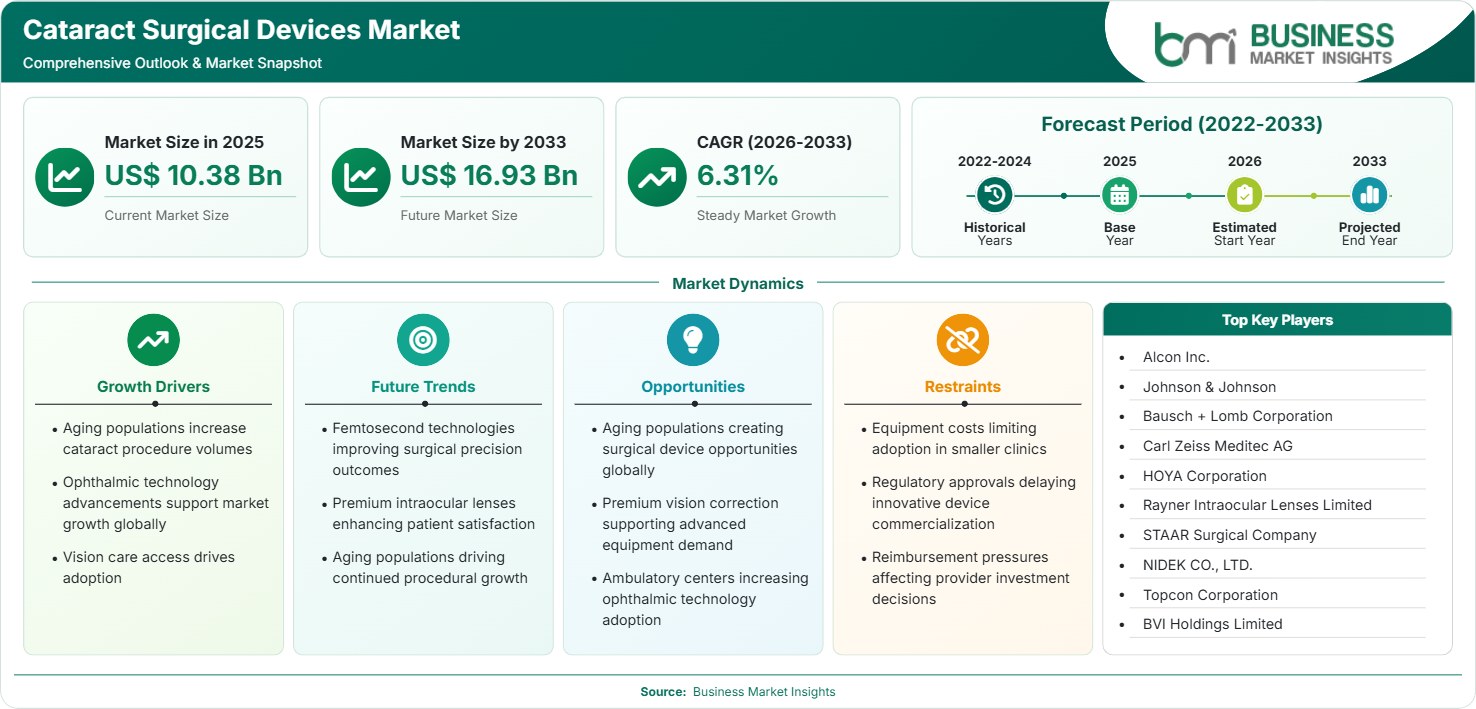
The Cataract Surgical Devices Market size was valued at US$ 10.38 Billion in 2025 and is projected to reach US$ 16.93 Billion by 2033, growing at a CAGR of 6.31% during 2026–2033, driven by aging populations, surgical access expansion, premium lenses, digital planning, and procedural efficiency.

Report Coverage
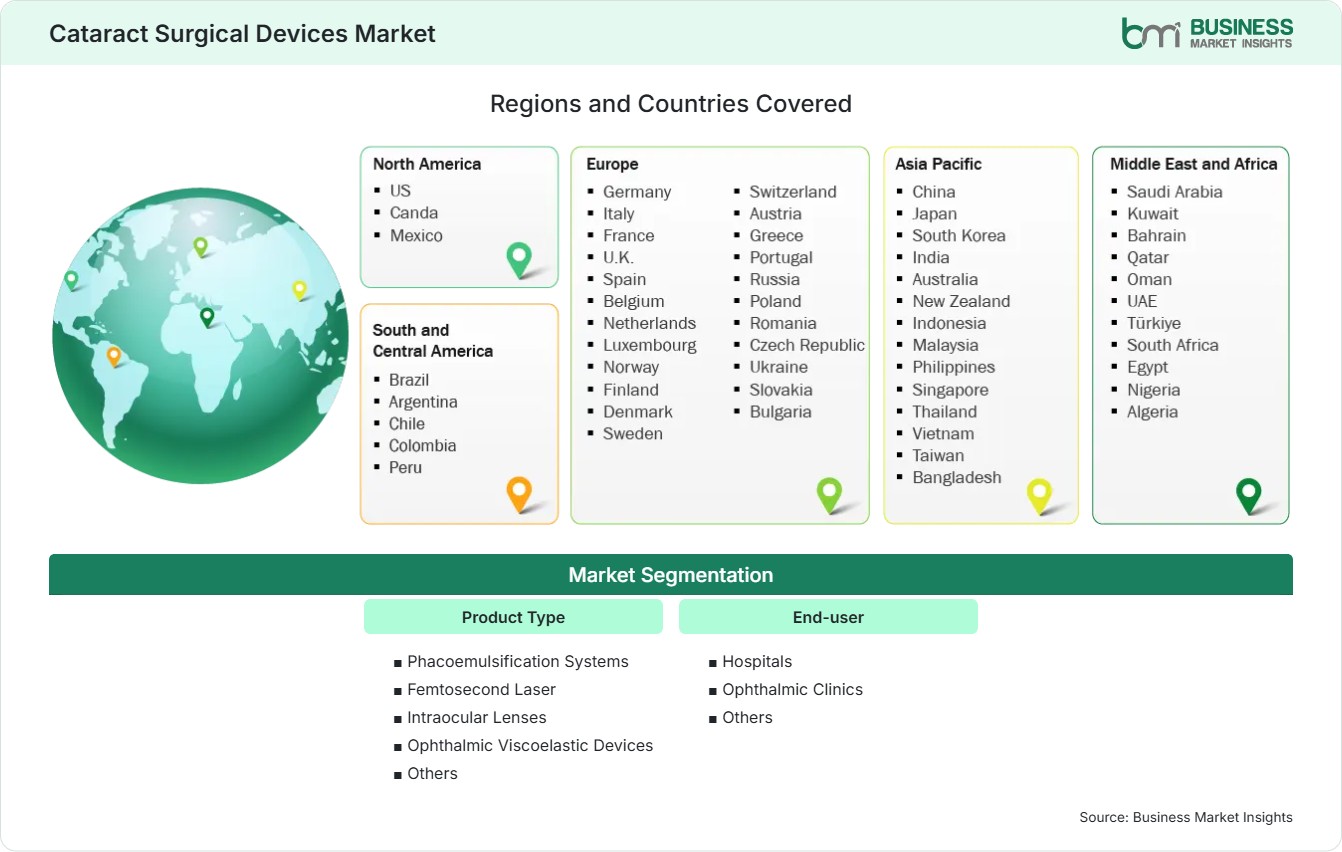
  • Product Type: Phacoemulsification Systems, Femtosecond Laser, Intraocular Lenses, Ophthalmic Viscoelastic Devices, Others
  • End-user: Hospitals, Ophthalmic Clinics, Others
US$ 10.38 Bn Market size in 2025
US$ 16.93 Bn Market Size by 2033
6.31% CAGR, 2026 - 2033
2026-2033 Forecast Period

AI Overview

Cataract Surgical Devices Market Summary

  • North America Region: North America holds a 32%–35% share in 2025, growing at a 5.8%–6.6% CAGR during 2026–2033, influenced by aging demographics, advanced ophthalmic infrastructure, premium IOL adoption, outpatient surgery, digital planning, and replacement demand. The US represents 78%–82% of regional demand, growing at a 6.0%–6.8% CAGR during 2026–2033, supported by high procedure volumes and technology adoption.
  • Fastest Growing Region: Asia Pacific holds a 28%–31% share in 2025, growing at a 7.1%–7.9% CAGR during 2026–2033, supported by expanding cataract treatment access, aging populations, hospital investment, ophthalmic clinic expansion, local manufacturing, medical tourism, and improving reimbursement across developing markets.
  • Leading Segment: Intraocular Lenses holds a 47%–51% share in 2025, growing at a 6.4%–7.1% CAGR during 2026–2033, driven by rising surgical volumes, premium lens adoption, presbyopia correction, toric technologies, optical performance improvements, surgeon preference, and broader availability across emerging ophthalmology markets.
  • High Growth Segment: Femtosecond Laser holds a 9%–12% share in 2025, growing at a 8.0%–9.0% CAGR during 2026–2033, driven by precision-assisted procedures, premium cataract workflows, reduced manual steps, digital planning, astigmatism management, improved reproducibility, and adoption among technologically advanced ophthalmic centers.
  • Key Market Opportunity: Integration of digital diagnostics, artificial intelligence, image-guided planning, premium lenses, automated surgical platforms, and connected patient records can improve outcomes while creating recurring software and consumables revenue.
  • Major Market Players: Alcon Inc.; Johnson & Johnson; Bausch + Lomb Corporation; Carl Zeiss Meditec AG; HOYA Corporation; Rayner Intraocular Lenses Limited; STAAR Surgical Company; NIDEK CO., LTD.; Topcon Corporation; BVI Holdings Limited.
Strategic Insights

Cataract Surgical Devices Market: Strategic Insights

Cataract Surgical Devices Market Strategic Framework
FREE PDF
Request your free sample
Request free sample
Stakeholder View

Key Takeaways

  • The supply chain is moving towards greater vertical integration, as top suppliers are combining their surgical consoles, handpieces, IOL ranges, viscoelastic products, digital planning services, training programs, and service agreements to improve account retention and generate recurring revenue.
  • The greatest commercial potential is to be found in the area of premium IOLs, in ophthalmic clinics, in ambulatory surgical settings, and in emerging markets where increasing capacity for procedures can turn unmet cataract demand into purchases of equipment and consumables.
  • Advances in the field of market are heading in the direction of lower-energy phacoemulsification, better fluidics, image-guided planning, the use of artificial intelligence to aid in the selection of the lens, more advanced optical designs, and connected surgical workflows, which help to ensure reproducibility and enhance surgeon efficiency.
  • Asia Pacific offers the strongest expansion case in Cataract Surgical Devices Market because treatment gaps, demographic aging, expanding private ophthalmology networks, domestic medical-device production, and healthcare infrastructure investment are developing simultaneously across several large markets.
  • More of the investment is now being directed towards differentiated IOL technologies and integrated surgical platforms, with product launches by the major suppliers showing a shift in competition towards premium optics, digital workflows, and more valuable surgical ecosystems.
Geographic Outlook

Cataract Surgical Devices Market Regional Highlights

North America Cataract Surgical Devices Market

North America accounts for a 32%–35% share in 2025 and is projected to grow at a 5.8%–6.6% CAGR through 2033. The Cataract Surgical Devices Market share is supported by mature surgical infrastructure, high ophthalmologist density, advanced outpatient facilities, and established reimbursement pathways. The US dominates regional demand, while Canada contributes through public and private ophthalmic services.

  • Ophthalmologists in the United States are increasingly choosing to use premium IOLs and surgically integrated digital platforms, which in turn leads to a higher demand for advanced phacoemulsification systems, precise lens calculation, control of the fluidics, and disposable surgical components.
  • The use of equipment can be supported by outpatient cataract surgery since ambulatory facilities tend to favor shorter procedure times, reliable workflows, ergonomic consoles, and dependable consumables, which allow for a higher daily surgical output.
  • The age structure of the population continues to be a factor affecting demand, and technological differences cause suppliers to compete by means of optical quality, astigmatism correction, presbyopia management, connectivity, and postoperative patient satisfaction.
  • Canada can take advantage of its aging population, the demand for cataract treatment, investment in ophthalmic clinics, and the fact that portable diagnostic and surgical technologies have been adopted to support patient populations that are spread out geographically.

US Cataract Surgical Devices Market

The US Cataract Surgical Devices Market represents 78%–82% of North American demand in 2025 and is projected to expand at a 6.0%–6.8% CAGR through 2033. The country remains the region's principal innovation and procurement center, supported by substantial cataract procedure volumes, sophisticated ophthalmic practices, premium IOL adoption, and strong manufacturer presence.

  • There are about 20.5 million people in the United States who are 40 years of age or older and have cataracts, whereas only around 6.1 million have had cataract surgery, which shows that there is a substantial amount of demand that can be addressed.
  • The premium IOL is now aimed more at providing improved intermediate vision, a greater depth of focus, better contrast performance, and fewer visual disturbances, thus opening up higher-value possibilities than those offered by conventional monofocal lens replacement.
  • Manufacturers are able to take advantage of the existing ophthalmic distribution networks and specialist clinics, since these can quickly adopt new surgical consoles, lenses, calculation tools, and digital technologies once the clinical and economic benefits have been demonstrated.

Europe Cataract Surgical Devices Market

Europe Cataract Surgical Devices Market holds a 24%–27% share in 2025 and is forecast to expand at a 5.7%–6.5% CAGR through 2033. Germany, France, Italy, the UK, and Spain remain important markets, while Poland and Nordic countries provide stronger growth opportunities. Germany and France lead established procurement, while Poland is estimated at a 6.8%–7.5% CAGR and Nordic markets at 6.4%–7.1% CAGR, supported by modernization and access expansion.

  • Germany and France have a strong demand for phacoemulsification platforms, premium IOLs, surgical consumables, and ophthalmic equipment, a demand which is backed by the presence of well-established hospitals and specialist outpatient clinics.
  • Italy and Spain provide opportunities in the area of high-volume cataract surgery, in private ophthalmology, in the use of premium lenses, and in replacing outmoded surgical equipment with more efficient digital systems.
  • Because healthcare investment and ophthalmic capacity are growing, Poland is seeing faster development, which offers opportunities for cost-effective surgical platforms, standardized consumables, and IOL portfolios that meet the varied needs of patients.
  • The Nordic countries place a strong emphasis on quality, efficiency, and advanced clinical workflows, preferring equipment that is digitally connected, precise planning, high-quality optics, and systems that are designed to ensure consistent results.

Asia Pacific Cataract Surgical Devices Market

Asia Pacific Cataract Surgical Devices Market commands a 28%–31% share in 2025 and is forecast to expand at a 7.1%–7.9% CAGR through 2033, making it the fastest-growing region. China, Japan, India, South Korea, and Australia represent major demand centers. India is estimated at a 7.8%–8.6% CAGR, while Southeast Asian markets collectively offer a 7.5%–8.3% CAGR opportunity. Expanding ophthalmic networks, medical tourism, domestic manufacturing, aging populations, and cataract treatment gaps support sustained regional demand.

  • China has a large elderly population, together with growing ophthalmic capacity and the ability to produce medical devices of its own, which is leading to increased demand for phacoemulsification systems, IOLs, consumables, and more sophisticated surgical procedures.
  • India has great potential since cataract is still a leading cause of avoidable vision impairment, and treatment capacity is being improved by the expansion of hospitals, the existence of charitable eye-care networks, private clinics, and domestic manufacturing.
  • Japan and South Korea place a strong emphasis on high-quality optical performance, surgical precision, digital diagnostics, and advanced outpatient care procedures, which in turn leads to a demand for sophisticated IOLs and equipment that offer technological distinctions.
  • Australia has an aging population together with advanced ophthalmic infrastructure, which is leading to increased demand for surgical consoles, for the use of premium IOLs, and for digitally enabled cataract management.

Rest of World Cataract Surgical Devices Market

South and Central America Cataract Surgical Devices Market provides expanding opportunities through Brazil, Mexico, Colombia, and Chile, where private ophthalmology networks, aging populations, and treatment access improvements support equipment demand. Brazil represents the largest regional opportunity, while Colombia and Chile provide stronger expansion prospects. The combined region holds a 10%–13% share in 2025 and is projected to grow at a 5.2%–6.1% CAGR through 2033.

  • Brazil enjoys large volumes of ophthalmic procedures, the expansion of its private healthcare sector, and the demand for efficient surgical systems, high-end IOLs, and consumables in both metropolitan and regional centers.
  • Mexico, Colombia, and Chile offer opportunities by expanding their specialist clinics, modernizing healthcare, promoting medical tourism, and increasing the uptake of more valuable IOL technologies.
  • The Gulf states are putting money into sophisticated healthcare facilities and medical tourism, and they are doing so by supporting high-end ophthalmic equipment, advanced lenses, digital diagnostics, and surgical environments that can handle a large number of cases.
  • In African markets, there is still a significant unmet need, since the WHO states that four out of every three people who need cataract surgery in the African Region do not receive it, thereby offering long-term opportunities for expanding capacity.
Global Market Geography
FREE PDF
Request your free sample
Request free sample
Segment Analysis

Cataract Surgical Devices Market Segmentation

Phacoemulsification Systems

Phacoemulsification Systems represent approximately 31%–35% Cataract Surgical Devices Market share in 2025, with a 5.9%–6.7% CAGR 2026-2033. Adoption depends on surgical volumes, console replacement cycles, fluidics performance, energy management, and operating-room efficiency. Hospitals and clinics increasingly favor systems integrating automated functions, ergonomic controls, reusable platforms, and specialized disposables to improve consistency and throughput.

  • Phacoemulsification Systems: Advanced fluidics, energy delivery, chamber stability, and ergonomic interfaces support high-volume cataract procedures while replacement cycles and workflow efficiency sustain equipment demand.

Femtosecond Laser

Femtosecond Laser systems represent approximately 9%–12% Cataract Surgical Devices Market share in 2025, with an 8.0%–9.0% CAGR 2026- 2033. Adoption remains concentrated in technologically advanced centers because capital costs and workflow requirements limit universal penetration. Demand benefits from precision-assisted corneal incisions, capsulotomy, lens fragmentation, astigmatism management, premium cataract procedures, and surgeon interest in reproducible surgical steps.

  • Femtosecond Laser: Laser-assisted capsulotomy, corneal incisions, lens fragmentation, and astigmatism treatment improve procedural precision and attract premium cataract practices seeking differentiated surgical workflows.

Intraocular Lenses

Intraocular Lenses represent approximately 47%–51% share in 2025, with a 6.4%–7.1% CAGR 2026-2033. The segment benefits from every cataract procedure requiring lens replacement, while premiumization expands value through multifocal, toric, extended-depth-of-focus, and other advanced optical designs. Increasing patient expectations for reduced spectacle dependence are strengthening demand for differentiated lens portfolios.

  • Intraocular Lenses: Monofocal, multifocal, toric, and extended-depth-of-focus designs address diverse visual requirements, while material advances and optical engineering support premiumization and surgeon differentiation.

Ophthalmic Viscoelastic Devices

Ophthalmic Viscoelastic Devices represent approximately 12%–15% Cataract Surgical Devices Market share in 2025, with a 5.7%–6.5% CAGR 2026- 2033. Demand follows cataract procedure volumes because viscoelastic materials support tissue protection, chamber maintenance, and controlled surgical manipulation. Product differentiation centers on viscosity, handling characteristics, endothelial protection, packaging, and compatibility with surgeon preferences.

  • Ophthalmic Viscoelastic Devices: Viscoelastic formulations protect ocular structures and maintain surgical space, with recurring consumption linked directly to procedure volumes and hospital or clinic surgical throughput.

End-user

The Cataract Surgical Devices Market scope covers phacoemulsification systems, femtosecond lasers, intraocular lenses, and ophthalmic viscoelastic devices across hospitals and ophthalmic clinics. Hospitals hold 48%–52% share in 2025, while clinics account for 40%–44%. The segment grows at a 6.0%–6.8% CAGR 2026-2033, supported by aging populations and outpatient expansion.

  • Hospitals: Hospitals require broad equipment portfolios, high reliability, training, service coverage, and integrated surgical workflows because they manage complex patient populations and higher infrastructure requirements.
  • Ophthalmic Clinics: Specialist clinics favor compact systems, efficient consumables, premium IOL portfolios, rapid procedure turnover, and intuitive interfaces that support high-volume outpatient cataract surgery.
Market Forces

Cataract Surgical Devices Market Dynamics

Key Market Drivers

Population Aging and Unmet Cataract Treatment Demand

The demographic trend of an increasing elderly population is broadening the base of patients for cataract surgery, whereas gaps in treatment are generating volume opportunities in developing countries due to continued unmet needs. According to the WHO, cataract is found in at least 94 million people worldwide, and more than half the patients who require cataract surgery lack proper access. All such trends suggest the existence of continuous demand for console systems, intraocular lenses, viscoelastics, and disposable instrumentation. Growth is bolstered by increasing healthcare access and specialist availability. The Cataract Surgical Devices Market trends increasingly favor technologies that reduce procedure time, support reproducibility, and improve surgeon ergonomics. Suppliers that combine capital equipment with recurring consumables can capture greater lifetime value from expanding procedure volumes.

Premium IOL Innovation and Patient-Centered Vision Correction

Premiumization is changing the economics of cataract surgery by shifting competition from basic lens replacement toward optical performance and lifestyle outcomes. Extended depth of focus, multifocal, toric, and full range of vision lenses provide surgeons with the opportunity to correct presbyopia and astigmatism during the process of cataract surgery. According to Johnson & Johnson, by October 2025, their TECNIS Odyssey IOL had been implanted into 100,000 eyes in the United States. Alcon also launched its Clareon PanOptix Pro in the United States during 2025. This innovative intraocular lens is distinguished by high light efficiency and minimal scattering.

Digital Surgical Workflow Integration

Digital integration is becoming a competitive differentiator as cataract providers seek consistent measurements, streamlined lens selection, and improved operating-room productivity. Modern surgical systems are increasingly linked to diagnostics, IOL calculation, patient data management, and post-surgery monitoring. Such integration may help decrease manual transfer of data and implement standard processes in large multi-site ophthalmology networks. The above trend also allows for software upgrades without changing the whole system. For example, the UNITY system by Alcon shows the way to integrate surgical systems, while RayTrace by Rayner is an example of digital IOL calculation that links lens choice with the patient process.

Key Market Opportunities

Expansion of Cataract Capacity in Emerging Markets

Expanding surgical capacity in underserved regions represents a major long-term opportunity. WHO’s 2026 assessment highlights substantial unmet demand, particularly in Africa. Manufacturers can address these markets through affordable, durable systems, portable technologies, accessible IOL portfolios, training, and local service networks. Market growth will depend partly on reducing procedure costs while maintaining quality. Partnerships with hospitals, governments, NGOs, and distributors, alongside local assembly and manufacturing, can improve affordability, strengthen supply chains, and accelerate adoption.

Ambulatory Ophthalmology and High-Throughput Surgical Centers

The shift towards performing cataract surgery on an outpatient basis offers manufacturers the chance to design their systems with a focus on throughput, reliability, and ease of operation. Ambulatory surgery centers need equipment that cuts down on setup time, ensures reliable fluid dynamics, makes management of consumables easier, and minimizes downtime. Companies can boost their revenue by offering bundled contracts that include the consoles, handpieces, disposables, maintenance, training, and software. Furthermore, clinic networks present opportunities for standardizing procurement across various locations. If patients are willing to choose premium visual results, then having an advanced range of intraocular lens (IOL) options can increase revenue per procedure. Suppliers who can show clear reductions in surgery time, equipment downtime, and staff workload can strengthen their position when bidding for contracts while at the same time developing ongoing relationships with rapidly growing ophthalmic providers.

AI-Assisted Planning and Advanced IOL Selection

AI offers a growing opportunity in Cataract Surgical Devices Market by integrating biometric data, historical outcomes, lens calculations, and patient preferences to support more consistent IOL selection. AI-assisted tools may be especially valuable for premium lenses, astigmatism, and complex biometric cases. Rayner’s AI-designed RayOne Galaxy reflects increasing computational innovation in IOL development. Applications can extend to predictive analytics, personalized surgical planning, and postoperative monitoring, while subscription-based software can create recurring revenue and strengthen supplier differentiation.

Market Restraints and Challenges

Capital Costs and Uneven Technology Adoption

The adoption of advanced femtosecond laser systems, high-end surgical consoles, imaging systems, and digital integration solutions requires a large initial outlay, which limits their use in smaller hospitals and clinics. As a result, healthcare providers in areas where costs are a major concern may keep on using their existing phacoemulsification equipment for longer, thereby delaying the replacement of this equipment and reducing the uptake of more expensive technologies. Because of their capital limitations, buyers tend to be more sensitive to the way equipment is used, the cost of maintenance, the pricing of consumables, and the terms of financing.

Regulatory Requirements and Clinical Evidence Burden

The need for cataract devices and IOLs to obtain regulatory approval involves obtaining clinical evidence, maintaining quality controls, ensuring manufacturing consistency, and carrying out post-market surveillance in various jurisdictions. As a result, launching a product can take a lot of time and involve substantial investment, and the fact that regulatory standards differ increases the complexity of both development and the amount of documentation required. With respect to premium IOLs, further evidence is needed, as manufacturers must demonstrate good optical performance and acceptable safety characteristics across all patient groups for whom the device is intended.

Company Analysis

Competitive Landscape

The Cataract Surgical Devices Market analysis indicates that competition is increasingly based on complete procedural ecosystems rather than individual devices. Leading suppliers combine surgical platforms, IOL portfolios, consumables, digital tools, training, and service capabilities to strengthen surgeon relationships and recurring revenue.

Company Name

Overview

Products and Services relevant to this market

Alcon Inc.

Global eye-care company with a broad surgical portfolio spanning cataract, refractive, and ophthalmic procedures.

UNITY cataract systems, CENTURION platforms, Clareon IOLs, PanOptix IOLs, surgical consumables, and digital solutions.

Johnson & Johnson

Major healthcare company with an established ophthalmic surgical portfolio and extensive IOL development capabilities.

TECNIS IOL portfolio, cataract surgery technologies, IOL delivery systems, surgical planning, and vision-care solutions.

Bausch + Lomb Corporation

Global eye-health company serving surgical, pharmaceutical, and consumer ophthalmology markets.

enVista IOLs, Stellaris surgical platforms, ophthalmic viscoelastics, surgical instruments, and cataract consumables.

Carl Zeiss Meditec AG

Ophthalmic technology specialist focused on surgical systems, diagnostics, visualization, and digital workflows.

QUATERA phaco systems, CALLISTO eye, IOLMaster diagnostics, surgical visualization, and cataract workflow technologies.

HOYA Corporation

Japanese optical and healthcare company with substantial expertise in ophthalmic lenses and surgical products.

Vivinex IOLs, premium lens technologies, surgical consumables, and ophthalmic solutions for cataract procedures.

Rayner Intraocular Lenses Limited

UK-based ophthalmic manufacturer specializing in IOLs and cataract surgery technologies.

RayOne IOL portfolio, RayOne Galaxy, RayTrace calculation software, delivery systems, and ophthalmic products.

STAAR Surgical Company

Ophthalmic device company focused on implantable lens technologies and precision vision correction.

Implantable lens technologies, IOL-related products, lens delivery systems, and ophthalmic surgical solutions.

NIDEK CO., LTD.

Japanese ophthalmic equipment manufacturer offering diagnostic and surgical technologies for eye-care providers.

Cataract surgical systems, phacoemulsification equipment, diagnostic devices, and ophthalmic imaging technologies.

Topcon Corporation

Global ophthalmic technology company combining diagnostics, imaging, digital workflows, and clinical equipment.

Cataract diagnostics, optical biometry, surgical planning support, imaging systems, and connected ophthalmic technologies.

BVI Holdings Limited

Ophthalmic surgical products provider with a broad portfolio of instruments, IOLs, and procedure-related consumables.

IOLs, viscoelastic devices, surgical instruments, phaco accessories, and cataract procedure consumables.

Trust & Transparency

Research Methodology

The market analysis combines proprietary research with secondary data from government agencies, company disclosures, regulatory filings, industry databases and expert interviews. Market estimates are validated through data triangulation, cross-market benchmarking and analyst review.

View Full Research Methodology

Questions Answered

Frequently Asked Questions

What factor most limits femtosecond laser penetration?

Capital expenditure remains a major constraint because femtosecond laser systems require specialized infrastructure and generate value primarily when procedure volumes and patient demand justify investment. Adoption is consequently concentrated in premium and technologically advanced ophthalmic centers.

How could AI influence IOL selection?

AI in Cataract Surgical Devices Market can combine biometric measurements, prior outcomes, lens characteristics, and patient preferences to support more consistent planning. Its commercial value will increase as digital records and postoperative outcome datasets become larger and more interoperable across ophthalmology networks.

What role do consumables play in recurring revenue?

The Cataract Surgical Devices Market Report evaluates recurring revenue potential from viscoelastic devices, surgical accessories, handpieces, and procedure-specific consumables. Their repeat use links revenue directly to cataract procedure volumes, allowing suppliers to generate ongoing sales from installed surgical platforms while strengthening customer relationships through bundled supply and service agreements.

Why are ophthalmic clinics becoming important purchasing centers?

Ophthalmic clinics can perform high volumes of standardized cataract procedures while maintaining focused specialist workflows. Their purchasing priorities often favor compact systems, predictable consumables, premium IOL availability, responsive service, and equipment configurations optimized for outpatient throughput.

How does premium IOL adoption affect supplier economics?

Premium IOLs can increase revenue per cataract procedure because patients may select advanced optical designs for reduced spectacle dependence, astigmatism correction, or broader visual ranges. This also increases demand for accurate biometry, lens calculation, surgeon training, and postoperative assessment.

Access the Full Cataract Surgical Devices Market Report

Get segment-level forecasts, regional estimates, competitive benchmarking, company profiles and downloadable Excel datasets.

Access the full Cataract Surgical Devices Market Report
350 pages PDF & Excel | 2026-11-02
Similar Research

Related Market Reports