
Surgical Imaging Market Outlook: Size, Share, Trends, Growth Analysis, Competitive Landscape & Forecast, 2026-2033

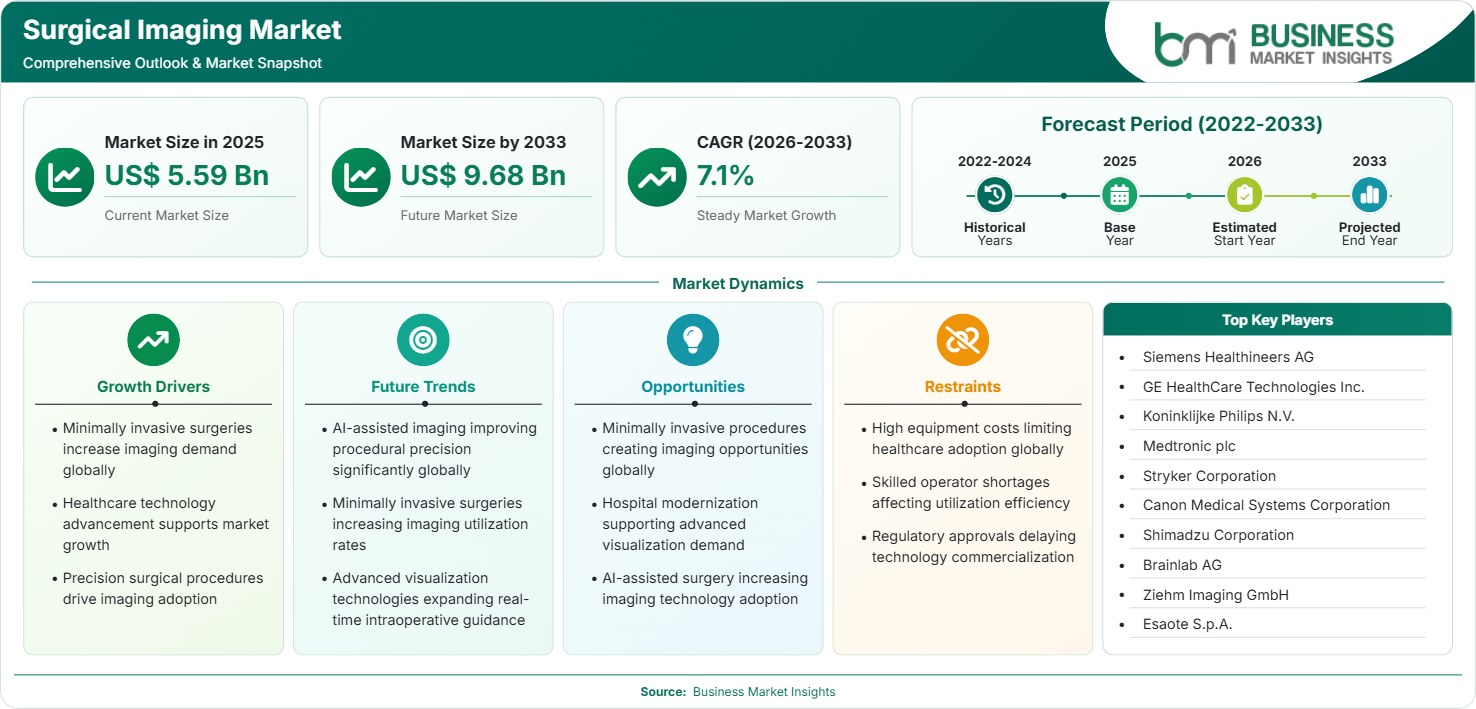
The Surgical Imaging Market size was valued at US$ 5.59 Billion in 2025 and is projected to reach US$ 9.68 Billion by 2033, growing at a CAGR of 7.10% during 2026–2033, driven by minimally invasive procedures, advanced 3D visualization, AI integration, hybrid operating rooms, and rising surgical volumes.

Report Coverage
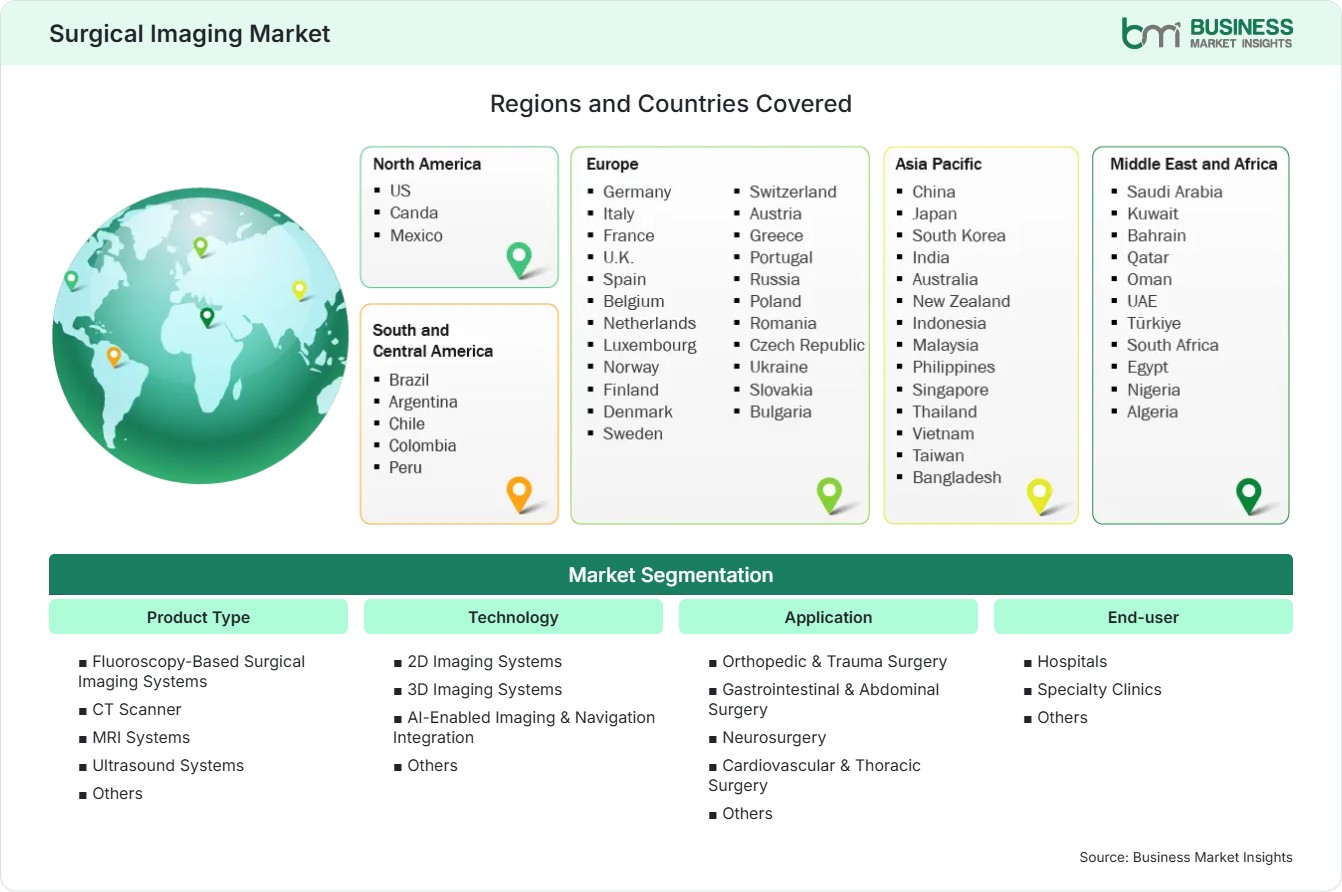
  • Product Type: Fluoroscopy-Based Surgical Imaging Systems, CT Scanner, MRI Systems, Ultrasound Systems, Others
  • Technology: 2D Imaging Systems, 3D Imaging Systems, AI-Enabled Imaging & Navigation Integration, Others
  • Application: Orthopedic & Trauma Surgery, Gastrointestinal & Abdominal Surgery, Neurosurgery, Cardiovascular & Thoracic Surgery, Others
  • End-user: Hospitals, Specialty Clinics, Others
US$ 5.59 Bn Market size in 2025
US$ 9.68 Bn Market Size by 2033
7.1% CAGR, 2026 - 2033
2026-2033 Forecast Period

AI Overview

Surgical Imaging Market Summary

  • North America Region: North America holds a market share of 34%–39% in 2025, growing with a CAGR of 6.5%–7.5%, influenced by advanced hospitals, hybrid operating rooms, reimbursement depth, replacement demand, AI adoption, and complex surgical procedures across specialties.
  • Fastest Growing Region: Asia Pacific holds a market Surgical Imaging Market share of 20%–25% in 2025, growing with a CAGR of 9.0%–10.5%, supported by expanding hospital infrastructure, rising procedure volumes, healthcare investment, urbanization, and increasing adoption of image-guided surgery.
  • Leading Segment: Fluoroscopy-based Surgical Imaging Systems holds a market share of 40%–45% in 2025, growing with a CAGR of 6.5%–7.5%, supported by C-arm utilization, orthopedic procedures, cardiovascular interventions, trauma care, and intraoperative visualization requirements.
  • High Growth Segment: 3D Imaging Systems holds a market share of 18%–22% in 2025, growing with a CAGR of 9.0%–10.0%, driven by volumetric visualization, spine procedures, orthopedic planning, navigation integration, complex interventions, and demand for intraoperative verification.
  • Key Market Opportunity: Integration of AI, 3D imaging, navigation, robotics, and intraoperative data creates opportunities for vendors to differentiate through workflow efficiency, radiation optimization, procedural precision, interoperability, and software-enabled recurring revenue.
  • Major Market Players: Siemens Healthineers AG, GE HealthCare Technologies Inc., Koninklijke Philips N.V., Medtronic plc, Stryker Corporation, Canon Medical Systems Corporation, Shimadzu Corporation, Brainlab AG, Ziehm Imaging GmbH, and Esaote S.p.A.
Strategic Insights

Surgical Imaging Market: Strategic Insights

Surgical Imaging Market Strategic Framework
FREE PDF
Request your free sample
Request free sample
Stakeholder View

Key Takeaways

  • The chain of value is shifting from a focus on hardware to include integrated ecosystems that combine imaging equipment, navigation, software, surgical planning, service contracts, data connectivity, and clinical workflow management.
  • Three-dimensional imaging, AI-assisted navigation, operations in the field of orthopedic trauma, neurosurgery, cardiovascular procedures, and specialist clinics offer appealing opportunities for growth since these applications directly benefit from accurate intraoperative visualization.
  • Product development is now placing a greater emphasis on automated positioning, low-dose imaging, volumetric reconstruction, image fusion, the use of artificial intelligence to assist with interpretation, spatial computing, and the smooth transfer of preoperative imaging into the operating room.
  • The strongest potential for expansion is in Asia Pacific since hospital construction, investment in private healthcare, surgical volumes, the availability of specialist services, and the uptake of technology are all progressing in China, India, Japan, South Korea and Southeast Asia.
  • Today's competitive activity is more focused on connected surgical ecosystems rather than on individual imaging devices, which is leading to a greater number of partnerships and acquisitions in the areas of navigation, planning software, robotics, AI, visualization, and procedure-specific technologies.
  • Hospitals are now evaluating imaging systems on the basis of lifecycle economics, utilization, service responsiveness, interoperability, radiation performance, and clinical workflow improvements, which in turn makes software and service differentiation more important.
Geographic Outlook

Surgical Imaging Market Regional Highlights

North America Surgical Imaging Market

North America accounted for a 34%–39% Surgical Imaging Market share in 2025 and is projected to expand at a 6.5%–7.5% CAGR through 2033. The region benefits from sophisticated hospitals, high procedure intensity, established reimbursement systems, and rapid adoption of advanced imaging.

  • More advanced hospitals are choosing integrated systems that combine C-arm, CT, navigation, and visualization capabilities to carry out complicated procedures and, at the same time, reduce workflow fragmentation and the need for unnecessary patient transfers between departments.
  • AI-enabled reconstruction and automated imaging procedures are attracting attention since healthcare providers want a consistent level of image quality, less radiation exposure, quicker acquisition, and better use of the limited resources available in the operating room.
  • Ambulatory and specialty clinics generate a gradually increasing need for small, mobile systems that are able to support orthopedic, pain-management, vascular, and other image-guided procedures without requiring major infrastructure investments.
  • The competition among vendors is now focusing more on lifecycle service, software upgrades, interoperability, cybersecurity, and workflow integration, which makes the relationships established with existing customers a key factor in determining opportunities for replacing and expanding systems.

US Surgical Imaging Market

The US represents approximately 80%–84% of the North American Surgical Imaging Market demand and is projected to grow at a 6.5%–7.5% CAGR through 2033. Strong hospital capital budgets, extensive surgical infrastructure, high procedure complexity, and regulatory pathways for innovative medical technologies support adoption.

  • Increasingly, health care systems are assessing surgical imaging systems on the basis of operating-room throughput, their ability to integrate, dose management, image quality, the extent of their service coverage, and their compatibility with existing navigation or robotic technologies.
  • There is a demand for compact imaging systems due to outpatient orthopedic and pain treatments, and at the same time, complex hospitals are still making investments in sophisticated 3D systems for use in the areas of the spine, trauma, vascular care, and cardiovascular care.
  • The number of FDA approvals for AI-powered imaging, visualization, and workflow technologies is still increasing, thereby expanding the commercial potential for software-integrated surgical systems and connected intraoperative applications.

Europe Surgical Imaging Market

Europe represented approximately 23%–27% of the global Surgical Imaging Market demand in 2025 and is forecast to grow at a 5.5%–6.5% CAGR through 2033. Germany, the United Kingdom, France, and Italy remain leading markets, while Germany is projected to have a CAGR of around 6.0%–7.0% CAGR, and the United Kingdom around 6.0%–7.0%.

  • Germany is still a major center for the adoption of new technology since university hospitals and specialist clinics make investments in advanced intraoperative imaging, navigation, and in digitally connected operating-room infrastructure.
  • The United Kingdom has the potential to take advantage of opportunities through the modernization of the NHS, by expanding surgical capacity, and due to the demand for workflow technologies that are able to improve efficiency without requiring a proportionate increase in staffing.
  • France and Italy prefer technologies that have demonstrable clinical and economic value and therefore ask suppliers to include in their procurement proposals equipment, service, software, training, and lifecycle support.
  • The radiation-efficient imaging, digital integration, and compact systems available in Nordic healthcare systems are due to the fact that the centralized procurement arrangements place increasing emphasis on measurable quality and operational outcomes.

Asia Pacific Surgical Imaging Market

Asia Pacific held approximately 20%–25% of the global Surgical Imaging Market demand in 2025 and is expected to achieve the fastest regional growth at a 9.0%–10.5% CAGR through 2033. China, Japan, India, South Korea, and Australia are major markets, while India and Southeast Asia offer higher expansion potential.

  • China still represents a significant opportunity since a growing number of large tertiary hospitals require advanced imaging, and because the country's policies regarding manufacturing and procurement have an effect on the competitiveness of vendors and on the localization of technology.
  • India has great potential for growth since the number of private hospital networks, medical tourism, orthopedic procedures, cardiovascular care, and specialist surgical centers is increasing, and the demand for mobile and advanced intraoperative imaging is increasing.
  • In Japan, there is a highly developed healthcare infrastructure together with a demand for small, high-performance systems, particularly in cases where operating-room efficiency, precision, radiation management, and integration with existing clinical workflows are important.
  • New opportunities are appearing in Southeast Asia as more investment takes place in the private healthcare sector and hospitals look to obtain modern imaging facilities to support orthopedic, trauma, cardiovascular, and minimally invasive surgical services.

Rest of World Surgical Imaging Market

The rest of the world accounted for approximately 13%–17% of the Surgical Imaging Market in 2025 and is projected to grow at a 6.0%–7.0% CAGR through 2033. South and Central America are led by Brazil and Mexico, while Chile and Colombia offer developing opportunities as private hospitals modernize surgical capabilities. Procurement remains concentrated in major urban facilities, but medical tourism and specialist centers can accelerate the adoption of advanced mobile imaging.

  • The best opportunities in Latin America are offered by Brazil and Mexico since private hospital groups are becoming more inclined to focus on modern surgical facilities and advanced imaging for high-value procedures.
  • The Gulf states are putting money into specialist hospitals and into operating rooms that are enabled by digital technology, which in turn provides opportunities for high-end imaging systems backed by full-service and training programs.
  • South Africa is still a technology center for the region, though it can be hampered by capital budgets, the cost of imported equipment, the need for infrastructure, and the fact that healthcare access is uneven.
  • Mobile systems are increasingly preferred in emerging markets since they need less infrastructure than fixed installations and are able to support several operating rooms, which improves the use of capital-intensive equipment.
Global Market Geography
FREE PDF
Request your free sample
Request free sample
Segment Analysis

Surgical Imaging Market Segmentation

Product Type

Product Type remains central to procurement decisions because procedure complexity determines required imaging capability. Fluoroscopy-based systems retain the largest Surgical Imaging Market share at 40%–45% in 2025 and a 6.5%–7.5% CAGR during 2026–2034. CT, MRI, and ultrasound broaden intraoperative capabilities, while hospitals increasingly favor interoperable portfolios supporting multiple surgical specialties.

  • Fluoroscopy–based Surgical Imaging Systems: C-arms provide real-time visualization for orthopedic, trauma, cardiovascular, and pain procedures, while flat-panel technology improves image quality, dose efficiency, mobility, and procedural flexibility.
  • CT Scanner: Intraoperative CT supports complex spine, neurological, trauma, and orthopedic procedures by providing volumetric anatomy and enabling verification before surgical closure or patient transfer.
  • MRI Systems: MRI supports soft-tissue visualization and specialized image-guided procedures, with workflow integration, compact configurations, and faster scanning, improving suitability for advanced surgical environments.
  • Ultrasound Systems: Ultrasound provides radiation-free, real-time imaging for vascular access, regional anesthesia, soft-tissue procedures, and selected surgical interventions where portability and immediate feedback are valuable.

Technology

Technology adoption is moving toward higher-dimensional visualization and software integration. 2D systems maintain broad installed-base penetration, while 3D imaging systems are forecast to achieve the strongest Surgical Imaging Market expansion at 9.0%–10.0% CAGR during 2026–2034. AI-enabled integration increasingly adds automation, navigation support, reconstruction, and workflow intelligence across imaging platforms.

  • 2D Imaging Systems: Mature 2D platforms remain widely used because they offer dependable real-time visualization, relatively straightforward workflows, lower infrastructure requirements, and broad compatibility with routine surgical procedures.
  • 3D Imaging Systems: Three-dimensional imaging improves spatial understanding and intraoperative verification, particularly for spine, trauma, orthopedics, and complex interventions requiring volumetric anatomical information.
  • AI-Enabled Imaging & Navigation Integration: AI integration supports image reconstruction, anatomy recognition, workflow automation, navigation, dose optimization, and procedural decision support, increasing software value within connected operating-room ecosystems.

Application

Application demand is concentrated in specialties where precise anatomical visualization directly affects procedural execution. Orthopedic and trauma procedures remain the leading application, supported by high procedure volumes and frequent imaging requirements. Neurosurgery, cardiovascular procedures, and gastrointestinal interventions increasingly adopt advanced visualization as minimally invasive techniques become more sophisticated.

  • Orthopedic & Trauma Surgery: Spine fixation, fracture management, joint procedures, and minimally invasive orthopedic interventions depend heavily on accurate intraoperative imaging, navigation compatibility, and rapid verification.
  • Gastrointestinal & Abdominal Surgery: Image guidance supports complex abdominal interventions by improving anatomical visualization, localization, and procedural confidence while enabling increasingly minimally invasive treatment approaches.
  • Neurosurgery: Neurosurgical applications benefit from high-resolution imaging, navigation, volumetric reconstruction, and intraoperative verification, where millimeter-level anatomical precision can influence procedural outcomes.
  • Cardiovascular & Thoracic Surgery: Cardiovascular and thoracic procedures increasingly use real-time imaging for device placement, structural interventions, vascular access, and procedural guidance, supporting demand for advanced imaging integration.

End-user

Hospitals represent the largest end-user category because they perform diverse and complex procedures requiring multiple imaging modalities. Specialty clinics provide a faster-growing niche where compact, mobile, and procedure-specific platforms support outpatient care. Hospitals are increasingly prioritizing integrated operating rooms, while specialty providers emphasize utilization, portability, and rapid deployment.

  • Hospitals: Hospitals require broad imaging portfolios spanning routine fluoroscopy to advanced 3D systems, with procurement increasingly linked to surgical volume, room utilization, interoperability, and service support.
  • Specialty Clinics: Specialty clinics favor compact imaging platforms that enable orthopedic, pain, vascular, and minimally invasive procedures while controlling infrastructure requirements and improving equipment utilization.
Market Forces

Surgical Imaging Market Dynamics

Key Market Drivers

Expansion of Image-Guided and Minimally Invasive Surgery

Rising use of minimally invasive procedures is a principal driver because surgeons require continuous visualization without relying solely on direct anatomical exposure. Orthopedic trauma, spine, cardiovascular, and vascular procedures increasingly use mobile C-arms, cone-beam CT, ultrasound, and navigation. The Surgical Imaging Market growth, therefore, reflects both procedure volume and greater imaging intensity per procedure. Image-guided workflows can support accurate device placement, anatomical verification, and immediate correction when positioning is inadequate. Increasing procedural complexity also strengthens demand for 3D visualization and image fusion.

Increasing Adoption of 3D Visualization and Intraoperative Verification

The shift from planar imaging toward volumetric visualization is strengthening the value proposition of advanced intraoperative systems. Three-dimensional imaging allows surgeons to assess anatomy from multiple planes and verify implant placement or anatomical correction before completing procedures. The Surgical Imaging Market trends increasingly center on mobile cone-beam CT, 3D C-arms, automated reconstruction, and integration with navigation platforms. Orthopedic and spinal surgery are particularly relevant because fixation accuracy can depend on detailed spatial information.

Integration of AI With Imaging, Navigation, and Surgical Workflows

AI is expanding imaging value from image acquisition toward decision support and workflow automation. Reconstruction algorithms can improve image quality while reducing noise, whereas AI-assisted segmentation can identify anatomical structures and support surgical planning. The Surgical Imaging Market growth increasingly depends on how effectively vendors connect imaging with navigation, robotics, digital planning, and clinical information systems. AI-enabled automation can also address staffing pressure by standardizing acquisition and reducing repetitive workflow steps. Recent technology development shows increasing emphasis on combining imaging data with real-time guidance rather than treating imaging as an isolated device.

Key Market Opportunities

Connected Hybrid Operating Rooms and Integrated Imaging Platforms

Hybrid operating rooms are an attractive way to make an investment since hospitals can bring together surgical and interventional capabilities in a coordinated setting. By using integrated imaging systems, patient movement can be reduced, access to up-to-date anatomical information can be improved, and procedures that require more than one modality can be better supported. The greatest opportunity exists in tertiary hospitals that carry out cardiovascular, vascular, neurological, and complex orthopedic interventions. Manufacturers can gain a competitive advantage by offering ceiling-mounted systems, mobile C-arms, integration with CT scanners, ultrasound, navigation facilities, and centralized workflow control. Interoperability is becoming more important as hospitals want imaging equipment to be able to communicate with surgical planning and information systems without leading to the formation of isolated technology silos.

AI-Enabled Imaging and Radiation Optimization

Investment opportunities arise at the point where image quality, radiation exposure, and workflow efficiency come together. By using advanced reconstruction methods, it is possible to maintain useful clinical image quality while at the same time reducing noise, which allows doctors to adopt lower-dose imaging approaches. In 2026, Philips stated that its SmartIQ technology enables an ultra-low-dose protocol that uses more than 50% less X-ray radiation than its existing low-dose settings when performing coronary procedures. These advances show that the overall trend in competition is moving towards software-defined imaging performance. Companies can make the most of this opportunity by incorporating anatomy recognition, automated positioning, protocol selection, device visualization, and image fusion.

Expansion of Advanced Imaging in Emerging Surgical Centers

Emerging healthcare systems provide substantial opportunities as specialist hospitals, private networks, and surgical centers expand capacity. Asia Pacific is particularly attractive because procedure volumes and healthcare investment are increasing, while many facilities remain in earlier stages of advanced imaging adoption. Vendors can address these markets through mobile systems, scalable configurations, local service partnerships, financing models, and training programs. The Surgical Imaging Market Forecasts opportunity extends beyond equipment sales because installed systems require maintenance, software upgrades, accessories, applications support, and staff education.

Market Restraints and Challenges

High Capital Cost and Infrastructure Requirements

The advanced 3D C-arms, intraoperative CT scanners, MRI systems, hybrid operating rooms, and integrated navigation systems involve a large initial outlay, demand extensive room preparation, necessitate specialized installation, and require trained staff. As a result, smaller hospitals and specialist clinics may delay making such purchases, especially in cases where the number of procedures carried out is not high enough to justify high levels of usage. When budgets are tight, procurement committees might prefer modular or mobile systems over complete platforms. Additional costs arise from service contracts, replacement parts, software upgrades, radiation shielding, and staff training throughout the lifecycle of the equipment.

Workflow Complexity, Interoperability, and Regulatory Burden

The combination of hardware, navigation, AI software, hospital information systems, robotic platforms, and applications specific to the procedure in surgical imaging is leading to challenges regarding interoperability and validation. Failures in integration may disrupt the flow of operations in the operating room, raise the demands for training, make cybersecurity management more complicated, and delay the acceptance of new technologies. Moreover, since regulatory requirements vary from one market to another, the time needed to develop and put AI-enabled imaging and decision-support applications onto the market is lengthened.

Company Analysis

Competitive Landscape

The Surgical Imaging Market analysis indicates that competition is increasingly based on integrated clinical workflows, software capabilities, navigation compatibility, installed-base strength, service infrastructure, and application-specific solutions rather than imaging hardware alone.

Company Name

Overview

Products and Services relevant to this market

Siemens Healthineers AG

Global healthcare technology company with strong imaging and precision therapy capabilities and broad hospital relationships.

Mobile C-arms, CT, MRI, surgical imaging, navigation software, image-guided therapy, and integrated operating-room solutions.

GE HealthCare Technologies Inc.

Major medical technology provider with an extensive imaging portfolio and established surgical imaging presence.

OEC C-arms, 2D and 3D imaging, ultrasound, CT, image-guided therapy, visualization, and workflow technologies.

Koninklijke Philips N.V.

Global health technology company focused on connected imaging, image-guided therapy, AI, and clinical workflow integration.

Image-guided therapy platforms, CT, MRI, ultrasound, interventional imaging, AI-enabled guidance, and workflow software.

Medtronic plc

Medical technology company with significant neurological and orthopedic surgical imaging integration capabilities.

O-arm imaging systems, 2D and 3D intraoperative imaging, surgical navigation, spine applications, and connected surgical platforms.

Stryker Corporation

Medical technology company focused strongly on orthopedics, neurotechnology, surgical technologies, and digitally enabled procedures.

Surgical planning, 3D visualization, navigation-related technologies, orthopedic imaging integration, and connected surgical applications.

Canon Medical Systems Corporation

Imaging technology specialist supplying advanced diagnostic and interventional equipment to hospitals worldwide.

CT, MRI, ultrasound, X-ray imaging, advanced visualization, interventional technologies, and imaging workflow solutions.

Shimadzu Corporation

Japanese technology company with established medical imaging expertise and strong X-ray equipment capabilities.

Mobile C-arms, fluoroscopy, radiography, X-ray systems, image processing, and surgical imaging technologies.

Brainlab AG

Digital surgery specialist focused on image-guided procedures, surgical planning, navigation, and software integration.

Surgical navigation, image management, planning software, intraoperative imaging integration, and digital surgical workflow platforms.

Ziehm Imaging GmbH

Specialist manufacturer focused on mobile C-arm technology for intraoperative imaging across surgical specialties.

Mobile C-arms, 3D C-arms, fluoroscopy, orthopedic imaging, vascular imaging, and advanced intraoperative visualization.

Esaote S.p.A.

European medical imaging specialist with expertise in ultrasound and dedicated MRI technologies.

Ultrasound, dedicated MRI, portable imaging, musculoskeletal imaging, and solutions supporting specialized clinical procedures.

Trust & Transparency

Research Methodology

The market analysis combines proprietary research with secondary data from government agencies, company disclosures, regulatory filings, industry databases and expert interviews. Market estimates are validated through data triangulation, cross-market benchmarking and analyst review.

View Full Research Methodology

Questions Answered

Frequently Asked Questions

How will emerging markets influence future industry competition?

Emerging markets will increasingly influence vendor strategies as hospital construction, specialist surgery, private healthcare investment, and minimally invasive procedures expand. Suppliers with localized distribution, training, financing, service networks, modular platforms, and interoperable software can gain advantages in these markets.

Which applications offer the strongest demand for 3D surgical imaging?

Orthopedic and trauma surgery, particularly spine procedures, represent strong applications because surgeons benefit from volumetric anatomical information and intraoperative verification.

Why are mobile imaging systems important for hospitals?

Mobile systems can serve multiple operating rooms and often require less infrastructure than fixed installations.

How is artificial intelligence changing intraoperative imaging?

AI is moving beyond image enhancement toward automated reconstruction, anatomy segmentation, device visualization, protocol optimization, workflow automation, and decision support.

What factors determine the adoption of advanced surgical imaging systems?

Adoption depends on procedure volume, clinical complexity, capital availability, operating-room infrastructure, interoperability, service support, radiation performance, and compatibility with navigation or robotic platforms.

Access the Full Surgical Imaging Market Report

Get segment-level forecasts, regional estimates, competitive benchmarking, company profiles and downloadable Excel datasets.

Access the full Surgical Imaging Market Report
350 pages PDF & Excel | 2026-10-22
Similar Research

Related Market Reports