
Carbon Offsets Market Outlook: Size, Share, Trends, Growth Analysis, Competitive Landscape & Forecast, 2026-2033

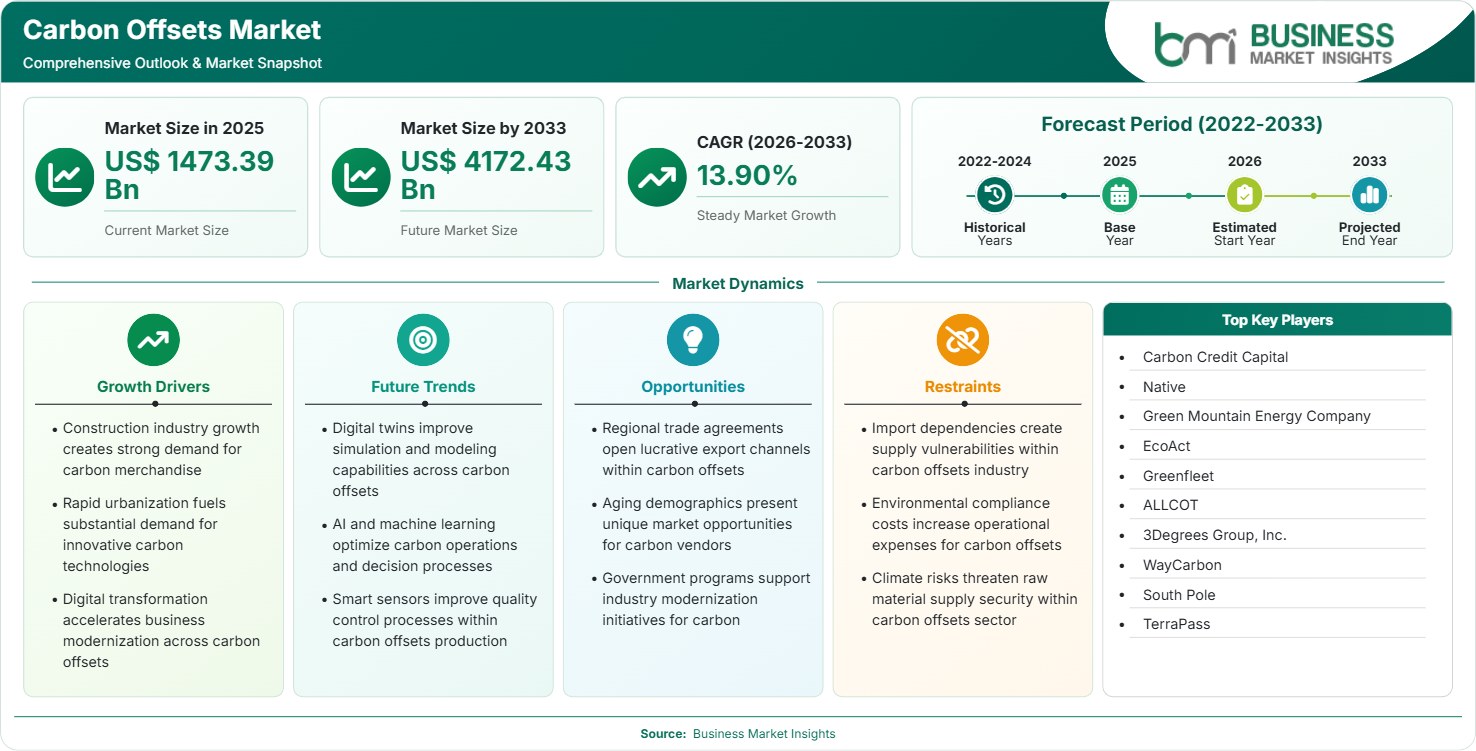
The Carbon Offsets Market size was valued at US$ 1473.39 Billion in 2025 and is projected to reach US$ 4172.43 Billion by 2033, growing at a CAGR of 13.90% during 2026–2033. Rising corporate net-zero commitments, expanding carbon pricing mechanisms, increasing investment in nature-based and engineered carbon removal projects, and strengthening ESG disclosure requirements are accelerating market demand, while digital monitoring technologies and cross-border climate finance create substantial long-term growth opportunities.

Report Coverage
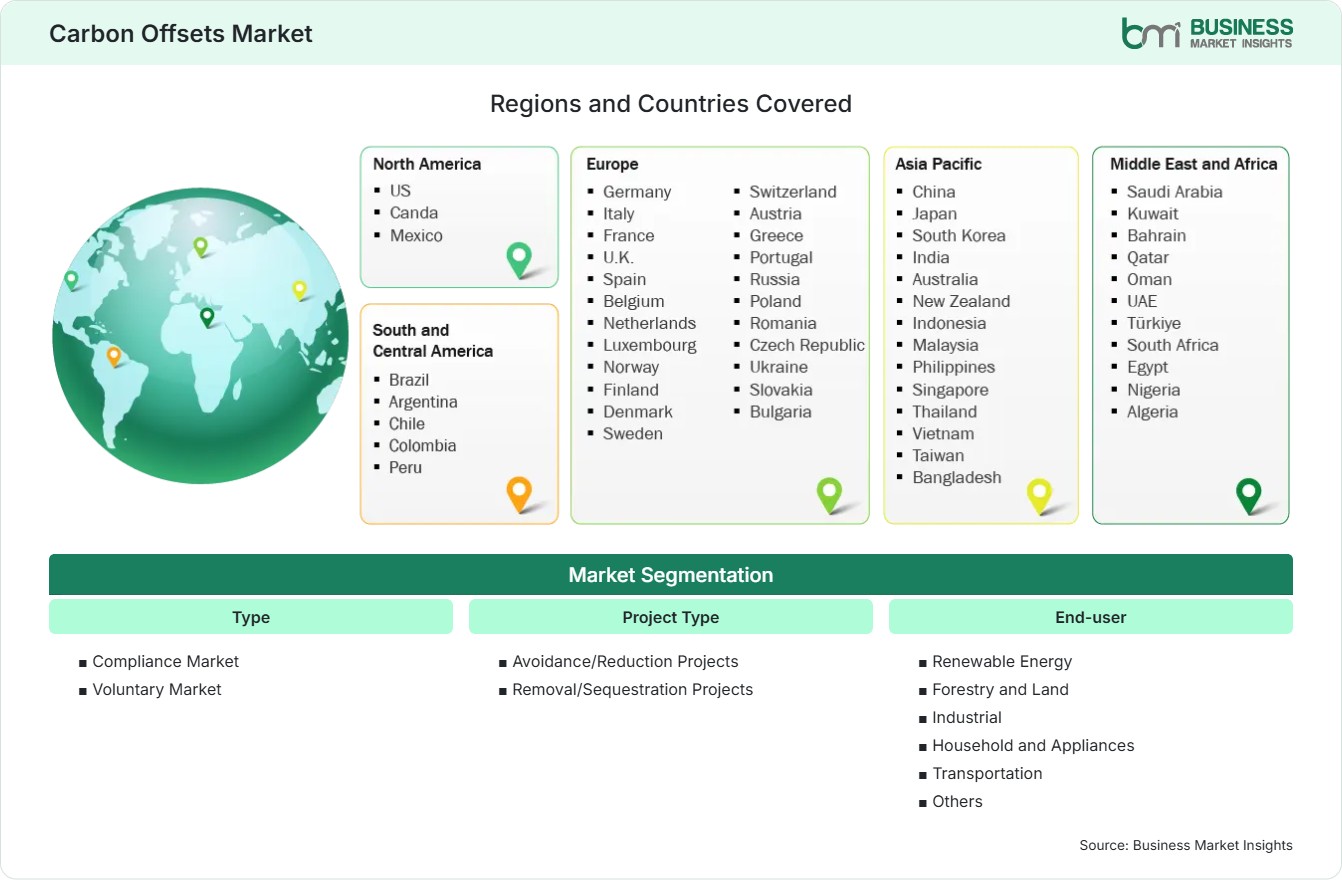
  • Type: Compliance Market, Voluntary Market
  • Project Type: Avoidance/Reduction Projects, Removal/Sequestration Projects
  • End-user: Renewable Energy, Forestry and Land, Industrial, Household and Appliances, Transportation, Others
US$ 1473.39 Bn Market size in 2025
US$ 4172.43 Bn Market Size by 2033
13.90% CAGR, 2026 - 2033
2026-2033 Forecast Period

AI Overview

Carbon Offsets Market Summary

  • North America Region: North America holds 36%–39% market share in 2025, growing with a 12.8%–13.5% CAGR during 2026–2033, supported by mature carbon trading systems, corporate sustainability investments, expanding carbon removal technologies, and transparent verification standards that strengthen buyer confidence and project financing. The U.S. market is supported by voluntary corporate purchasing and carbon removal investments, expanding at a CAGR of 13.0%–13.7% through 2033.
  • Fastest Growing Region: Asia Pacific holds 22%–25% market share in 2025 and is expected to expand at a 15.0%–15.8% CAGR during 2026–2033. Rapid industrial decarbonization, renewable energy deployment, national emissions trading initiatives, and increasing ESG investments continue creating attractive opportunities for project developers.
  • Leading Segment: Compliance Market accounts for 56%–60% share in 2025 and is projected to grow at a 13.1%–13.8% CAGR during 2026–2033. Mandatory emission reduction regulations, expanding cap-and-trade programs, and stronger government enforcement continue supporting consistent demand across regulated industries worldwide.
  • High Growth Segment: Removal/Sequestration Projects represent 30%–34% share in 2025 while expanding at a 15.2%–16.0% CAGR during 2026–2033. Growing preference for permanent carbon removal, direct air capture technologies, afforestation, and soil carbon initiatives strengthens long-term investment prospects.
  • Key Market Opportunity: Expanding investments in high-integrity carbon removal technologies, digital monitoring platforms, and nature-based climate solutions are enabling organizations to meet ambitious net-zero commitments while improving transparency, scalability, and long-term environmental impact.
  • Major Market Players: Carbon Credit Capital, Native, Green Mountain Energy Company, EcoAct, Greenfleet, ALLCOT, 3Degrees Group, Inc., WayCarbon, South Pole, and TerraPass.
Strategic Insights

Carbon Offsets Market: Strategic Insights

Carbon Offsets Market Strategic Framework
FREE PDF
Request your free sample
Request free sample
Stakeholder View

Key Takeaways

  • The value chain is becoming increasingly integrated as project developers, verification agencies, digital registry providers, financial institutions, and corporate buyers collaborate to improve transparency, liquidity, and environmental integrity across carbon credit transactions.
  • Removal and sequestration projects present the strongest long-term commercial opportunity because organizations increasingly prioritize durable carbon removal solutions alongside conventional avoidance projects to achieve science-based climate targets.
  • Innovation is shifting toward satellite monitoring, artificial intelligence-enabled project verification, blockchain-supported registry systems, and digital MRV platforms that improve traceability while reducing verification costs and transaction complexity.
  • Asia Pacific presents the most compelling regional investment opportunity due to expanding emissions trading systems, accelerating renewable energy deployment, large-scale afforestation initiatives, and increasing corporate participation in sustainability programs.
  • Strategic acquisitions, long-term carbon credit purchase agreements, and partnerships between technology providers, climate consultants, and project developers are strengthening financing availability while accelerating commercialization of premium-quality offset projects.
  • Growing demand for independently verified, high-integrity carbon credits is encouraging developers to invest in advanced project methodologies, biodiversity co-benefits, and transparent environmental reporting that enhance buyer confidence and long-term market resilience.
Geographic Outlook

Carbon Offsets Market Regional Highlights

North America Carbon Offsets Market

North America accounted for 36%–39% of global revenue in 2025 and is projected to expand at a 12.8%–13.5% CAGR during 2026–2033. Strong corporate net-zero commitments, mature carbon trading infrastructure, and expanding demand for high-integrity credits continue supporting regional expansion. The United States leads regional adoption through voluntary corporate purchasing, while Canada strengthens demand with provincial carbon pricing programs and investments in nature-based and engineered carbon removal initiatives. The Carbon Offsets Market share remains highest in this region because of advanced sustainability regulations and established environmental markets.

  • Corporate climate strategies continue increasing purchases of verified carbon credits across technology, aviation, manufacturing, and financial sectors, strengthening liquidity while encouraging project developers to introduce diversified offset portfolios with improved monitoring and reporting standards.
  • Government-backed emissions reduction policies, carbon pricing mechanisms, and expanding environmental disclosure requirements encourage organizations to integrate offsets alongside direct emission reduction programs, supporting sustained market demand throughout the forecast period.
  • Rapid adoption of digital measurement, reporting, and verification platforms enhances transparency, reduces transaction complexity, and improves confidence among institutional buyers seeking high-quality certified carbon credits.
  • Investments in engineered carbon removal technologies, including direct air capture and bioenergy with carbon capture projects, diversify regional supply and attract long-term funding from corporate sustainability initiatives.
  • Financial institutions increasingly incorporate voluntary carbon assets into ESG investment strategies, supporting project financing while expanding secondary trading activity for premium-quality verified offsets.

US Carbon Offsets Market

The United States represented approximately 80%–84% of the North American Carbon Offsets Market revenue in 2025 and is anticipated to grow at a 13.0%–13.7% CAGR through 2033. Large corporate sustainability programs, voluntary procurement leadership, and expanding investments in carbon removal technologies continue strengthening domestic demand across industrial, aviation, and technology sectors.

  • Fortune 500 companies increasingly prioritize verified removal credits alongside operational decarbonization strategies, creating sustained demand for premium offset projects with measurable environmental outcomes.
  • Expanding investments in direct air capture, forestry restoration, and regenerative agriculture improve domestic credit availability while encouraging innovation in verification methodologies and project development.
  • Federal incentives supporting clean technologies indirectly strengthen offset demand by encouraging organizations to pursue comprehensive emissions management strategies integrating both reduction and compensation measures.
  • Growing participation from financial institutions and institutional investors improves market liquidity while accelerating financing for large-scale carbon sequestration and renewable energy projects.

Europe Carbon Offsets Market

Europe held approximately 27%–30% of global Carbon Offsets Market revenue in 2025 and is forecast to register a 13.5%–14.2% CAGR through 2033. Comprehensive climate legislation, ambitious emissions reduction targets, and strong corporate sustainability reporting continue driving adoption. Germany leads regional demand through industrial decarbonization initiatives, while the Nordic countries demonstrate the fastest expansion supported by advanced carbon removal investments and circular economy policies.

  • Stringent environmental regulations encourage businesses to complement emission reduction efforts with certified offset procurement across hard-to-abate industrial sectors.
  • Financial institutions increasingly integrate climate-risk management into investment portfolios, supporting long-term financing for certified carbon reduction and sequestration projects.
  • Aviation, maritime, and manufacturing industries expand voluntary offset purchases to strengthen progress toward corporate and regulatory climate objectives.
  • Digital MRV technologies improve project transparency and enhance buyer confidence, supporting premium pricing for high-integrity credits throughout European markets.
  • Cross-border collaboration between governments and private organizations accelerates investment in nature-based and engineered carbon removal initiatives across the region.

Asia Pacific Carbon Offsets Market

Asia Pacific accounted for 22%–25% of global Carbon Offsets Market revenue in 2025 and is expected to record the fastest regional expansion with a 15.0%–15.8% CAGR during 2026–2033. China remains the largest regional contributor through expanding emissions trading initiatives, while India demonstrates the strongest growth driven by renewable energy investments, afforestation programs, and increasing corporate ESG commitments.

  • Rapid industrialization combined with expanding sustainability commitments encourages organizations to invest in verified offset projects supporting long-term emissions reduction objectives.
  • Growing renewable energy deployment generates additional certified credits while strengthening regional participation in voluntary and compliance carbon markets.
  • Governments continue introducing climate policies encouraging private-sector investment in forestry, ecosystem restoration, and low-carbon technology deployment.
  • International corporations increasingly source high-quality offsets from Asia Pacific projects because of abundant renewable resources and large-scale ecosystem restoration opportunities.
  • Expanding digital verification platforms improve transparency and facilitate cross-border trading of verified carbon credits throughout regional markets.

Rest of World Carbon Offsets Market

The rest of the world accounted for approximately 11%–14% of global Carbon Offsets Market revenue in 2025 and is projected to grow at a 13.8%–14.6% CAGR through 2033. South & Central America benefit from extensive forest conservation initiatives led by Brazil, while the Middle East and Africa experience accelerating adoption through renewable energy developments, biodiversity conservation projects, and international climate finance supporting sustainable economic diversification.

  • Brazil continues leading regional project development through large-scale forest conservation, reforestation, and regenerative agriculture initiatives generating internationally recognized carbon credits.
  • Gulf countries increase investments in carbon management technologies alongside national sustainability programs supporting diversified low-carbon economic development.
  • African nations expand participation through nature-based projects, clean cooking initiatives, and ecosystem restoration supported by multilateral climate financing programs.
  • International investors increasingly finance high-integrity conservation and renewable energy projects across emerging economies seeking scalable carbon reduction opportunities.
  • Improved certification standards and stronger environmental governance enhance confidence among global buyers sourcing offsets from developing regional markets.
Global Market Geography
FREE PDF
Request your free sample
Request free sample
Segment Analysis

Carbon Offsets Market Segmentation

Type

The Type segment accounted for the complete Carbon Offsets Market scope, with the Compliance Market maintaining 56%–60% share in 2025 and advancing at a 13.1%–13.8% CAGR during 2026–2033. Regulatory mandates, national emissions trading systems, and corporate decarbonization strategies continue shaping demand across both categories. Meanwhile, voluntary participation is expanding as organizations adopt net-zero targets and strengthen ESG commitments, creating balanced long-term growth across regulated and voluntary offset ecosystems.

  • Compliance Market: Driven by mandatory emission reduction regulations, cap-and-trade frameworks, and industrial decarbonization requirements, this segment remains the primary revenue contributor across developed economies while expanding steadily through regulatory modernization and broader sector participation.
  • Voluntary Market: Increasing corporate sustainability commitments, carbon neutrality programs, and stakeholder expectations continue accelerating demand for verified carbon credits purchased beyond regulatory obligations across multiple industries worldwide.

Project Type

The Project Type segment reflects evolving buyer preferences toward long-term climate impact. Avoidance/Reduction Projects retained 66%–70% Carbon Offsets Market share in 2025, while the overall segment is projected to expand at a 14.0%–14.7% CAGR through 2033. Growing investment in engineered removal technologies, nature-based sequestration, and improved monitoring standards is reshaping project portfolios as organizations seek higher-quality, durable climate mitigation solutions with measurable environmental outcomes.

  • Avoidance/Reduction Projects: Renewable energy, methane capture, energy efficiency improvements, and fuel-switching initiatives continue generating substantial verified credits while supporting immediate emission reduction objectives across industrial and infrastructure applications.
  • Removal/Sequestration Projects: Afforestation, reforestation, biochar production, direct air capture, and soil carbon enhancement projects continue attracting premium pricing because of their long-term carbon storage capabilities and stronger environmental credibility.

End-user

The End-user segment demonstrates diversified demand across multiple economic sectors. Renewable Energy represented 28%–32% Carbon Offsets Market share in 2025, while the segment is forecast to grow at a 14.2%–14.9% CAGR during 2026–2033. Expanding climate commitments, stricter sustainability reporting, and investments in low-carbon operations encourage broader adoption of verified carbon offsets across industrial, transportation, and land-use applications globally.

  • Renewable Energy: Wind, solar, hydroelectric, and biomass projects continue producing verified carbon credits while supporting global clean energy transitions and enabling organizations to compensate for unavoidable operational emissions.
  • Forestry and Land: Reforestation, avoided deforestation, ecosystem restoration, and sustainable land management initiatives generate high-integrity offsets while delivering biodiversity conservation and community development benefits alongside measurable carbon sequestration.
  • Industrial: Manufacturing, chemicals, cement, steel, and mining organizations increasingly integrate verified offsets with operational efficiency programs to address residual emissions and strengthen environmental compliance strategies.
  • Household and Appliances: Residential energy efficiency initiatives, clean cooking technologies, efficient appliances, and distributed renewable energy solutions contribute verified reductions while supporting community-level climate action and sustainable development objectives.
  • Transportation: Airlines, logistics providers, shipping companies, and fleet operators increasingly utilize verified offsets to complement fuel efficiency improvements, sustainable fuels, and broader transportation decarbonization strategies across domestic and international operations.
Market Forces

Carbon Offsets Market Dynamics

Key Market Drivers

Expansion of Corporate Net-Zero and ESG Commitments

Companies in the manufacturing, airline, technology, finance, and consumer goods sectors are making rapid progress towards investing in verified carbon credits, alongside efforts to reduce emissions directly. Climate targets based on science, mandatory sustainability reporting, and pressure from investors have led to an increased need for authentic offsets that can generate environmental benefits. Firms have become more interested in offsets that comply with global standards. The greater use of digital platforms for monitoring, measuring, and verifying also builds buyer confidence through eliminating worries about poor-quality offsets. As businesses pursue comprehensive decarbonization pathways, the Carbon Offsets Market growth is still driven by procurement deals, diversification of projects, and increased carbon management in sustainable business models. The shift also stimulates investment in advanced removal technologies and natural climate solutions.

Growth of Carbon Pricing and Compliance Mechanisms

Increasingly, governments are employing carbon prices and trading schemes for emissions to accelerate their decarbonization process. The need to reduce their emissions ensures that businesses adopt offsets wherever possible, creating a continuous demand in energy-based industries. The regulatory trends in Europe, North America, and a number of Asia-Pacific nations have improved participation in both the compliance and voluntary markets. Standardized reporting requirements and enhanced verification methodologies improve Carbon Offsets Market transparency and reduce transaction uncertainty. Policy backing will further ensure that private funding will flow to renewable energy, forestry, methane capture, and engineered carbon removal projects. The above-mentioned changes will ensure market stability in the long run while fostering innovation in project development, certification, and international carbon trading systems.

Advancements in Digital MRV and Carbon Removal Technologies

Advancements in technology are changing the way that project development occurs with the help of better measurement, reporting, and verification systems that use satellite images, remote sensing, artificial intelligence, and registry systems using blockchain. Better data will increase the buyer’s trust and decrease verification costs and administrative complexity of projects. On the other hand, investment in technologies such as direct air capture, biochar, enhanced weathering, and soil carbon sequestration will make more credits available for carbon removal. These innovations improve Carbon Offsets Market integrity while supporting premium pricing for verified removal credits. The combination of digital verification and engineered removal technologies is transforming procurement strategies and encouraging greater institutional participation across global carbon ecosystems.

Key Market Opportunities

Scaling High-Integrity Carbon Removal Projects

Demand for durable carbon removal solutions presents one of the strongest long-term investment opportunities for developers, technology providers, and institutional investors. There is an increasing trend of companies looking for removal credits that are able to fulfill their net-zero aspirations beyond the traditional means of avoidance. Direct air capture, bioenergy carbon capture and storage, mineralization techniques, and extensive ecosystem restoration all represent exciting growth opportunities. The advancement in credit certification methods and clear monitoring systems helps build buyer trust and ensures high pricing for credits. Purchasing agreements with long-term engagements help finance such costly projects. These Carbon Offsets Market Forecasts indicate growing commercial potential as organizations prioritize measurable climate outcomes supported by independently verified carbon sequestration technologies.

Expansion Across Emerging Carbon Markets

Rapid industrialization, supportive climate policies, and international sustainability funding create favorable conditions for the Carbon Offsets Market expansion across emerging economies. There are abundant renewable energy sources and substantial prospects for reforestation and regeneration in various countries in the Asia Pacific, Latin America, Africa, and the Middle East. The use of verified credits by international businesses from such regions is increasing owing to the scalability of projects and lower development costs. Improved regulations and digital verification solutions make investments more appealing while lowering risks. There are more public-private partnerships, climate finance schemes, and development aid programs that promote pipeline generation and provide access to carbon value chains on a global level.

Digital Carbon Trading Platforms and Marketplace Innovation

Emerging Carbon Offsets Market Trends, including the increasing digitalization of carbon credit transactions, creates significant commercial opportunities for technology providers and market participants. Advanced trading platforms will lead to an improvement in price discovery, traceability, registry connectivity, and transactions, at the same time simplifying administration. Artificial intelligence will help buyers analyze projects for their quality according to sustainability criteria. Blockchain registries will provide additional security and eliminate risks of duplicates by means of the immutability of transactions. Financial organizations increasingly use digital platforms to assist in secondary trading and diversification. This technology will increase liquidity and market accessibility and encourage further participation of companies, investors, and project developers.

Market Restraints and Challenges

Variability in Credit Quality and Market Integrity

Factor: Differences in project methodologies, permanence, additionality, and verification quality continue to create uncertainty regarding environmental outcomes across global carbon markets.

Impact: The buyers are becoming increasingly critical about the credibility of projects before purchasing, resulting in longer due diligence processes and higher transaction costs. The problems related to inconsistencies in certification procedures, double counting, and overestimation of the amount of emission reductions can lower the confidence levels among corporate buyers and investors. While international standards are consistently improving their levels of transparency, the discrepancies between the different registries and approaches make it difficult for market participants to ensure project quality.

Regulatory Fragmentation Across Global Markets

Factor: Carbon pricing mechanisms, compliance requirements, eligibility criteria, and reporting obligations differ significantly across countries and regional jurisdictions.

Impact: The process of complying with regulations, administrative complications, and lengthy commercialization times increases when project developers and multinational entities work across several jurisdictions. The regulatory uncertainties can dissuade investments, especially those that are of a long-term nature, such as carbon removal programs that require heavy investment upfront. The divergent legal systems make cross-border trade in credits challenging as well. International cooperation in terms of standardization in carbon accounting, verification techniques, and registry will go a long way in addressing this fragmentation issue.

Company Analysis

Competitive Landscape

The competitive environment is characterized by increasing investments in project development, digital monitoring platforms, carbon credit verification, and advisory services. The Carbon Offsets Market analysis indicates that market participants are expanding nature-based and engineered carbon removal portfolios while strengthening strategic partnerships with corporations pursuing science-based climate targets. Companies are also investing in digital measurement, reporting, and verification (MRV) capabilities to improve transparency, traceability, and credit quality across global carbon markets.

Company Name

Overview

Products and Services Relevant to this Market

Carbon Credit Capital

U.S.-based climate solutions company specializing in carbon project development, advisory, and emissions management for corporate sustainability programs across multiple industries.

Carbon offset project development, carbon credit procurement, emissions consulting, carbon portfolio management, ESG advisory, and climate strategy implementation.

Native

Provides carbon offset solutions focused on helping businesses and individuals reduce environmental impact through verified climate projects and sustainability initiatives.

Verified carbon offsets, renewable energy credits, reforestation programs, methane reduction projects, and carbon neutrality solutions.

Green Mountain Energy Company

Renewable energy provider offering sustainability solutions supporting residential and commercial decarbonization initiatives through clean energy and environmental products.

Renewable electricity plans, renewable energy certificates, carbon offset programs, sustainability consulting, and environmental impact solutions.

EcoAct

International climate consultancy supporting organizations with decarbonization strategies, climate reporting, and carbon project investments across global markets.

Carbon strategy consulting, carbon footprint assessment, offset procurement, net-zero planning, climate reporting, and ESG advisory services.

Greenfleet

Develops environmental restoration and biodiversity projects while helping organizations compensate for unavoidable greenhouse gas emissions through verified offsets.

Reforestation projects, biodiversity conservation, verified carbon credits, corporate offset programs, and sustainability partnerships.

ALLCOT

Switzerland-based climate solutions provider supporting governments and businesses through carbon market advisory and project development services.

Carbon market consulting, emissions trading support, offset project development, climate finance, and sustainability advisory.

3Degrees Group, Inc.

Global climate solutions company helping organizations accelerate decarbonization through renewable energy and carbon market expertise.

Carbon credits, renewable energy procurement, emissions reporting, decarbonization consulting, and climate risk management solutions.

WayCarbon

Brazilian environmental consultancy specializing in climate intelligence, emissions management, and sustainability solutions for public and private organizations.

Carbon accounting, climate analytics, ESG software, emissions inventories, carbon project advisory, and sustainability consulting.

South Pole

International climate solutions provider developing carbon projects and advising organizations on comprehensive climate transition strategies worldwide.

Carbon project development, nature-based solutions, carbon removal, climate consulting, ESG services, and environmental finance solutions.

TerraPass

U.S.-based provider of verified carbon offset programs serving businesses and consumers seeking practical emissions compensation solutions.

Carbon offset credits, fleet emissions programs, renewable energy projects, business sustainability solutions, and consumer offset products.

Trust & Transparency

Research Methodology

The market analysis combines proprietary research with secondary data from government agencies, company disclosures, regulatory filings, industry databases and expert interviews. Market estimates are validated through data triangulation, cross-market benchmarking and analyst review.

View Full Research Methodology

Questions Answered

Frequently Asked Questions

What does this Carbon Offsets Market Report help stakeholders understand?

It provides insights into market size, growth prospects, competitive positioning, regional opportunities, segment performance, emerging technology trends, strategic developments, and investment priorities to support informed business and investment decisions.

Which industries are the major end users?

Renewable energy, forestry and land management, industrial manufacturing, transportation, and household energy efficiency programs represent the major end-user sectors utilizing verified carbon credits to complement broader decarbonization strategies.

Which project type is expected to grow the fastest?

Removal and sequestration projects are anticipated to record the highest growth because organizations increasingly prioritize permanent carbon storage solutions such as afforestation, direct air capture, biochar, and soil carbon sequestration.

Which region leads the market?

North America maintains the largest regional share because of mature carbon trading infrastructure, strong corporate sustainability investments, advanced verification systems, and growing adoption of carbon removal technologies across multiple industries.

What is driving demand for carbon offsets worldwide?

Demand is primarily supported by corporate net-zero commitments, expanding ESG reporting requirements, carbon pricing mechanisms, and increasing investment in verified nature-based and engineered carbon removal projects. Organizations increasingly use offsets alongside direct emissions reduction initiatives.

Access the Full Carbon Offsets Market Report

Get segment-level forecasts, regional estimates, competitive benchmarking, company profiles and downloadable Excel datasets.

Access the full Carbon Offsets Market Report
350 pages PDF & Excel | 2026-08-18
Similar Research

Related Market Reports