
Silicon Carbon Battery Market Outlook: Size, Share, Trends, Growth Analysis, Competitive Landscape & Forecast, 2026-2033

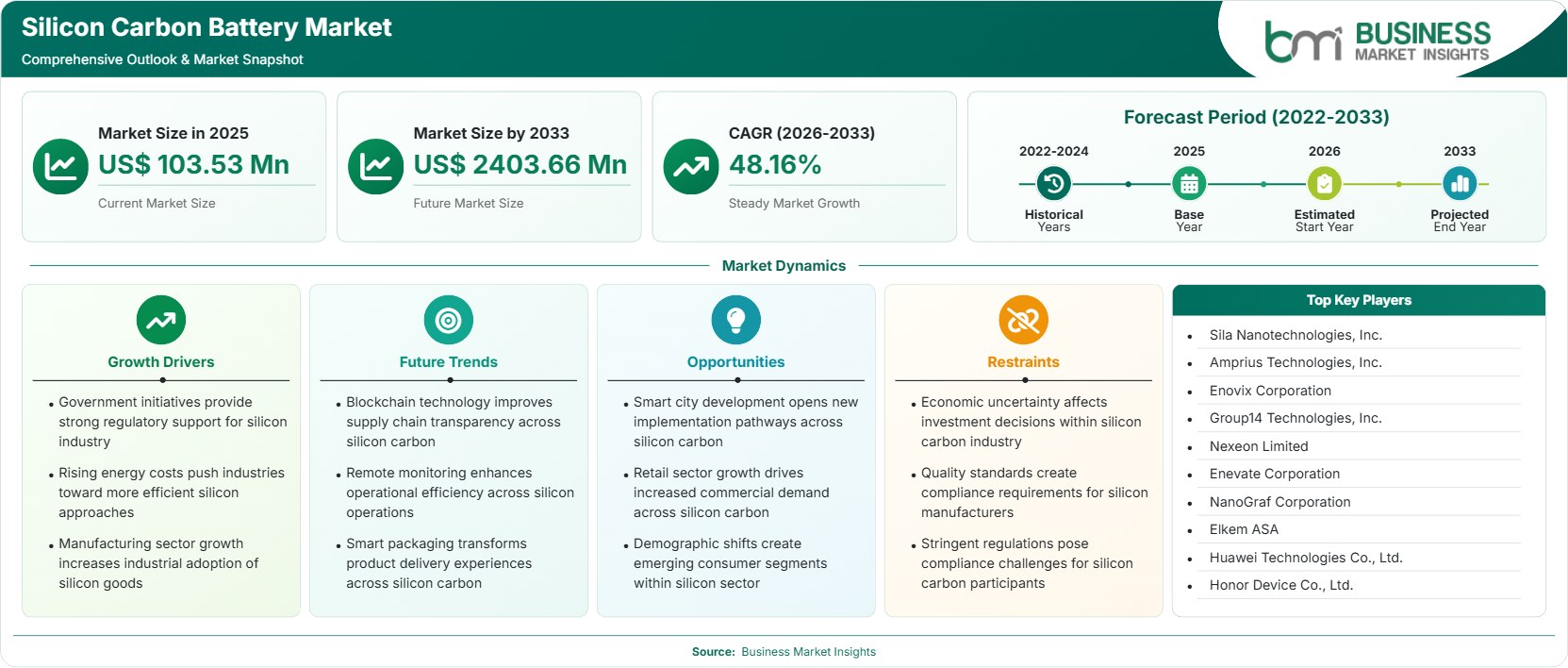
The Silicon Carbon Battery Market size was valued at US$ 103.53 Million in 2025 and is projected to reach US$ 2403.66 Million by 2033, growing at a CAGR of 48.16% during 2026–2033, driven by EV electrification, premium consumer electronics demand, higher energy-density requirements, fast-charging innovations, silicon-anode commercialization, grid storage expansion, and growing investments in advanced battery manufacturing ecosystems.

Report Coverage
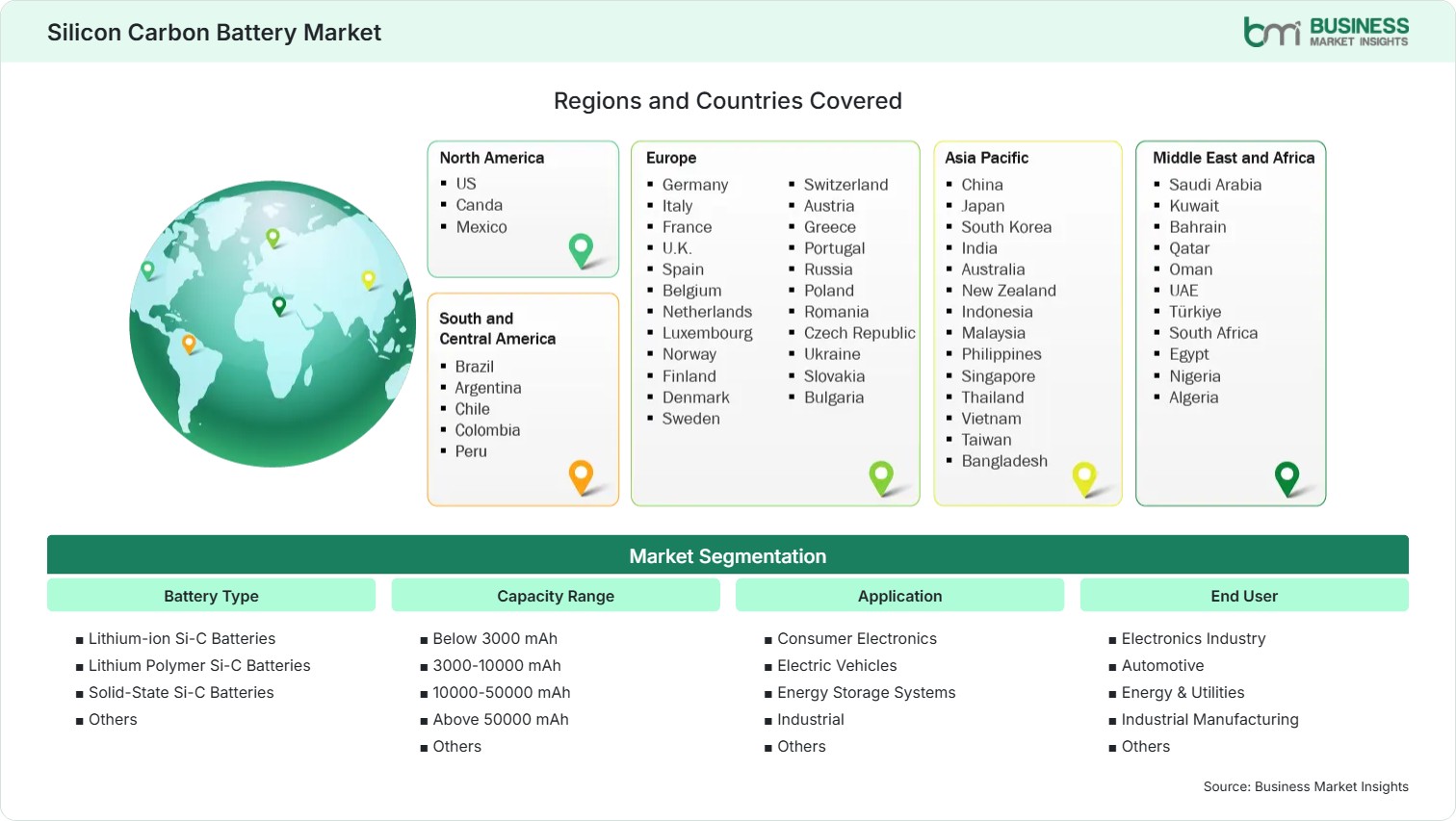
  • Battery Type: Lithium-ion Si-C Batteries, Lithium Polymer Si-C Batteries, Solid-State Si-C Batteries, Others
  • Capacity Range: Below 3000 mAh, 3000-10000 mAh, 10000-50000 mAh, Above 50000 mAh, Others
  • Application: Consumer Electronics, Electric Vehicles , Energy Storage Systems, Industrial , Others
  • End User: Electronics Industry, Automotive, Energy & Utilities, Industrial Manufacturing, Others
US$ 103.53 Mn Market size in 2025
US$ 2403.66 Mn Market Size by 2033
48.16% CAGR, 2026 - 2033
2026-2033 Forecast Period

AI Overview

Silicon Carbon Battery Market Summary

  • North America Region: Holds a market share of 33%–36% in 2025, growing at a CAGR of 45%–48% during 2026–2033, supported by battery manufacturing incentives, aerospace adoption, EV platform upgrades, and silicon-anode scaling. Opportunities emerge from domestic supply-chain localization, defense applications, and next-generation energy-density requirements across transportation and portable electronics sectors globally. Brief U.S. market analysis: Strong commercialization activity and battery innovation programs support adoption, with an estimated CAGR of 46%–49% through 2033.
  • Fastest Growing Region: Asia Pacific accounts for 29%–32% share in 2025 and expands at 50%–53% CAGR during 2026–2033, driven by EV production concentration, smartphone innovation, battery-material investments, manufacturing scale advantages, and increasing deployment of advanced storage technologies across major economies.
  • Leading Segment: Consumer Electronics represents 38%–42% share in 2025 and advances at 46%–49% CAGR, supported by compact-device battery upgrades, demand for longer runtime, rapid charging capabilities, premium smartphone launches, wearable technology expansion, and continuous miniaturization requirements.
  • High Growth Segment: Electric Vehicles account for 24%–28% share in 2025 and grow at 52%–55% CAGR, fueled by vehicle range optimization, charging-performance enhancements, battery weight reductions, sustainability targets, next-generation battery architectures, and increasing automaker investments in silicon-enhanced energy storage.
  • Key Market Opportunity: Integration of silicon-carbon chemistry into electric vehicles and utility-scale storage creates opportunities for enhanced energy density, faster charging, lower system weight, improved efficiency, differentiated performance, and long-term manufacturing scale advantages.
  • Major Market Players: Sila Nanotechnologies, Inc.; Amprius Technologies, Inc.; Enovix Corporation; Group14 Technologies, Inc.; Nexeon Limited; Enevate Corporation; NanoGraf Corporation; Elkem ASA; Huawei Technologies Co., Ltd.; Honor Device Co., Ltd.
Strategic Insights

Silicon Carbon Battery Market: Strategic Insights

Silicon Carbon Battery Market Strategic Framework
FREE PDF
Request your free sample
Request free sample
Stakeholder View

Key Takeaways

  • Commercial success increasingly depends on integration between silicon-anode material suppliers, cell manufacturers, pack assemblers, electronics brands, and automotive OEMs, creating a highly collaborative value chain.
  • Electric mobility and high-end portable electronics offer the strongest revenue upside because energy-density improvements translate directly into customer value and performance differentiation.
  • Industry innovation is moving beyond silicon additives toward silicon-dominant and silicon-carbon composite architectures designed to improve cycle life and charging speed.
  • Asia Pacific presents a compelling investment environment due to manufacturing scale, battery supply-chain concentration, and strong regional demand for advanced energy-storage solutions.
  • Venture funding, strategic alliances, and production-scale partnerships continue to shape competitive positioning as companies seek faster commercialization of silicon-based technologies.
  • Aerospace, defense, and industrial drone applications are becoming early premium adopters because performance advantages often outweigh higher battery costs.
Geographic Outlook

Silicon Carbon Battery Market Regional Highlights

North America Silicon Carbon Battery Market

North America accounted for 33%–36% Silicon Carbon Battery Market share in 2025 and is projected to expand at a 45%–48% CAGR through 2033. Strong innovation ecosystems, government incentives for battery manufacturing, and growing adoption across aerospace, defense, and electric mobility support regional demand. The region benefits from active silicon-anode developers and increasing investments in domestic battery supply chains. Commercial deployments across premium electronics and industrial applications further reinforce growth prospects while reducing dependence on imported advanced battery technologies.

  • U.S. manufacturers are accelerating silicon-anode scaling and pilot production to support advanced mobility, aerospace, and defense applications requiring superior energy density and lightweight power solutions.
  • Strategic funding programs support regional battery-material investments and encourage localization of critical components across the broader energy-storage ecosystem.
  • Partnerships between material innovators and automakers continue expanding commercialization pathways for next-generation battery chemistries.
  • Demand from premium consumer devices supports early revenue generation and technology validation opportunities.

US Silicon Carbon Battery Market

The United States represents roughly 72%–76% of North American revenue and is expected to register a 46%–49% CAGR through 2033. Significant venture capital activity, technology commercialization programs, and advanced manufacturing initiatives support market expansion. Battery developers increasingly collaborate with automotive and electronics manufacturers to validate silicon-carbon performance advantages. Growth is supported by strong research infrastructure, access to capital, and rising demand for batteries capable of delivering longer range, faster charging, and improved operating efficiency.

  • Silicon-based battery startups continue attracting investment to expand production capacity and technology commercialization.
  • Defense and aerospace sectors create high-value demand for lightweight batteries with enhanced performance characteristics.
  • EV technology development remains a central driver of advanced battery adoption across the country.
  • Universities and national laboratories contribute significantly to materials innovation and process optimization.

Europe Silicon Carbon Battery Market

Europe held approximately 24%–27% share in 2025 and is forecast to grow at a 44%–47% CAGR during 2026–2033. Battery sovereignty initiatives, EV adoption targets, and sustainability regulations support investment activity. Germany remains the leading revenue contributor, while the United Kingdom demonstrates strong technology-development activity. Nordic countries continue investing in clean-energy infrastructure and battery ecosystems. Regional growth is reinforced by efforts to reduce supply-chain dependency and increase advanced-material manufacturing within Europe.

  • Germany leads regional adoption through automotive innovation and battery development programs.
  • The United Kingdom ranks among the faster-growing technology-development hubs, supported by specialized battery innovators.
  • Sustainability regulations encourage investment in advanced batteries with improved energy efficiency.
  • Collaborative projects between automakers and battery developers accelerate commercialization activities.

Asia Pacific Silicon Carbon Battery Market

Asia Pacific accounted for 29%–32% share in 2025 and is expected to achieve the fastest growth at 50%–53% CAGR through 2033. China dominates manufacturing and technology deployment, while South Korea and Japan contribute advanced battery expertise. Expanding EV production, smartphone manufacturing leadership, and substantial battery-material investments strengthen regional competitiveness. High-volume production capabilities enable rapid commercialization of emerging chemistries. Strong domestic demand and export potential support sustained investment across the silicon-carbon battery value chain.

  • China leads production capacity expansion and adoption across EV and consumer electronics industries.
  • South Korea benefits from globally competitive battery manufacturers and advanced materials expertise.
  • Japan focuses on premium technology development and high-performance battery applications.
  • Regional smartphone and wearable device production creates substantial demand for advanced batteries.
  • Governments continue supporting strategic battery manufacturing and supply-chain development.

Rest of World Silicon Carbon Battery Market

Rest of World represented 10%–13% share in 2025 and is projected to grow at 41%–44% CAGR through 2033. South and Central America are witnessing increasing interest in energy-storage applications and electrification initiatives. Meanwhile, Middle East and Africa markets are gradually integrating advanced batteries into renewable energy and industrial projects. Adoption remains comparatively early-stage but continues benefiting from infrastructure expansion, renewable-energy deployment, and growing awareness of higher-performance battery technologies.

  • Brazil leads adoption within South and Central America through expanding electrification initiatives and energy-storage investments.
  • The United Arab Emirates demonstrates increasing interest in advanced energy technologies and renewable integration.
  • Industrial modernization projects support demand for higher-performance rechargeable battery systems.
  • Renewable-energy growth creates opportunities for next-generation storage technologies.
Global Market Geography
FREE PDF
Request your free sample
Request free sample
Segment Analysis

Silicon Carbon Battery Market Segmentation

Battery Type

Battery Type accounted for technology differentiation across the industry. Lithium-ion variants represented the largest revenue contribution, supporting approximately 48%–52% share in 2025, while the overall segment advanced near 47%–50% CAGR. Ongoing improvements in energy density, fast charging, and cycle performance continue shaping the Silicon Carbon Battery Market scope across consumer, automotive, and industrial applications.

  • Lithium-ion Si-C Batteries: Widely adopted due to compatibility with existing manufacturing infrastructure, strong energy-density improvements, and suitability for consumer devices, EV platforms, and commercial energy-storage deployments.
  • Lithium Polymer Si-C Batteries: Favored for lightweight and flexible form factors supporting premium smartphones, wearable electronics, and compact connected devices requiring space-efficient battery integration.
  • Solid-State Si-C Batteries: Emerging technology attracting investment through superior safety, higher energy density potential, and long-term applicability in automotive and industrial markets.

Capacity Range

Capacity requirements vary significantly across end-use environments. The 3,000–10,000 mAh category leads demand with 34%–38% share in 2025, while segment growth remains around 46%–49% CAGR through the forecast period. Product innovation increasingly targets optimized energy storage within compact dimensions across mobility, industrial and electronics markets.

  • Below 3,000 mAh: Supports wearables, compact sensors, and portable electronics requiring efficient power delivery within highly constrained device footprints.
  • 3,000–10,000 mAh: Dominates smartphone, tablet, and consumer electronics applications where longer operating time remains a key differentiator.
  • 10,000–50,000 mAh: Increasingly utilized in drones, industrial tools, and specialized equipment demanding higher energy reserves and reliability.
  • Above 50,000 mAh: Serves electric mobility, large-scale industrial systems, and advanced storage environments with substantial power requirements.

Application

Applications continue expanding as energy-density benefits improve commercial value. Consumer electronics generated 38%–42% share in 2025 and progressed at 46%–49% CAGR. Silicon Carbon Battery Market trends indicate increasing adoption across transportation and energy-storage sectors as manufacturers seek enhanced runtime, reduced weight, and rapid charging performance.

  • Consumer Electronics: Drives large-scale adoption through smartphones, tablets, laptops, wearables, and premium portable devices prioritizing compact high-capacity batteries.
  • Electric Vehicles: Benefits from potential range extension, improved charging speed, and enhanced vehicle efficiency through higher energy-density battery systems.
  • Energy Storage Systems: Supports renewable integration, backup power availability, and grid modernization initiatives requiring efficient energy retention capabilities.
  • Industrial (Drones, Tools): Gains traction from performance-sensitive applications where longer runtime and lightweight designs create operational advantages.

End User

The electronics industry remains the dominant end-user category with 40%–44% share in 2025 and estimated growth of 46%–49% CAGR. Demand is driven by continuous product upgrades and battery performance competition. Automotive and utility segments are emerging as significant long-term revenue contributors as commercialization expands.

  • Electronics Industry: Relies heavily on advanced batteries to improve user experience, device longevity, and charging convenience.
  • Automotive: Expands adoption as manufacturers pursue improved driving range and battery efficiency targets.
  • Energy & Utilities: Increasingly explores advanced chemistry solutions for next-generation energy-storage deployments.
  • Industrial Manufacturing: Uses higher-performance batteries in automation equipment, tools, robotic systems, and specialized operational environments.
Market Forces

Silicon Carbon Battery Market Dynamics

Key Market Drivers

Rising Demand for High-Energy-Density Consumer Devices

Smartphone, wearable, laptop, and portable electronics manufacturers continue prioritizing higher energy density without increasing device size. With the use of silicon-carbon batteries, there is an enormous advantage of energy storage compared to graphite batteries, where the time period is extended, and the charging speed is improved. The shipment of connected devices in the market has been quite substantial worldwide. Premium devices are becoming increasingly defined by their battery capability, thus increasing the pace of adoption of silicon batteries. The need for smaller battery technology, higher usability expectations from consumers, and device upgrades continue to drive development efforts in the industry.

Acceleration of Electric Vehicle Electrification

Global EV adoption continues rising as governments pursue decarbonization objectives and automakers expand electrified vehicle portfolios. Batteries with higher energy contribute positively in terms of range of operation of the vehicle along with lightness and limited charging constraints. The silicon carbon technology has caught up as it increases the performance of the battery to some extent with silicon. It becomes increasingly important for automakers to team up with material experts to explore potential scenarios for commercialization. With the efficiency of batteries being the point of differentiation, there is a growing need for anodes.

Advances in Silicon-Anode Material Engineering

Commercialization problems that existed before were related to expansion of silicon when it was being charged. With recent advancement in engineering regarding nanostructures, composite materials, and improved electrode structures, a lot has been done to improve performance and durability. Continuous research endeavors from research institutions as well as corporate organizations aim to provide a solution for the challenges associated with increasing the cycle life without reducing the energy density. This makes silicon carbon batteries more viable within consumer electronics, transport industry, aviation, and industrial sectors. More research investments will be made throughout the forecast period.

Key Market Opportunities

Expansion into Utility-Scale Energy Storage

As operators of energy-storage facilities look more towards technologies which would provide better efficiency, smaller installation sites, and better economics, silicon-carbon batteries could help achieve larger capacities for systems which would facilitate renewable energy production and grid modernization. With the rise of solar and wind power plants, there is a need for more efficient technologies for energy storage so that all produced energy is utilized efficiently. Silicon Carbon Battery Market Forecasts indicate expanded opportunity as energy transition programs accelerate. Strategic investments in storage-focused product development are likely to create meaningful revenue potential.

Commercialization Across Aerospace and Defense

Aerospace and defense applications place strong value on lightweight batteries with high energy density. Drones, unmanned systems, and aviation platforms are well served by long flight times and lightweight systems. Silicon-carbon battery chemistries are especially compelling when the benefits outweigh the costs involved. Energy storage technologies have become a key factor in procurement policies designed to meet new demands. Supplier companies that meet strict reliability criteria can win lucrative contracts and competitive advantages. Such demand represents a lucrative application field for advanced batteries.

Localized Battery Supply Chain Development

Governments worldwide are encouraging domestic battery production through incentives, grants, and industrial policies. These efforts open up possibilities for suppliers of silicon-carbon materials, cell producers, and developers of technologies to have production bases in the region. The creation of localized production lines lowers geopolitical risk while enhancing industrial competitiveness. Opening new facilities and making alliances will help shorten timelines for commercialization and increase access to customers. There is likely to be a lot of demand for firms that can implement these materials into production systems.

Market Restraints and Challenges

Material Expansion and Cycle-Life Limitations

Factor: Silicon experiences significant volume expansion during lithium insertion and extraction cycles.

Impact: Mechanical stress is capable of influencing the integrity of the electrodes, as well as the longevity of the battery. Even though the advancements made in technology have helped to improve these aspects, the performance consistency is one of the main concerns that needs to be considered during the process of commercializing the battery. It is necessary for the producers of the batteries to strike a balance between increasing energy density and making the battery durable to meet the needs of its consumers.

Higher Production Costs and Manufacturing Complexity

Factor: Advanced silicon-carbon materials often require specialized processing techniques and greater research investment.

Impact: High production costs could prevent wide acceptance in applications that are cost-sensitive and also hinder widespread market adoption. It is difficult for new vendors to scale up their manufacturing processes and still adhere to quality standards. Validation is often needed by commercial clients before using new batteries on critical equipment. It is crucial to be competitive in terms of cost for widespread adoption. They should keep improving on their economic strengths over existing battery chemistry options.

Company Analysis

Competitive Landscape

The competitive environment is characterized by material innovation, scale-up strategies, partnerships, and commercialization initiatives. Current Silicon Carbon Battery Market analysis indicates strong competition among silicon-anode specialists and technology-focused battery developers.

Company Name

Overview

Products and Services relevant to this market

Sila Nanotechnologies, Inc.

U.S.-based battery materials innovator focused on silicon-rich anode technologies for high-performance energy storage.

Titan Silicon materials, battery-performance enhancement solutions, automotive and electronics battery integration support.

Amprius Technologies, Inc.

Developer of silicon-anode batteries emphasizing energy density and fast-charging capabilities.

Silicon nanowire batteries, aviation batteries, drone energy solutions, advanced lithium-ion cells.

Enovix Corporation

Advanced battery company known for proprietary cell architectures and silicon-anode technologies.

High-energy lithium-ion batteries, consumer electronics batteries, defense and industrial battery solutions.

Group14 Technologies, Inc.

Producer of silicon-carbon composite materials designed for scalable battery manufacturing.

SCC55 material platform, silicon-carbon anode materials, battery-performance optimization products.

Nexeon Limited

UK-based specialist developing silicon-anode materials for next-generation lithium-ion batteries.

Silicon anode materials, battery technology licensing, engineering and development services.

Enevate Corporation

Technology developer focused on fast-charging silicon-dominant battery solutions.

Silicon-dominant anode technologies, EV battery solutions, licensing and development services.

NanoGraf Corporation

Advanced materials specialist supporting higher-performance lithium-ion battery applications.

Silicon-anode materials, defense batteries, energy-density enhancement solutions.

Elkem ASA

Global materials company expanding into silicon-based battery-material opportunities.

Silicon materials, battery-grade silicon products, advanced composite material solutions.

Huawei Technologies Co., Ltd.

Technology company driving adoption of silicon-carbon batteries in premium devices.

Smartphone batteries, consumer electronics power systems, battery-management technologies.

Honor Device Co., Ltd.

Consumer electronics manufacturer deploying silicon-carbon battery designs in flagship products.

High-capacity smartphone batteries, charging technologies, device power-management solutions.

Trust & Transparency

Research Methodology

The market analysis combines proprietary research with secondary data from government agencies, company disclosures, regulatory filings, industry databases and expert interviews. Market estimates are validated through data triangulation, cross-market benchmarking and analyst review.

View Full Research Methodology

Questions Answered

Frequently Asked Questions

What is the main challenge facing commercialization?

Managing silicon expansion during charging cycles while maintaining long-term durability and cost competitiveness remains the primary technical and manufacturing challenge for widespread adoption.

What does the Silicon Carbon Battery Market Report cover?

The Silicon Carbon Battery Market Report examines technology developments, competitive positioning, regional demand patterns, segmentation performance, growth opportunities, investment trends, and future commercialization prospects.

How does silicon improve battery performance?

Silicon can store substantially more lithium ions than graphite, increasing theoretical capacity and supporting higher energy density when combined with effective material-engineering solutions.

What industries are expected to adopt these batteries most rapidly?

Consumer electronics, electric vehicles, aerospace, defense, industrial drones, and energy-storage applications are positioned to be the primary adopters because performance benefits create measurable operational value.

Why are silicon-carbon batteries gaining attention?

They provide higher energy density than conventional graphite-based batteries, enabling longer runtime, faster charging potential, and improved device or vehicle performance without significantly increasing battery size.

Access the Full Silicon Carbon Battery Market Report

Get segment-level forecasts, regional estimates, competitive benchmarking, company profiles and downloadable Excel datasets.

Access the full Silicon Carbon Battery Market Report
350 pages PDF & Excel | 2026-08-31