
Carbon Credit Trading Platform Market Outlook: Size, Share, Trends, Growth Analysis, Competitive Landscape & Forecast, 2026-2033

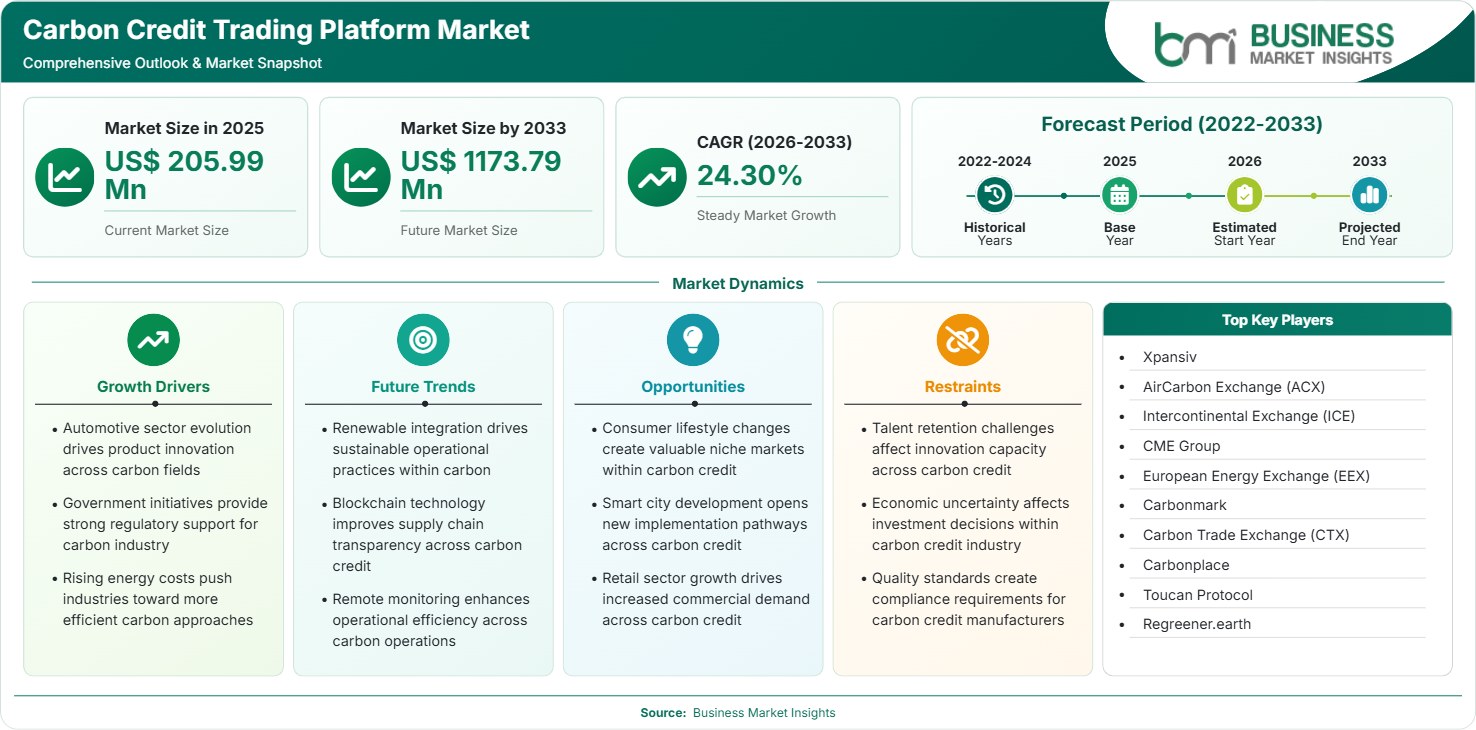
The Carbon Credit Trading Platform Market size was valued at US$ 205.99 Million in 2025 and is projected to reach US$ 1173.79 Million by 2033, growing at a CAGR of 24.30% during 2026–2033, driven by expanding corporate decarbonization commitments, stronger emissions compliance frameworks, digital trading innovation, growing voluntary carbon markets, and increasing investment opportunities across climate finance ecosystems.

Report Coverage
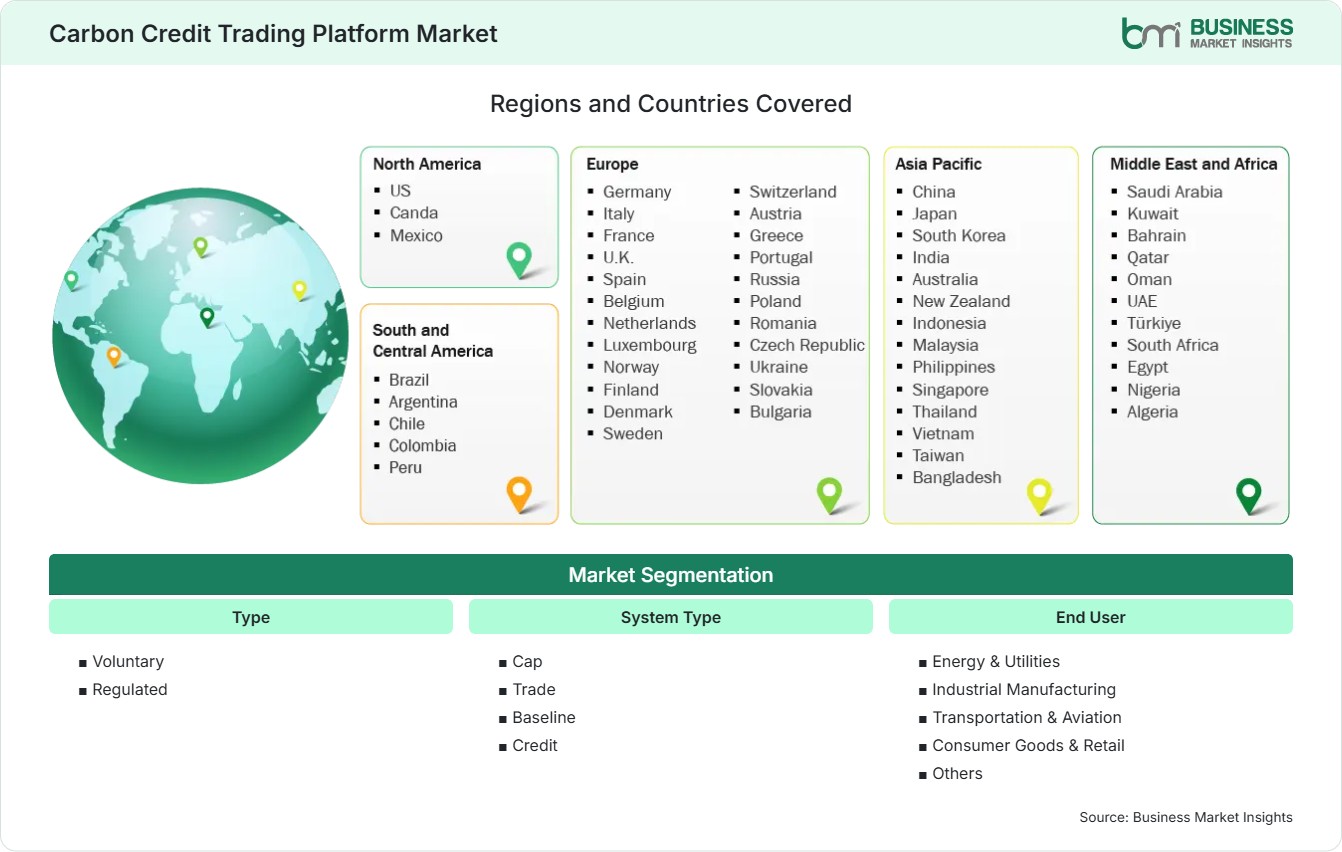
  • Type: Voluntary, Regulated
  • System Type: Cap, Trade, Baseline, Credit
  • End User: Energy & Utilities, Industrial Manufacturing, Transportation & Aviation, Consumer Goods & Retail, Others
US$ 205.99 Mn Market size in 2025
US$ 1173.79 Mn Market Size by 2033
24.30% CAGR, 2026 - 2033
2026-2033 Forecast Period

01 AI Overview

Carbon Credit Trading Platform Market Summary

  • North America Region: North America holds 36%–39% market share in 2025, growing with a 22.5%–24.5% CAGR during 2026–2033, supported by mature carbon exchanges, corporate net-zero commitments, digital infrastructure investments, evolving compliance mechanisms, expanding climate-finance participation, and institutional demand for transparent environmental asset trading platforms worldwide. The U.S. benefits from voluntary carbon market innovation, enterprise sustainability investments, and advanced digital exchanges, recording an estimated 23.0%–25.0% CAGR through 2033.
  • Fastest Growing Region: Asia Pacific holds 24%–27% market share in 2025 and advances with a 27.0%–29.5% CAGR during 2026–2033 as national emissions trading systems expand, industrial decarbonization accelerates, regulatory reforms mature, digital exchanges attract investment, and multinational corporations pursue verified carbon offset portfolios.
  • Leading Segment: Voluntary accounts for 57%–60% market share in 2025 while advancing at a 24.5%–26.5% CAGR through 2033 because corporations increasingly adopt voluntary offsets, sustainability reporting strengthens, digital verification improves transparency, institutional investors participate actively, and high-quality carbon credit portfolios gain commercial relevance.
  • High Growth Segment: Cap and Trade represents 53%–56% market share in 2025 while expanding at a 25.5%–27.5% CAGR during 2026–2033 as governments strengthen emissions regulations, compliance markets mature, digital settlement capabilities improve, cross-border trading expands, and regulated industries prioritize cost-effective emissions management strategies.
  • Key Market Opportunity: Rapid tokenization of verified carbon credits, blockchain-enabled settlement, AI-driven verification, standardized registries, and expanding participation from financial institutions create scalable investment opportunities while improving liquidity, transparency, and confidence across global environmental asset markets.
  • Major Market Players: Xpansiv Inc.; AirCarbon Exchange Holdings Pte. Ltd.; Intercontinental Exchange, Inc.; CME Group Inc.; European Energy Exchange AG; Carbonmark; Carbon Trade Exchange Pty Ltd.; Carbonplace Ltd.; Toucan Protocol; earth.
02 Strategic Insights

Carbon Credit Trading Platform Market: Strategic Insights

Carbon Credit Trading Platform Market Strategic Framework
FREE PDF
Request your free sample
Request free sample
03 Stakeholder View

Key Takeaways

  • The industry is evolving from fragmented bilateral transactions toward highly digitalized exchange ecosystems that integrate registries, verification agencies, financial institutions, blockchain infrastructure providers, and institutional investors into a transparent carbon asset value chain.
  • The strongest commercial upside is emerging across voluntary trading platforms serving multinational enterprises, financial institutions, aviation operators, technology companies, and industrial manufacturers pursuing measurable net-zero and ESG objectives.
  • Artificial intelligence, blockchain-based registries, digital MRV (Monitoring, Reporting, and Verification), tokenized environmental assets, API-enabled integrations, and automated compliance tools are redefining operational efficiency and improving transaction transparency.
  • Asia Pacific presents one of the most compelling long-term investment destinations as national emissions trading systems expand alongside industrial decarbonization programs, growing renewable energy deployment, and stronger climate-related regulatory frameworks.
  • Strategic collaborations among exchanges, banks, registry operators, fintech companies, and sustainability technology providers are accelerating liquidity, improving settlement efficiency, reducing transaction costs, and enabling broader participation from institutional investors.
  • Future competitive differentiation will increasingly depend on verification quality, interoperability with international registries, cybersecurity capabilities, scalable digital infrastructure, and trusted environmental data management rather than transaction execution alone.
04 Geographic Outlook

Carbon Credit Trading Platform Market Regional Highlights

North America Carbon Credit Trading Platform Market

North America accounted for 36%–39% of the global Carbon Credit Trading Platform Market share in 2025 and is projected to expand at a 22.5%–24.5% CAGR during 2026–2033. The region benefits from mature financial markets, established environmental registries, corporate sustainability mandates, and increasing investments in digital carbon trading infrastructure. Rising participation from institutional investors, expanding voluntary carbon transactions, and technological innovation in exchange platforms continue strengthening regional competitiveness while supporting transparent, scalable, and high-liquidity carbon credit trading ecosystems.

  • Strong participation from financial institutions and multinational corporations continues improving market liquidity as organizations increasingly integrate carbon credits into broader ESG investment strategies, sustainability reporting frameworks, and long-term climate risk management initiatives.
  • Growing adoption of blockchain-enabled settlement platforms and digital monitoring technologies improves transaction transparency, reduces verification complexity, and enhances confidence among buyers, sellers, project developers, and regulatory stakeholders participating in carbon markets.
  • The United States and Canada continue investing in carbon pricing initiatives, renewable energy deployment, and climate finance infrastructure, encouraging wider participation from industrial manufacturers, utilities, transportation companies, and institutional investors.
  • Strategic partnerships among environmental registries, technology providers, exchanges, and financial organizations are creating interoperable trading ecosystems that improve market accessibility, operational efficiency, and confidence in verified environmental assets.
  • Increasing demand for premium-quality carbon credits from technology companies, aviation operators, and consumer brands supports continued exchange innovation while encouraging stronger verification standards and improved market transparency.

US Carbon Credit Trading Platform Market

The United States represents approximately 74%–77% of the North American Carbon Credit Trading Platform Market while advancing at a 23.0%–25.0% CAGR through 2033. Corporate sustainability commitments, growing voluntary offset demand, advanced financial market infrastructure, and widespread adoption of digital environmental asset exchanges continue supporting market expansion. Federal climate investments, state-level emissions programs, and increasing ESG disclosures further strengthen demand for reliable trading platforms capable of supporting transparent carbon credit transactions.

  • Large enterprises increasingly incorporate carbon credits into enterprise-wide decarbonization roadmaps, creating sustained transaction volumes across voluntary exchanges while encouraging higher-quality project verification and standardized reporting.
  • Financial technology innovation supports automated settlement, digital asset custody, and enhanced compliance capabilities, improving operational efficiency across environmental commodity exchanges and attracting institutional investors.
  • Expanding renewable energy investments, carbon removal initiatives, and nature-based climate projects increase the diversity of verified credits available through digital exchanges serving domestic and international participants.
  • Growing collaboration between environmental registries, financial institutions, and technology developers enhances interoperability while improving confidence in credit authenticity, transaction security, and transparent lifecycle tracking.

Europe Carbon Credit Trading Platform Market

Europe captured 29%–32% of global market revenue during 2025, and the Carbon Credit Trading Platform Market is forecast to expand at a 23.5%–25.5% CAGR through 2033. The region benefits from mature emissions trading regulations, ambitious climate neutrality objectives, and well-established carbon pricing mechanisms. Germany remains the leading regional market, while the United Kingdom demonstrates the fastest growth owing to expanding climate finance initiatives, digital exchange investments, and increasing participation from financial institutions and industrial enterprises.

  • The European Union Emissions Trading System continues driving demand for sophisticated trading platforms capable of supporting compliance obligations, efficient settlement processes, and transparent environmental asset management across regulated industries.
  • Germany maintains regional leadership through advanced industrial decarbonization strategies, strong renewable energy investments, and extensive participation from utilities, manufacturing companies, and financial service providers engaged in emissions trading.
  • The United Kingdom records the fastest regional expansion as domestic carbon market reforms, fintech innovation, and sustainable investment strategies accelerate adoption of advanced digital trading infrastructure.
  • Increasing investment in carbon removal technologies, nature-based solutions, and engineered sequestration projects broadens the range of tradable environmental assets while improving market diversification and investor confidence.
  • Cross-border collaboration among exchanges, registries, technology firms, and sustainability organizations continues strengthening regional liquidity while supporting internationally recognized verification and reporting standards.

Asia Pacific Carbon Credit Trading Platform Market

Asia Pacific represented 24%–27% of the global Carbon Credit Trading Platform Market in 2025 and is projected to register the fastest expansion at a 27.0%–29.5% CAGR during 2026–2033. Rapid industrialization, strengthening national emissions trading systems, increasing renewable energy deployment, and expanding corporate decarbonization initiatives are accelerating platform adoption. China leads the regional market through its national emissions trading system, while India records the fastest growth as carbon market regulations mature and climate finance investments increase across multiple industrial sectors.

  • China continues dominating regional trading activity through expanding emissions trading coverage, increasing participation from power producers, and continuous improvements in digital trading infrastructure supporting transparent compliance transactions.
  • India is expected to record the fastest regional growth as policy reforms, renewable energy expansion, voluntary carbon initiatives, and industrial decarbonization programs encourage wider participation across carbon exchanges and digital marketplaces.
  • Japan and South Korea continue strengthening demand through ambitious net-zero commitments, advanced industrial sustainability strategies, and growing investments in carbon capture, utilization, and storage projects generating verified carbon credits.
  • Financial institutions and technology companies across Asia Pacific increasingly collaborate to establish secure blockchain-enabled exchanges capable of improving transparency, transaction efficiency, and investor confidence in environmental asset markets.
  • Growing international participation from multinational corporations seeking diversified carbon credit portfolios supports regional exchange expansion while encouraging harmonization of verification methodologies and interoperability among registries.

Rest of World Carbon Credit Trading Platform Market

The Rest of World accounted for 8%–10% of the global Carbon Credit Trading Platform Market revenue in 2025 and is anticipated to expand at a 24.0%–26.0% CAGR during the forecast period. South & Central America continue benefiting from large-scale forestry and nature-based carbon projects, whereas the Middle East & Africa increasingly invest in climate finance infrastructure, renewable energy developments, and sustainability initiatives that strengthen participation in international carbon trading ecosystems.

South & Central America is led by Brazil because of its extensive forest conservation initiatives and carbon offset project development. Within the Middle East & Africa, the United Arab Emirates demonstrates the fastest expansion through climate investment strategies, sustainable finance programs, and digital environmental marketplace development supporting regional carbon trading activities.

  • Brazil remains the regional leader owing to abundant forestry assets, expanding REDD+ projects, and increasing participation from international buyers seeking high-quality nature-based carbon credits verified under recognized global standards.
  • The United Arab Emirates records the fastest regional expansion through investments in climate technology, sustainable finance ecosystems, and advanced digital exchanges supporting voluntary and compliance carbon trading activities.
  • Growing international funding for biodiversity conservation, renewable energy deployment, and ecosystem restoration projects increases the availability of verified carbon credits while strengthening regional participation in global environmental markets.
  • Governments across emerging economies continue developing carbon pricing mechanisms, regulatory frameworks, and digital infrastructure that improve transparency, attract foreign investment, and encourage broader corporate participation.
  • Rising collaboration between development finance institutions, environmental organizations, project developers, and exchange operators enhances market credibility while improving access to verified environmental assets across international buyers and investors.
Global Market Geography
FREE PDF
Request your free sample
Request free sample
05 Segment Analysis

Carbon Credit Trading Platform Market Segmentation

Type

The Type segment represents the primary classification of trading activity across digital carbon exchanges. It accounted for the largest adoption across global platforms, with the Voluntary segment contributing 57%–60% market share in 2025 and advancing at a 24.5%–26.5% CAGR during 2026–2033. Increasing corporate sustainability commitments, expanding ESG reporting requirements, and wider participation from institutional investors continue supporting long-term market expansion. The Carbon Credit Trading Platform Market scope is broadening as organizations integrate digital carbon trading into enterprise-wide climate strategies.

  • Voluntary: Corporations, financial institutions, and technology companies increasingly purchase verified carbon credits to achieve net-zero objectives, strengthen ESG performance, improve sustainability disclosures, and address stakeholder expectations through transparent environmental asset procurement.
  • Regulated: Government-mandated emissions trading systems encourage regulated industries to purchase carbon allowances and credits through secure digital exchanges, improving compliance efficiency while supporting transparent emissions accounting and standardized regulatory reporting.

System Type

System Type determines the regulatory structure through which carbon credits are generated, allocated, and traded across environmental marketplaces. Cap and Trade remained the dominant framework with 53%–56% market share during 2025 and is projected to register a 25.5%–27.5% CAGR throughout the Carbon Credit Trading Platform Market forecast period. Government climate policies, expanding emissions trading systems, and increasing digitalization of regulated exchanges continue strengthening demand for efficient trading platforms and transparent market operations.

  • Cap and Trade: National and regional emissions trading systems establish emission caps while allowing regulated organizations to trade allowances efficiently, encouraging cost-effective decarbonization and supporting active participation across digital carbon exchanges.
  • Baseline and Credit: Organizations generating emissions below approved baselines receive tradable credits, encouraging operational efficiency, renewable energy deployment, carbon sequestration projects, and broader participation across voluntary environmental asset marketplaces.

End User

The End User segment reflects the expanding adoption of digital carbon trading solutions across multiple industries pursuing measurable emissions reductions. Energy & Utilities accounted for 31%–34% Carbon Credit Trading Platform Market share during 2025 and is anticipated to expand at a 24.0%–26.0% CAGR through 2033. Rising carbon pricing policies, renewable energy investments, sustainability targets, and digital compliance requirements continue encouraging organizations to integrate carbon credit procurement into long-term environmental strategies.

  • Energy & Utilities: Utilities increasingly utilize carbon trading platforms to manage regulatory obligations, offset residual emissions, optimize compliance costs, and strengthen decarbonization strategies alongside renewable energy investments.
  • Industrial Manufacturing: Heavy industries adopt digital trading platforms to balance emissions reduction costs, improve sustainability reporting, comply with environmental regulations, and access verified carbon credits supporting long-term operational transformation.
  • Transportation & Aviation: Airlines, logistics providers, and transportation operators increasingly purchase verified offsets to address unavoidable emissions while supporting international climate commitments and customer-driven sustainability initiatives.
  • Consumer Goods & Retail: Consumer-facing companies utilize carbon credits to strengthen sustainable branding, achieve climate targets, improve ESG disclosures, and satisfy growing investor and consumer expectations for environmental responsibility.
06 Market Forces

Carbon Credit Trading Platform Market Dynamics

Key Market Drivers

Expansion of Corporate Net-Zero and ESG Commitments

Growing corporate commitments toward net-zero emissions remain one of the strongest growth drivers for digital carbon trading ecosystems. Many multinational companies have set science-based climate targets, which means that the need for credible carbon credits to deal with the remaining emissions is rising. Sustainability reporting systems, such as the requirements from ISSB and CSRD, encourage companies to buy environmental assets with traceable origin. Climate risks have been included in the risk management of financial institutions, thereby widening the need for trading platforms as well. As companies are better performing on the criteria of ESG and climate change, there will be more trades conducted using digital platforms that ensure verification, secure settlement, and connectivity around the world.

Government Support for Carbon Pricing Mechanisms

The trend across the globe has been the intensification of policies for reducing emissions by employing such mechanisms as carbon taxation, cap-and-trade programs, and compliance-oriented carbon pricing. It is stated in climate policy assessments that more regions use explicit carbon pricing mechanisms than ever before. These electronic platforms facilitate adherence by virtue of making it possible for transactions to be transparent, prices to be discovered effectively, and settlement procedures to be standardized. Continued expansion of national carbon trading markets in Asia Pacific, Europe, and North America continues to ensure high transaction volumes. Increased regulatory clarity ensures that industries engage in environmental markets in a structured manner.

Advancements in Digital Verification and Blockchain Technologies

Technological innovation is significantly improving confidence in environmental asset trading. Artificial intelligence, blockchain, smart contracts, and automated Monitoring, Reporting, and Verification (MRV) systems reduce fraud risks while improving transparency throughout the carbon credit lifecycle. The digitization of registries reduces duplicate issuance and increases traceability from the creation of projects to their decommissioning. Trading infrastructure based on cloud technology helps in real-time settlement, integration with APIs, and analytics for institutional players. In addition to streamlining processes, they also help in lowering overheads, thus making digital carbon markets even more attractive to companies, project developers, finance firms, and green investors.

Key Market Opportunities

Expansion of Global Voluntary Carbon Markets

Commercial gains still remain evident in voluntary carbon markets due to corporations seeking to cut their emissions beyond compliance needs. Technology firms, banks, manufacturing companies, airlines, and consumer brands are buying offset credits in order to improve their sustainability initiatives and meet investors’ expectations. The rising need for quality carbon credits is leading marketplaces to incorporate better verification methods. The Carbon Credit Trading Platform Market Forecasts indicate that broader participation from institutional investors and multinational corporations will continue supporting exchange expansion while improving liquidity across international voluntary environmental markets.

Tokenization of Environmental Assets

Tokenization of carbon credit can lead to the possibility of enhancing liquidity, accessibility, and transparency in environmental markets. Tokenization of carbon credits is more transferable, reduces settlement times, and allows for fractional ownership. The smart contract technology will ensure that the transactions will be automated and that the cost of operation will be reduced since there will be no need for existing trading infrastructure. With time, environmental commodities will have more participation in the Carbon Credit Trading Platform Market, creating new revenue opportunities for exchange operators, fintech providers, and climate technology companies serving global carbon markets.

Integration with Sustainable Finance Ecosystems

Emerging Carbon Credit Trading Platform Market trends indicate that Carbon trading platforms are increasingly integrating with broader sustainable finance ecosystems, including green bonds, sustainability-linked loans, ESG investment funds, and climate risk management solutions. Banks are looking to develop an all-in-one platform that is able to manage environmental assets in addition to financial products. The integration with the enterprise sustainability software allows for automatic emissions calculations, compliance reports, and portfolio optimization. Such trends promote institutional engagement and create cross-selling opportunities for technology companies, exchanges, registries, and financial services companies operating within the domain of climate finance.

Market Restraints and Challenges

Quality Variability Across Carbon Credit Projects

Factor: Great differences in methodologies, permanence, additionality, and verification standards make it uncertain whether some carbon credits are environmentally sound.

Impact: Buyers increasingly demand independently verified, high-quality credits, reducing liquidity for projects with weaker certification practices. Carbon Credit Trading Platform Market participants must commit themselves to due diligence processes and proper reporting mechanisms. There is a growing demand on exchanges to be stricter on their listing requirements and work with registries that can provide assurance of similar environmental quality of the traded carbon assets.

Regulatory Fragmentation Across International Markets

Factor: Regulations for carbon pricing, carbon registries, compliance methods, and reporting requirements still differ greatly between countries, making international trade difficult.

Impact: Global expansion leads to increased compliance costs and difficulties in operation and interconnectivity for exchange operators. Those that are active in more than one market face varying levels of regulations which lead to increased costs of transactions. Greater international standardization, stronger registry collaboration, and harmonized verification frameworks will be essential for improving cross-border Carbon Credit Trading Platform Market efficiency and supporting long-term expansion of global digital carbon trading ecosystems.

07 Company Analysis

Competitive Landscape

The competitive environment remains dynamic as technology providers, commodity exchanges, climate-finance specialists, and digital infrastructure companies compete through product innovation, blockchain integration, interoperability, verification capabilities, and strategic partnerships. The Carbon Credit Trading Platform Market analysis indicates that market leaders are investing in automated Monitoring, Reporting, and Verification (MRV), tokenization technologies, AI-driven analytics, cybersecurity, and global registry connectivity to improve transparency, liquidity, and trading efficiency across both voluntary and regulated carbon markets.

Company Name

Overview

Products and Services Relevant to this Market

Xpansiv Inc.

Operates one of the world's leading environmental commodities marketplaces, providing digital infrastructure for transparent carbon credit trading and settlement across global markets.

Digital environmental commodity exchange, carbon credit marketplace, registry connectivity, market intelligence, settlement solutions, ESG data services, and environmental asset management platforms.

AirCarbon Exchange Holdings Pte. Ltd. (ACX)

Global carbon exchange focused on efficient and transparent trading through advanced digital infrastructure supporting institutional and corporate market participants.

Carbon credit exchange services, electronic trading platform, blockchain-supported settlement infrastructure, environmental asset trading, and compliance-focused transaction services.

Intercontinental Exchange, Inc. (ICE)

International exchange operator providing regulated commodity markets and financial infrastructure supporting environmental products and emissions trading.

Futures and derivatives trading, environmental commodity contracts, emissions trading products, market data, clearing services, and risk management solutions.

CME Group Inc.

Leading global derivatives marketplace expanding participation in environmental products through standardized carbon-related contracts and risk management instruments.

Carbon futures, environmental derivatives, clearing services, commodity risk management, trading technology, and institutional market infrastructure.

European Energy Exchange AG (EEX)

Europe's leading energy exchange supporting emissions allowance trading through secure digital infrastructure and transparent market operations.

EU emissions allowance trading, auction services, environmental commodities, market data, clearing, and digital exchange services.

Carbonmark

Digital marketplace simplifying access to verified carbon credits for organizations pursuing voluntary climate commitments and sustainability objectives.

Carbon credit marketplace, project discovery, digital transactions, environmental asset sourcing, and sustainability procurement solutions.

Carbon Trade Exchange Pty Ltd. (CTX)

Specialist electronic exchange connecting buyers and sellers through an international marketplace for verified carbon credits and environmental assets.

Carbon trading exchange, registry integration, emissions offset trading, transaction management, and digital environmental marketplace services.

Carbonplace Ltd.

Financial-sector collaboration enabling secure carbon credit settlement through trusted banking infrastructure and standardized digital connectivity.

Carbon settlement network, banking integration, transaction processing, registry connectivity, and secure environmental asset transfer services.

Toucan Protocol

Blockchain-based climate technology platform focused on improving transparency, interoperability, and accessibility within digital environmental markets.

Tokenized carbon credits, blockchain infrastructure, decentralized environmental assets, digital registries, and Web3 climate finance solutions.

earth

Climate technology company developing digital infrastructure that simplifies carbon market participation through transparent environmental asset management capabilities.

Carbon management software, digital trading infrastructure, sustainability analytics, emissions reporting, and environmental marketplace integration solutions.

10 Trust & Transparency

Research Methodology

The market analysis combines proprietary research with secondary data from government agencies, company disclosures, regulatory filings, industry databases and expert interviews. Market estimates are validated through data triangulation, cross-market benchmarking and analyst review.

View Full Research Methodology

11 Questions Answered

Frequently Asked Questions

What future developments will influence the Carbon Credit Trading Platform Market Report?

Future developments will include AI-based verification, automated emissions accounting, regulatory harmonization, digital asset integration, and improved global registry connectivity. These advancements will influence platform scalability, market liquidity, and institutional participation.

How do carbon trading platforms improve carbon credit quality?

These platforms improve quality by integrating verified registries, standardized assessment processes, digital monitoring tools, and transparent transaction histories. Enhanced data visibility helps buyers evaluate project credibility and environmental impact before purchasing credits.

Why are financial institutions entering carbon credit markets?

Financial institutions are participating because carbon assets are becoming integrated into sustainable finance strategies. Banks and investment firms are exploring environmental commodities as portfolio diversification tools while supporting corporate climate transition initiatives.

What role does blockchain technology play in carbon credit trading ecosystems?

Blockchain improves traceability, ownership verification, transaction transparency, and settlement efficiency by creating immutable records of carbon credit issuance, transfer, and retirement. It also supports tokenization and interoperability between environmental asset platforms.

What factors are accelerating adoption of carbon credit trading platforms market among enterprises?

Enterprise adoption is increasing due to stronger climate disclosure requirements, corporate net-zero commitments, investor pressure, and demand for transparent carbon offset procurement. Digital platforms simplify credit discovery, verification, settlement, and reporting processes.

Access the Full Carbon Credit Trading Platform Market Report

Get segment-level forecasts, regional estimates, competitive benchmarking, company profiles and downloadable Excel datasets.

Access the full Carbon Credit Trading Platform Market Report
350 pages PDF & Excel | 2026-08-17