Market Summary
Executive Summary and Global Market Analysis
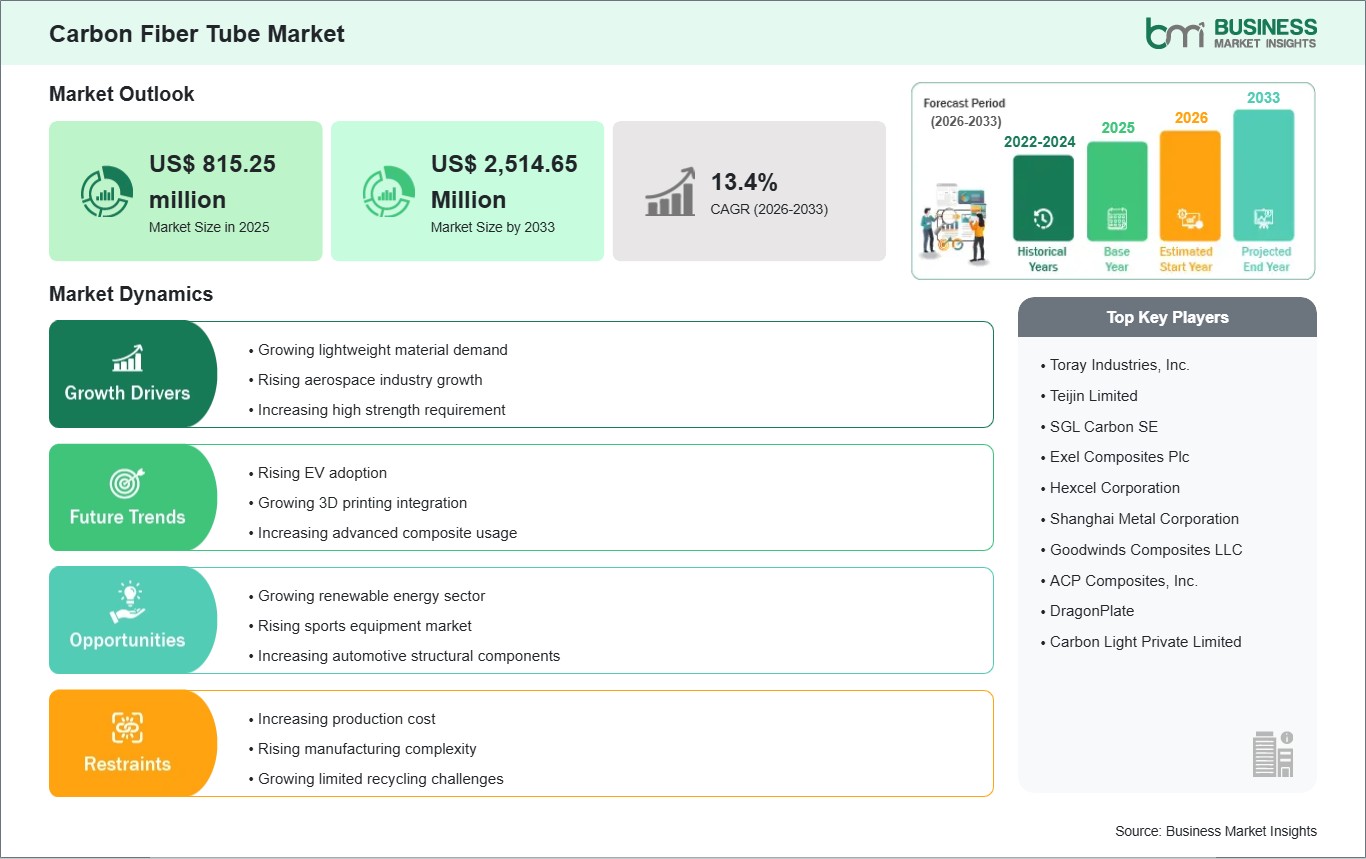
Carbon fiber tube is a lightweight, strong composite made from carbon fiber reinforcements and resin systems like epoxy or polyester. It is known for its excellent stiffness-to-weight ratio, resistance to corrosion, performance under fatigue, and stability. Carbon fiber tubes are often used in industries like aerospace, automotive, marine, construction, sports equipment, robotics, and other fields where both structural strength and reduced weight are important. They are commonly found in frames, support structures, drive shafts, masts, and components for precision equipment because of their durability and efficiency.
Market growth is propelled by the rising demand for lightweight materials that enhance fuel efficiency and operational performance in the transportation and aerospace industries. The growing use of composites in renewable energy systems and industrial automation also fuels this demand. Advances in production methods like filament winding, pultrusion, and roll-wrapping improve efficiency and consistency of the products. Moreover, increased investments in modernizing infrastructure and high-performance sports goods are speeding up adoption in both developed and emerging markets.
Segment Analysis
Carbon Fiber Tube Market Segmentation
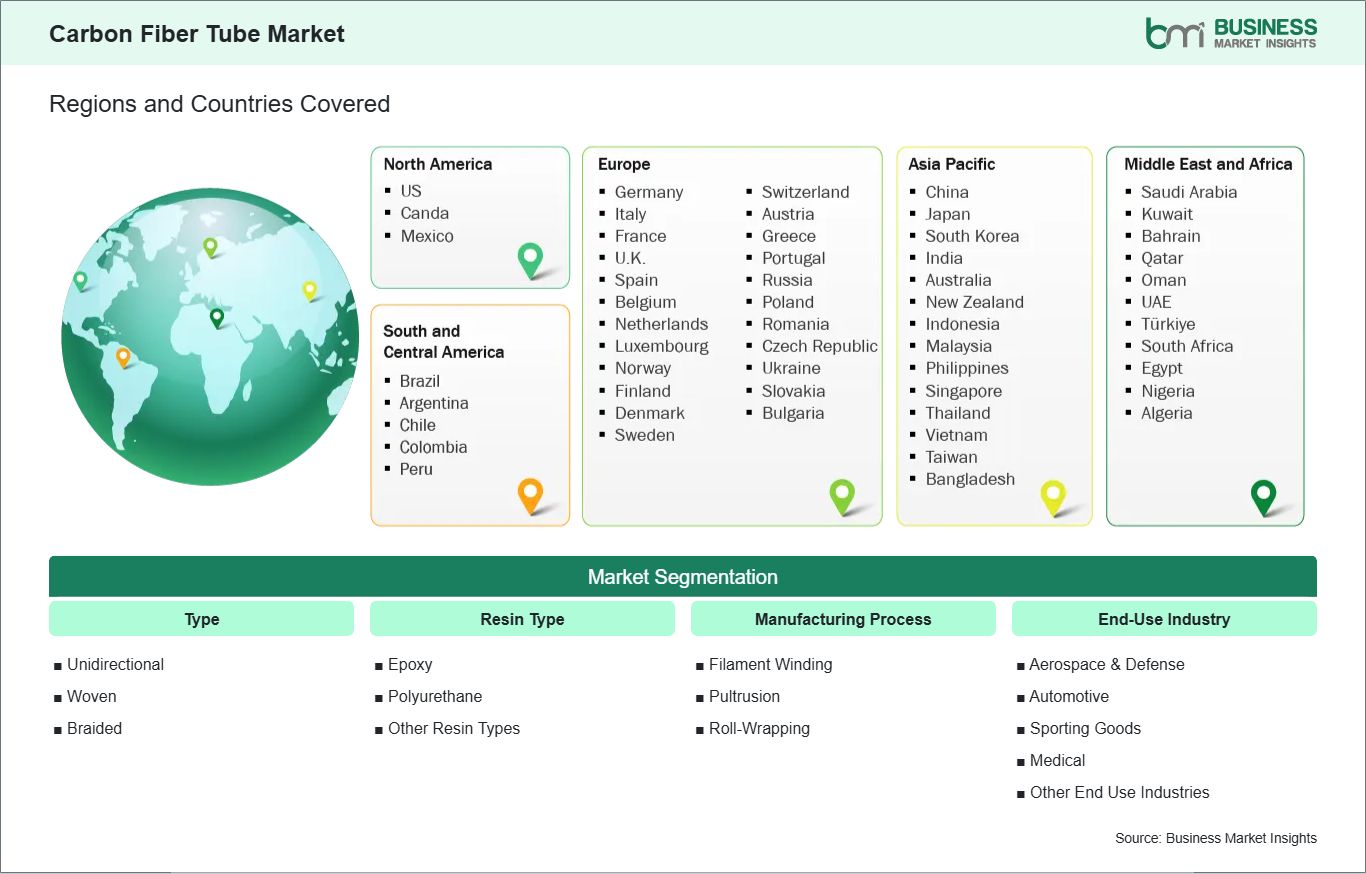
Key segments that contributed to the derivation of the carbon fiber tube market analysis are type, resin type, manufacturing process, and end-use industry.
- By type, the carbon fiber tube market is segmented into unidirectional, woven, and braided. The unidirectional segment held the largest market share in 2025.
- By resin type, the carbon fiber tube market is segmented into epoxy, polyurethane, and others. The epoxy segment accounted for the largest market share in 2025.
- By manufacturing process, the carbon fiber tube market is segmented into filament winding, pultrusion, and roll-wrapping. The filament winding segment dominated the market in 2025.
- By end-use industry, the carbon fiber tube market is segmented into aerospace & defense, automotive, sporting goods, medical, and others. The aerospace & defense segment held the largest market share in 2025.
Market Forces
Carbon Fiber Tube Market Drivers and Opportunities
Expansion of Aerospace and Automotive Applications
A main factor driving the carbon fiber tube market is the growing use of lightweight structural components in the aerospace and automotive industries. Manufacturers want to improve fuel efficiency, cut emissions, and boost performance to meet strict environmental and regulatory standards. Carbon fiber tubes offer high tensile strength and stiffness while greatly reducing overall structural weight compared to traditional metal options.
In aerospace, they are used in structural frames, control systems, and interior parts where durability and fatigue resistance are crucial. In automotive applications, carbon fiber tubes are used in drive shafts, chassis reinforcements, and crash structures to improve efficiency and handling. The shift towards electric vehicles increases the need for lightweight materials to balance battery weight and extend driving range. These performance benefits, along with long-lasting durability and resistance to corrosion, continue to drive strong demand in high-performance engineering sectors.
Increasing Adoption in Industrial Automation and Robotics
A major growth opportunity in the carbon fiber tube market comes from its rising use in industrial automation and robotics. As industries incorporate robotics and automated systems to boost productivity and accuracy, the need for lightweight and strong structural components is increasing. Carbon fiber tubes provide excellent vibration damping, stability, and strength, making them perfect for robotic arms, conveyor systems, drone frames, and precision manufacturing tools. Their lightweight nature allows for quicker motion control and lower energy use in automated systems, enhancing operational efficiency.
Additionally, the rapid growth of drone technology in commercial, defense, and logistics areas creates new opportunities for application. Ongoing research on affordable manufacturing methods and hybrid composite designs further improves access for mid-scale industrial users. As smart manufacturing and Industry 4.0 efforts grow worldwide, carbon fiber tubes are set to play a key role in future automation infrastructure, offering significant long-term growth potential.
Size and Share Analysis
Carbon Fiber Tube Market Size and Share Analysis
The carbon fiber tube market demonstrates steady growth, with size and share analysis revealing evolving trends and competitive positioning among key players. The report examines subsegments categorized within type, resin type, manufacturing process, and end-use industry, offering insights into their contribution to overall market performance. By manufacturing process, the filament winding segment holds the largest market share. This dominance comes from its common use in making strong, lightweight carbon fiber tubes for aerospace, automotive, and industrial applications. Filament winding allows for precise fiber alignment, leading to better mechanical strength, stiffness, and structural consistency. The process is popular for its efficiency and cost-effectiveness in large-scale production. It can create complex cylindrical structures while keeping material waste to a minimum. It also meets strict industry standards for parts that are critical to performance. The growth of this segment is driven by rising demand for lightweight structural parts, increased aircraft production, and a greater use of composite pressure vessels and drive shafts.
Report Coverage
Carbon Fiber Tube Market Report Coverage and Deliverables
The " Carbon Fiber Tube Market Size and Forecast (2022 - 2033)" report provides a detailed analysis of the market covering below areas:
- Carbon fiber tube market size and forecast at global, regional, and country levels for all the key market segments covered under the scope
- Carbon fiber tube market trends, as well as market dynamics such as drivers, restraints, and key opportunities
- Carbon fiber tube market analysis covering key market trends, global and regional framework, major players, regulations, and recent market developments
- Industry landscape and competition analysis covering market concentration, heat map analysis, prominent players, and recent developments for the carbon fiber tube market
- Detailed company profiles, including SWOT analysis
Geographic Insights
Carbon Fiber Tube Market Geographic Insights
The geographical scope of the carbon fiber tube market report is divided into five regions: North America, Asia Pacific, Europe, the Middle East & Africa, and South & Central America. Asia Pacific holds a significant share of the carbon fiber tube market. This is due to its strong industrial base, growing manufacturing sector, and rising investments in composite materials. Countries like China, Japan, South Korea, and India are major centers for automotive production, aerospace parts manufacturing, renewable energy development, and industrial equipment production.
The benefits from cost-effective manufacturing, supportive government programs, and increasing domestic demand for lightweight, high-performance materials. Rapid urbanization and infrastructure projects push the adoption of composite structural components. Additionally, the growth of robotics and drone manufacturing in the Asia-Pacific region boosts the demand for carbon fiber tubes in precise applications. With established raw material suppliers and composite manufacturers, the supply chain becomes more efficient, and market access improves. Overall, these factors position Asia-Pacific as the top regional market, with ongoing growth backed by technology and industrial modernization.
Industry Activity
Recent Developments
The carbon fiber tube market is evaluated by gathering qualitative and quantitative data post-primary and secondary research, which includes important corporate publications, association data, and databases. A few of the key developments in the carbon fiber tube market are:
- In August 2025, DIC Corporation announced an increase in its epoxy resin capacity by 59% at its Chiba Plant in Japan. The expansion received about a US$20 million government subsidy. It aimed to meet the growing demand for semiconductors and improve global competitiveness.
- In March 2025, BASF and Sika launched a new epoxy hardener called Baxxodur EC 151. This product is designed for sustainable flooring and construction coatings. It significantly lowers volatile organic compounds, cures at low temperatures, and improves durability in epoxy resin applications.
Trust & Transparency
Research Methodology
The market analysis combines proprietary research with secondary data from government agencies, company disclosures, regulatory filings, industry databases and expert interviews. Market estimates are validated through data triangulation, cross-market benchmarking and analyst
review.
View Full Research Methodology
Key Sources Referred:
World Bank - Global Trade IndicatorsWorld Trade Organization (WTO)International Monetary Fund (IMF)International Trade Administration (ITA)Company WebsitesCompany Annual ReportsCompany Investor PresentationsAmerican Composites Manufacturers Association (ACMA)European Composites Industry Association (EuCIA)Japan Carbon Fiber Manufacturers Association (JCMA)China Composites Industry Association (CCIA)