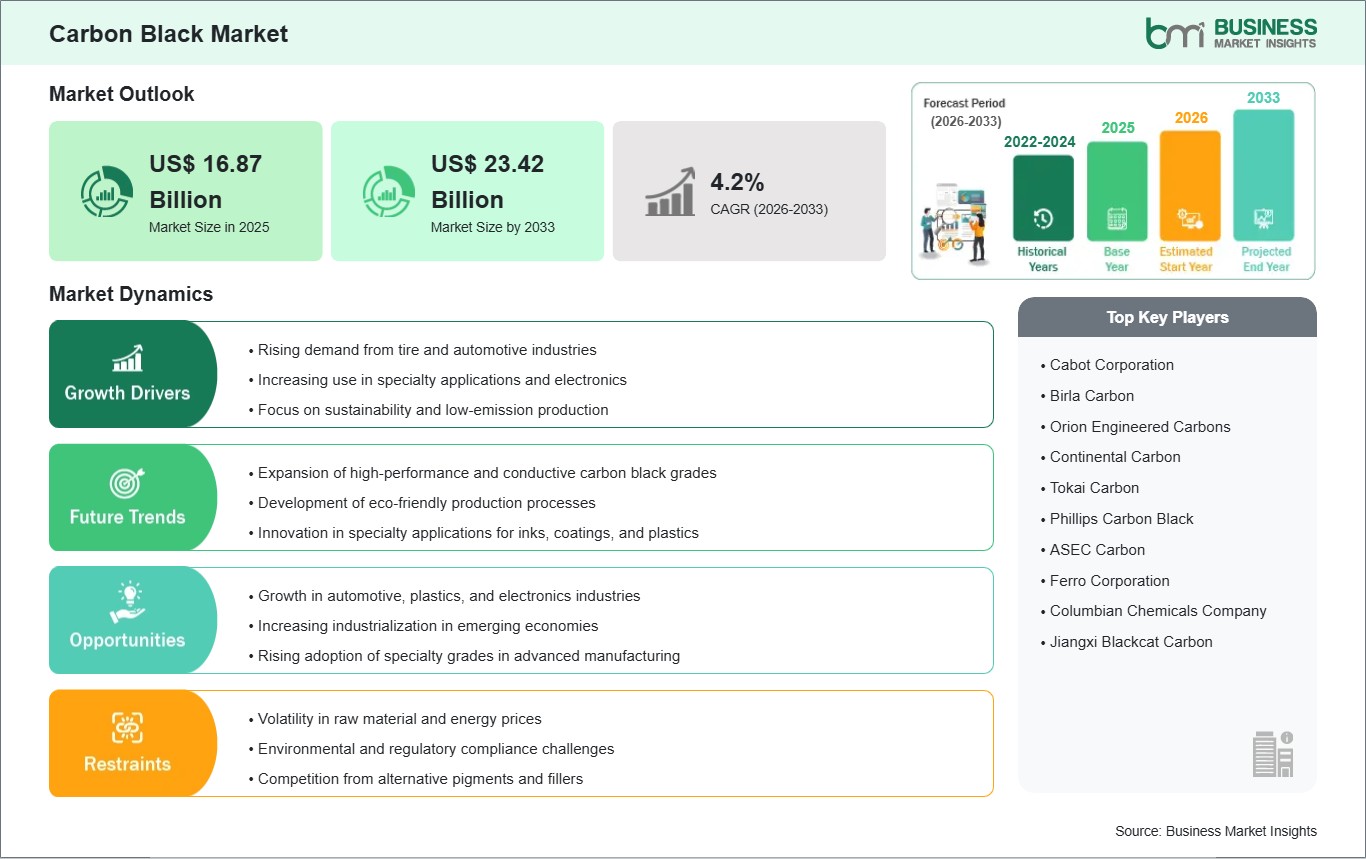
The Carbon Black Market size is expected to reach US$ 23,420 million by 2033 from US$ 16,870 million in 2025. The market is estimated to record a CAGR of 4.2% from 2026 to 2033.
The global carbon black market is expanding steadily due to rising demand from automotive, plastics, and coatings industries. Carbon black is a reinforcing agent in rubber, pigment in inks and coatings, and filler in plastics. Growth in tire production, automotive components, and industrial plastics is fueling demand globally.
Advancements in furnace, thermal, and acetylene production processes improve product consistency, particle size, and performance. Specialty grades with enhanced surface area, conductivity, and pigment properties are increasingly used in high-performance applications such as conductive plastics, electronics, and advanced coatings.
Regulatory emphasis on sustainable production, environmental safety, and emission control is driving low-emission manufacturing innovations. Manufacturers are investing in eco-friendly carbon black solutions to comply with regulations and cater to sustainability-conscious industries.

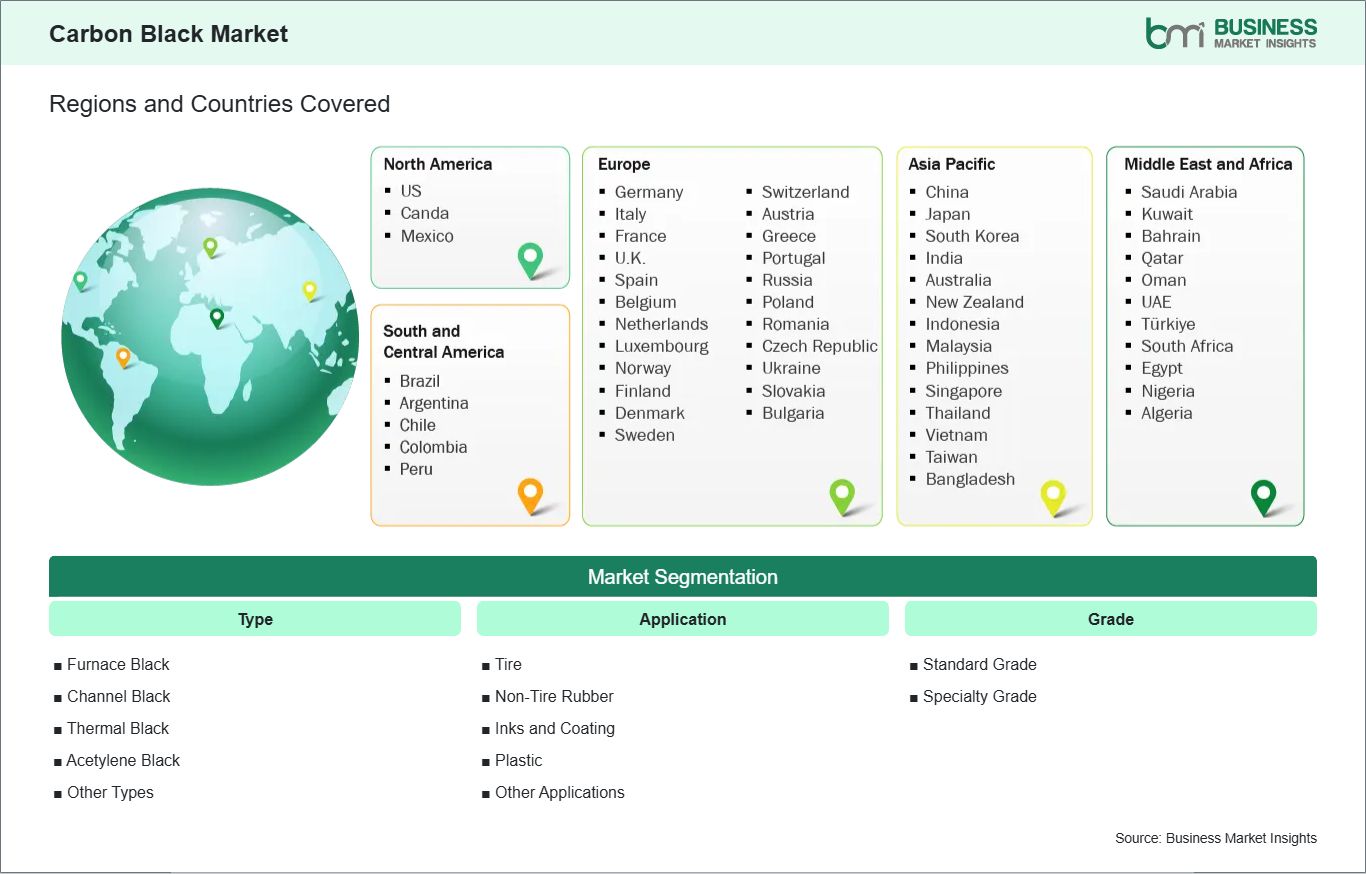
Key segments that contributed to the derivation of the carbon black market analysis are type, application, and grade.
The main drivers of the global market for carbon black are the tire and automotive sectors. Carbon black is used as a reinforcing filler in tires through the enhancement of tensile strength, abrasion resistance and durability of both tires and their data. As the automotive sector continues to grow around the world, and especially in the developing world, so will the global demand for tires as it pertains to the production of passenger vehicles, commercial trucks, and off-road vehicles using carbon black as the basis of those vehicles. As well, as the trend towards electric vehicles creates greater need for specialized and high-end tires using specialty carbon black grades, manufacturers are continuing to spend large sums of money on producing lightweight and fuel-efficient tires while adhering to safety and durability standards. To this end, carbon black will continue to help tire manufacturers reach the aforementioned performance targets; therefore, securing a steady growth market for carbon black. Similarly, in regards to non-tire rubber products, such as belts, hoses and gaskets, they utilize carbon black to achieve enhanced strength and durability. The increase in industrial and commercial activity, infrastructure and machinery construction and production will continue to lead to increased demand for these end-use products. Emerging economies, particularly in Asia Pacific where automotive production has exploded, will play a key role in driving the growth of the carbon black market.
As with tires, carbon black contributes to increasing thermal effects and UV resistance in rubber components made from carbon black-based materials for outdoor applications and or high-end applications. Therefore, through the same reasons stated above, the automotive market will have significant expansion potential in both the industrial and commercial use of carbon-black-based materials.
The increasing adoption of specialty carbon black in high-performance applications presents a significant market opportunity. Specialty grades, characterized by controlled particle size, high surface area, and tailored conductivity, are used in electronic devices, conductive plastics, coatings, and inks. The expansion of electronic and advanced manufacturing sectors, particularly in North America and Asia Pacific, is fueling demand for these high-value products.
In addition to performance-driven applications, sustainability initiatives are influencing market growth. Environmental regulations targeting emissions and pollutants in carbon black production are encouraging manufacturers to adopt cleaner, low-emission processes. Companies investing in eco-friendly production techniques, such as gas-phase or furnace black processes with emission reduction controls, are better positioned to serve environmentally conscious clients and comply with regulatory standards.
Carbon black is also increasingly integrated into high-performance plastics and polymer composites, where it enhances mechanical strength, conductivity, and UV resistance. The growing need for electrically conductive materials in batteries, electronics, and EV components is driving specialty carbon black adoption.
Furthermore, the inks and coatings industry presents another growth avenue, with carbon black serving as a primary pigment in printing inks, paints, and industrial coatings. Rising demand for packaging, printing, and high-quality coating applications globally is supporting market expansion.
Overall, the combination of specialty applications, regulatory compliance, and environmental sustainability is enabling manufacturers to innovate and diversify their product portfolios, creating new revenue streams and long-term growth opportunities for the carbon black market.

The Carbon Black Market demonstrates steady growth, with size and share analysis highlighting evolving trends and competitive dynamics among key players. The report examines subsegments categorized within type, application, and grade, offering insights into their contribution to overall market performance.
By type, the furnace black subsegment dominated the market in 2025, due to widespread use in rubber reinforcement.
In terms of application, the tire subsegment dominated the market in 2025, driven by global automotive production.
By grade, the standard grade subsegment dominated the market in 2025, owing to high demand from conventional tire and rubber applications.
| Report Attribute | Details |
|---|---|
| Market size in 2025 | US$ 16.87 Billion |
| Market Size by 2033 | US$ 23.42 Billion |
| Global CAGR (2026 - 2033) | 4.2% |
| Historical Data | 2022-2024 |
| Forecast period | 2026-2033 |
| Segments Covered | By Type
|
|
Regions and Countries Covered
| |
| North America | US, Canada, Mexico |
| Europe | Belgium, Austria, Finland, Denmark, Greece, Poland, Romania, Russia, Ukraine, Czech Republic, Slovakia, Bulgaria, Italy, Luxembourg, Germany, Switzerland, France, Netherlands, Norway, Portugal, Spain, Sweden, United Kingdom |
| Asia-Pacific | Australia, China, India, Japan, South Korea, Indonesia, Malaysia, Philippines, Singapore, Thailand, Vietnam, Bangladesh, New Zealand, Taiwan |
| South and Central America | Brazil, Argentina, Peru, Chile, Colombia |
| Middle East and Africa | Bahrain, Kuwait, Oman, Qatar, Saudi Arabia, United Arab Emirates, Turkiye, South Africa, Egypt, Algeria, Nigeria |
| Market leaders and key company profiles |
|
The "Carbon Black Market Size and Forecast (2022 - 2033)" report provides a detailed analysis of the market covering below areas:
The geographical scope of the Carbon Black Market report is divided into North America, Asia Pacific, Europe, Middle East & Africa, and South & Central America. North America held the largest share in 2025.
North America represents a mature market with well-established automotive, plastics, and electronics sectors. The United States and Canada have high demand for specialty carbon black in coatings, inks, and conductive materials. Regulatory emphasis on environmental compliance and sustainable production practices supports the adoption of cleaner carbon black products.
Europe also exhibits steady growth due to stringent environmental regulations, strong automotive production, and emphasis on industrial efficiency. Germany, France, and Italy are key markets, with a focus on high-performance and specialty carbon black applications. Asia Pacific market is growing due to rapid industrialization, robust automotive production, and high demand for tires and rubber products. Countries such as China, India, and Japan are leading consumers of carbon black for both tire and non-tire applications. The expansion of the automotive and electronics industries in the region is driving demand for standard and specialty carbon black products.
The Middle East & Africa region is witnessing gradual growth driven by tire production, industrial rubber, and plastics manufacturing. Emerging automotive and industrial sectors in the Gulf Cooperation Council (GCC) countries are supporting market expansion.
South & Central America, particularly Brazil and Mexico, is experiencing moderate growth due to increasing industrialization and automotive production. Across all regions, industrial demand, regulatory compliance, and specialty application adoption shape the competitive dynamics of the carbon black market.

The Carbon Black Market is evaluated by gathering qualitative and quantitative data post primary and secondary research, which includes important corporate publications, association data, and databases. A few of the key developments in the carbon black market are:
The Carbon Black Market is valued at US$ 16.87 Billion in 2025, it is projected to reach US$ 23.42 Billion by 2033.
As per our report Carbon Black Market, the market size is valued at US$ 16.87 Billion in 2025, projecting it to reach US$ 23.42 Billion by 2033. This translates to a CAGR of approximately 4.2% during the forecast period.
The Carbon Black Market report typically cover these key segments-
The historic period, base year, and forecast period can vary slightly depending on the specific market research report. However, for the Carbon Black Market report:
The Carbon Black Market is populated by several key players, each contributing to its growth and innovation. Some of the major players include:
The Carbon Black Market report is valuable for diverse stakeholders, including:
Essentially, anyone involved in or considering involvement in the Carbon Black Market value chain can benefit from the information contained in a comprehensive market report.
Please tell us your area of interest
(Market Segments/ Regions and Countries/ Companies)