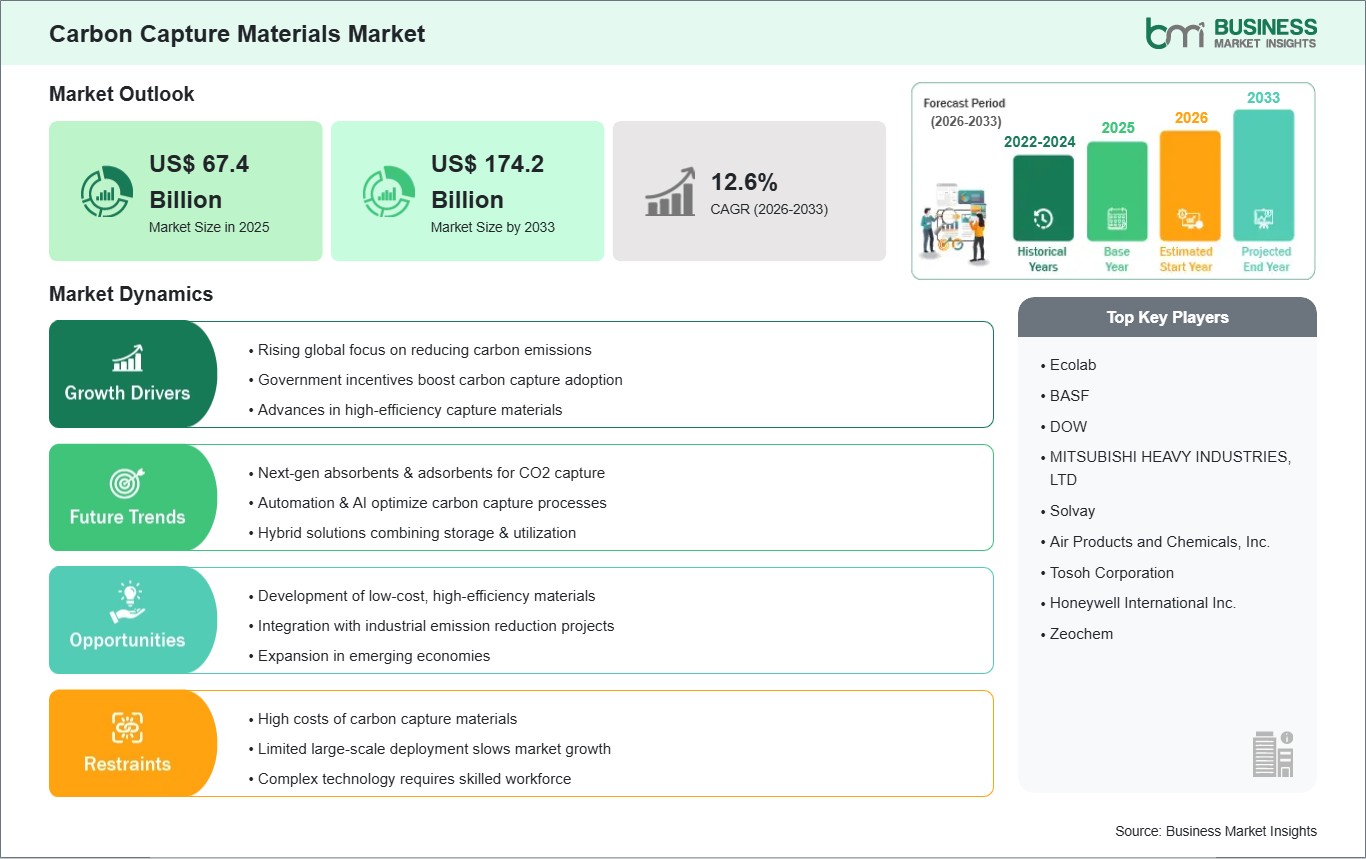
The Carbon Capture Materials market size is expected to reach US$ 174.2 billion by 2033 from US$ 67.4 billion in 2025. The market is estimated to record a CAGR of 12.6% from 2026 to 2033.
Carbon Capture Materials form the core platform for enabling global decarbonization efforts. This category includes advanced solvents such as amines and ionic liquids, high-performance solid sorbents including metal-organic frameworks (MOFs) and zeolites, as well as next-generation gas-separation membranes. Together, these materials offer industries a highly practical pathway to reduce emissions at the point of release. By capturing carbon before it enters the atmosphere, they allow hard-to-abate sectors—such as power generation, cement, steel, and chemicals—to significantly lower their carbon footprint without the need for major modifications to existing infrastructure. This approach delivers measurable emission reductions while minimizing operational disruption and capital investment, positioning these materials as a strategically important enabler of industrial decarbonization worldwide. The market is growing as a result of strict net-zero rules, new carbon taxes, and credits such as the 45Q credit in the US, and the rising need for cleaner hydrogen (Blue Hydrogen). Additionally, the move toward Direct Air Capture (DAC), which uses special materials with lots of surface area to pull CO2 out of the air, is opening up new opportunities beyond just capturing emissions from factories.
However, several challenges can restrain market growth: high energy penalties associated with the thermal regeneration of traditional amine solvents significantly increase operational costs and lower overall plant efficiency. Impurities in flue gas often lead to material degradation and corrosion, making it difficult for large facilities to maintain equipment and ensure durability. Additionally, the industry faces constraints due to high initial capital expenditure (CAPEX) for capture infrastructure and a persistent lack of standardized transport and storage networks, which creates a dilemma for material adopters. Despite these hurdles, the drive for sustainability is creating new opportunities. Materials like MOFs are becoming more popular, making it easier to adopt new methods and improve efficiency while using less energy. The expansion into carbon mineralization, where captured CO2 is converted into solid construction materials, and the integration of AI-driven material discovery to identify more resilient polymers and catalysts are expected to create significant opportunities for market growth.

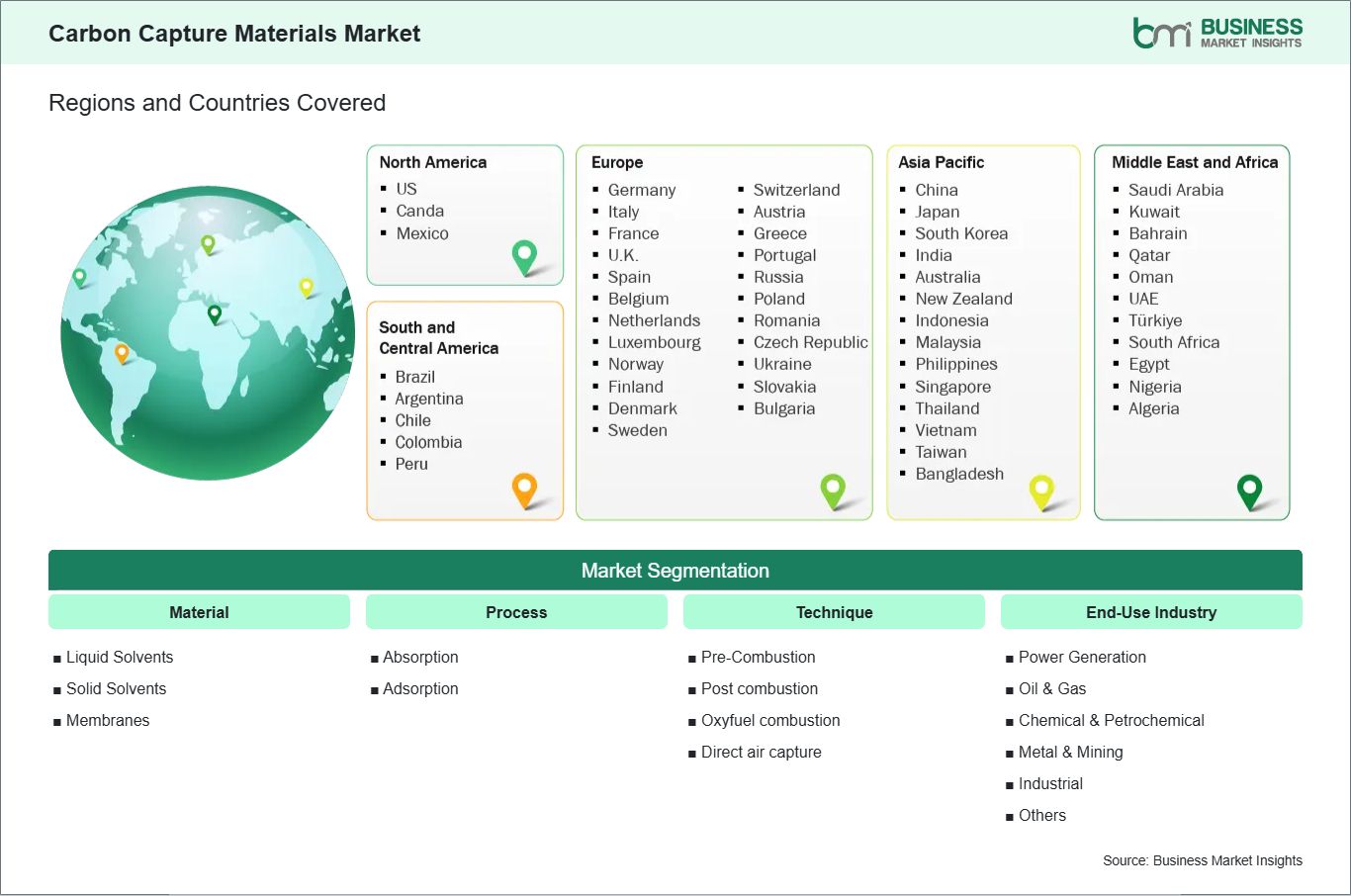
Key segments that contributed to the derivation of the Carbon Capture Materials market analysis are material, process, technique, and end-use industry.
As countries strengthen their climate agendas through policies such as the EU’s Green Deal and the US Inflation Reduction Act (IRA), energy-intensive industries face increasing pressure to reduce their carbon emissions. These regulations introduce higher carbon taxes, stricter reporting requirements, and meaningful financial penalties for non-compliance, making it essential for companies to invest in technologies that can dramatically cut emissions without disrupting production. As a result, hard-to-abate sectors—including cement, steel, and chemical manufacturing—are turning to advanced carbon capture solutions as a core part of their decarbonization strategies.
To meet these demands, industries rely heavily on specialized materials such as high-performance liquid solvents, solid adsorbents, and engineered membranes that can capture CO2 directly at the point of release. These materials allow companies to integrate carbon capture into existing operations, avoiding costly system overhauls while still achieving significant emissions reductions. At the same time, rising ESG expectations from investors, regulators, and customers are pushing firms to present clear, credible plans for transitioning toward cleaner operations.
By adopting carbon capture materials, businesses can maintain operational efficiency, reduce regulatory risks, and demonstrate tangible progress toward sustainability goals. More broadly, carbon capture is becoming a pivotal bridge technology—helping industries continue operating within today’s fossil-fuel-based systems while progressing toward a resilient, low-carbon future.
Innovations in next-generation capture materials—particularly metal-organic frameworks, advanced amine-based solvents, and high-flux membrane technologies—are reshaping the economics of carbon capture. These breakthroughs promise significantly higher capture efficiency while reducing energy consumption, addressing one of the most persistent barriers to scaling carbon capture systems across industrial facilities. As these technologies continue to mature, they enable solutions that are more cost-effective, modular, and easier to integrate into existing infrastructure, accelerating the commercial viability of large-scale deployment.
At the same time, a rapidly expanding market for Carbon Capture and Utilization (CCU) is creating new value pathways. Captured CO2 can now be converted into products such as synthetic e-fuels, sustainable construction materials, and carbon-neutral chemicals, turning what was once an unavoidable waste stream into a profitable resource. This shift supports the emergence of a circular carbon economy where emissions are not only reduced but actively repurposed to generate new revenue opportunities.
Manufacturers that lead the development of modular, scalable systems—particularly for Direct Air Capture (DAC) and low-carbon hydrogen production—are positioned to capture substantial market share. As industries and governments increasingly prioritize resource recovery alongside emissions reduction, these technology providers stand to benefit from strong demand, robust policy incentives, and global investment in climate-aligned infrastructure.

The Carbon Capture Materials market demonstrates steady growth, with size and share analysis revealing evolving trends and competitive positioning among key players. The report further examines subsegments categorized within material, process, technique, and end-use industry, offering insights into their contribution to overall market performance.
For instance, the Liquid Solvents subsegment remains a cornerstone of the market. Amine-based solutions are the standard for Post-combustion capture, as they can be effectively retrofitted to existing Power Generation facilities and coal-fired plants. This combination is favored for its high capture efficiency and technological maturity, allowing large-scale industrial players to meet immediate emission reduction targets without completely overhauling their existing infrastructure.
| Report Attribute | Details |
|---|---|
| Market size in 2025 | US$ 67.4 Billion |
| Market Size by 2033 | US$ 174.2 Billion |
| Global CAGR (2026 - 2033) | 12.6% |
| Historical Data | 2022-2024 |
| Forecast period | 2026-2033 |
| Segments Covered | By Material
|
|
Regions and Countries Covered
| |
| North America | US, Canada, Mexico |
| Europe | Belgium, Austria, Finland, Denmark, Greece, Poland, Romania, Russia, Ukraine, Czech Republic, Slovakia, Bulgaria, Italy, Luxembourg, Germany, Switzerland, France, Netherlands, Norway, Portugal, Spain, Sweden, United Kingdom |
| Asia-Pacific | Australia, China, India, Japan, South Korea, Indonesia, Malaysia, Philippines, Singapore, Thailand, Vietnam, Bangladesh, New Zealand, Taiwan |
| South and Central America | Brazil, Argentina, Peru, Chile, Colombia |
| Middle East and Africa | Bahrain, Kuwait, Oman, Qatar, Saudi Arabia, United Arab Emirates, Turkiye, South Africa, Egypt, Algeria, Nigeria |
| Market leaders and key company profiles |
|
The Carbon Capture Materials Market Size and Forecast (2022–2033) report provides a detailed analysis of the market covering below areas:
The geographical scope of the Carbon Capture Materials market report is divided into five regions: North America, Asia Pacific, Europe, Middle East & Africa, and South & Central America.
The Asia-Pacific Carbon Capture Materials Market is segmented into China, Japan, South Korea, India, Australia, New Zealand, Indonesia, Malaysia, the Philippines, Singapore, Thailand, Vietnam, Taiwan, Bangladesh, and the Rest of Asia. The market is primarily driven by the region's status as the world’s largest CO2 emitter and ambitious net-zero pledges.
Growth is further bolstered by the rapid development of carbon-to-product technologies, which convert captured emissions into biofuels and construction materials. The adoption of advanced solid sorbents and membranes, alongside supportive government frameworks like China’s "14th Five-Year Plan," solidifies Asia-Pacific as the primary hub for carbon capture material innovation and large-scale deployment.

The Carbon Capture Materials market is evaluated by gathering qualitative and quantitative data post primary and secondary research, which includes important corporate publications, association data, and databases. A few of the key developments in the Carbon Capture Materials market are:
The Carbon Capture Materials Market is valued at US$ 67.4 Billion in 2025, it is projected to reach US$ 174.2 Billion by 2033.
As per our report Carbon Capture Materials Market, the market size is valued at US$ 67.4 Billion in 2025, projecting it to reach US$ 174.2 Billion by 2033. This translates to a CAGR of approximately 12.6% during the forecast period.
The Carbon Capture Materials Market report typically cover these key segments-
The historic period, base year, and forecast period can vary slightly depending on the specific market research report. However, for the Carbon Capture Materials Market report:
The Carbon Capture Materials Market is populated by several key players, each contributing to its growth and innovation. Some of the major players include:
The Carbon Capture Materials Market report is valuable for diverse stakeholders, including:
Essentially, anyone involved in or considering involvement in the Carbon Capture Materials Market value chain can benefit from the information contained in a comprehensive market report.
Please tell us your area of interest
(Market Segments/ Regions and Countries/ Companies)