
BVLOS Drones Market Size, Share, Trends & Forecast Report, 2026–2033

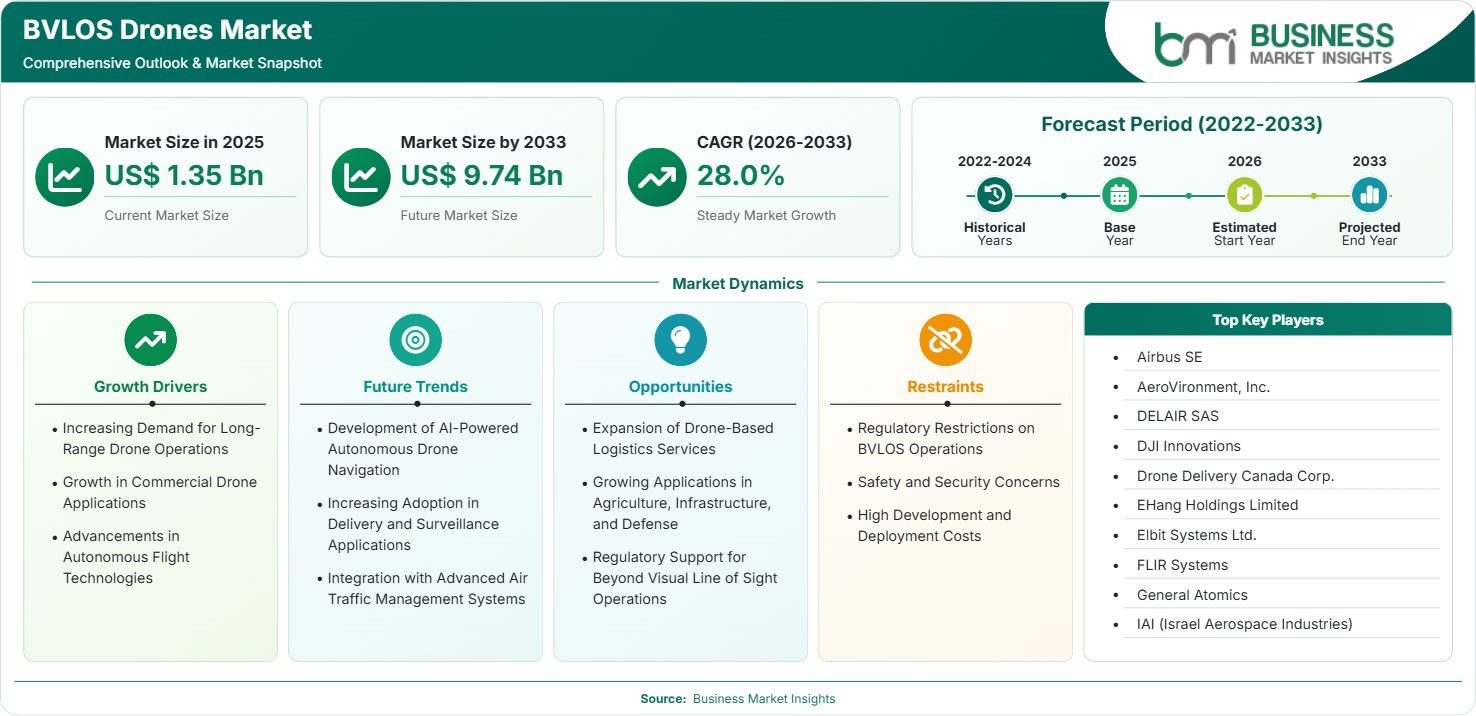
The BVLOS Drones Market size was valued at US$ 1.35 Billion in 2025 and is projected to reach US$ 9.74 Billion by 2033, growing at a CAGR of US$ 28.0% during 2026–2033, driven by autonomous flight adoption, commercial drone deployment, regulatory advancements, and expanding applications across logistics, infrastructure, energy, and defense sectors.

Report Coverage
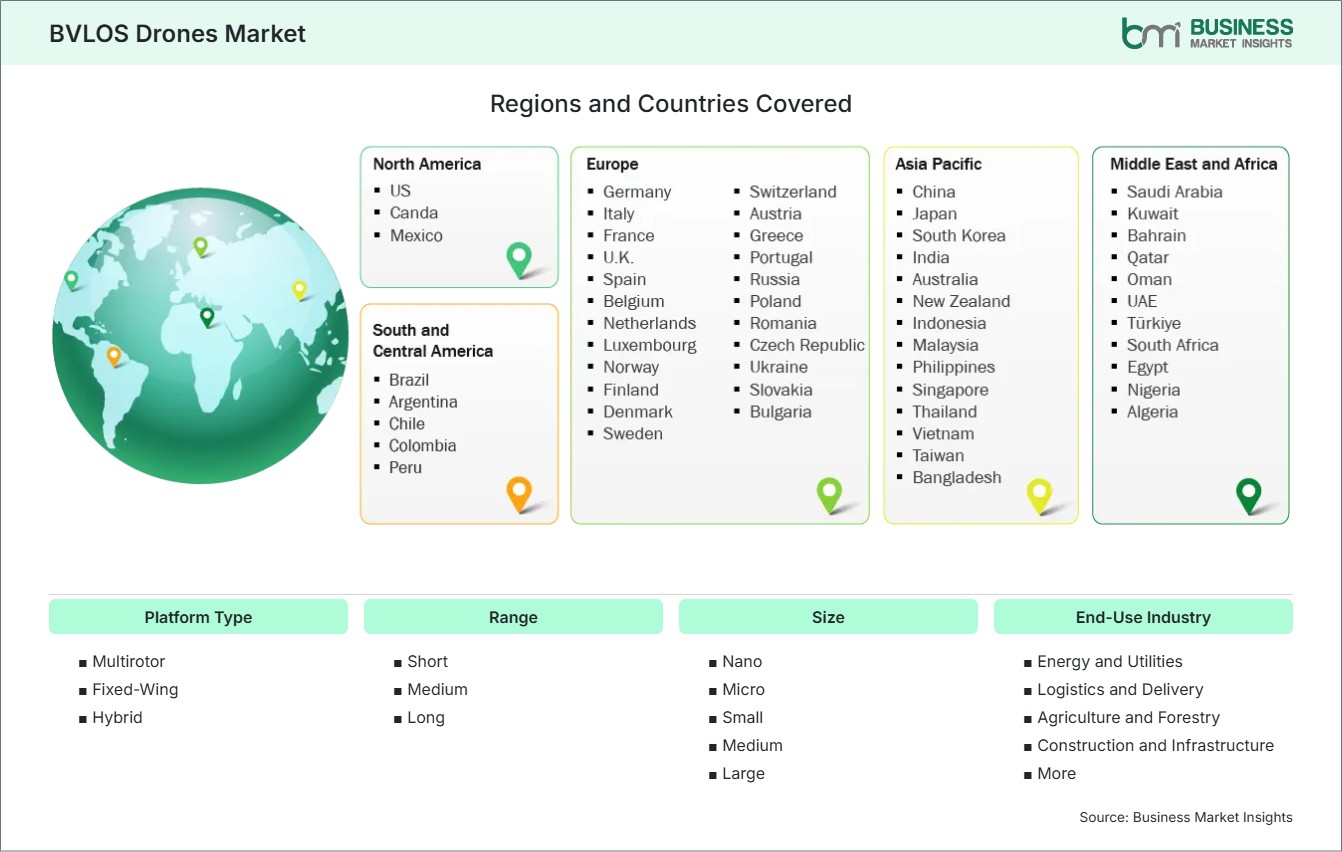
  • Platform Type: Multirotor, Fixed-Wing, Hybrid
  • Range: Short, Medium, Long
  • Size: Nano, Micro, Small, Medium, Large
  • End-Use Industry: Energy and Utilities, Logistics and Delivery, Agriculture and Forestry, Construction and Infrastructure, More
US$ 1.35 Bn Market size in 2025
US$ 9.74 Bn Market Size by 2033
28.0% CAGR, 2026 - 2033
2026-2033 Forecast Period

AI Overview

BVLOS Drones Market Summary

  • North America Region: North America holds a market share of 38%–42% in 2025, growing with a CAGR of 27%–30% influenced by FAA approvals, infrastructure monitoring, defense demand, and commercial drone expansion. The US market advances through regulatory pathways and enterprise adoption with a CAGR of 28%–31% between 2026 and 2033.
  • Fastest Growing Region: Asia Pacific holds a market share of 22%–26% in 2025, growing with a CAGR of 31%–34% supported by smart city programs, agricultural automation, delivery networks, and rising investments in autonomous aerial technologies across emerging economies.
  • Leading Segment: Fixed-Wing platforms hold a market share of 42%–46% in 2025, growing with a CAGR of 27%–30% due to extended endurance, surveillance capability, mapping applications, and suitability for large-area industrial operations.
  • High Growth Segment: Logistics and Delivery applications hold a market share of 18%–22% in 2025, growing with a CAGR of 33%–36% supported by automated delivery trials, e-commerce expansion, healthcare logistics, and urban mobility initiatives.
  • Key Market Opportunity: Expansion of long-distance autonomous operations creates opportunities through logistics networks, remote inspections, precision agriculture, and defense applications requiring reliable unmanned aerial coverage beyond visual limitations.
  • Major Market Players: Airbus SE, AeroVironment, Inc., DELAIR SAS, DJI Innovations, Drone Delivery Canada Corp., EHang Holdings Limited, Elbit Systems Ltd., FLIR Systems, General Atomics, and Israel Aerospace Industries Ltd.
Strategic Insights

BVLOS Drones Market: Strategic Insights

BVLOS Drones Market Strategic Framework
FREE PDF
Request your free sample
Request free sample
Stakeholder View

Key Takeaways

  • The ecosystem is transitioning from standalone drone manufacturing toward integrated platforms combining aircraft, autonomous software, communication systems, data analytics, and managed operational services.
  • Logistics, infrastructure inspection, and energy monitoring represent high-value application areas as organizations seek alternatives to manual inspections and conventional transportation models.
  • Innovation priorities are shifting toward advanced autonomy, artificial intelligence-based navigation, collision avoidance systems, and improved battery technologies that extend operational range.
  • Asia Pacific presents a strong investment case due to expanding agricultural automation, smart infrastructure initiatives, and government-backed unmanned aviation programs in countries including China, Japan, and India.
  • Investment activity is increasingly focused on partnerships between drone manufacturers, technology providers, and service operators to accelerate commercial deployment and regulatory compliance.
  • Defense modernization programs continue influencing technology development by supporting high-endurance platforms, secure communications, and mission-specific autonomous capabilities.
Geographic Outlook

BVLOS Drones Market Regional Highlights

North America BVLOS Drones Market

North America accounted for a 35%–38% share in 2025 and is projected to expand at a CAGR of 26%–29% during 2026–2033. The region benefits from advanced aerospace infrastructure, defense investments, commercial drone adoption, and progressive regulatory development. The BVLOS Drones Market share in this region is supported by enterprise demand for automated inspection, surveillance, and logistics operations.

  • The United States remains the dominant contributor due to defense procurement, FAA initiatives, and increasing commercial drone applications across multiple industries.
  • Canada is advancing autonomous delivery and remote monitoring projects through supportive innovation programs and emerging drone service ecosystems.
  • Energy companies are adopting long-range unmanned platforms for pipeline, utility, and renewable infrastructure inspection activities.
  • Defense modernization programs continue creating demand for reliable autonomous aerial systems with enhanced endurance and intelligence capabilities.

US BVLOS Drones Market

The US represented a 30%–33% share in 2025 and is expected to grow at a CAGR of 27%–30% through 2033. Competencies in aerospace engineering, regulatory framework for drones in commerce, and automation drive market growth. The nation continues to be a central center of innovation in autonomous aircraft technology, with companies in the tech and defense sectors driving BVLOS operations in various applications.

  • The FAA’s evolving regulatory framework is encouraging commercial operators to conduct advanced BVLOS testing and operational programs.
  • Defense agencies continue investing in autonomous systems for surveillance, reconnaissance, and mission-critical applications.
  • Logistics providers are developing drone delivery networks requiring reliable long-distance flight capabilities and automated control systems.

Europe BVLOS Drones Market

Europe held a 25%–28% share in 2025 and is estimated to grow at a CAGR of 27%–29% between 2026–2033. There are harmonized rules of aviation, sustainable developments, and the need for industrial automation in the area. Germany, France, and the UK are among the key markets, while Poland and the Nordics show increasing prospects. The BVLOS Drones Market growth in Europe is supported by infrastructure monitoring, agriculture applications, and defense technology investments.

  • Germany is expanding industrial drone adoption through manufacturing automation, inspection services, and advanced mobility research programs.
  • France supports aerospace innovation through domestic manufacturers developing autonomous and long-range unmanned platforms.
  • The United Kingdom is increasing commercial drone trials for logistics, emergency response, and infrastructure management.
  • European regulatory frameworks are improving operational clarity for certified BVLOS missions across commercial applications.
  • Defense modernization initiatives are creating demand for advanced unmanned aerial systems with autonomous capabilities.

Asia Pacific BVLOS Drones Market

Asia Pacific accounted for a 22%–25% share in 2025 and is projected to register a CAGR of 30%–33% during 2026–2033. The region represents the fastest-growing market due to expanding industrial digitization, agricultural automation, and government support for unmanned technologies. China, Japan, India, South Korea, and Australia are emerging as important markets. The BVLOS Drones Market share is increasing through large-scale commercial deployments.

  • China is investing heavily in autonomous aerial systems for logistics, agriculture, infrastructure, and urban applications.
  • India is developing drone ecosystems through policy initiatives supporting commercial and agricultural drone adoption.
  • Japan is exploring autonomous delivery and inspection solutions to address labor shortages and aging infrastructure challenges.
  • Australia is adopting long-range drones for mining, environmental monitoring, and remote area operations.
  • South Korea is advancing smart city initiatives integrating autonomous aerial monitoring technologies.

Rest of World BVLOS Drones Market

Rest of World represented a 10%–13% share in 2025 and is expected to grow at a CAGR of 25%–28% from 2026–2033. South and Central America are adopting unmanned systems for agriculture, mining, and environmental monitoring, while Middle East and Africa markets are focusing on security, infrastructure, and energy applications. The BVLOS Drones Market expansion in these regions is supported by operational efficiency requirements.

  • Brazil is adopting drone solutions for agricultural monitoring, forestry management, and large-scale land assessment operations.
  • Middle Eastern countries are investing in autonomous systems for security, oil infrastructure, and smart city projects.
  • African markets are exploring drones for healthcare delivery, mapping, and remote infrastructure monitoring applications.
  • Mining companies across emerging economies are deploying drones to improve safety and operational visibility.
  • Government programs are encouraging technology partnerships to strengthen local unmanned aviation capabilities.
Global Market Geography
FREE PDF
Request your free sample
Request free sample
Segment Analysis

BVLOS Drones Market Segmentation

Platform Type

Platform Type segment accounted for a 45%–48% share in 2025 and is projected to grow at a CAGR of 27%–30% between 2026–2033. The segment benefits from demand for endurance, operational flexibility, and specialized missions. The BVLOS Drones Market scope is expanding as fixed-wing, multirotor, and hybrid platforms address different commercial and industrial requirements.

  • Multirotor: Multirotor platforms support short-distance operations requiring vertical takeoff, precise hovering, and flexible deployment across inspection and monitoring applications.
  • Fixed-Wing: Fixed-wing systems provide extended flight duration, efficient coverage, and suitability for large-scale surveying, mapping, and infrastructure assessment missions.
  • Hybrid: Hybrid platforms combine vertical takeoff capabilities with extended endurance, enabling flexible operations across complex environments and commercial applications.

Range

Range segment represented a 30%–33% share in 2025 and is expected to grow at a CAGR of 28%–31% during 2026–2033. Increasing demand for longer operational coverage, remote monitoring, and automated missions is strengthening adoption. Extended-range capabilities enable industries to improve efficiency while reducing dependence on traditional inspection methods and manual operations.

  • Short: Short-range systems are preferred for localized monitoring, urban applications, and operations requiring frequent deployment flexibility.
  • Medium: Medium-range platforms support industrial inspections, agricultural monitoring, and commercial missions requiring balanced endurance and operational coverage.
  • Long: Long-range drones are gaining adoption for defense, infrastructure, and remote-area applications requiring persistent aerial capabilities.

Size

Size segment accounted for a 22%–25% share in 2025 and is anticipated to expand at a CAGR of 29%–32% during 2026–2033. Increasing mission diversity, payload requirements, and industry-specific deployment models are influencing adoption across size categories. The segment includes compact systems for agile operations and larger platforms for endurance-focused commercial and defense missions.

  • Nano: Nano drones are used for compact surveillance, research activities, and specialized applications requiring lightweight designs and enhanced portability.
  • Micro: Micro drones support indoor inspections, security monitoring, and localized commercial operations where compact deployment provides operational advantages.
  • Small: Small drones are widely adopted for mapping, surveying, agriculture monitoring, and infrastructure assessments due to balanced performance capabilities.
  • Medium: Medium platforms provide increased endurance and payload capacity for commercial inspection, logistics, and industrial monitoring applications.
  • Large: Large drones are designed for extended missions, defense operations, and heavy-payload applications requiring advanced autonomous capabilities.

End-Use Industry

End-Use Industry segment represented a 38%–41% share in 2025 and is projected to grow at a CAGR of 29%–32% through 2026–2033. Rising automation demand across industries is accelerating adoption of unmanned systems. The BVLOS Drones Market trends indicate increasing utilization for inspection, delivery, monitoring, and data-driven decision-making across commercial and government sectors.

  • Energy and Utilities: Energy companies deploy drones for powerline inspection, renewable asset monitoring, and infrastructure assessment to improve safety and reduce operational costs.
  • Logistics and Delivery: Logistics providers are adopting autonomous drones for last-mile delivery, medical transportation, and remote cargo movement solutions.
  • Agriculture and Forestry: Agricultural users leverage drones for crop monitoring, precision farming, forestry analysis, and resource management applications.
  • Construction and Infrastructure: Construction firms utilize drones for surveying, progress tracking, safety monitoring, and large-scale infrastructure inspection activities.
  • More: Additional industries include defense, public safety, mining, environmental monitoring, and emergency response requiring autonomous aerial capabilities.
Market Forces

BVLOS Drones Market Dynamics

Key Market Drivers

Increasing Demand for Long-Range Drone Operations

Growing demand for long-range flights is driven by industries that need autonomous monitoring of wide territories. Market development is facilitated by use cases from the energy sector, defense, and logistics that imply high operational expenses and potential dangers under conventional conditions. The BVLOS Drones Market trends indicate rising investment in communication systems, satellite connectivity, and detect-and-avoid technologies. Regulatory progress from aviation authorities is enabling more commercial testing, while operators are improving mission reliability through advanced navigation systems and artificial intelligence-based automation.

Growth in Commercial Drone Applications

Commercial adoption is expanding as enterprises identify drones as efficient alternatives for inspection, transportation, and data collection activities. The BVLOS Drones market is receiving the advantage of various applications of drones in agriculture, construction, utilities, and logistics industries. Industry experts have estimated that commercial drone usage is growing as companies look to speed up the surveying process while minimizing the exposure of their workers to dangerous working conditions. This is being supported by the use of cloud platforms and automation in analytics software and flight planning.

Advancements in Autonomous Flight Technologies

Technological improvements in artificial intelligence, sensors, and autonomous navigation are strengthening adoption across complex operational environments. The BVLOS Drones Market trends will be affected by better obstacle detection capabilities, decision-making processes in real time, and improved flight control mechanisms. Organizations have been working on developing machine learning systems and sensor kits in order to provide reliability in their operations for a long period of time. Increased efficiency of batteries and use of lightweight materials will help extend the flying time of UAVs.

Key Market Opportunities

Expansion of Drone-Based Logistics Services

Drone delivery networks represent a major opportunity as retailers, healthcare providers, and logistics companies explore faster transportation models. The BVLOS Drones Market Forecasts indicate the following are some of the trends that present growth potential for the drone logistics industry: remote delivery needs, problems due to city traffic, and efficient last-mile solutions. In addition, investment in drones' dedicated flight paths, automatic charging systems, and fleet management systems will fast-track the commercial implementation of the drones. Emergency medical logistics is one of the future application areas of drones.

Growing Applications in Agriculture, Infrastructure, and Defense

Expansion into agriculture, infrastructure, and defense will give varied growth possibilities that are not limited to conventional drone applications. Agricultural businesses need regular inspections on vast lands, whereas infrastructure companies require constant surveillance of their critical equipment. Autonomous technology has been incorporated by defense agencies to conduct surveillance and reconnaissance operations. This will create business prospects with the help of improved payload capability, advanced imaging technology, and autonomy. These uses have increased the demand for specialized drones.

Regulatory Support for Beyond Visual Line of Sight Operations

The evolution of regulations presents an opportunity for increased adoption as the aviation sector comes up with more clarity on how these technologies should be used. Governments are investing in testing areas, digital airspace management tools, and safety regulations to enable autonomous flights. Harmonization of regulations may spur cross-border operations and boost investors’ confidence in this area. Companies that design regulatory-compliant technology, communication systems, and automated safety features stand to gain from this trend.

Market Restraints and Challenges

Regulatory Restrictions on BVLOS Operations

Factor: Limited regulatory approval processes and varying aviation requirements across countries restrict rapid deployment of commercial operations. Impact: Operators face longer certification timelines, increased compliance costs, and operational limitations that can delay large-scale adoption. Although governments are introducing BVLOS frameworks, differences in airspace management standards create complexity for international providers. Companies must invest in compliance systems, pilot programs, and safety validation before expanding operations. Regulatory uncertainty remains a key challenge for businesses seeking scalable drone services across multiple regions.

Safety and Security Concerns

Factor: Risks associated with autonomous flight reliability, cybersecurity threats, and collision avoidance limitations affect stakeholder confidence. Impact: These concerns may limit applications in urbanized zones and critical operating environments. Missions BVLOS need robust communication links, efficient navigation ssystems, and data protection systems. The manufacturers have been coping with such problems by incorporating redundancy in the system, employing artificial intelligence, and building robust cybersecurity infrastructure. However, ensuring consistent safety performance in all weather conditions is essential.

Company Analysis

Competitive Landscape

The BVLOS Drones Market analysis highlights competition among aerospace manufacturers, autonomous technology developers, defense suppliers, and specialized drone service providers. Companies are focusing on advanced platforms, autonomous navigation capabilities, long-range communication systems, and industry-specific solutions to strengthen market positioning.

Company Name

Overview

Products and Services relevant to this market

Airbus SE

Global aerospace company developing advanced unmanned aerial and autonomous aviation solutions.

BVLOS drone platforms, aerospace systems, autonomous flight technologies, and defense applications.

AeroVironment, Inc.

Specialist in unmanned aircraft systems with strong defense and commercial expertise.

Long-endurance UAVs, autonomous systems, tactical drone solutions, and aerial intelligence platforms.

DELAIR SAS

French drone manufacturer focused on professional long-range unmanned solutions.

Fixed-wing drones, industrial inspection platforms, and autonomous mission services.

DJI Innovations

Leading drone technology company serving commercial and professional users globally.

Enterprise drones, flight systems, sensors, and aerial data solutions.

Drone Delivery Canada Corp.

Drone logistics provider developing automated delivery networks and services.

Cargo drones, delivery platforms, and drone transportation solutions.

EHang Holdings Limited

Autonomous aerial vehicle developer focused on urban air mobility technologies.

Autonomous aerial systems, passenger drones, and logistics platforms.

Elbit Systems Ltd.

Defense technology company producing advanced unmanned systems.

Military UAVs, surveillance drones, and integrated autonomous solutions.

FLIR Systems

Technology provider specializing in sensing and imaging solutions.

Thermal sensors, drone payloads, and aerial inspection technologies.

General Atomics

Aerospace and defense company producing advanced unmanned aircraft systems.

Long-endurance UAVs, surveillance platforms, and defense drone systems.

Israel Aerospace Industries Ltd.

Aerospace manufacturer developing unmanned aircraft and defense technologies.

UAV systems, autonomous platforms, and mission-specific aerial solutions.

Industry Activity

Recent Developments

May 2026

Viasat Inc. collaborated with TTP plc and Frequentis AG under the European Space Agency’s Iris programme to conduct BVLOS remotely piloted aircraft system (RPAS) flight trials. The demonstration evaluated satellite connectivity and air traffic management integration to support safe BVLOS drone operations in complex and remote environments.

April 2026

Thales Group collaborated with Viasat Inc., Dimetor GmbH, TTP plc, and the European Space Agency to complete BVLOS connectivity trials under the Iris RPAS programme. The trials focused on resilient multi-link communications required for integrating unmanned aircraft into shared airspace.

September 2025

Volatus Aerospace Inc. received approval from Transport Canada to conduct advanced BVLOS operations using MatrixSpace radar integrated with Kongsberg Geospatial’s IRIS Terminal platform. The approval enables scalable drone-in-a-box, automated inspection, logistics, and enterprise monitoring applications using detect-and-avoid technologies.

September 2025

Uber Technologies, Inc. partnered with Flytrex Inc. and made its first investment in drone technology to expand autonomous delivery capabilities through Uber Eats. Flytrex’s FAA-authorized BVLOS drone operations support the development of scalable last-mile aerial delivery services for food and convenience products.

Trust & Transparency

Research Methodology

The market analysis combines proprietary research with secondary data from government agencies, company disclosures, regulatory filings, industry databases and expert interviews. Market estimates are validated through data triangulation, cross-market benchmarking and analyst review.

View Full Research Methodology

Questions Answered

Frequently Asked Questions

Where can investors find opportunities in this market?

The BVLOS Drones Market Report indicates opportunities in logistics networks, industrial inspection services, autonomous software platforms, and specialized drone applications requiring long-range operations.

What technologies are shaping future BVLOS drone capabilities?

Artificial intelligence, autonomous navigation, satellite communication, advanced sensors, and automated fleet management technologies are improving flight reliability and mission efficiency.

How does regulation influence the BVLOS Drones Market?

Regulatory approval determines operational scalability by defining safety standards, certification processes, and airspace integration requirements. Progressive frameworks are enabling controlled expansion of commercial BVLOS applications.

Which industries are expected to generate the highest demand?

Energy, utilities, logistics, agriculture, defense, and infrastructure sectors are expected to remain major users due to their requirement for large-area monitoring and autonomous data collection.

What factors are accelerating adoption of BVLOS drone solutions?

Adoption is being driven by demand for automated inspections, logistics efficiency, remote monitoring, and reduced operational costs. Improved communication networks, artificial intelligence, and regulatory advancements are enabling broader commercial deployment.

Access the Full BVLOS Drones Market Report

Get segment-level forecasts, regional estimates, competitive benchmarking, company profiles and downloadable Excel datasets.

Access the full BVLOS Drones Market Report
350 pages PDF & Excel | 2026-08-31
Similar Research

Related Market Reports