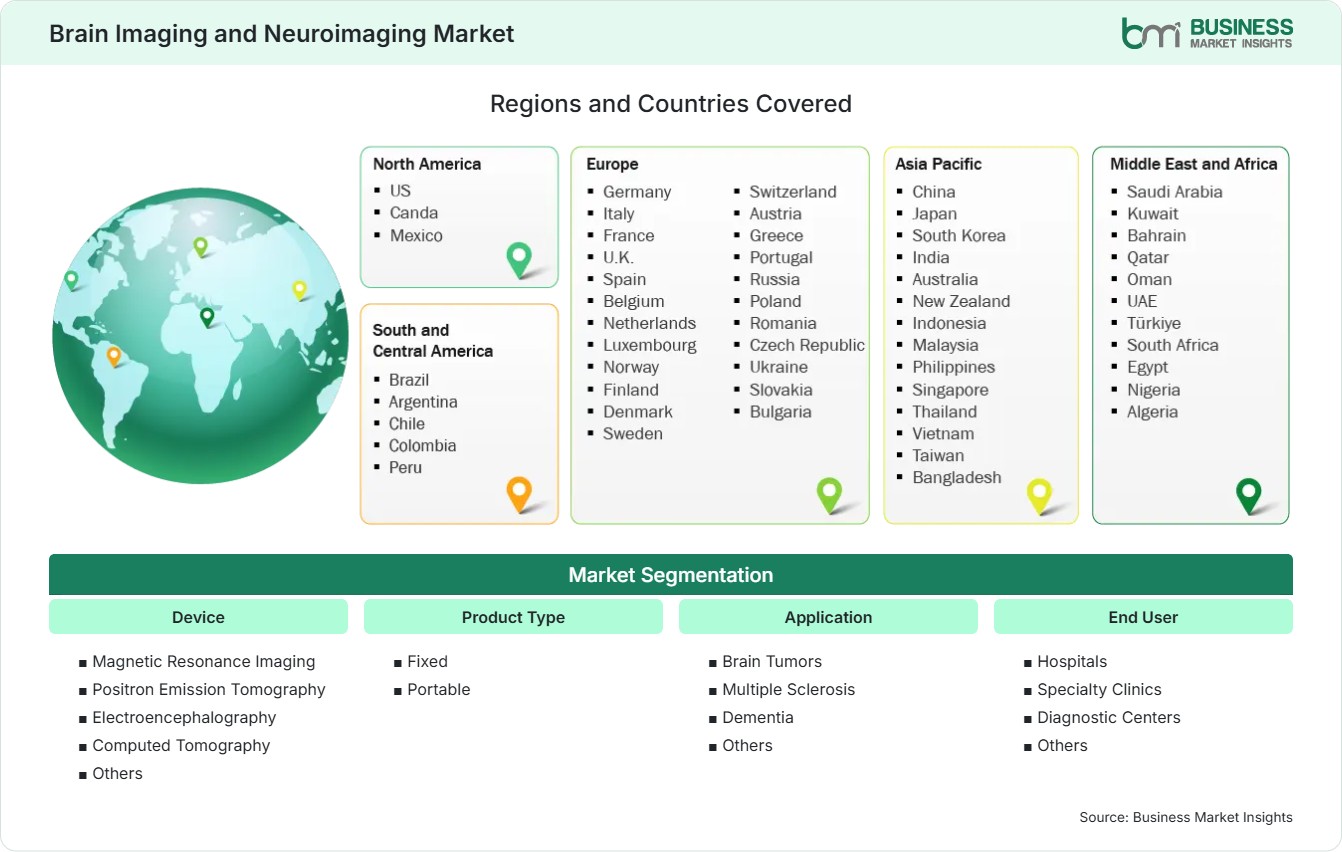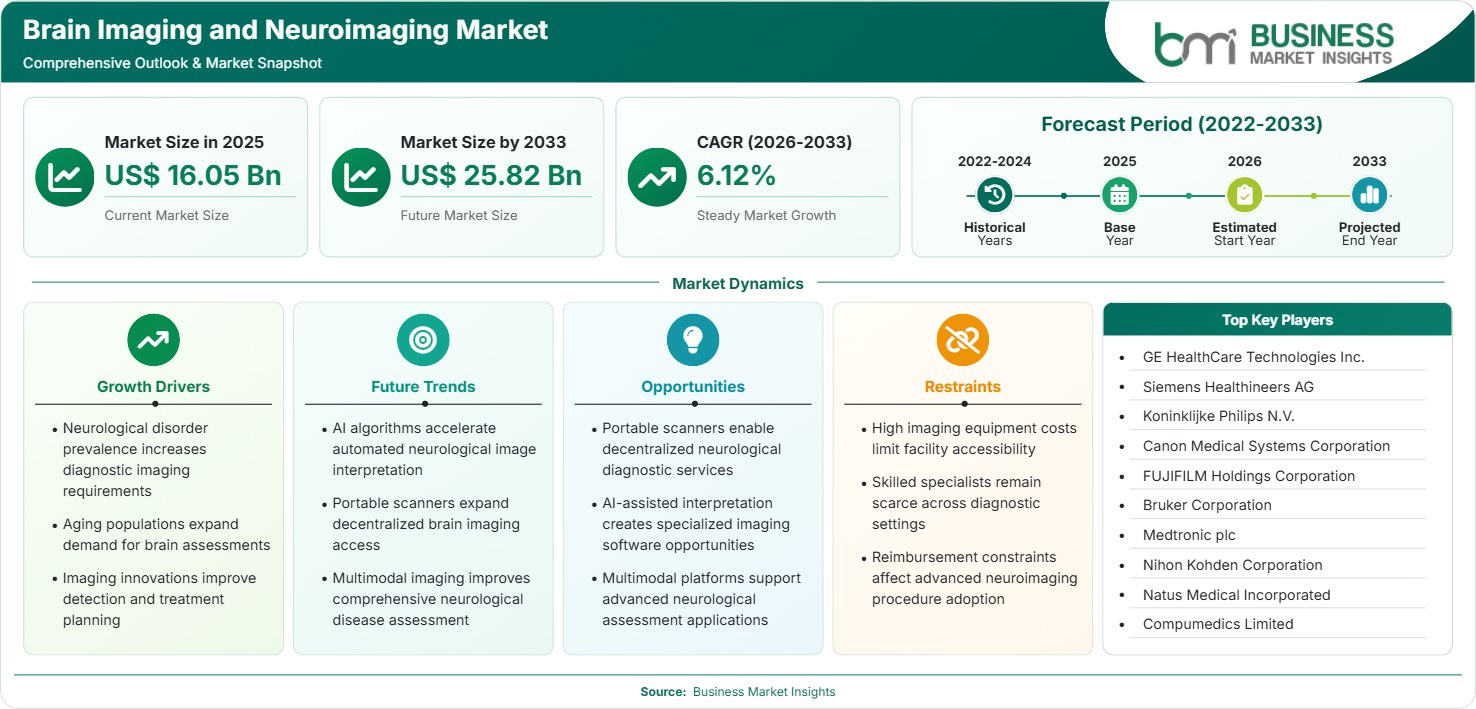
Brain Imaging and Neuroimaging Market Regional Highlights
North America Brain Imaging and Neuroimaging Market
North America accounts for a 34%–37% Brain Imaging and Neuroimaging Market share in 2025 and is projected to expand at a 5.7%–6.4% CAGR through 2033. The region benefits from extensive MRI and CT installed bases, specialist neurological centers, research funding, reimbursement infrastructure, and early adoption of AI. The United States represents the dominant regional market, while Canada provides additional demand through hospital modernization and academic neuroscience programs. Vendor investment increasingly targets software-enabled imaging, quantitative MRI, and enterprise workflow integration.
- Advanced academic medical centers are accelerating adoption of quantitative imaging, AI-supported interpretation, and multimodal neurodiagnostic workflows as neurological treatment becomes more data-intensive.
- Replacement demand is supported by aging equipment fleets, requirements for improved throughput, and increasing preference for systems that integrate image acquisition with automated analysis.
- PET adoption benefits from molecular imaging research, Alzheimer's disease assessment, oncology applications, and expanding interest in radiopharmaceutical-enabled precision medicine.
- Cloud-based image management is improving collaboration among hospitals, neurologists, radiologists, research institutions, and outpatient imaging networks across geographically distributed healthcare systems.
US Brain Imaging and Neuroimaging Market
The US represents approximately 82%–86% of North American demand in 2025 and is projected to grow at a 5.8%–6.5% CAGR of the Brain Imaging and Neuroimaging Market through 2033. Demand is supported by neurological disease diagnosis, advanced academic hospitals, high imaging utilization, pharmaceutical research, and strong vendor presence. Alzheimer's disease has also increased demand for sophisticated MRI and PET workflows, particularly as disease-modifying therapies require imaging-based monitoring. AI-enabled quantitative assessment is becoming an important differentiator.
- US providers are prioritizing workflow automation that can reduce interpretation burden, improve scan consistency, and support longitudinal monitoring of neurological abnormalities.
- Leading imaging vendors are integrating AI software with MRI, PET, CT, and enterprise platforms, creating recurring software opportunities alongside conventional equipment sales.
- Pharmaceutical and clinical research activity supports specialized neuroimaging demand because imaging biomarkers increasingly contribute to patient selection, treatment monitoring, and trial endpoints.
Europe Brain Imaging and Neuroimaging Market
Europe accounts for 27%-30% market share in 2025, with an anticipated CAGR of 5.4%-6.1% through 2033 in the Brain Imaging and Neuroimaging Market. Leading markets include Germany, the UK, France, Italy, and Spain, whereas high-growth markets are found in Poland and certain Central European nations. An aging population, advances in the treatment of neurological diseases, upgrades to the public healthcare system, and investments in research are factors driving demand. European suppliers focus more on energy efficiency, interoperability, data management, and asset utilization.
- Germany remains a major opportunity because advanced hospitals and university medical centers require high-performance MRI, PET, CT, and integrated neurological imaging capabilities.
- The United Kingdom is supported by national diagnostic capacity expansion and increasing emphasis on earlier neurological disease detection and imaging-supported clinical pathways.
- France and Italy provide replacement-cycle opportunities as hospitals modernize imaging infrastructure while seeking improved throughput and reduced operational complexity.
- Central and Eastern European markets can deliver 6.5%–7.3% CAGRs as private diagnostic networks expand and hospitals close technology gaps with Western European facilities.
Asia Pacific Brain Imaging and Neuroimaging Market
Asia Pacific accounts for a 25%–29% share in 2025 and is projected to expand at a 7.0%–7.8% CAGR of the Brain Imaging and Neuroimaging Market, making it the fastest-growing major region. China, Japan, India, South Korea, and Australia are leading demand centers. China and India provide substantial capacity-expansion potential, while Japan has advanced neuroimaging expertise and an aging population. Private hospitals, diagnostic chains, domestic manufacturing, and government healthcare investment are broadening access to advanced modalities.
- China benefits from hospital modernization, domestic medical-device development, large patient populations, and increasing adoption of AI-supported radiology and neurological diagnostics.
- India offers a strong growth opportunity as private diagnostic networks, tertiary hospitals, and urban healthcare providers add MRI, CT, PET, and EEG capacity.
- Japan combines sophisticated imaging infrastructure with high neurological disease-management requirements, creating demand for advanced MRI, PET, and quantitative imaging solutions.
- South Korea and Australia support premium imaging adoption through advanced hospital systems, clinical research, and increasing demand for precision neurological assessment.
Rest of World Brain Imaging and Neuroimaging Market
Rest of World represents a 9%–12% share in 2025 and is projected to grow at a 5.8%–6.8% CAGR through 2033 of the Brain Imaging and Neuroimaging Market. South and Central America benefit from private healthcare investment and diagnostic-network expansion, particularly in Brazil and Mexico. Middle Eastern markets are supported by hospital infrastructure development and medical tourism, while selected African markets remain focused on basic imaging capacity before advanced neuroimaging penetration can accelerate.
- Brazil and Mexico provide the strongest Latin American opportunities because private diagnostic providers are expanding advanced imaging capacity and improving access outside major metropolitan centers.
- Gulf countries are investing in tertiary hospitals, oncology infrastructure, and specialized neurological care, supporting demand for high-end MRI, PET, CT, and integrated imaging platforms.
- Saudi Arabia and the United Arab Emirates can achieve 6.4%–7.2% CAGRs as healthcare transformation programs expand specialist diagnostic infrastructure and attract international clinical expertise.
- African markets remain constrained by equipment affordability and specialist availability, but regional referral centers offer targeted opportunities for advanced imaging and centralized neurodiagnostic services.