
Bone Void Fillers Market Outlook: Size, Share, Trends, Growth Analysis, Competitive Landscape & Forecast, 2026-2033

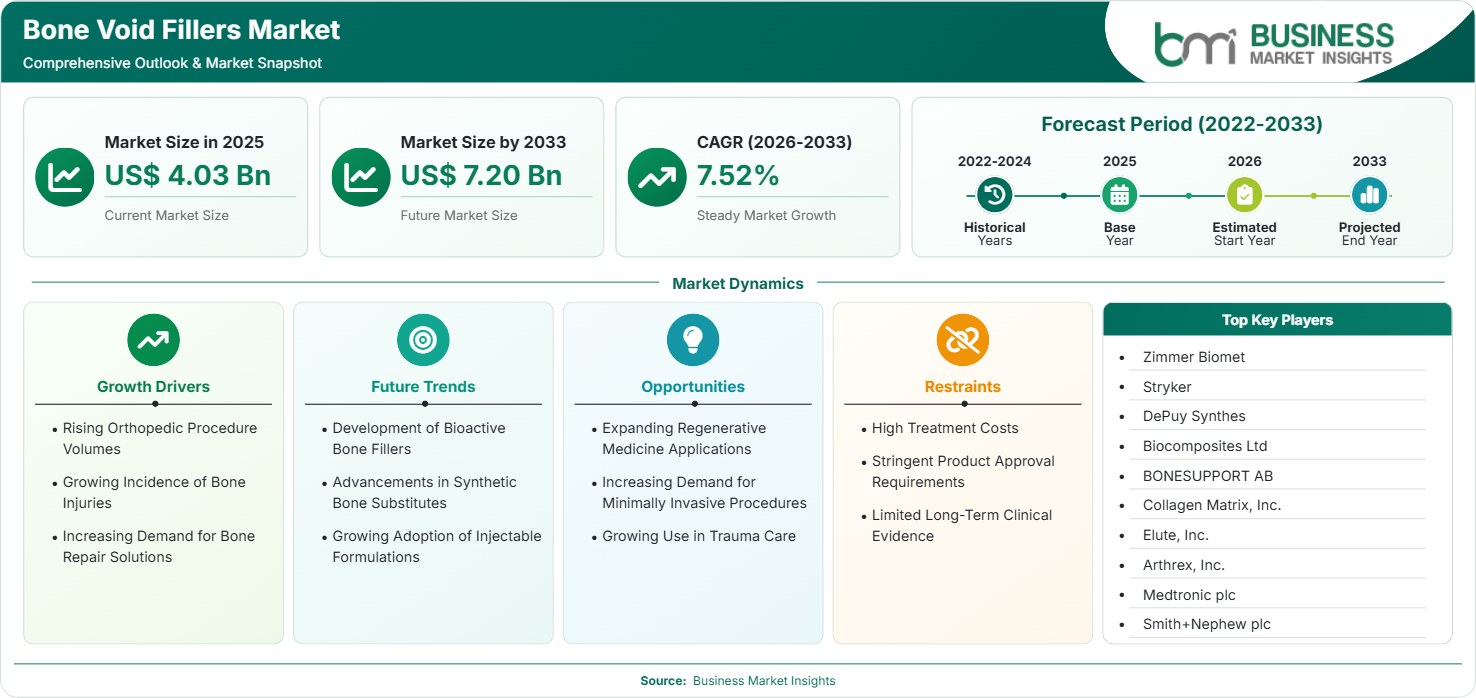
The Bone Void Fillers Market size was valued at US$ 4.03 Billion in 2025 and is projected to reach US$ 7.20 Billion by 2033, growing at a CAGR of 7.52% during 2026–2033, supported by orthopedic procedure demand, regenerative repair, minimally invasive techniques, trauma care, and biomaterial innovation.

Report Coverage
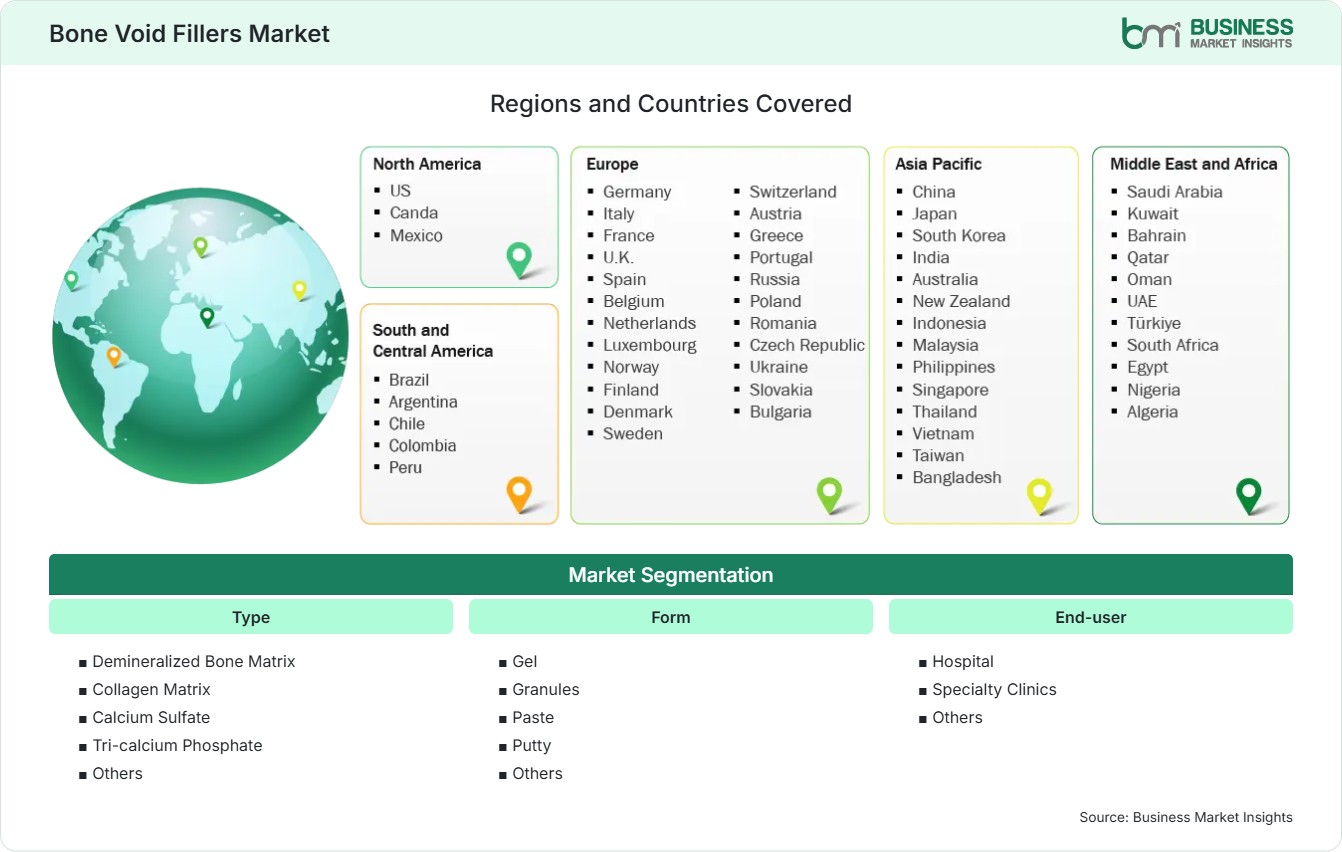
  • Type: Demineralized Bone Matrix, Collagen Matrix, Calcium Sulfate, Tri-calcium Phosphate, Others
  • Form: Gel, Granules, Paste, Putty, Others
  • End-user: Hospital, Specialty Clinics, Others
US$ 4.03 Bn Market size in 2025
US$ 7.20 Bn Market Size by 2033
7.52% CAGR, 2026 - 2033
2026-2033 Forecast Period

AI Overview

Bone Void Fillers Market Summary

  • North America Region: North America holds a 34%–37% share in 2025, growing at a 7.0%–7.8% CAGR through 2033, influenced by established orthopedic infrastructure, advanced biomaterials adoption, specialist surgical expertise, reimbursement frameworks, regenerative medicine investment, and demand for predictable bone repair solutions. The US market maintains strong purchasing depth, with a 7.1%–7.9% CAGR supported by sophisticated hospitals and orthopedic centers.
  • Fastest Growing Region: Asia Pacific represents a 23%–26% share in 2025 and is projected to expand at an 8.4%–9.2% CAGR, driven by expanding orthopedic capacity, improving specialist access, healthcare infrastructure investment, rising procedural awareness, localized manufacturing, and broader availability of advanced bone repair technologies across emerging healthcare systems.
  • Leading Segment: Demineralized Bone Matrix represents a 34%–37% share in 2025 and is projected to advance at a 7.4%–8.0% CAGR, supported by established clinical familiarity, osteoinductive properties, flexible handling formats, surgeon preference, reconstructive applications, and continued integration into orthopedic and trauma treatment workflows.
  • High Growth Segment: Gel-based products account for a 18%–21% share in 2025 and are projected to register an 8.0%–8.7% CAGR, supported by injectability, defect conformity, minimally invasive delivery, controlled placement, procedural flexibility, and growing interest in materials designed for anatomically challenging bone defects.
  • Key Market Opportunity: Opportunities center on injectable biomaterials, combination products, regenerative formulations, personalized delivery, trauma applications, and minimally invasive workflows that can improve handling, defect filling, integration, and procedural efficiency.
  • Major Market Players: Zimmer Biomet Holdings, Inc.; Stryker Corporation; DePuy Synthes; Biocomposites Ltd; BONESUPPORT AB; Collagen Matrix, Inc.; Elute, Inc.; Arthrex, Inc.; Medtronic plc; Smith & Nephew plc.
Strategic Insights

Bone Void Fillers Market: Strategic Insights

Bone Void Fillers Market Strategic Framework
FREE PDF
Request your free sample
Request free sample
Stakeholder View

Key Takeaways

  • The value chain involves the acquisition of biomaterials, formulation, sterilization, packaging, qualifying regulatory approval, distribution, purchase by hospitals, and adoption by specialized clinicians.
  • Demineralized Bone Matrix retains its market leadership position due to established clinical experience; however, the injectable form of delivery allows more potential for cases when minimal invasiveness and conformity to the defect play a role in decision-making.
  • Trends in product development are directed towards development of composites, regulation of resorption, injectability, good handling properties, and formulation that promotes integration without additional surgery complexity.
  • The Asia Pacific region represents an interesting investment opportunity in light of growing orthopedic capacities, healthcare development, specialist education, and availability of advanced biomaterials.
  • Market competition increasingly depends on portfolio size, biologics expertise, distribution capabilities, clinical proof, and orthopedic surgery innovations.
Geographic Outlook

Bone Void Fillers Market Regional Highlights

North America Bone Void Fillers Market

North America holds a 34%–37% share in 2025 and is projected to grow at a 7.0%–7.8% CAGR through 2033. The region benefits from mature orthopedic infrastructure, specialist expertise, established reimbursement mechanisms, sophisticated hospital procurement, and broad availability of biomaterial technologies. The regional Bone Void Fillers Market share reflects strong adoption across trauma, reconstruction, and regenerative applications, while market growth increasingly favors differentiated injectable and biologically oriented formulations.

  • Established orthopedic centers support adoption of advanced biomaterial solutions where surgeon familiarity and procedural consistency influence product selection.
  • Regulatory experience and mature distribution structures help manufacturers introduce differentiated formulations while maintaining established hospital and specialist-clinic relationships.
  • Product differentiation increasingly emphasizes injectability, handling, resorption characteristics, delivery precision, and compatibility with minimally invasive workflows.
  • Procurement teams increasingly compare clinical utility and workflow efficiency alongside material characteristics, encouraging suppliers to strengthen evidence-based product positioning.

US Bone Void Fillers Market

The US Bone Void Fillers Market accounts for 72%–76% of North America’s regional share in 2025 and is projected to grow at a 7.1%–7.9% CAGR through 2033. The market benefits from extensive orthopedic specialization, established trauma-care networks, advanced hospital infrastructure, and a broad portfolio of commercial biomaterials.

  • Hospital systems favor products that integrate efficiently into established orthopedic workflows while maintaining consistent preparation, delivery, and handling characteristics.
  • Specialist adoption increasingly depends on evidence quality, regulatory clarity, product usability, and compatibility with existing surgical instrumentation and procedural protocols.
  • Commercial success requires effective surgeon education, distributor coverage, clinical support, and reliable supply across geographically dispersed healthcare providers.

Europe Bone Void Fillers Market

Europe represents a 27%–30% of Bone Void Fillers Market share in 2025 and is expected to expand at a 7.2%–7.9% CAGR through 2033. Germany, France, the United Kingdom, Italy, and Spain remain important markets because of established orthopedic services and specialized clinical capabilities. Germany leads regional adoption, while Poland and selected Central European markets provide higher-growth potential at approximately 8.0%–8.6% CAGR. Procurement increasingly emphasizes clinical utility, evidence, health-economic value, regulatory compliance, and sustainable healthcare resource utilization across national systems.

  • Germany benefits from extensive orthopedic infrastructure and specialist treatment capacity, supporting demand for established biomaterial technologies and differentiated delivery formats.
  • France and the United Kingdom provide opportunities where specialist networks and hospital procurement structures support adoption of clinically differentiated bone repair solutions.
  • Southern European markets increasingly provide opportunities for products that balance procedural convenience, clinical performance, and procurement efficiency.
  • Central European adoption can accelerate as specialist capabilities expand and access to advanced biomaterials becomes broader across healthcare institutions.

Asia Pacific Bone Void Fillers Market

Asia Pacific accounts for a 23%–26% share in 2025 and records the fastest regional trajectory at an 8.4%–9.2% CAGR through 2033. Japan, China, South Korea, Australia, and India represent important demand centers, while India and selected Southeast Asian markets offer higher-growth opportunities around 9.0%–9.8% CAGR. Bone Void Fillers Market trends indicate expanding orthopedic infrastructure, improving specialist access, healthcare modernization, domestic manufacturing, and growing familiarity with regenerative biomaterials support adoption across diverse healthcare systems.

  • China provides substantial commercialization potential as advanced orthopedic services expand and domestic healthcare capabilities increasingly support sophisticated biomaterial adoption.
  • Japan emphasizes clinically established technologies, quality consistency, procedural reliability, and advanced specialist care, supporting premium biomaterial positioning.
  • India offers strong expansion potential as orthopedic capacity broadens, specialist services become more accessible, and minimally invasive treatment approaches gain wider acceptance.
  • Southeast Asian markets provide distribution-led opportunities where healthcare modernization and specialist training improve access to advanced bone repair products.

Rest of World Bone Void Fillers Market

Rest of World represents an estimated 11%–14% share in 2025 and is projected to expand at a 6.2%–7.0% CAGR through 2033. South and Central America provide opportunities through improving specialist care and private healthcare investment, while Brazil and Mexico remain important demand centers. The Middle East and Africa present selective opportunities, particularly in Gulf healthcare systems. Saudi Arabia and the United Arab Emirates provide comparatively stronger growth potential at approximately 7.1%–7.8% CAGR.

  • Brazil offers the largest regional opportunity in South America, supported by established orthopedic services and expanding access to specialized biomaterials.
  • Mexico provides a strategic bridge between North American technology ecosystems and Latin American healthcare markets, supporting distribution-oriented commercialization.
  • Gulf countries are developing advanced healthcare infrastructure that can support premium orthopedic technologies and specialist treatment capabilities.
  • Distributor partnerships remain important where direct commercial infrastructure is less developed and procurement is fragmented across healthcare institutions.
Global Market Geography
FREE PDF
Request your free sample
Request free sample
Segment Analysis

Bone Void Fillers Market Segmentation

Type

The Type segment is led by Demineralized Bone Matrix, representing a 34%–37% share in 2025 and advancing at a 7.4%–8.0% CAGR through 2033. The segment benefits from established clinical familiarity, flexible handling, and broad reconstructive relevance. Collagen Matrix and synthetic calcium-based materials strengthen product choice by addressing different biological and procedural requirements across orthopedic care.

  • Demineralized Bone Matrix: Established clinical familiarity and osteoinductive potential support continued use across reconstructive workflows, while processing consistency, handling characteristics, and formulation quality influence purchasing decisions.
  • Collagen Matrix: Collagen-based structures provide flexible biomaterial platforms for defect management, with adoption supported by handling convenience, tissue compatibility, and compatibility with regenerative treatment strategies.
  • Calcium Sulfate: Rapidly resorbable calcium sulfate formulations support temporary defect filling, particularly where controlled material replacement and straightforward preparation complement established orthopedic procedures.
  • Tri-calcium Phosphate: Synthetic calcium phosphate materials offer osteoconductive scaffolding and controlled resorption, supporting applications requiring predictable structural support during bone remodeling and regeneration.

Form

The Form segment is increasingly influenced by delivery convenience and procedural adaptability. Gel represents a 18%–21% share in 2025 and is projected to grow at an 8.0%–8.7% CAGR through 2033. Injectable and moldable formats benefit from precise placement, improved defect conformity, and compatibility with minimally invasive treatment approaches across diverse anatomical locations.

  • Gel: Injectable gel formats support precise placement within irregular defects, improving conformity and procedural flexibility while aligning with growing interest in minimally invasive bone repair workflows.
  • Granules: Granular materials provide adaptable filling characteristics and can be selected where controlled packing, scaffold formation, and predictable handling are important during reconstructive procedures.
  • Paste: Paste formulations offer moldability and direct placement advantages, supporting applications where surgeons require material that conforms closely to localized defects.
  • Putty: Putty provides convenient handling and shape retention, making it suitable for procedures requiring controlled placement and reduced preparation complexity during bone defect management.

End-user

The End-user segment is dominated by Hospital settings because complex orthopedic procedures, trauma services, surgical infrastructure, and procurement capabilities remain concentrated within institutional care. Hospitals account for an estimated 61%–65% share in 2025 and are projected to expand at a 7.2%–7.9% CAGR through 2033. Specialty clinics provide additional growth through focused orthopedic services and ambulatory treatment pathways.

  • Hospital: Hospitals remain central purchasers because they combine orthopedic surgery, trauma management, sterile operating facilities, specialist teams, procurement systems, and postoperative care within integrated treatment environments.
  • Specialty Clinics: Specialty clinics increasingly support outpatient orthopedic pathways, creating demand for convenient biomaterials with straightforward preparation, predictable handling, and compatibility with focused procedural workflows.
Market Forces

Bone Void Fillers Market Dynamics

Key Market Drivers

Rising Orthopedic Procedure Volumes

Growing orthopedic intervention activity supports demand for materials that fill surgically created defects and provide temporary or regenerative scaffolding. Growing orthopedic intervention activity supports demand for materials that fill surgically created defects and provide temporary or regenerative scaffolding. The Bone Void Fillers Market growth is enhanced by the demand for bone void fillers with properties conducive to integration into existing fixation, reconstruction, and revision procedures performed by surgeons. A wide product range allows manufacturers to offer materials appropriate to various defects, whereas specialized companies have the means of competition in terms of formulation, delivery, and application.

Growing Incidence of Bone Injuries

Trauma-related bone defects create recurring demand for materials that support defect management alongside fixation and reconstruction. Clinical teams need to have products that are able to fill irregular areas while still retaining their reliable formulation and delivery properties. It would meet the demands of emergency orthopedics, trauma care, and future reconstructive surgery. Biomaterials will be selected based on the defect site, stabilization needs, goals for healing, surgeon's preference, and indication of regulatory agencies. Calcium-based synthetic compounds and biological products serve different surgical needs and form a competitive market. The companies can increase adoption by improving the delivery system and making it easier to prepare the product during surgery.

Increasing Demand for Bone Repair Solutions

Demand is increasingly shaped by the need for predictable bone repair solutions that fit diverse surgical workflows. Surgical assessment of materials is done based on handling, defect adaptation, resorption characteristics, biological properties, and procedural advantages. This means that materials that have different formulations rather than one universal biomaterial will be more popular in the Bone Void Fillers Market. There is an increasing interest in regeneration technology that promotes natural remolding rather than fixation of materials inside the body. Thus, there is a focus by developers in combining calcium-containing materials, collagen-based structures, demineralized matrices, and delivery systems. The commercial potential goes further than simply filling defects in components of overall orthopedic therapies.

Key Market Opportunities

Expanding Regenerative Medicine Applications

Regenerative medicine creates an opportunity to move bone void fillers toward increasingly biologically responsive products. The Bone Void Fillers Market Forecasts indicate that commercial potential will increasingly depend on formulations that combine structural support with controlled remodeling characteristics. Continued research in the field of interactions between biomaterials and tissue regeneration create space for products which have better osteoconductivity and osteoinductivity properties. The commercialization process will be successful in those cases where manufacturers can prove their ability to consistently manufacture and regulate the process, make clinical use out of their product, and provide procurement economics.

Increasing Demand for Minimally Invasive Procedures

Minimally invasive techniques create demand for biomaterials that can be delivered through constrained access routes and positioned accurately within irregular defects. Injections, low-viscosity formulations, and versatile delivery systems can meet this demand without altering the surgical workflow process. The developer can add value through enhancement of flow properties, working time, visibility, and placement control. This demand becomes especially pertinent in cases where small access ports and material placement contribute to procedure efficiency. Simplified preparation and handling can also be a consideration for hospitals. With the growing use of minimally invasive orthopedic surgery, material design will progressively become associated with delivery system design.

Growing Use in Trauma Care

Trauma care offers a broad opportunity because bone defects can require coordinated fixation, filling, stabilization, and subsequent healing management. The suppliers can design products in relation to workflow compatibility within trauma systems as opposed to treating defect filling as merely purchasing materials. Formulation of products to fit into the portfolio that can integrate well with fixation devices could increase convenience to surgeons and facilitate the purchasing process. Bone Void Fillers Market growth possibilities are high where trauma facilities are growing as well as expertise becoming more accessible. Developers of products could also capitalize on formulation flexibility, radiopacity, controlled resorption, and precise delivery of products.

Market Restraints and Challenges

High Treatment Costs

Factor: Advanced biomaterials can require specialized formulation, sterile manufacturing, regulatory testing, clinical evidence, and controlled distribution, increasing product development and commercialization expenses. Impact: Higher treatment costs can constrain adoption when hospitals prioritize budget predictability or when reimbursement does not fully reflect the clinical value of differentiated materials. Cost sensitivity can encourage procurement teams to compare products based on total procedural economics rather than material performance alone. Products that combine clear clinical differentiation with practical operating-room benefits are better positioned to justify premium pricing where purchasing decisions are strongly cost controlled.

Stringent Product Approval Requirements

Factor: Bone void fillers may require extensive evaluation of biomaterial composition, manufacturing controls, biological characteristics, intended use, safety, and clinical performance before commercialization. Impact: Lengthy regulatory pathways can increase development costs, delay market entry, and raise barriers for smaller companies with limited regulatory resources. Requirements vary according to formulation, claims, delivery mechanism, and jurisdiction, making global commercialization complex. Developers must maintain strong quality systems and regulatory documentation throughout product development.

Company Analysis

Competitive Landscape

The Bone Void Fillers Market analysis indicates a competitive environment combining diversified orthopedic technology companies with specialist biomaterial developers. Large participants benefit from established hospital relationships, broad surgical portfolios, regulatory capabilities, and distribution reach, while focused companies compete through formulation expertise, regenerative technologies, delivery systems, and specialized clinical positioning.

Company Name

Overview

Products and Services relevant to this market

Zimmer Biomet Holdings, Inc.

Diversified orthopedic technology company with extensive reconstruction, trauma, biologics, and bone repair capabilities across global healthcare markets.

Bone graft substitutes, calcium-based biomaterials, biologics, delivery systems, trauma solutions, and technologies supporting bone defect management.

Stryker Corporation

Major medical technology company with broad orthopedic, trauma, biologics, and surgical product capabilities serving hospitals worldwide.

Pro-Dense regenerative graft, bone graft substitutes, trauma technologies, biologics, and complementary orthopedic procedural solutions.

DePuy Synthes

Orthopedic business of Johnson & Johnson providing reconstruction, trauma, spine, and biologic technologies for surgical care.

Bone graft substitutes, biomaterials, trauma products, fixation technologies, and complementary orthopedic reconstruction solutions.

Biocomposites Ltd

Specialist developer focused on advanced bone graft substitute technologies and biomaterial solutions for orthopedic applications.

Synthetic bone graft substitutes, calcium-based biomaterials, antibiotic-compatible solutions, and delivery technologies for bone repair.

BONESUPPORT AB

Orthobiologics specialist focused on injectable bioceramic technologies for bone defect management and regenerative treatment.

CERAMENT bone graft substitute platform, injectable bone void fillers, and drug-eluting orthobiologic technologies.

Collagen Matrix, Inc.

Biomaterials company specializing in collagen-based regenerative technologies for healthcare and tissue repair applications.

Collagen matrices, regenerative scaffolds, bone repair biomaterials, and tissue-engineering solutions supporting orthopedic applications.

Elute, Inc.

Biomaterials developer focused on regenerative technologies and localized therapeutic delivery for orthopedic applications.

Bone repair biomaterials, regenerative products, and localized delivery approaches supporting skeletal tissue management.

Arthrex, Inc.

Global orthopedic company with strong emphasis on sports medicine, biologics, surgical systems, and procedural innovation.

Bone graft substitutes, biologic products, fixation systems, delivery technologies, and orthopedic surgical solutions.

Medtronic plc

Global medical technology company with substantial spine and orthopedic-related technologies and established healthcare distribution.

Bone graft materials, spine biologics, regenerative products, delivery systems, and complementary spinal reconstruction technologies.

Smith & Nephew plc

Global medical technology company serving orthopedic reconstruction, trauma, sports medicine, and advanced surgical care.

Orthobiologics, bone graft substitutes, trauma solutions, surgical technologies, and products supporting orthopedic reconstruction.

Trust & Transparency

Research Methodology

The market analysis combines proprietary research with secondary data from government agencies, company disclosures, regulatory filings, industry databases and expert interviews. Market estimates are validated through data triangulation, cross-market benchmarking and analyst review.

View Full Research Methodology

Questions Answered

Frequently Asked Questions

Which product-development priorities are likely to remain important?

Future development will emphasize improved injectability, predictable remodeling, formulation consistency, delivery precision, biological integration, procedural convenience, and compatibility with minimally invasive orthopedic workflows while maintaining regulatory and manufacturing discipline.

How is the Bone Void Fillers Market Report useful to decision-makers?

The report supports strategic evaluation of regional demand, material categories, product formats, end-user structures, competitive positioning, technology priorities, commercialization opportunities, and factors affecting future investment decisions.

What determines Bone Void Fillers Market commercialization success across countries?

Commercial success depends on regulatory requirements, reimbursement, clinical evidence, distributor capabilities, surgeon education, hospital procurement structures, manufacturing reliability, and the ability to adapt product positioning to local healthcare priorities.

Why are injectable formulations gaining attention?

Injectable formulations can provide controlled placement within irregular defects and support minimally invasive workflows. Their value depends on flow characteristics, working time, setting behavior, delivery precision, and compatibility with the intended procedure.

How do biomaterial characteristics influence product selection?

Material handling, resorption profile, biological performance, defect conformity, delivery method, and procedural compatibility influence selection. Hospitals and surgeons also consider regulatory status, evidence quality, supply reliability, and total treatment economics.

Access the Full Bone Void Fillers Market Report

Get segment-level forecasts, regional estimates, competitive benchmarking, company profiles and downloadable Excel datasets.

Access the full Bone Void Fillers Market Report
350 pages PDF & Excel | 2026-08-21