
Bone Conduction Hearing Devices Market Outlook: Size, Share, Trends, Growth Analysis, Competitive Landscape & Forecast, 2026-2033

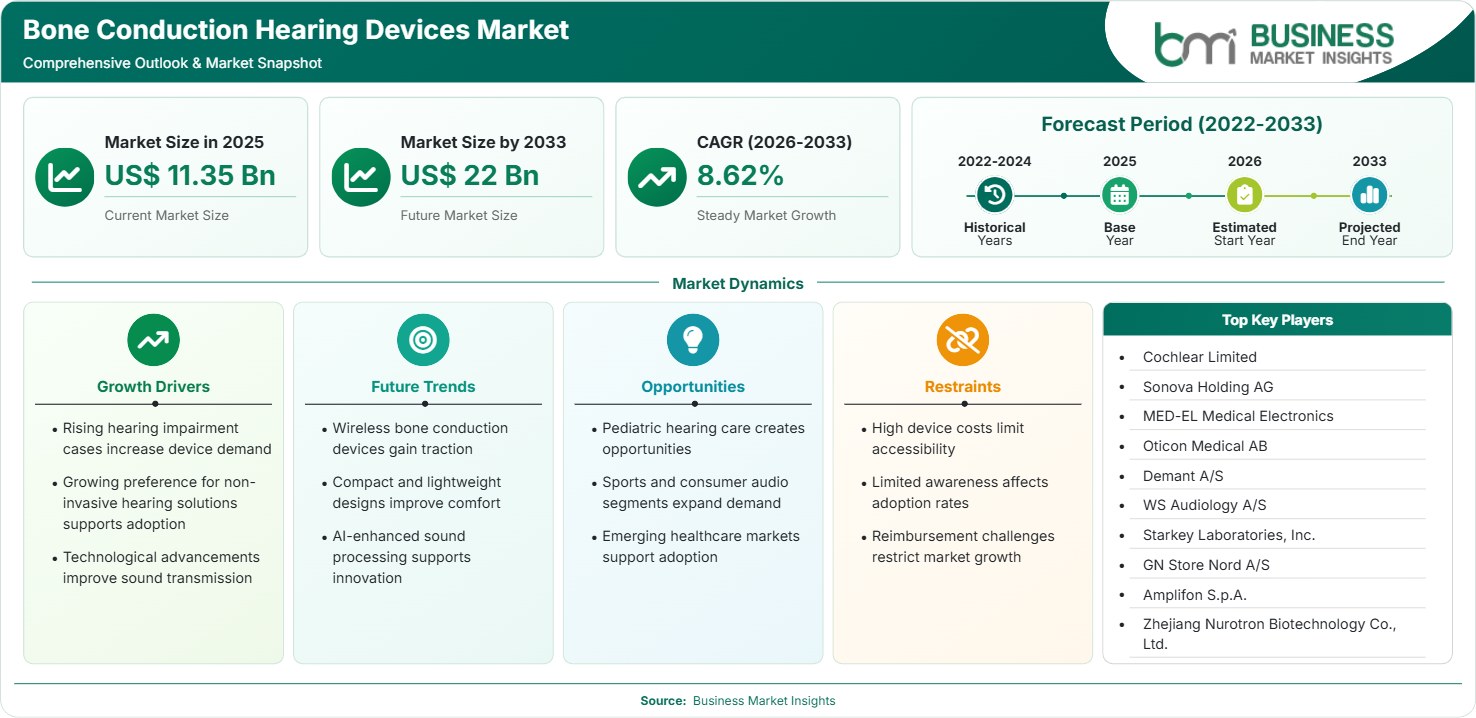
The Bone Conduction Hearing Devices Market size was valued at US$ 11.35 Billion in 2025 and is projected to reach US$ 22 Billion by 2033, growing at a CAGR of 8.62% during 2026–2033. Key growth drivers include rising hearing-loss prevalence, implant innovation, digital connectivity, pediatric adoption, and expanding reimbursement frameworks, while opportunities emerge from minimally invasive systems, emerging healthcare markets, AI-enabled sound optimization, and outpatient treatment expansion.

Report Coverage
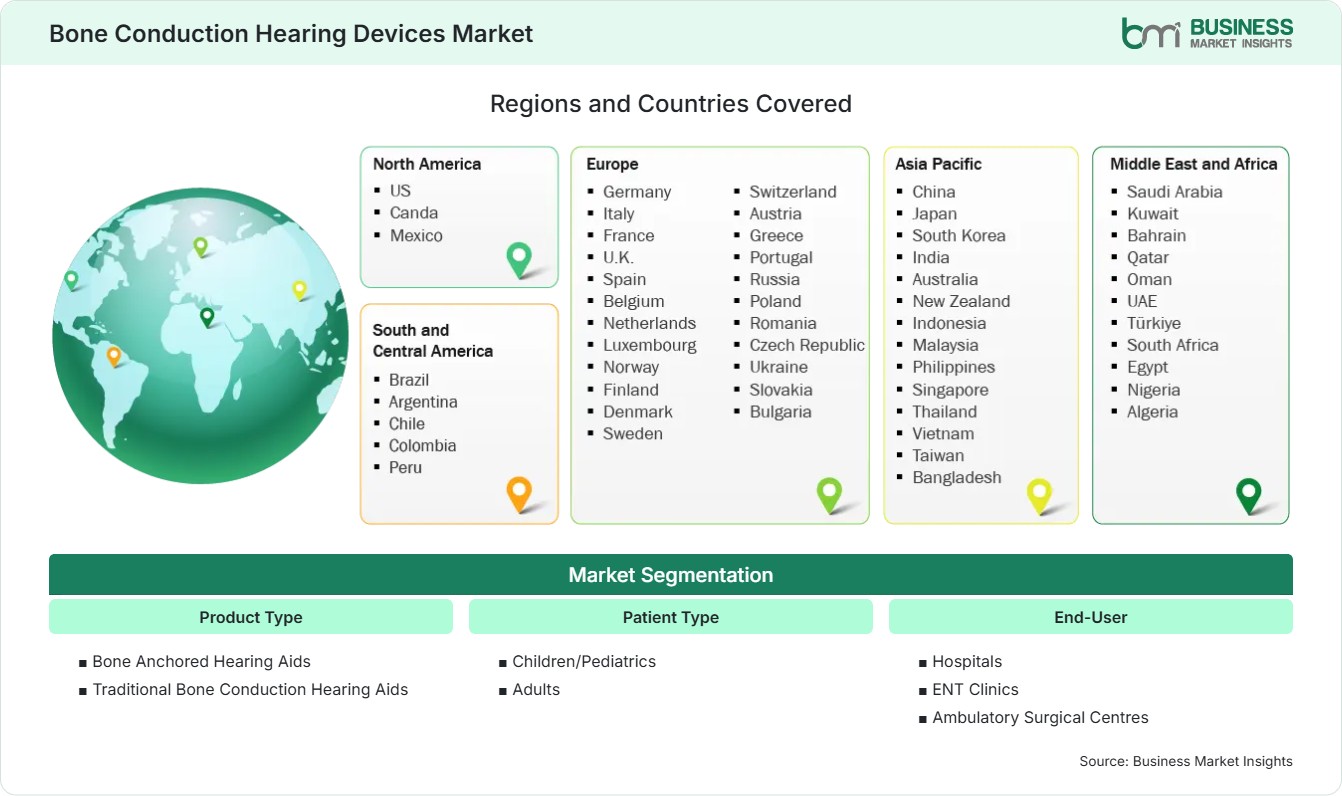
  • Product Type: Bone Anchored Hearing Aids, Traditional Bone Conduction Hearing Aids
  • Patient Type: Children/Pediatrics, Adults
  • End-User: Hospitals, ENT Clinics, Ambulatory Surgical Centres
US$ 11.35 Bn Market size in 2025
US$ 22 Bn Market Size by 2033
8.62% CAGR, 2026 - 2033
2026-2033 Forecast Period

AI Overview

Bone Conduction Hearing Devices Market Summary

  • North America Region: North America holds a market share of 37%–40% in 2025, growing at a CAGR of 7.8%–8.4% during 2026–2033. Growth is supported by strong reimbursement pathways, advanced audiology infrastructure, high implant awareness, an increasing elderly population, expanding pediatric treatment programs, continuous product innovation, clinical expertise, regulatory approvals, and rising hearing rehabilitation demand across healthcare systems. US market benefits from broad specialist access, favorable coverage expansion, and an estimated CAGR of 7.9%–8.5%.
  • Fastest Growing Region: Asia Pacific holds a Bone Conduction Hearing Devices Market share of 24%–27% in 2025, growing at a CAGR of 10.2%–11.1% during 2026–2033. Growth is driven by healthcare modernization, larger patient pools, improving diagnostic rates, expanding insurance access, stronger hospital investments, local manufacturing capabilities, growing ENT specialist networks, and increasing hearing health awareness programs.
  • Leading Segment: Bone-Anchored Hearing Aids hold a market share of 58%–62% in 2025, growing at a CAGR of 8.7%–9.3% during 2026–2033. Adoption benefits from superior clinical outcomes, increasing implantation procedures, wider surgeon acceptance, technological upgrades, improved processor performance, expanding indications, rising conductive hearing-loss cases, and favorable reimbursement structures.
  • High Growth Segment: Ambulatory Surgical Centres hold a Bone Conduction Hearing Devices Market share of 14%–17% in 2025, growing at a CAGR of 9.8%–10.6% during 2026–2033. Expansion reflects outpatient treatment preferences, shorter recovery periods, cost efficiency, increasing minimally invasive procedures, higher procedural volumes, improved surgical technologies, patient convenience, and growing healthcare decentralization.
  • Key Market Opportunity: Increasing deployment of AI-enhanced processors, wireless connectivity, tele-audiology platforms, remote fitting technologies, and emerging-country hearing care investments creates substantial opportunities for broader patient access, outcome improvement, and premium device adoption.
  • Major Market Players: Cochlear Limited, Sonova Holding AG, MED-EL Medical Electronics, Oticon Medical AB, Demant A/S, WS Audiology A/S, Starkey Laboratories, Inc., GN Store Nord A/S, Amplifon S.p.A., Zhejiang Nurotron Biotechnology Co., Ltd.
Strategic Insights

Bone Conduction Hearing Devices Market: Strategic Insights

Bone Conduction Hearing Devices Market Strategic Framework
FREE PDF
Request your free sample
Request free sample
Stakeholder View

Key Takeaways

  • The industry value chain increasingly integrates implant manufacturers, audiologists, surgeons, digital software providers, and rehabilitation specialists, creating recurring revenue streams through upgrades, accessories, and aftercare services.
  • Pediatric intervention and early diagnosis programs present attractive commercial opportunities because long-term treatment pathways often involve ongoing processor replacements and clinical support requirements.
  • Innovation is shifting toward AI-assisted sound processing, smartphone-enabled personalization, and transcutaneous systems designed to improve comfort while reducing complication risks.
  • China, India, and Southeast Asian healthcare markets offer compelling investment potential due to expanding audiology infrastructure and rising awareness of hearing-health management.
  • Strategic partnerships, acquisitions, and distribution agreements continue to strengthen global reach, particularly among manufacturers seeking access to specialist ENT networks and emerging reimbursement markets.
  • Tele-audiology platforms are becoming important differentiators, helping providers improve follow-up care efficiency while expanding patient access in geographically dispersed populations.
Geographic Outlook

Bone Conduction Hearing Devices Market Regional Highlights

North America Bone Conduction Hearing Devices Market

North America accounts for 37%–40% of the Bone Conduction Hearing Devices Market share in 2025 and is projected to expand at a 7.8%–8.4% CAGR through 2033. Regional demand is supported by advanced audiological services, strong cochlear implant ecosystems, high healthcare spending, and favorable reimbursement mechanisms. Widespread awareness of conductive hearing loss treatment options continues to support procedure volumes. Academic research institutions and specialist ENT centers contribute to innovation adoption, while established manufacturer presence strengthens product accessibility across major healthcare networks.

  • Growing elderly populations increase demand for hearing rehabilitation technologies and long-term auditory care interventions across hospital and specialist settings.
  • Strong reimbursement frameworks support patient affordability and encourage adoption of premium implantable hearing solutions.
  • Digital health integration enables remote programming, monitoring, and clinical follow-up, improving treatment continuity and patient satisfaction.
  • High research expenditure accelerates commercialization of enhanced processors, wireless technologies, and minimally invasive implantation approaches.

US Bone Conduction Hearing Devices Market

The United States represents approximately 78%–82% of the regional market and records growth of 7.9%–8.5% CAGR. Clinical adoption benefits from a large base of audiologists and ENT specialists, increasing implant awareness, and robust healthcare infrastructure. Favorable insurance coverage for qualifying indications supports procedure accessibility. Strong manufacturer activity, clinical research programs, and continuous technology launches contribute to expanding adoption among both adult and pediatric patient populations requiring advanced hearing restoration solutions.

  • Healthcare providers increasingly utilize digital fitting tools, improving personalization and optimizing clinical performance outcomes.
  • Pediatric screening initiatives support earlier intervention and stronger long-term treatment adherence.
  • Academic medical centers remain influential in evaluating advanced implant technologies and generating supporting clinical evidence.

Europe Bone Conduction Hearing Devices Market

Europe holds 27%–30% of the market share in 2025 and is expected to grow at a 7.6%–8.3% CAGR. The demand is driven by universal healthcare coverage policies, effective hearing-care pathways, and high awareness of auditory problems. Germany stands out as the leading revenue generator by region, whereas Eastern European markets show rapid growth potential. Positive demographic factors, the ease of access to treatment, and innovative reimbursement policies will continue to fuel adoption during the Bone Conduction Hearing Devices Market forecast period.

  • Germany remains the largest national market due to extensive audiology infrastructure and strong implant utilization rates.
  • Poland and selected Eastern European countries exhibit above-regional growth supported by healthcare investment programs.
  • Public healthcare systems improve treatment access for eligible patients requiring conductive hearing-loss solutions.
  • Collaborative research activity accelerates development of next-generation sound processing and implantation technologies.

Asia Pacific Bone Conduction Hearing Devices Market

The Asia Pacific region is estimated to hold a 24% – 27% share in 2025 and is the most rapidly growing region, with a 10.2% – 11.1% CAGR during 2033. It is driven by factors such as a large population base, rising healthcare spending, increased awareness, and growing hospital infrastructure. China dominates regional demand, with India showing high growth potential. Government initiatives for healthcare infrastructure development, along with better access to ENT specialists, fuel market penetration. Local manufacturing developments and digital health investments further strengthen long-term regional prospects.

  • China represents the largest revenue contributor owing to improving diagnosis rates and expanding implant availability.
  • India records one of the highest regional growth trajectories due to healthcare expansion and awareness initiatives.
  • Urban hospital networks continue adopting advanced hearing restoration technologies for complex auditory conditions.
  • Growing middle-income populations increase affordability and acceptance of premium hearing devices.

Rest of World Bone Conduction Hearing Devices Market

The rest of world holds an 8%–10% market share and is anticipated to register 8.8%–9.6% CAGR until 2033. South and Central America benefit from increased access to specialists and healthcare privatization. Middle Eastern and African markets remain smaller but are gaining importance owing to improvements in healthcare infrastructure and rising awareness of audiology. Brazil dominates Latin American demand, while Saudi Arabia and the UAE serve as centers of innovation for the region. International manufacturer partnerships support broader availability of technology.

  • Brazil remains the largest Latin American market supported by expanding ENT service networks and private healthcare participation.
  • Saudi Arabia demonstrates strong growth through healthcare transformation programs and specialist-care investments.
  • UAE facilities increasingly adopt advanced hearing restoration technologies within premium healthcare systems.
  • Regional awareness campaigns improve diagnosis rates and encourage earlier intervention across eligible patients.
Global Market Geography
FREE PDF
Request your free sample
Request free sample
Segment Analysis

Bone Conduction Hearing Devices Market Segmentation

Product Type

Product Type constituted a significant aspect of demand, with Bone Anchored Hearing Aids occupying a 58%–62% market share in 2025 and growing at a CAGR of 8.7%–9.3%. The Bone Conduction Hearing Devices Market scope has grown as physicians prefer treatment options that offer enhanced speech recognition, greater patient comfort, and improved hearing rehabilitation outcomes.

  • Bone Anchored Hearing Aids: Strong clinical acceptance stems from proven effectiveness for conductive hearing loss and single-sided deafness, supported by continuous processor innovations and established reimbursement structures.
  • Traditional Bone Conduction Hearing Aids: Demand remains relevant among patients preferring non-surgical solutions, particularly for temporary use cases, pediatric applications, and individuals not eligible for implantation procedures.

Patient Type

Patient demographics will continue to play a crucial role in adoption. Adults accounted for 63% to 67% of the population in 2025 and are expected to grow at 8.3% to 8.9% CAGR. The rising incidence of age-related hearing problems, diagnoses, and treatments is driving utilization across hospital and specialty clinic settings.

  • Children/Pediatrics: Early intervention programs, newborn hearing screening initiatives, and educational support frameworks continue encouraging use among eligible pediatric patient populations.
  • Adults: Demand benefits from aging demographics, occupational hearing concerns, growing treatment awareness, and wider availability of technologically advanced implant solutions.

End-User

The hospital's market share remained consistent at 48%-52%, and it is expected to grow at a CAGR of 8.1%-8.8%. The Bone Conduction Hearing Devices Market trends include an increase in outpatient cases, the adoption of multidisciplinary approaches in hearing care, and the adoption of digital monitoring technology.

  • Hospitals: Comprehensive surgical capabilities, specialist expertise, and post-implant rehabilitation services support continued dominance in procedural volumes and patient management.
  • ENT Clinics: Rising consultation volumes and diagnostic capabilities make these facilities essential referral and follow-up centers within hearing restoration pathways.
  • Ambulatory Surgical Centres: Growing preference for cost-efficient outpatient procedures supports rapid expansion, particularly where minimally invasive implantation techniques are increasingly utilized.
Market Forces

Bone Conduction Hearing Devices Market Dynamics

Key Market Drivers

Rising Global Burden of Hearing Disorders

According to the World Health Organization, more than 1.5 billion people experience some degree of hearing loss globally, while hundreds of millions require rehabilitation support. The rising number of patients directly increases demand for advanced hearing solutions. The Bone Conduction Hearing Devices Market is also growing due to rising detection rates of conductive, mixed, and unilateral hearing loss. The growing number of screening programs for children and the elderly adds fuel to the market. Medical experts have recommended the implantable devices to individuals who require conventional hearing aids. Awareness campaigns and evidence have continued to promote the adoption of such devices in both developing and developed medical markets.

Technological Advances in Implant and Processor Design

Processor efficiency, wireless capabilities, audio quality, and patient comfort are continually improving among manufacturers. The latest devices offer Bluetooth connectivity, smartphone apps, and digital customization options to improve the patient experience. Miniaturization and transcutaneous implantation options make the product less visible and increase its aesthetic acceptability. This provides the opportunity to achieve better clinical results and build physicians' trust. Bone conduction hearing devices are being used by an increasing number of patients, including children and active people. Investment in R&D by existing market players generates new products.

Expansion of Audiology Infrastructure Worldwide

Specialist ENT facilities, hearing screening, and rehabilitation are being funded by healthcare organizations. Increased availability of audiologists and cochlear implant surgeons ensures better identification and management of patients. The availability of multidisciplinary models ensures higher success rates and greater compliance throughout the process. Hearing health management is gaining importance in emerging economies, which are making efforts to include people with disabilities in healthcare. Increased accessibility and awareness help reduce delays in patient treatment. The development of infrastructure and healthcare, and the improvement of referral networks, ensure that sustainable platforms for growth are created.

Key Market Opportunities

AI-Enabled Personalization and Remote Care Platforms

AI offers many possibilities for optimizing the audio experience for users. The next generation of processors will be able to better adapt to the environment and specific individual auditory needs. Remote programming technologies will enable professionals to program settings without the need for in-person visits. Predictions for the Bone Conduction Hearing Devices Market Trends include the development of tele-audiology as a profitable growth area. Better patient involvement, higher treatment adherence, and broader geographic coverage deliver value to companies and providers. Investment in connected digital ecosystems is likely to become a key competitive differentiator across the industry.

Untapped Potential Across Emerging Healthcare Markets

Highly populated regions with undiagnosed hearing impairments remain prevalent in Asia, Latin America, Africa, and the Middle East. Increased expenditure on health services and insurance provides ample chances for the development of hearing reconstruction technologies. There is significant investment in developing healthcare facilities, alongside disability-inclusive programs. Increased awareness efforts lead to increased diagnoses and early interventions. Companies that can establish local distribution and educational channels will be able to tap into long-term demand. The expanding middle class also contributes greatly to affordability.

Growth in Outpatient and Minimally Invasive Procedures

The medical fraternity is adopting efficient approaches that help minimize procedure costs and hospital resource utilization. Ambulatory surgical facilities present a great avenue for implant services, especially where technology is less invasive. Quick recovery periods and enhanced patient convenience help improve acceptance of the treatment. Device manufacturers are adopting simpler implant systems and effective post-operative management systems. As healthcare systems focus on efficiency, minimally invasive treatments will create opportunities for rapid procedural growth, improved capacity utilization, and greater availability of hearing restoration services.

Market Restraints and Challenges

High Device and Procedure Costs

Factor: Bone conduction implants and associated clinical procedures involve considerable acquisition, surgical, and follow-up expenses. Impact: Cost barriers can restrict adoption, particularly in markets with limited reimbursement coverage or lower healthcare spending capacity. Many eligible patients postpone treatment due to affordability concerns. Hospitals and providers may also face procurement constraints when evaluating premium systems. Although technological advancements improve outcomes, pricing pressure remains a significant challenge. Manufacturers must balance innovation investment with accessibility objectives. Broader reimbursement coverage and value-based healthcare models will remain important to addressing cost-related adoption limitations over the forecast period.

Limited Specialist Availability in Underserved Regions

Factor: Successful implantation and rehabilitation require access to trained surgeons, audiologists, and specialized clinical infrastructure. Impact: Workforce shortages can delay diagnosis, reduce treatment availability, and constrain procedure volumes. Developing regions often face uneven distribution of hearing-care expertise, limiting patient access despite substantial unmet need. Training requirements also increase implementation complexity for healthcare providers. Insufficient clinical capacity can slow adoption of advanced solutions and reduce long-term market penetration. Expanding specialist education programs, telehealth support systems, and international training partnerships will be essential to overcoming these structural challenges.

Company Analysis

Competitive Landscape

The competitive environment is characterized by strong innovation activity, implant technology advancements, and expanding digital care capabilities. Current Bone Conduction Hearing Devices Market analysis indicates competition is increasingly focused on sound quality, connectivity, patient comfort, and clinical outcomes.

Company Name

Overview

Products and Services relevant to this market

Cochlear Limited

Global hearing implant leader with strong clinical evidence base and worldwide distribution network.

Baha systems, Osia implants, sound processors, audiology support solutions and accessories.

Sonova Holding AG

Major hearing-care company with extensive technology development and premium hearing solutions portfolio.

Implant systems, hearing technologies, connectivity platforms, audiological services.

MED-EL Medical Electronics

Specialist implant manufacturer focused on advanced hearing restoration technologies and clinical innovation.

Bone conduction implants, hearing implant systems, rehabilitation solutions.

Oticon Medical AB

Recognized provider of implantable hearing technologies and patient-centered hearing solutions.

Bone-anchored hearing systems, processors, clinical support tools.

Demant A/S

Global hearing healthcare group with extensive audiology expertise and distribution capabilities.

Hearing care technologies, diagnostics, auditory rehabilitation solutions.

WS Audiology A/S

International hearing technology company serving diverse patient populations.

Hearing devices, digital fitting technologies, hearing-care services.

Starkey Laboratories, Inc.

Technology-focused hearing healthcare manufacturer with strong innovation capabilities.

Hearing solutions, digital hearing platforms, connectivity applications.

GN Store Nord A/S

Established audio and hearing technology company with international presence.

Hearing enhancement devices, wireless audio technologies, digital platforms.

Amplifon S.p.A.

Leading hearing-care service provider with extensive global clinic network.

Audiology services, hearing evaluations, hearing solution distribution.

Zhejiang Nurotron Biotechnology Co., Ltd.

Chinese hearing implant company expanding technology adoption across regional markets.

Implantable hearing devices, auditory rehabilitation technologies, support systems.

Trust & Transparency

Research Methodology

The market analysis combines proprietary research with secondary data from government agencies, company disclosures, regulatory filings, industry databases and expert interviews. Market estimates are validated through data triangulation, cross-market benchmarking and analyst review.

View Full Research Methodology

Questions Answered

Frequently Asked Questions

What does a Bone Conduction Hearing Devices Market Report typically evaluate?

A comprehensive Market Report assesses demand drivers, technology evolution, competition, regional performance, regulatory developments, investment trends, and forecast opportunities.

How does tele-audiology influence industry adoption?

Remote fitting, monitoring, and follow-up capabilities improve patient convenience, extend specialist reach, and support greater treatment continuity in underserved locations.

Which region offers the strongest long-term expansion potential?

Asia Pacific presents the strongest long-term opportunity because of its large patient base, healthcare modernization programs, and expanding specialist hearing-care infrastructure.

Why are bone-anchored systems preferred in many cases?

They bypass damaged outer or middle ear structures and can deliver improved hearing outcomes for patients with conductive hearing loss or single-sided deafness.

Which patient population generates the highest demand?

Adults account for the greatest demand due to the prevalence of age-related hearing disorders, higher diagnosis rates, and broader access to implant procedures through established healthcare systems.

Access the Full Bone Conduction Hearing Devices Market Report

Get segment-level forecasts, regional estimates, competitive benchmarking, company profiles and downloadable Excel datasets.

Access the full Bone Conduction Hearing Devices Market Report
350 pages PDF & Excel | 2026-08-31
Similar Research

Related Market Reports