
Bone Graft Substitutes Market Outlook: Size, Share, Trends, Growth Analysis, Competitive Landscape & Forecast, 2026-2033

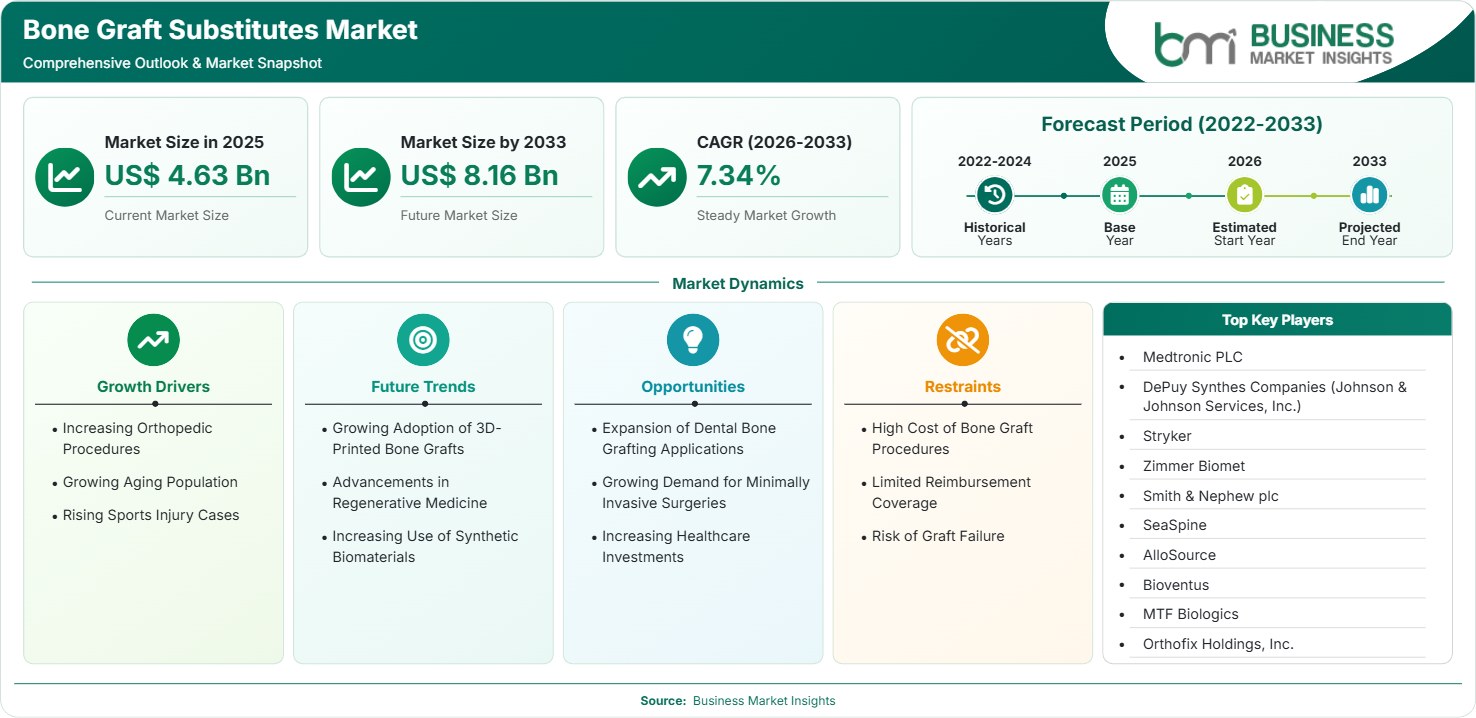
The Bone Graft Substitutes Market size was valued at US$ 4.63 Billion in 2025 and is projected to reach US$ 8.16 Billion by 2033, growing at a CAGR of 7.34% during 2026–2033. Market expansion is supported by increasing orthopedic procedures, rising spinal fusion surgeries, growing sports injury treatment, continuous biomaterial innovation, expanding regenerative medicine applications, and higher healthcare investments improving access to advanced bone regeneration technologies.

Report Coverage
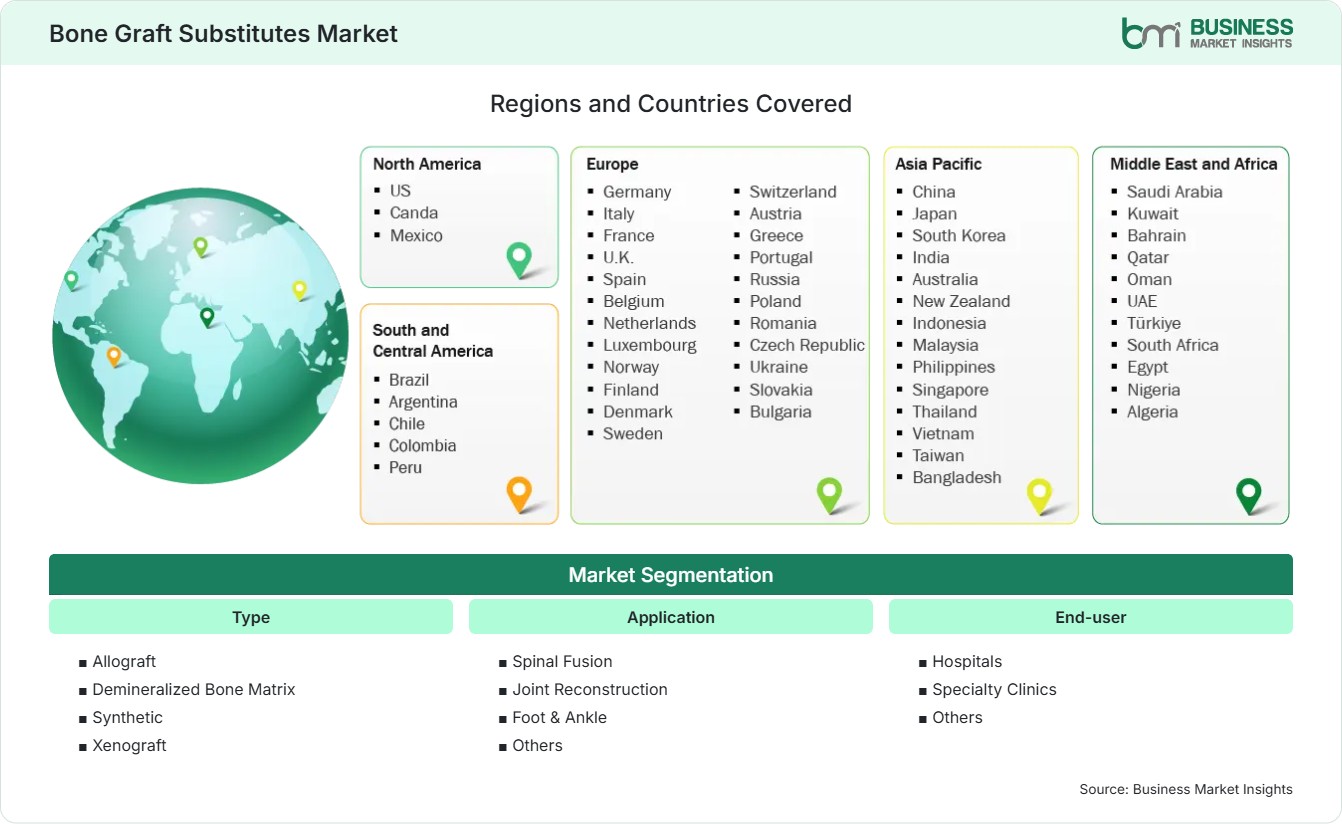
  • Type: Allograft, Demineralized Bone Matrix, Synthetic, Xenograft
  • Application: Spinal Fusion, Joint Reconstruction, Foot & Ankle, Others
  • End-user: Hospitals, Specialty Clinics, Others
US$ 4.63 Bn Market size in 2025
US$ 8.16 Bn Market Size by 2033
7.34% CAGR, 2026 - 2033
2026-2033 Forecast Period

01 AI Overview

Bone Graft Substitutes Market Summary

  • North America Region: North America holds 39%–42% share in 2025 and is projected to grow at a 6.8%–7.3% CAGR during 2026–2033. Strong orthopedic procedure volumes, advanced reimbursement systems, biologics adoption, and continuous innovation in regenerative medicine support sustained regional demand and product commercialization. The U.S. remains the largest contributor, expanding at an estimated 6.9%–7.4% CAGR, supported by high spinal surgery volumes and favorable hospital infrastructure.
  • Fastest Growing Region: Asia Pacific accounts for 23%–26% market share in 2025 while registering a 8.6%–9.2% CAGR through 2033. Expanding healthcare infrastructure, increasing trauma surgeries, aging demographics, and improving access to advanced orthopedic treatments continue accelerating regional adoption.
  • Leading Segment: Allograft represents 37%–40% share during 2025 while advancing at a 7.0%–7.5% CAGR. Broad clinical acceptance, abundant tissue availability, reduced operative time, and established outcomes continue supporting widespread utilization across orthopedic reconstruction procedures.
  • High Growth Segment: Spinal Fusion contributes 42%–45% share in 2025 and is anticipated to register a 7.8%–8.4% CAGR through 2033. Rising degenerative spinal disorders, minimally invasive spine surgeries, and increasing elderly patient populations continue driving procedural demand.
  • Key Market Opportunity: Expanding regenerative medicine research, next-generation synthetic biomaterials, customized bone scaffolds, biologically active graft technologies, and wider adoption of minimally invasive orthopedic procedures continue creating attractive long-term commercial opportunities worldwide.
  • Major Market Players: Medtronic plc; DePuy Synthes Companies (Johnson & Johnson); Stryker Corporation; Zimmer Biomet Holdings, Inc.; Smith & Nephew plc; SeaSpine Holdings Corporation; AlloSource; Bioventus Inc.; MTF Biologics; Orthofix Medical Inc.
02 Strategic Insights

Bone Graft Substitutes Market: Strategic Insights

bone-graft-substitutes-market-market-strategic-framework
FREE PDF
Request your free sample
Request free sample
03 Stakeholder View

Key Takeaways

  • Integration between tissue banks, biomaterial manufacturers, orthopedic device companies, and healthcare providers is strengthening supply chain resilience while improving product availability across trauma, spine, and reconstructive surgery applications.
  • Spinal fusion procedures and advanced synthetic biomaterials present the strongest commercial opportunities because surgeons increasingly seek alternatives that deliver reliable bone regeneration while minimizing donor-site morbidity.
  • Innovation continues focusing on osteoinductive materials, bioactive ceramics, growth factor technologies, and three-dimensional scaffold development to improve fusion rates and accelerate postoperative recovery.
  • Asia Pacific offers compelling long-term investment potential due to expanding healthcare infrastructure, rising orthopedic surgery volumes, growing medical tourism, and increasing access to advanced regenerative therapies.
  • Strategic acquisitions, biologics partnerships, and investments in manufacturing capacity remain central competitive strategies as companies strengthen product portfolios and broaden geographic reach.
  • Digital surgical planning, personalized implants, and regenerative medicine platforms are expected to improve procedural precision and support broader clinical adoption of advanced bone graft substitute technologies.
04 Geographic Outlook

Bone Graft Substitutes Market Regional Highlights

North America Bone Graft Substitutes Market

North America accounts for 39%–42% of the Bone Graft Substitutes Market share in 2025 and is projected to expand at a 6.8%–7.3% CAGR through 2033. The region benefits from high orthopedic procedure volumes, advanced healthcare infrastructure, favorable reimbursement policies, and widespread adoption of biologic graft technologies. Continuous investments in regenerative medicine, tissue banking, and spinal surgery innovation support sustained product demand. Rising trauma cases, sports-related injuries, and an aging population requiring joint reconstruction further strengthen regional expansion and long-term commercial opportunities.

  • Hospitals continue increasing the use of allografts and synthetic graft materials in spinal fusion and trauma surgeries to improve healing outcomes, shorten operative time, and reduce donor-site complications compared with conventional autograft procedures.
  • Growing adoption of minimally invasive orthopedic procedures is encouraging surgeons to select advanced graft substitutes offering enhanced osteoconductive and osteoinductive performance while reducing hospitalization periods and postoperative recovery times.
  • Regulatory support for innovative biomaterials and expanding collaborations between tissue banks and orthopedic manufacturers continue improving product availability while accelerating commercialization of next-generation regenerative technologies.
  • Increasing healthcare expenditure and favorable reimbursement for complex orthopedic procedures encourage wider utilization of premium bone graft substitute products across academic medical centers and specialty hospitals.

US Bone Graft Substitutes Market

The United States represents approximately 83%–86% of the North American market while advancing at a 6.9%–7.4% CAGR through 2033. High spinal fusion volumes, strong orthopedic device innovation, advanced surgical infrastructure, and increasing prevalence of osteoporosis continue supporting consistent demand for bone regeneration technologies across healthcare facilities.

  • Continuous investment in orthopedic research strengthens development of bioactive graft substitutes capable of improving fusion success and long-term clinical outcomes across complex musculoskeletal procedures.
  • Ambulatory surgical centers are increasingly adopting advanced graft materials for selected orthopedic interventions, supporting procedural efficiency and optimized patient recovery pathways.
  • Rising participation in sports and active lifestyles contributes to increasing ligament reconstruction and trauma procedures requiring effective bone regeneration products.

Europe Bone Graft Substitutes Market

Europe contributes 27%–30% Bone Graft Substitutes Market share during 2025 and is forecast to grow at a 7.0%–7.5% CAGR through 2033. Germany remains the leading regional market because of advanced orthopedic services, while Spain records comparatively faster expansion supported by healthcare modernization and rising orthopedic surgery volumes. Strong regulatory standards, increasing elderly populations, and broader adoption of regenerative biomaterials continue supporting regional market development.

  • National healthcare systems increasingly incorporate advanced graft substitutes into orthopedic treatment pathways to improve long-term patient outcomes while reducing revision surgery rates.
  • Rising incidence of degenerative musculoskeletal disorders continues increasing demand for spinal fusion, joint reconstruction, and trauma management procedures utilizing biologic graft materials.
  • Tissue banking infrastructure and stringent quality standards improve product safety while strengthening physician confidence in allograft-based orthopedic treatments.
  • Medical device manufacturers continue investing in research collaborations with hospitals and academic institutions to accelerate innovation in regenerative orthopedic technologies.

Asia Pacific Bone Graft Substitutes Market

Asia Pacific represents 23%–26% market share in 2025 while recording the fastest expansion at 8.6%–9.2% CAGR through 2033. China leads regional revenue generation, whereas India demonstrates the highest growth owing to expanding healthcare infrastructure, increasing orthopedic procedures, and improving patient access to advanced regenerative therapies. Rising healthcare expenditure and favorable government initiatives continue supporting Bone Graft Substitutes Market growth across the region.

  • Expanding hospital infrastructure and increasing availability of specialized orthopedic surgeons are improving access to advanced bone graft substitute procedures across urban healthcare facilities.
  • Rapid growth in road traffic injuries and sports participation continues driving demand for trauma reconstruction products requiring effective bone regeneration technologies.
  • Medical tourism expansion encourages healthcare providers to invest in innovative orthopedic solutions that improve treatment quality and international patient outcomes.
  • Local manufacturing investments and strategic partnerships strengthen regional supply chains while improving affordability and product accessibility across emerging economies.

Rest of World Bone Graft Substitutes Market

The Rest of World region accounts for 8%–11% Bone Graft Substitutes Market share during 2025 and is expected to grow at a 7.2%–7.8% CAGR through 2033. South & Central America benefit from improving orthopedic care infrastructure, while the Middle East & Africa continue expanding specialized surgical services and trauma treatment capabilities. Brazil leads regional demand, whereas Saudi Arabia records faster growth through healthcare modernization and increasing investment in orthopedic specialty care.

  • Expansion of private healthcare providers continues increasing access to advanced orthopedic procedures requiring synthetic and biologic bone graft substitutes across developing healthcare systems.
  • Government investments in hospital modernization and trauma care strengthen procurement of regenerative orthopedic products supporting complex surgical interventions.
  • Rising awareness regarding minimally invasive orthopedic procedures encourages adoption of advanced graft technologies that improve clinical outcomes and reduce postoperative complications.
  • International collaborations with global orthopedic manufacturers improve physician training, technology transfer, and product availability across emerging regional healthcare markets.
global-market-geography
FREE PDF
Request your free sample
Request free sample
05 Segment Analysis

Bone Graft Substitutes Market Segmentation

Type

The Type segment represents the foundation of the Bone Graft Substitutes Market scope, driven by continuous advances in regenerative biomaterials, tissue engineering, and orthopedic reconstruction. The segment accounts for approximately 37%–40% market share in 2025 and is projected to expand at a 7.0%–7.5% CAGR through 2033. Increasing surgeon preference for biologically active graft materials, improved clinical outcomes, and expanding spinal and trauma procedures continue supporting long-term segment growth.

  • Allograft: Widely adopted because of established clinical performance, abundant tissue availability, reduced surgical complexity, and elimination of donor-site morbidity, making it suitable for spinal fusion, trauma repair, and reconstructive orthopedic procedures.
  • Demineralized Bone Matrix (DBM): Increasingly utilized owing to its osteoinductive characteristics, flexible handling properties, and compatibility with multiple orthopedic procedures requiring enhanced bone regeneration and improved fusion outcomes.
  • Synthetic: Demand continues rising due to advancements in calcium phosphate ceramics, bioactive glass, and composite biomaterials that provide consistent quality, unlimited availability, and reduced disease transmission concerns.
  • Xenograft: Selected for specialized reconstructive applications where structural support and biological compatibility are required, supported by continuous improvements in processing technologies and stringent sterilization standards.

Application

The Application segment remains the largest revenue contributor because bone graft substitutes are increasingly utilized across complex orthopedic interventions requiring effective bone regeneration. The segment represents nearly 42%–45% market share during 2025 while expanding at a 7.8%–8.4% CAGR through 2033. Rising incidence of degenerative musculoskeletal disorders, trauma injuries, and growing Bone Graft Substitutes Market trends related to minimally invasive orthopedic procedures continue strengthening long-term demand.

  • Spinal Fusion: Represents the leading application because increasing spinal degeneration, deformity correction procedures, and minimally invasive spine surgeries require reliable graft materials supporting durable bone fusion and structural stability.
  • Joint Reconstruction: Increasing utilization in revision arthroplasty, hip reconstruction, and knee replacement procedures supports improved implant fixation, bone defect management, and long-term orthopedic outcomes.
  • Foot & Ankle: Growing adoption is driven by rising sports injuries, diabetic foot reconstruction, trauma management, and corrective procedures requiring effective bone healing and structural restoration.

End-user

The End-user segment continues expanding as healthcare providers increase investment in advanced orthopedic technologies and regenerative treatment capabilities. The segment contributes approximately 68%–71% market share in 2025 and is projected to grow at a 7.2%–7.8% CAGR through 2033. Increasing orthopedic procedure volumes, specialized surgical expertise, and wider availability of biologic graft materials continue supporting sustained adoption across healthcare institutions.

  • Hospitals: Represent the primary end users because they perform the highest volume of spinal fusion, trauma reconstruction, joint replacement, and complex orthopedic surgeries requiring comprehensive regenerative bone graft solutions.
  • Specialty Clinics: Growing orthopedic specialty centers increasingly perform elective musculoskeletal procedures, sports injury treatments, and minimally invasive interventions utilizing advanced bone graft substitute technologies to improve patient recovery and surgical efficiency.
06 Market Forces

Bone Graft Substitutes Market Dynamics

Key Market Drivers

Increasing Orthopedic Procedures

Increase in orthopedic surgeries is one of the major factors boosting the uptake of bone graft substitutes. The prevalence of osteoarthritis, osteoporosis, spinal deterioration, and bone fractures is leading to increased need for bone regeneration products in both developed and developing health care environments. Graft substitutes are preferred by hospitals over autografts because they avoid complications at the donor site along with providing enhanced efficiency in surgery. Innovations in biomaterials, biologics, and regenerative medicine are helping in Bone Graft Substitutes Market growth.

Growing Aging Population

Rapid population aging continues increasing the incidence of degenerative bone diseases, osteoporosis, and age-related fractures requiring surgical intervention. Older adults frequently require spinal fusion, hip replacement, knee arthroplasty, and fracture fixation where bone graft substitutes improve structural stability and healing outcomes. Healthcare providers increasingly adopt advanced regenerative materials to shorten recovery periods and enhance long-term implant success. Expanding geriatric healthcare services and greater access to specialized orthopedic treatment continue strengthening demand for innovative bone regeneration products worldwide.

Rising Sports Injury Cases

Increased involvement in sports, recreational activities, and physical exercises has led to an increase in ligament damage, bone fractures, tendon injuries, and orthopedic injuries. There is increased use of bone substitutes for reconstruction surgery among sports medicine practitioners to enhance bone fusion and treatment success. Football, basketball, cycling, skiing, and other contact sports continue to be a source of increased surgery cases worldwide. Improvements in orthopedic techniques through minimally invasive surgery have facilitated the adoption of regenerative grafts that enhance recovery. Investment in sports medicine continues to bolster procedure demand.

Key Market Opportunities

Expansion of Dental Bone Grafting Applications

Dental implants are now needing more and more bone graft substitutes in order to augment bone volume prior to implant installation, providing new markets for bone graft substitutes outside traditional uses in orthopedics. An increasing awareness about restorative dentistry, cosmetic dentistry treatments, and oral rehabilitation is driving up the demand for synthetic bone grafting materials and demineralized bone matrix products. Aging population, tooth loss due to periodontal disease, and increasing popularity of dental implants will keep fueling procedure advancements. Increased utilization of regenerative biomaterials in maxillofacial surgery contributes positively to Bone Graft Substitutes Market Forecasts, prompting manufacturers to expand their product offerings and form strategic collaborations.

Growing Demand for Minimally Invasive Surgeries

Growth in demand for minimally invasive orthopedic surgeries is providing favorable market growth opportunities for the companies engaged in developing bone regeneration solutions. Contemporary surgery demands grafting material that would be convenient to use, biologically compatible, and would facilitate quick bone development through minimal incisions. The development of injectable bone graft substitutes, bioactive composites, and moldable regenerative bone grafts is opening up new possibilities in spinal, trauma, and reconstructive orthopedic surgeries.

Increasing Healthcare Investments

Healthcare investments in the public and private sector keep encouraging the modernization of orthopedic facilities, expansion of specialist surgical centers and increased adoption of regenerative medicine techniques. Economies in the developing world are raising their healthcare budgets in order to enhance trauma treatment, orthopedic surgery capabilities and adoption of medical devices. Cooperation between healthcare facilities, research institutes and medical technology companies keeps speeding up the product development and commercialization process. Investments in education for physicians, tissue banks and manufacturing of advanced biomaterials are creating a strong growth potential and increased access to novel bone regenerating solutions in healthcare markets of all maturity levels.

Market Restraints and Challenges

High Cost of Bone Graft Procedures

Factor: Advanced bone graft substitute products involve sophisticated biomaterial engineering, tissue processing, sterilization, regulatory compliance, and specialized manufacturing techniques that increase production and procedural costs. Premium biologics and next-generation regenerative products further elevate treatment expenses for healthcare providers and patients.

Impact: High procedure costs may limit adoption in price-sensitive healthcare systems, particularly where hospitals operate under constrained budgets. Cost pressures can delay technology adoption, reduce accessibility for patients, and encourage continued reliance on conventional grafting techniques despite clinical advantages offered by advanced regenerative materials.

Limited Reimbursement Coverage

Factor: Reimbursement policies for bone graft substitute procedures differ considerably across healthcare systems, with varying levels of coverage depending on product type, clinical indication, and regional regulatory frameworks. Limited reimbursement remains particularly challenging in several developing healthcare markets.

Impact: Inconsistent reimbursement creates financial uncertainty for hospitals and patients, potentially restricting utilization of premium regenerative products. Manufacturers must demonstrate strong clinical evidence, cost-effectiveness, and long-term patient benefits to improve reimbursement acceptance and support broader commercialization of advanced bone graft substitute technologies.

07 Company Analysis

Competitive Landscape

The competitive environment is shaped by continuous innovation in regenerative biomaterials, biologics, synthetic graft technologies, and tissue processing capabilities. Bone Graft Substitutes Market analysis indicates that manufacturers are expanding research collaborations, strengthening tissue banking networks, and introducing advanced osteoconductive and osteoinductive products to improve clinical outcomes. Strategic acquisitions, product portfolio diversification, and geographic expansion remain key competitive strategies as companies address growing demand across spinal fusion, trauma reconstruction, and joint replacement procedures.

Company Name

Overview

Products and Services Relevant to this Market

Medtronic plc

Global medical technology company specializing in spine, orthopedic, and surgical solutions with strong regenerative medicine capabilities.

Bone graft substitutes, spinal fusion systems, biologics, surgical navigation technologies, orthopedic implants, and procedural support solutions.

DePuy Synthes Companies (Johnson & Johnson)

Orthopedic division providing comprehensive trauma, spine, sports medicine, and reconstructive solutions for healthcare providers worldwide.

Bone graft materials, spinal implants, trauma fixation devices, joint reconstruction systems, biologics, and orthopedic surgical technologies.

Stryker Corporation

Leading orthopedic device manufacturer focused on advanced implant technologies and regenerative surgical solutions.

Synthetic bone graft substitutes, orthopedic implants, spinal products, trauma systems, navigation technologies, and surgical equipment.

Zimmer Biomet Holdings, Inc.

Global musculoskeletal healthcare company delivering reconstructive implants and biologic solutions across orthopedic specialties.

Bone graft substitutes, joint reconstruction implants, sports medicine products, biologics, spinal technologies, and regenerative solutions.

Smith & Nephew plc

International medical technology company with expertise in orthopedic reconstruction, sports medicine, and advanced wound management.

Bone regeneration products, orthopedic implants, sports medicine devices, biologics, trauma systems, and surgical instrumentation.

SeaSpine Holdings Corporation

Spine-focused medical technology company specializing in biologics and spinal implant solutions for complex spinal procedures.

Demineralized bone matrix products, spinal implants, biologics, interbody fusion devices, surgical instruments, and regenerative technologies.

AlloSource

Non-profit tissue organization providing high-quality allograft tissues for orthopedic, spine, and sports medicine procedures.

Allografts, demineralized bone matrices, tissue processing services, orthopedic biologics, and regenerative tissue solutions.

Bioventus Inc.

Medical device company developing biologic therapies and restorative solutions supporting musculoskeletal healing and bone regeneration.

Bone graft substitutes, biologics, fracture healing products, orthopedic regenerative therapies, and musculoskeletal treatment solutions.

MTF Biologics

Global tissue bank specializing in biologic grafts and regenerative medicine products for orthopedic and reconstructive surgery.

Allografts, demineralized bone matrices, tissue grafts, biologic implants, orthopedic regenerative products, and tissue banking services.

Orthofix Medical Inc.

Orthopedic and spine company focused on regenerative biologics, fixation systems, and advanced musculoskeletal treatment technologies.

Bone graft substitutes, bone growth therapies, spinal fixation systems, orthopedic implants, biologics, and regenerative surgical solutions.

10 Trust & Transparency

Research Methodology

The market analysis combines proprietary research with secondary data from government agencies, company disclosures, regulatory filings, industry databases and expert interviews. Market estimates are validated through data triangulation, cross-market benchmarking and analyst review.

View Full Research Methodology

11 Questions Answered

Frequently Asked Questions

What is the projected value of the Bone Graft Substitutes Market by 2033?

The market is projected to reach US$ 8.16 Billion by 2033, increasing from US$ 4.63 Billion in 2025, at a CAGR of 7.34% during 2026–2033.

What are the major long-term growth opportunities?

Future opportunities include regenerative biomaterials, minimally invasive orthopedic procedures, dental bone grafting applications, tissue engineering innovations, personalized bone scaffolds, and expanding healthcare investment across emerging economies.

Which companies are included in the Bone Graft Substitutes Market Report?

The report profiles Medtronic plc, DePuy Synthes Companies (Johnson & Johnson), Stryker Corporation, Zimmer Biomet Holdings, Inc., Smith & Nephew plc, SeaSpine Holdings Corporation, AlloSource, Bioventus Inc., MTF Biologics, and Orthofix Medical Inc.

Which region is expected to witness the fastest expansion?

Asia Pacific is projected to record the fastest growth owing to expanding healthcare infrastructure, increasing orthopedic procedure volumes, improving reimbursement systems, and rising investments in regenerative medicine technologies.

Which segment accounts for the largest revenue contribution?

The Allograft segment leads the market because of its established clinical performance, broad availability, reduced donor-site complications, and extensive use in spinal fusion, trauma reconstruction, and orthopedic surgeries.

Access the Full Bone Graft Substitutes Market Report

Get segment-level forecasts, regional estimates, competitive benchmarking, company profiles and downloadable Excel datasets.

Access the full Bone Graft Substitutes Market Report
350 pages PDF & Excel | 2026-08-06