
Bone Morphogenetic Proteins Market Outlook: Size, Share, Trends, Growth Analysis, Competitive Landscape & Forecast, 2026-2033

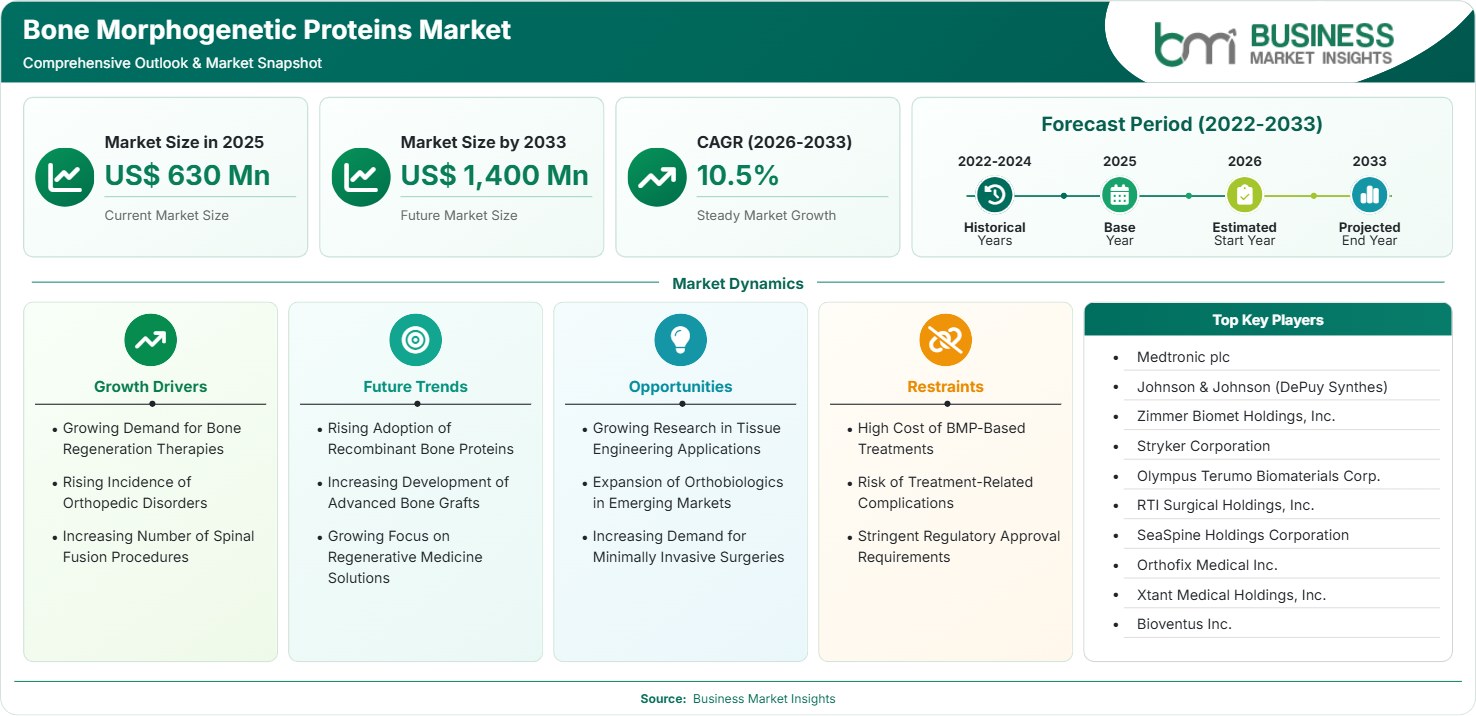
The Bone Morphogenetic Proteins Market size was valued at US$ 0.63 Billion in 2025 and is projected to reach US$ 1.40 Billion by 2033, growing at a CAGR of 10.5% during 2026–2033. The market is driven by growing demand for bone regeneration therapies, rising incidence of orthopedic disorders, and an increasing number of spinal fusion procedures. Expanding research in tissue engineering, growing orthobiologics adoption in emerging markets, and increasing demand for minimally invasive surgeries are expected to create substantial growth opportunities during the forecast period.

Report Coverage
  • Type: rhBMP-2, rhBMP-7, Others
  • Application: Spinal Fusion, Trauma Surgery, Reconstructive Surgery, Maxillofacial & Dental
US$ 630 Mn Market size in 2025
US$ 1,400 Mn Market Size by 2033
10.5% CAGR, 2026 - 2033
2026-2033 Forecast Period

01 AI Overview

Bone Morphogenetic Proteins Market Summary

  • North America Region: North America accounted for 44%–47% of the global market in 2025 and is projected to register a CAGR of 10.1%–10.6% during 2026–2033. Strong adoption of orthobiologics, advanced spinal surgery infrastructure, and increasing orthopedic procedures continue driving regional demand. The U.S. market is expected to grow at a CAGR of 10.2%–10.8%, supported by rising spinal fusion surgeries and favourable reimbursement for selected orthopedic procedures.
  • Fastest Growing Region: Asia Pacific held 22%–25% of the global market in 2025 and is projected to register the fastest CAGR of 11.3%–11.9% during 2026–2033. Rising healthcare expenditure, increasing orthopedic surgeries, expanding hospital infrastructure, and growing adoption of regenerative medicine continue accelerating market growth across the region.
  • Leading Segment: rhBMP-2 accounted for 68%–71% of market revenue in 2025 and is projected to expand at a CAGR of 10.6%–11.1%, owing to its extensive clinical use in spinal fusion and bone regeneration procedures.
  • High Growth Segment: Spinal Fusion accounted for 49%–52% of market revenue in 2025 and is expected to register the fastest CAGR of 10.8%–11.3%, driven by increasing prevalence of degenerative spine disorders and growing preference for biologic bone graft substitutes.
  • Key Market Opportunity: Growing research in tissue engineering applications, expansion of orthobiologics across emerging healthcare markets, and increasing adoption of minimally invasive orthopedic surgeries continue creating significant growth opportunities for BMP manufacturers.
  • Major Market Players: Medtronic plc, Johnson & Johnson (DePuy Synthes), Zimmer Biomet Holdings, Inc., Stryker Corporation, Olympus Terumo Biomaterials Corp., RTI Surgical Holdings, Inc., SeaSpine Holdings Corporation, Orthofix Medical Inc., Xtant Medical Holdings, Inc., and Bioventus Inc.
02 Strategic Insights

Bone Morphogenetic Proteins Market: Strategic Insights

Bone Morphogenetic Proteins Market Strategic Framework
FREE PDF
Request your free sample
Request free sample
03 Stakeholder View

Key Takeaways

  • The market is witnessing steady growth, supported by increasing adoption of bone morphogenetic proteins in spinal fusion, trauma, and reconstructive surgeries, alongside advancements in regenerative medicine.
  • Innovation is centered on next-generation recombinant BMP formulations, advanced delivery systems, and combination biomaterials that improve bone regeneration while minimizing adverse effects.
  • Asia Pacific presents significant growth potential due to expanding healthcare infrastructure, increasing orthopedic procedure volumes, and growing investments in biotechnology across China, India, and Southeast Asia.
  • Strategic collaborations, licensing agreements, and acquisitions are accelerating as companies seek to strengthen regenerative medicine portfolios, enhance manufacturing capabilities, and expand their global footprint.
  • Regulatory approvals, clinical evidence supporting product safety and efficacy, and cost-effective treatment solutions are becoming key competitive differentiators, influencing physician adoption and hospital procurement decisions.
04 Geographic Outlook

Bone Morphogenetic Proteins Market Regional Highlights

North America Bone Morphogenetic Proteins Market

North America accounted for 44%–47% of the global market in 2025 and is projected to expand at a CAGR of 10.1%–10.6% during 2026–2033. Strong adoption of orthobiologics, advanced orthopedic healthcare infrastructure, and increasing spinal fusion procedures continue driving regional market growth. The Bone Morphogenetic Proteins Market share remains dominant due to high utilization of recombinant bone graft substitutes, favorable reimbursement for selected procedures, and continuous investments in regenerative medicine.

  • The United States remains the largest regional market owing to increasing spinal fusion procedures and advanced orthopedic care.
  • Hospitals continue adopting recombinant BMP products to improve bone healing and reduce autograft harvesting.
  • Growing prevalence of degenerative spine disorders supports increasing clinical demand.
  • Research institutions continue advancing regenerative medicine and tissue engineering applications.
  • Strong presence of leading orthopedic device manufacturers accelerates market innovation.

US Bone Morphogenetic Proteins Market

The United States represented 39%–42% of the global market in 2025 and is anticipated to grow at a CAGR of 10.2%–10.8% through 2026–2033. Rising orthopedic procedures, increasing prevalence of musculoskeletal disorders, and expanding adoption of biologic bone graft substitutes continue driving the Bone Morphogenetic Proteins Market growth.

  • Spinal fusion procedures remain the primary clinical application for recombinant BMP products.
  • Orthopedic surgeons increasingly utilize biologic bone regeneration therapies to improve surgical outcomes.
  • Continuous innovation in regenerative medicine strengthens future clinical adoption.
  • Expanding research activities continue supporting next-generation orthopedic biologics.

Europe Bone Morphogenetic Proteins Market

Europe held 26%–29% of global revenue in 2025 and is expected to register a CAGR of 10.2%–10.8% during 2026–2033. Rising orthopedic procedures, increasing aging populations, and growing demand for regenerative therapies continue driving regional market expansion. Germany remains the leading regional Bone Morphogenetic Proteins Market, while Poland is projected to register the fastest growth.

  • Germany dominates regional demand through advanced orthopedic healthcare systems and widespread spinal surgery adoption.
  • Poland is projected to register a CAGR of 11.0%–11.5%, supported by improving healthcare infrastructure and increasing orthopedic investments.
  • France, Italy, and the United Kingdom continue expanding utilization of orthobiologic products.
  • Growing clinical research continues supporting adoption of tissue engineering technologies.
  • Increasing healthcare expenditure continues strengthening orthopedic treatment capabilities.

Asia Pacific Bone Morphogenetic Proteins Market

Asia Pacific accounted for 22%–25% of global market revenue in 2025 and is projected to register the fastest CAGR of 11.3%–11.9% during 2026–2033. Rising healthcare expenditure, increasing orthopedic surgeries, expanding hospital infrastructure, and growing awareness regarding regenerative medicine continue accelerating regional growth. China remains the largest market, while India is projected to witness the fastest growth.

  • China dominates regional demand through expanding orthopedic healthcare infrastructure and increasing surgical volumes.
  • India is projected to register a CAGR of 11.8%–12.4%, supported by growing healthcare investments, rising spinal procedures, and expanding orthobiologics adoption.
  • Japan continues witnessing increasing utilization of regenerative medicine technologies.
  • South Korea continues investing in advanced orthopedic research and biologic therapies.
  • Southeast Asian countries continue expanding access to specialized orthopedic care.

Rest of World Bone Morphogenetic Proteins Market

The Rest of the World accounted for 5%–7% of the global Bone Morphogenetic Proteins Market revenue in 2025 and is expected to expand at a CAGR of 9.8%–10.3% during 2026–2033. Market growth is supported by improving healthcare infrastructure, increasing orthopedic procedure volumes, and expanding adoption of regenerative medicine across Latin America, the Middle East, and Africa.

Growing investments in orthopedic hospitals, trauma care centers, and advanced surgical technologies continue creating new opportunities for bone morphogenetic protein manufacturers across emerging healthcare markets.

  • Brazil continues expanding orthopedic surgery capabilities and regenerative medicine adoption.
  • Saudi Arabia is investing in specialized orthopedic healthcare infrastructure.
  • The United Arab Emirates continues strengthening advanced spine surgery services.
  • South Africa is gradually expanding access to orthopedic biologic therapies.
  • Increasing healthcare modernization continues supporting long-term market growth across emerging regions.
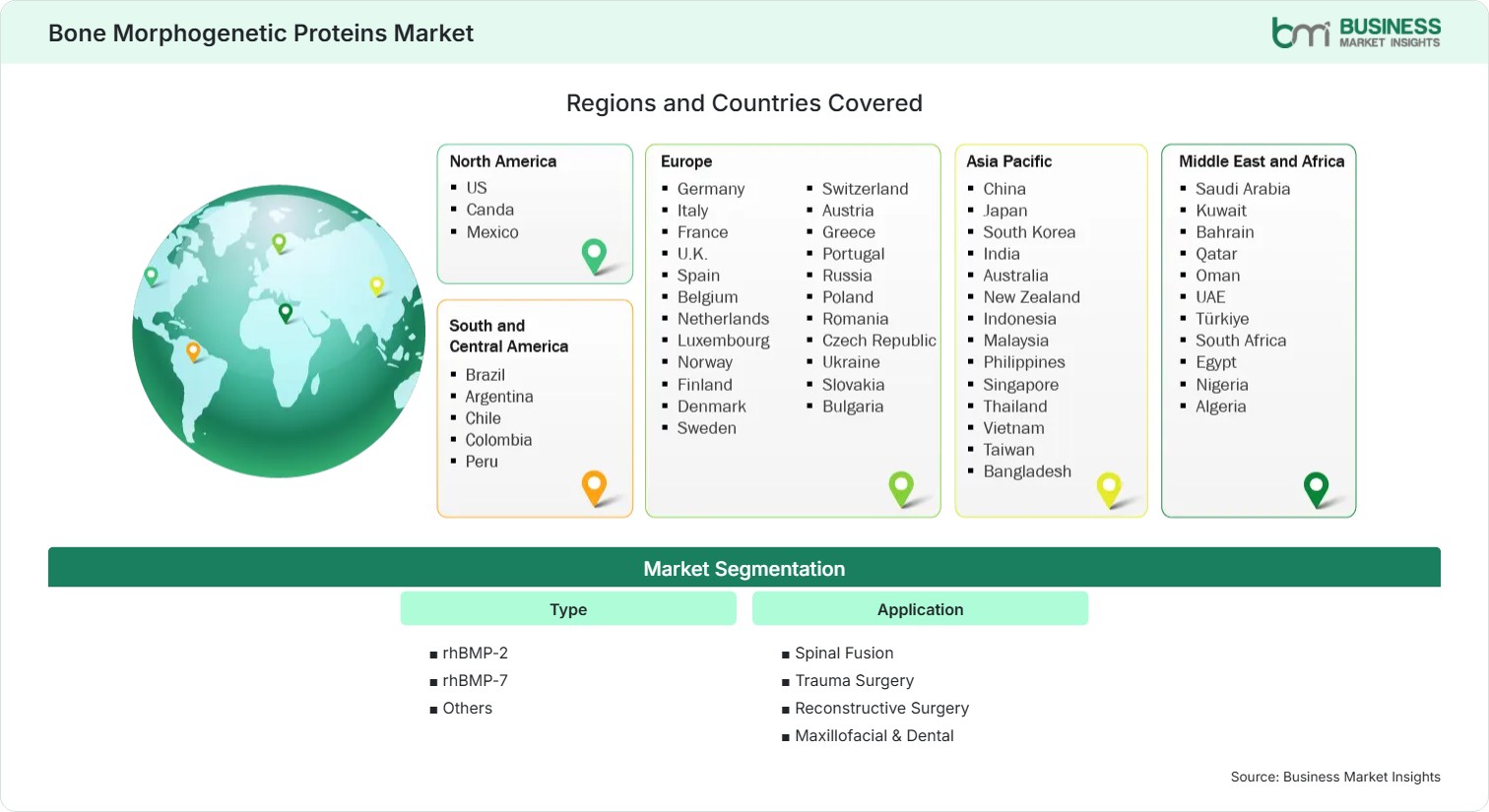
Global Market Geography
FREE PDF
Request your free sample
Request free sample
05 Segment Analysis

Bone Morphogenetic Proteins Market Segmentation

Type

The rhBMP-2 segment accounted for 68%–71% of the global market in 2025 and is projected to expand at a CAGR of 10.6%–11.1% during 2026–2033. rhBMP-2 remains the most widely used bone morphogenetic protein due to its proven clinical efficacy in spinal fusion, trauma surgery, and bone regeneration procedures. The Bone Morphogenetic Proteins Market scope continues expanding as recombinant protein technologies improve surgical outcomes while reducing the need for autologous bone graft harvesting.

  • rhBMP-2: Dominates the market owing to extensive clinical adoption in spinal fusion, orthopedic trauma, and reconstructive procedures.
  • rhBMP-7: Continues maintaining clinical relevance for selected orthopedic and bone healing applications, supported by ongoing research in regenerative medicine.
  • Others: Includes emerging recombinant bone morphogenetic proteins and next-generation biologic growth factors under clinical development for specialized orthopedic applications.

Application

The Spinal Fusion segment accounted for 49%–52% of market revenue in 2025 and is projected to register a CAGR of 10.8%–11.3% during 2026–2033. Increasing prevalence of degenerative disc disease, spinal deformities, and minimally invasive spine surgeries continues driving demand for recombinant bone morphogenetic proteins.

  • Spinal Fusion: Leads the market through increasing adoption of biologic bone graft substitutes for lumbar and cervical fusion procedures.
  • Trauma Surgery: Continues witnessing growing utilization for treatment of complex fractures, non-union fractures, and severe bone defects.
  • Reconstructive Surgery: Increasing demand for bone regeneration in orthopedic reconstruction supports steady market growth.
  • Maxillofacial & Dental: Growing adoption of BMPs in dental implants, periodontal regeneration, sinus augmentation, and maxillofacial reconstruction continues expanding this application segment.
06 Market Forces

Bone Morphogenetic Proteins Market Dynamics

Key Market Drivers

Growing Demand for Bone Regeneration Therapies

Increasing preference for biologic bone graft substitutes and regenerative therapies is driving demand for bone morphogenetic proteins across orthopedic and reconstructive surgeries. Recombinant BMPs promote faster bone healing, reduce donor-site complications associated with autografts, and improve surgical outcomes. These advancements continue supporting market growth, while evolving Bone Morphogenetic Proteins Market trends indicate increasing investments in regenerative medicine and advanced orthobiologic technologies.

Rising Incidence of Orthopedic Disorders

Growing prevalence of osteoporosis, degenerative spine disorders, traumatic injuries, and musculoskeletal diseases continues increasing the demand for advanced bone regeneration therapies. Aging populations and rising sports-related injuries are further contributing to higher volumes of orthopedic surgical procedures globally.

Increasing Number of Spinal Fusion Procedures

The rising number of spinal fusion surgeries performed to treat degenerative disc disease, spinal instability, scoliosis, and other spinal conditions continues driving BMP adoption. Surgeons increasingly utilize recombinant bone morphogenetic proteins to enhance fusion rates, reduce recovery time, and improve long-term clinical outcomes.

Key Market Opportunities

Growing Research in Tissue Engineering Applications

Ongoing advancements in tissue engineering and regenerative medicine are expanding the therapeutic potential of bone morphogenetic proteins beyond conventional orthopedic procedures. Researchers are exploring BMPs in combination with biomaterial scaffolds, stem cell therapies, and advanced tissue regeneration technologies to improve bone healing and reconstructive outcomes. Positive Bone Morphogenetic Proteins Market Forecasts continue encouraging investments in next-generation biologics and regenerative orthopedic solutions.

Expansion of Orthobiologics in Emerging Markets

Rapid improvements in healthcare infrastructure, increasing orthopedic procedure volumes, and growing awareness of biologic treatment options are creating significant opportunities across emerging economies. Hospitals and specialty orthopedic centers are increasingly adopting orthobiologics to improve surgical outcomes, while expanding reimbursement systems and healthcare investments continue supporting market penetration.

Increasing Demand for Minimally Invasive Surgeries

The growing preference for minimally invasive orthopedic and spinal procedures is driving demand for advanced biologic bone graft substitutes, including recombinant BMPs. These procedures offer reduced tissue trauma, faster recovery, shorter hospital stays, and improved patient outcomes, encouraging wider adoption of bone regeneration therapies in modern orthopedic practice.

Market Restraints and Challenges

High Cost of BMP-Based Treatments

Factor: Recombinant bone morphogenetic protein therapies involve high manufacturing costs, specialized production processes, and significant clinical development expenses.

Impact: The elevated cost of BMP-based treatments can limit patient access and hospital adoption, particularly in cost-sensitive healthcare systems and emerging markets. Healthcare providers continue evaluating cost-effectiveness while manufacturers focus on improving production efficiency and expanding reimbursement support.

Risk of Treatment-Related Complications

Factor: Although BMPs provide significant clinical benefits, inappropriate dosage, off-label use, or patient-specific factors may increase the risk of adverse events such as ectopic bone formation, inflammation, swelling, or neurological complications in certain procedures.

Impact: Safety concerns and regulatory scrutiny may influence physician adoption, patient selection, and clinical guidelines. Manufacturers continue investing in improved delivery systems, optimized formulations, and expanded clinical research to enhance treatment safety and therapeutic outcomes.

07 Company Analysis

Competitive Landscape

The Bone Morphogenetic Proteins Market analysis indicates that leading companies are strengthening their market positions through clinical research, product innovation, strategic collaborations, and expansion of advanced orthopedic and spine care portfolios.

Company Name

Overview

Products and Services Relevant to this Market

Medtronic plc

Global medical technology company and leading provider of spinal surgery solutions.

INFUSE™ Bone Graft (rhBMP-2), spinal fusion systems, biologic bone grafts, and orthopedic implants.

Johnson & Johnson (DePuy Synthes)

Global orthopedic device manufacturer offering trauma, spine, and reconstructive solutions.

Spine implants, trauma fixation systems, orthopedic biomaterials, and bone regeneration solutions.

Zimmer Biomet Holdings, Inc.

Global musculoskeletal healthcare company specializing in orthopedic implants and biologics.

Orthobiologics, bone graft substitutes, spinal implants, trauma devices, and regenerative products.

Stryker Corporation

Medical technology company providing orthopedic and spinal surgery solutions.

Spine systems, orthopedic implants, biologic solutions, trauma fixation products, and surgical technologies.

Olympus Terumo Biomaterials Corp.

Japanese biomaterials company focused on regenerative medicine and orthopedic biomaterials.

Bone graft substitutes, regenerative biomaterials, orthopedic biologics, and bone repair products.

RTI Surgical Holdings, Inc.

Developer of biologic and implant solutions for orthopedic and spine surgery.

Allografts, bone graft substitutes, spinal biologics, and regenerative surgical solutions.

SeaSpine Holdings Corporation

Spine technology company specializing in biologics and spinal implant systems.

Orthobiologics, spinal fusion implants, biologic graft materials, and surgical navigation solutions.

Orthofix Medical Inc.

Global orthopedic company focused on spine, trauma, and biologic therapies.

Bone growth therapies, spinal fusion systems, orthobiologics, and external fixation devices.

Xtant Medical Holdings, Inc.

Medical device company specializing in regenerative biologics and spinal surgery products.

Bone grafts, regenerative biologics, spinal implants, and orthopedic surgical solutions.

Bioventus Inc.

Global medical device company focused on active healing and regenerative therapies.

Bone healing therapies, orthobiologics, regenerative medicine products, and orthopedic treatment solutions.

08 Industry Activity

Recent Developments

February 2026

Medtronic plc announced that the U.S. FDA approved INFUSE Bone Graft for one- and two-level Transforaminal Lumbar Interbody Fusion (TLIF) procedures. The approval expanded the indications for the recombinant human Bone Morphogenetic Protein-2 (rhBMP-2) product.

April 2025

CGBIO announced its innovative bone graft substitute, NOVOSIS PUTTY, has received Investigational Device Exemption (IDE) approval from the U.S. Food and Drug Administration (FDA). This pivotal approval paves the way for a clinical trial in spinal fusion procedures within the United States.

March 2025

Zimmer Biomet Holdings, Inc. announced its diverse portfolio of orthopedic and musculoskeletal innovations at the American Academy of Orthopaedic Surgeons (AAOS). The company's booth will prominently feature its comprehensive hip portfolio, anchored by the new Z1 Triple-Taper Femoral Hip System, along with the latest technologies.

March 2024

CGBIO transitioned its eCommerce operations in Indonesia from SigmaAldrich to the global SigmaAldrich.com platform. This will help to offer customers enhanced features, such as product pricing in Indonesian.

10 Trust & Transparency

Research Methodology

The market analysis combines proprietary research with secondary data from government agencies, company disclosures, regulatory filings, industry databases and expert interviews. Market estimates are validated through data triangulation, cross-market benchmarking and analyst review.

View Full Research Methodology

11 Questions Answered

Frequently Asked Questions

Why is the Bone Morphogenetic Proteins Market Report valuable for stakeholders?

The Bone Morphogenetic Proteins Report provides comprehensive insights into market size, technological advancements, competitive landscape, clinical trends, regional opportunities, and future growth prospects, enabling stakeholders to make informed strategic and investment decisions.

Which application segment is expected to witness the fastest growth?

Spinal Fusion is expected to witness the fastest growth due to the increasing prevalence of degenerative spine disorders, rising surgical volumes, and growing use of biologic bone graft substitutes.

Which type holds the largest market share?

rhBMP-2 holds the largest market share owing to its extensive clinical use in spinal fusion, orthopedic trauma, and bone regeneration procedures.

Which region dominates the market?

North America dominates the market due to advanced orthopedic healthcare infrastructure, high adoption of orthobiologics, increasing spinal surgeries, and strong presence of leading medical device manufacturers.

What is driving the Bone Morphogenetic Proteins Market?

The market is driven by growing demand for bone regeneration therapies, rising incidence of orthopedic disorders, and increasing numbers of spinal fusion procedures worldwide.

Access the Full Bone Morphogenetic Proteins Market Report

Get segment-level forecasts, regional estimates, competitive benchmarking, company profiles and downloadable Excel datasets.

Access the full Bone Morphogenetic Proteins Market Report
350 pages PDF & Excel | 2026-07-28