
Blockchain In Retail Market Outlook: Size, Share, Trends, Growth Analysis, Competitive Landscape & Forecast, 2026-2033

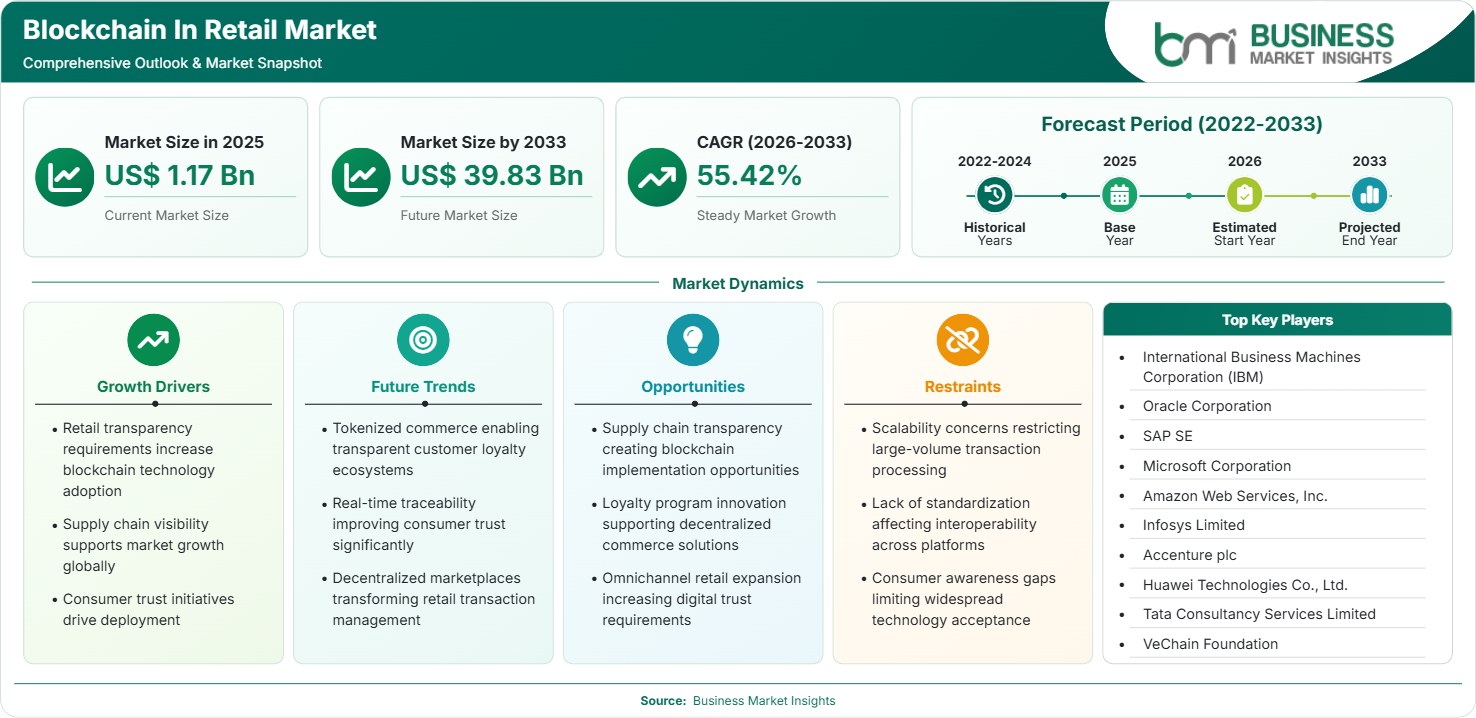
The Blockchain in Retail Market size was valued at US$ 1.17 Billion in 2025 and is projected to reach US$ 39.83 Billion by 2033, growing at a CAGR of 55.42% during 2026–2033. Key growth catalysts include supply chain transparency, counterfeit prevention, digital identity adoption, smart contract deployment, and rising investments in traceability platforms across omnichannel retail ecosystems.

Report Coverage
  • Component: Platform/Solutions, Services
  • Type: Public Blockchain, Private Blockchain, Consortium Blockchain
  • Application: Supply Chain Management, Food Safety Management, Customer Data Management, Identity Management, Compliance Management, Billing Transaction Processing, Others
US$ 1.17 Bn Market size in 2025
US$ 39.83 Bn Market Size by 2033
55.42% CAGR, 2026 - 2033
2026-2033 Forecast Period

AI Overview

Blockchain In Retail Market Summary

  • North America Region: North America holds a market share of 37%–40% in 2025, growing with a CAGR of 52%–55% during 2026–2033, supported by enterprise blockchain spending, retail digitization, and traceability mandates. Opportunities are emerging through tokenized loyalty ecosystems, real-time inventory visibility, and interoperable retail networks across major supply chains. The U.S. market benefits from large-scale retailer investments, cloud blockchain integration, and an estimated CAGR of 53%–56% through 2033.
  • Fastest Growing Region: Asia Pacific accounts for a 24%–27% share in 2025 and is expected to expand at a CAGR of 58%–61% during 2026–2033. Growth is supported by expanding digital commerce ecosystems, mobile payment adoption, government-backed distributed ledger initiatives, and increasing demand for transparent sourcing among regional retailers.
  • Leading Segment: Supply Chain Management represents a 32%–35% Blockchain in Retail Market share in 2025 and advances at a 54%–57% CAGR through 2033. Retailers increasingly deploy immutable product tracking, supplier verification, inventory synchronization, and automated contract execution to improve efficiency, reduce losses, and strengthen consumer confidence.
  • High Growth Segment: Customer Data Management Identity Management captures 14%–17% share in 2025 and grows at 59%–62% CAGR during 2026–2033. Adoption accelerates as retailers prioritize secure digital identities, customer-controlled data permissions, privacy compliance, and personalized engagement across physical and digital channels.
  • Key Market Opportunity: Retailers are increasingly investing in blockchain-enabled provenance systems that verify product origin, sustainability claims, ethical sourcing standards, and transaction records, creating differentiated consumer experiences and measurable supply chain intelligence.
  • Major Market Players: International Business Machines Corporation (IBM), Oracle Corporation, SAP SE, Microsoft Corporation, Amazon Web Services, Inc., Infosys Limited, Accenture plc, Huawei Technologies Co., Ltd., Tata Consultancy Services Limited, and VeChain Foundation.
Strategic Insights

Blockchain In Retail Market: Strategic Insights

Blockchain In Retail Market Strategic Framework
FREE PDF
Request your free sample
Request free sample
Stakeholder View

Key Takeaways

  • Retail value chains are increasingly transitioning toward decentralized information architectures, allowing suppliers, distributors, logistics providers, and merchants to access synchronized and immutable operational records.
  • Supply chain management and digital identity applications present the strongest commercial upside as retailers seek measurable improvements in traceability, fraud reduction, and customer trust.
  • Innovation activity is moving toward AI-enabled blockchain platforms that combine predictive analytics, automated compliance workflows, and real-time transaction validation capabilities.
  • Asia Pacific offers a compelling investment case due to expanding digital commerce infrastructure, strong fintech ecosystems, and growing government interest in distributed ledger adoption.
  • Strategic acquisitions and partnership agreements increasingly focus on blockchain-as-a-service capabilities, cloud-native architectures, and interoperability technologies supporting enterprise-scale deployments.
  • Sustainability verification and ethical sourcing documentation are emerging as differentiating capabilities for premium brands seeking stronger consumer confidence and regulatory alignment.
Geographic Outlook

Blockchain In Retail Market Regional Highlights

North America Blockchain in Retail Market

North America accounted for approximately 37%–40% of the Blockchain in Retail Market share in 2025 and is projected to record a 52%–55% CAGR between 2026 and 2033. Market expansion is supported by strong enterprise software adoption, widespread cloud infrastructure, and retailer investments in transparent sourcing systems. Large retailers are deploying distributed ledger technologies to reduce fraud, optimize inventory management, and improve supply chain accountability. Continued collaboration among technology vendors, logistics providers, and retailers strengthens commercialization prospects across diverse retail formats.

  • Major retailers increasingly implement blockchain-enabled provenance tracking to combat counterfeit products, improve supplier verification, and satisfy consumer expectations regarding authenticity, quality assurance, and ethical sourcing practices.
  • Cloud service providers are expanding blockchain-as-a-service offerings, reducing deployment complexity and enabling retailers to integrate traceability capabilities without substantial infrastructure investments.
  • Sustainability reporting requirements encourage broader adoption of immutable record-keeping systems capable of validating emissions, sourcing standards, and supplier compliance throughout retail operations.
  • Growing integration between IoT devices and distributed ledgers enables automated monitoring of inventory movement, storage conditions, and product lifecycle events across retail networks.

US Blockchain in Retail Market

The United States accounted for 78%–82% of North American revenue in 2025 and is expected to grow at a 53%–56% CAGR through 2033. The technological infrastructure, higher e-commerce penetration, and substantial investments by large retailers are the major factors driving market growth. Companies are focusing on blockchain-based traceability solutions to monitor suppliers and customers and meet compliance requirements. The rise in the presence of blockchain platform vendors, cloud services ecosystem, and digital identity solutions is contributing to the country's leadership within the region.

  • Retail chains increasingly connect supplier networks through distributed ledgers, enabling end-to-end product visibility and reducing reconciliation inefficiencies across procurement, warehousing, transportation, and store operations.
  • Food retailers are deploying blockchain-powered traceability systems to rapidly identify contamination origins, improve recall management processes, and enhance transparency regarding sourcing and production practices.
  • Loyalty program modernization is gaining traction as tokenized reward ecosystems improve interoperability, customer engagement, redemption flexibility, and partner collaboration across retail channels.
  • Digital identity solutions supported by blockchain infrastructures assist retailers in strengthening consumer privacy protections while maintaining personalized customer engagement and regulatory compliance objectives.

Europe Blockchain in Retail Market

The European share was around 26%–29% of the Blockchain in Retail Market share in 2025, and Europe is forecasted to witness a CAGR of 53%–56% from 2026 - 2033. Retailers in this region are using traceability platforms to help them meet their sustainability targets and ensure product transparency. The presence of advanced retail supply chains and robust data governance policies facilitates technology adoption in businesses. Germany still holds its position as the top market in Europe, whereas Spain and certain Nordic countries are fast-growing markets.

  • European retailers increasingly use distributed ledger solutions to document sustainability claims, ethical sourcing standards, and circular economy initiatives across complex multinational supply networks.
  • Germany maintains regional leadership through strong enterprise software deployment, advanced manufacturing-retail linkages, and broad participation in digital transformation programs supporting distributed ledger adoption.
  • Spain is emerging as one of the fastest-growing countries, supported by expanding omnichannel retail models and increasing investments in supply chain transparency technologies.
  • Luxury goods retailers are strengthening product authentication processes through blockchain-enabled digital certificates that help combat counterfeiting and improve customer confidence.
  • Regulatory emphasis on consumer data protection encourages retailers to explore decentralized identity management frameworks that improve transparency while maintaining strict privacy standards.

Asia Pacific Blockchain in Retail Market

Asia Pacific held around 24%-27% market share in 2025 and is expected to grow at the highest regional CAGR, 58%-61%, during 2026-2033. The key factors driving market growth are the development of the digital commerce ecosystem, mobile-first customers, and strong government support for blockchain innovation. China is the leader in regional market adoption through massive technology rollouts, while India is the fastest-growing market due to the rising digitization of the retail sector and the development of the start-up ecosystem.

  • Large e-commerce platforms are implementing blockchain frameworks to improve transaction transparency, enhance seller verification, and strengthen customer trust within rapidly expanding online retail environments.
  • China continues leading deployment volumes through extensive technology investments, sophisticated digital payment ecosystems, and strong enterprise participation in distributed ledger initiatives.
  • India demonstrates one of the strongest growth profiles owing to fast digital adoption, increasing cloud investments, and expanding retailer interest in supply chain modernization.
  • Cross-border commerce applications are gaining traction as blockchain technologies improve documentation accuracy, transaction visibility, and settlement efficiency among regional trading partners.
  • Retailers increasingly combine blockchain, AI, and IoT technologies to create data-rich supply chain intelligence capabilities supporting operational optimization and customer experience improvement.

Rest of World Blockchain in Retail Market

The Rest of World region accounted for approximately 8%–11% of the Blockchain in Retail Market in 2025 and is projected to achieve a 54%–57% CAGR through 2033. South and Central America benefit from increasing retail digitization and the expansion of fintech ecosystems. Brazil leads regional deployment activity, while Mexico demonstrates significant growth potential through omnichannel retail investments.

Middle East and Africa markets continue developing through smart city initiatives, digital commerce expansion, and government-supported innovation programs. The UAE leads adoption levels, while Saudi Arabia represents one of the fastest-growing opportunities due to ongoing technology modernization efforts across retail and logistics sectors.

  • Brazilian retailers increasingly explore blockchain-based supply chain visibility platforms to reduce inefficiencies, strengthen sourcing transparency, and enhance inventory management capabilities.
  • Mexico benefits from rising digital payment adoption and growing interest in transparent retail ecosystems supporting customer trust and transaction verification requirements.
  • The UAE maintains regional leadership through technology-focused economic diversification strategies and strong support for enterprise digital transformation initiatives.
  • Saudi Arabia is emerging rapidly owing to investments in digital infrastructure, logistics modernization, and innovation programs aligned with broader economic diversification objectives.
  • Food traceability, pharmaceutical retail monitoring, and luxury goods authentication applications continue driving adoption across several developing economies.
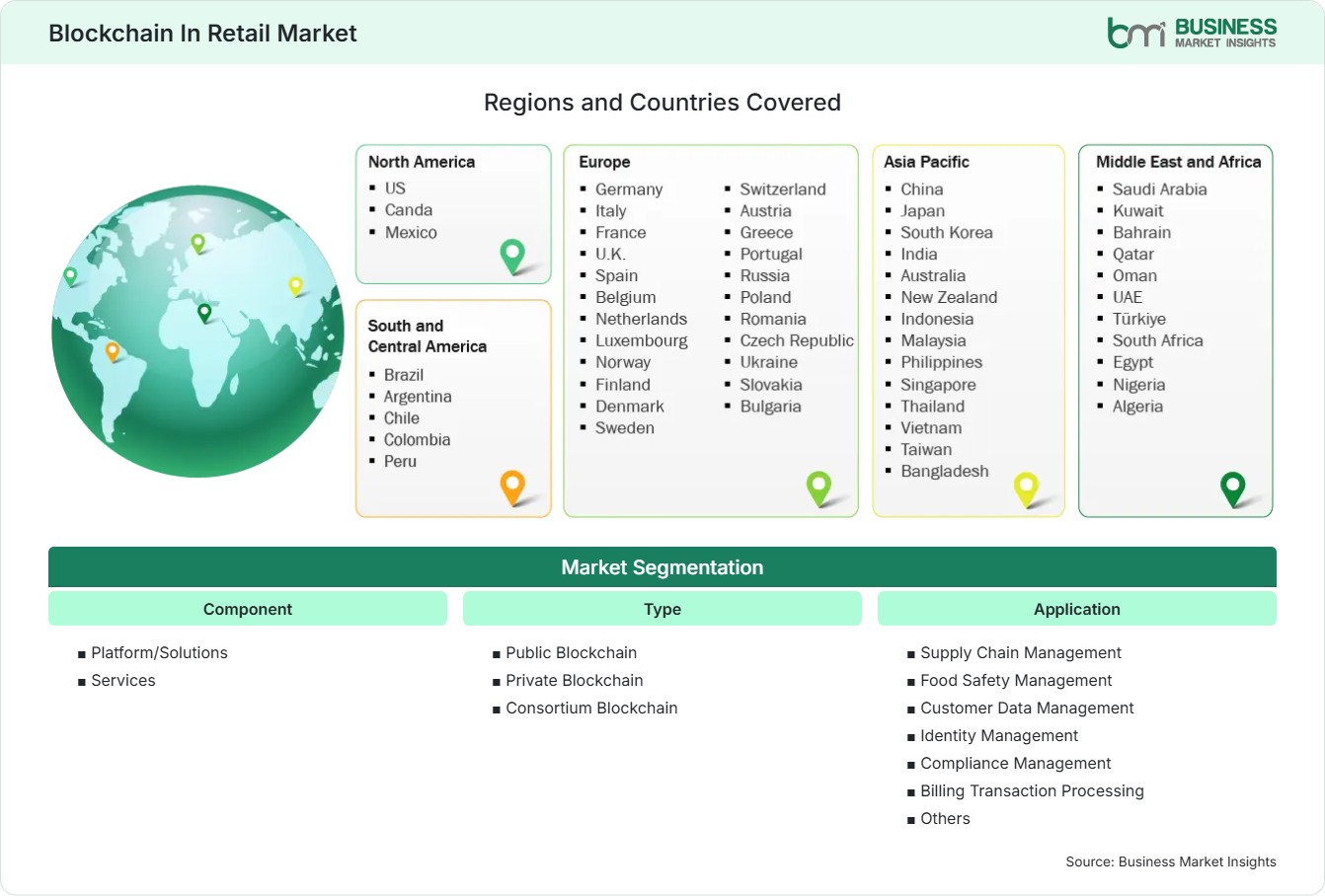
Global Market Geography
FREE PDF
Request your free sample
Request free sample
Segment Analysis

Blockchain In Retail Market Segmentation

Component

The Component sector continues to play an important role in adoption approaches. In 2025, this sector accounted for about 48%-51% of market share and is projected to grow at a CAGR of 54%-57% from 2025 through 2033. The factors influencing demand include scalability of deployment approaches, integrability, and increased interest of retailers in transparency. The Blockchain in Retail Market scope is growing as organizations are purchasing both software solutions and consulting services for blockchain implementation.

  • Platform/Solutions: Retailers increasingly deploy blockchain platforms to manage traceability, automate contracts, validate transactions, and integrate supply chain data streams across multi-vendor retail ecosystems while improving operational efficiency.
  • Services: Consulting, implementation, maintenance, and managed services support enterprise adoption by helping retailers overcome deployment complexity, regulatory considerations, and integration challenges associated with distributed ledger technologies.

Type

Type segmentation depends on distinct needs for transparency, governance, scalability, and access to information. This segment was characterized by very high demands from enterprises in 2025; they chose blockchain technologies based on their needs. All segments have been showing very good development rates, driven by greater digitization efforts and collaboration needs. Retailers balance different criteria when choosing a technology.

  • Public Blockchain: Open transparency and decentralized validation attract use cases involving product authenticity verification, customer engagement initiatives, and multi-party information sharing among retailers and consumers.
  • Private Blockchain: Enterprises prefer private networks when greater control, enhanced data confidentiality, faster transaction processing, and internal governance requirements are prioritized across retail operations.
  • Consortium Blockchain: Collaborative governance structures support industry-wide traceability programs, supplier networks, and shared retail ecosystems where multiple stakeholders require trusted, synchronized operational information.

Application

The application diversity continues to grow as retailers become aware of their strategic importance beyond just keeping transaction records. The market leader in Supply Chain Management was projected to hold a 32%-35% share in 2025, with an estimated CAGR of 54%-57% through 2033. At the same time, the fastest-growing sector was Customer Data Management and Identity Management, with a 59%-62% CAGR. Growing interest in transparency, compliance, and secure digital interactions continues to shape Blockchain in Retail Market trends across application environments.

  • Supply Chain Management: Enables real-time tracking, provenance verification, supplier accountability, and operational visibility, helping retailers improve efficiency and strengthen consumer trust throughout product journeys.
  • Food Safety Management: Supports rapid contamination tracing, recall optimization, and documentation transparency while helping retailers meet increasingly stringent food quality and safety expectations.
  • Customer Data Management Identity Management: Empowers consumers with greater control over personal information while enhancing privacy compliance, secure authentication, and personalized retail engagement capabilities.
  • Compliance Management: Provides immutable audit trails and transparent documentation processes that streamline regulatory reporting and support adherence to evolving retail governance standards.
  • Billing Transaction Processing: Facilitates secure transaction verification, automated settlements, reduced reconciliation costs, and enhanced operational efficiency across retail payment environments.
Market Forces

Blockchain In Retail Market Dynamics

Key Market Drivers

Growing Demand for End-to-End Supply Chain Transparency

Global retail supply chains are becoming increasingly complex, involving multiple sourcing locations, logistics providers, manufacturing partners, and distribution channels. Retailers are adopting blockchain technology to track their transactions with unchangeable records and improve transparency from the source to sales points. The demand for traceability in food retailers, luxury goods, and consumer goods companies is arising because of consumers' need to ensure that products are authentic and sustainable. Digital traceability projects from the World Economic Forum and GS1 are still pushing towards digital traceability. All these aspects are still important drivers of market growth.

Expansion of Digital Identity and Data Privacy Requirements

In retail firms, there is rising demand for the security of customer information against potential threats amid new privacy regulations. Blockchain-based identity management will ensure decentralized identity authentication, helping to avoid cybersecurity risks. Consumer-controlled identity management solutions provide insights into how they share their data. There has been an increased need for secure customer identification systems due to the growing trend toward omnichannel retail. The growing popularity of digital wallets, loyalty platforms, and personalized engagement initiatives further boosts adoption. As retailers seek stronger protection against breaches and unauthorized access, distributed identity technologies continue driving enterprise investment and implementation activity.

Integration of Blockchain with IoT and Intelligent Retail Systems

Blockchain technology and IoT sensors are increasingly used together to enhance operational intelligence for retailers. Sensors provide real-time data on how products are moved and stored, whether temperatures are within range, and stock levels. Blockchain helps ensure that the record cannot be altered while also providing a safe environment for storing data for all stakeholders. Intelligent retail infrastructures can also perform automated reconciliation, make decisions more quickly, and improve customer service outcomes. As businesses move forward with their digital transformations, these types of technology integrations are becoming even more popular, with distributed ledger systems continuing to build momentum for enterprise-scale deployments across numerous retail applications.

Key Market Opportunities

Expansion of Blockchain-Enabled Sustainability Verification Platforms

There is growing demand for retail brands to demonstrate environmental performance, ethical sourcing, labor standards, and sustainability efforts. Blockchain systems provide a way to trace the source of origin, greenhouse gas emissions, certifications, and compliance levels of suppliers. Consumers tend to prefer products with verifiable sustainability credentials, primarily in premium segments of the food, clothing, and cosmetics industries. Companies have an opportunity to offer differentiated products by showing product histories through QR codes and digital solutions. There is an increasing trend of investments in traceability solutions focused on sustainability. These developments create attractive opportunities for technology providers delivering scalable verification, monitoring, and reporting capabilities.

Tokenized Loyalty Programs and Consumer Engagement Models

Retail loyalty programs have evolved from the usual points system to token-based systems that leverage blockchain technology. Interoperability of rewards, ownership verification, and flexible redemption options become possible in tokenized loyalty systems. It provides retailers with more opportunities for engagement and retention, while consumers gain enhanced transparency into the accrual and redemption of rewards. Moreover, tokenization of digital assets would provide a means to design tailored marketing campaigns, build communities, and build brand partnerships. Given the growing importance of the digital user experience for consumers, blockchain-based loyalty solutions could be a significant growth area. More investments are expected as retailers look for unique approaches to building customer relationships and lifetime value.

Cross-Border Retail Networks and Blockchain in Retail Market Forecasts

The international retail business is characterized by the need for coordination among suppliers, logisticians, customs, and retailers. Blockchain can help simplify document processing, ensure greater transparency, and reduce reconciliation time. More and more organizations planning expansion into regions and globally are considering distributed ledgers as an important component of efficient management. The development of new models of digital trade and growth in cross-border e-commerce activities create a good opportunity for this technology. The long-term Blockchain in Retail Market forecasts are driven by demand for secure data exchange, faster payments, and cooperation.

Market Restraints and Challenges

Integration Complexity Across Legacy Retail Infrastructure

Factor: Many retailers still have enterprise resource planning, inventory, and supply chain management systems built over many years. Impact: Integrating with other systems will become difficult for such retailers, delaying implementation and increasing the cost of integrating existing systems with the blockchain-based system. It is common for specific interfaces, testing, and workflow changes to be needed for these retailers to see any operational improvement. This can delay investment, particularly for medium enterprises with limited technology funding. Collaboration among suppliers, distributors, and external parties is yet another area of concern. Integration barriers are thus among the major factors affecting the adoption of e-commerce.

Data Governance, Scalability, and Regulatory Uncertainty

Factor: Regulatory and governance standards and data management procedures differ across regions, creating uncertainty for multinational retailers when implementing DLT. Impact: It can cause problems in complying with requirements, incur extra expenses, and delay the participation of all stakeholders in the process. Issues with scalability arise when transaction speed is required. There are challenges in maintaining the balance between transparency and privacy. Standards associated with electronic documents, verification, and international data exchange influence the implementation process. These challenges can restrict deployment speed despite strong underlying demand for blockchain-enabled retail innovation.

Company Analysis

Competitive Landscape

The competitive environment remains characterized by partnerships among cloud providers, enterprise software companies, consulting firms, and blockchain specialists. Current Blockchain in Retail Market analysis indicates increasing emphasis on interoperability, traceability, digital identity, and blockchain-as-a-service capabilities.

Company Name

Overview

Products and Services relevant to this market

International Business Machines Corporation (IBM)

Global technology leader supporting enterprise blockchain adoption across retail supply chain and traceability ecosystems.

IBM Blockchain Platform, food traceability solutions, supply chain transparency tools, consulting and integration services.

Oracle Corporation

Enterprise software provider enabling distributed ledger deployments for retail operations and transaction management.

Oracle Blockchain Platform, supply chain visibility tools, cloud integration services, enterprise data management solutions.

SAP SE

Major enterprise application provider supporting blockchain integration across retail and logistics processes.

SAP Business Network solutions, supply chain traceability, procurement systems, digital commerce integration capabilities.

Microsoft Corporation

Cloud technology company delivering scalable blockchain-enabled services through enterprise cloud environments.

Azure infrastructure, digital identity services, data integration platforms, analytics and automation tools.

Amazon Web Services, Inc.

Leading cloud provider offering managed blockchain infrastructure for enterprise deployment requirements.

Blockchain services, cloud hosting, analytics platforms, security capabilities, enterprise integration support.

Infosys Limited

Global IT services company supporting blockchain transformation strategies for retail enterprises.

Consulting, implementation services, digital transformation programs, blockchain development and support services.

Accenture plc

Professional services organization assisting enterprises with blockchain strategy and deployment initiatives.

Advisory services, blockchain consulting, supply chain modernization, system integration and managed services.

Huawei Technologies Co., Ltd.

Technology company providing digital infrastructure supporting distributed ledger environments.

Cloud solutions, digital platforms, connectivity infrastructure, enterprise technology services.

Tata Consultancy Services Limited

IT services and consulting provider enabling blockchain adoption across retail ecosystems.

Blockchain frameworks, consulting services, system modernization, supply chain solutions and support.

VeChain Foundation

Blockchain specialist focused on traceability, product verification, and transparency applications.

Provenance tracking platforms, authentication systems, sustainability verification solutions, blockchain ecosystem services.

Trust & Transparency

Research Methodology

The market analysis combines proprietary research with secondary data from government agencies, company disclosures, regulatory filings, industry databases and expert interviews. Market estimates are validated through data triangulation, cross-market benchmarking and analyst review.

View Full Research Methodology

Questions Answered

Frequently Asked Questions

Why are digital identity solutions gaining importance in retail?

Retailers increasingly require secure mechanisms for authentication, consent management, privacy compliance, fraud mitigation, and personalized engagement while providing consumers greater control over personal information.

How does the Blockchain in Retail Market Report help stakeholders?

The Market Report provides strategic intelligence regarding technology adoption, regional opportunities, competitive positioning, investment priorities, emerging applications, and long-term industry transformation trends.

What role does blockchain play in retail sustainability initiatives?

Blockchain creates immutable records documenting sourcing conditions, certifications, emissions data, and supplier compliance, enabling retailers to validate sustainability claims and improve consumer confidence in product origins.

Which region presents the strongest future investment opportunity?

Asia Pacific offers the most attractive growth profile, supported by expanding e-commerce ecosystems, government-backed digital initiatives, growing cloud deployments, and accelerating retailer technology investments across major economies.

Which retail application currently generates the highest blockchain adoption?

Supply Chain Management remains the leading application because retailers prioritize product provenance, supplier visibility, inventory accuracy, recall efficiency, and counterfeit prevention across increasingly globalized sourcing networks.

Access the Full Blockchain In Retail Market Report

Get segment-level forecasts, regional estimates, competitive benchmarking, company profiles and downloadable Excel datasets.

Access the full Blockchain In Retail Market Report
350 pages PDF & Excel | 2026-10-28
Similar Research

Related Market Reports