
Low Code Development Platform Market Outlook: Size, Share, Trends, Growth Analysis, Competitive Landscape & Forecast, 2026-2033

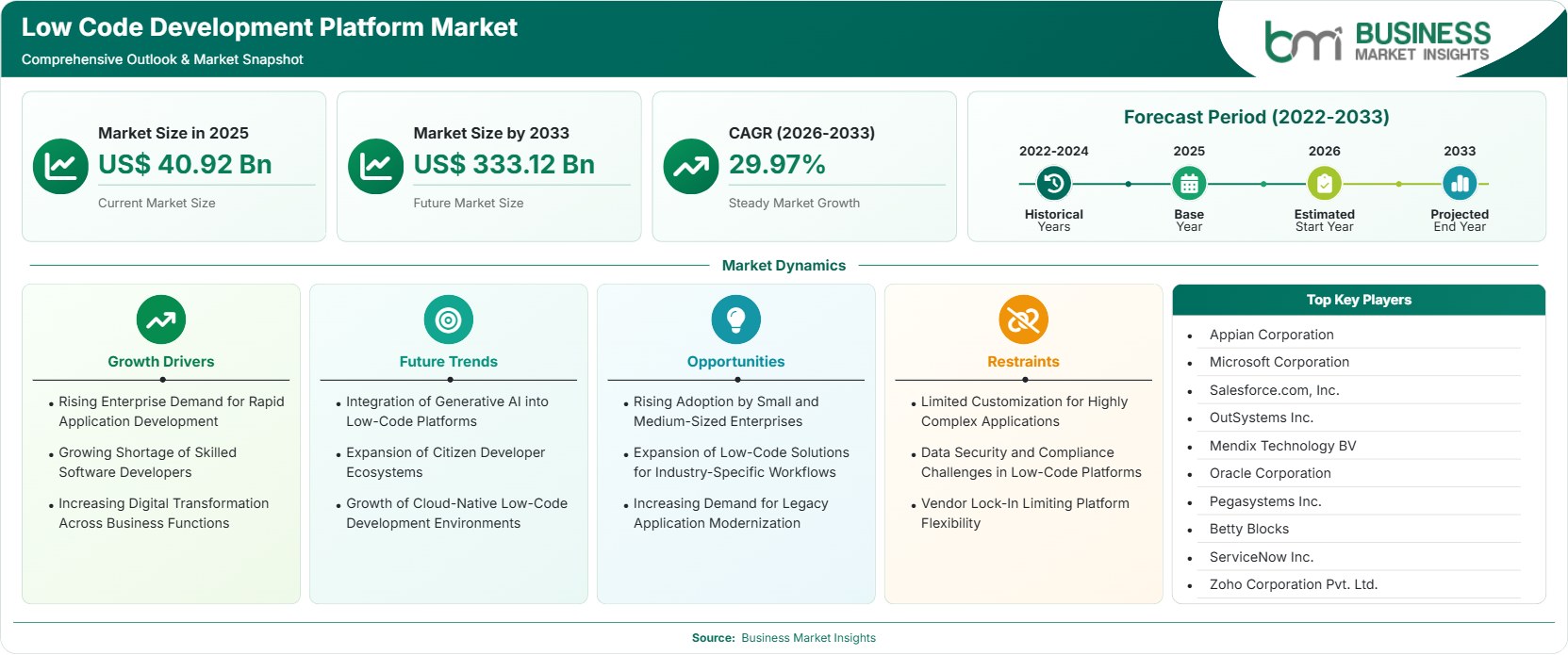
The Low Code Development Platform Market size was valued at US$ 40.92 Billion in 2025 and is projected to reach US$ 333.12 Billion by 2033, growing at a CAGR of 29.97% during 2026–2033. Rising demand for rapid application development, increasing digital transformation initiatives, growing shortage of skilled software developers, and expanding enterprise automation requirements are supporting market growth. Opportunities are emerging from AI-assisted application development, citizen developer adoption, and increasing deployment of low-code platforms across industry verticals.

Report Coverage
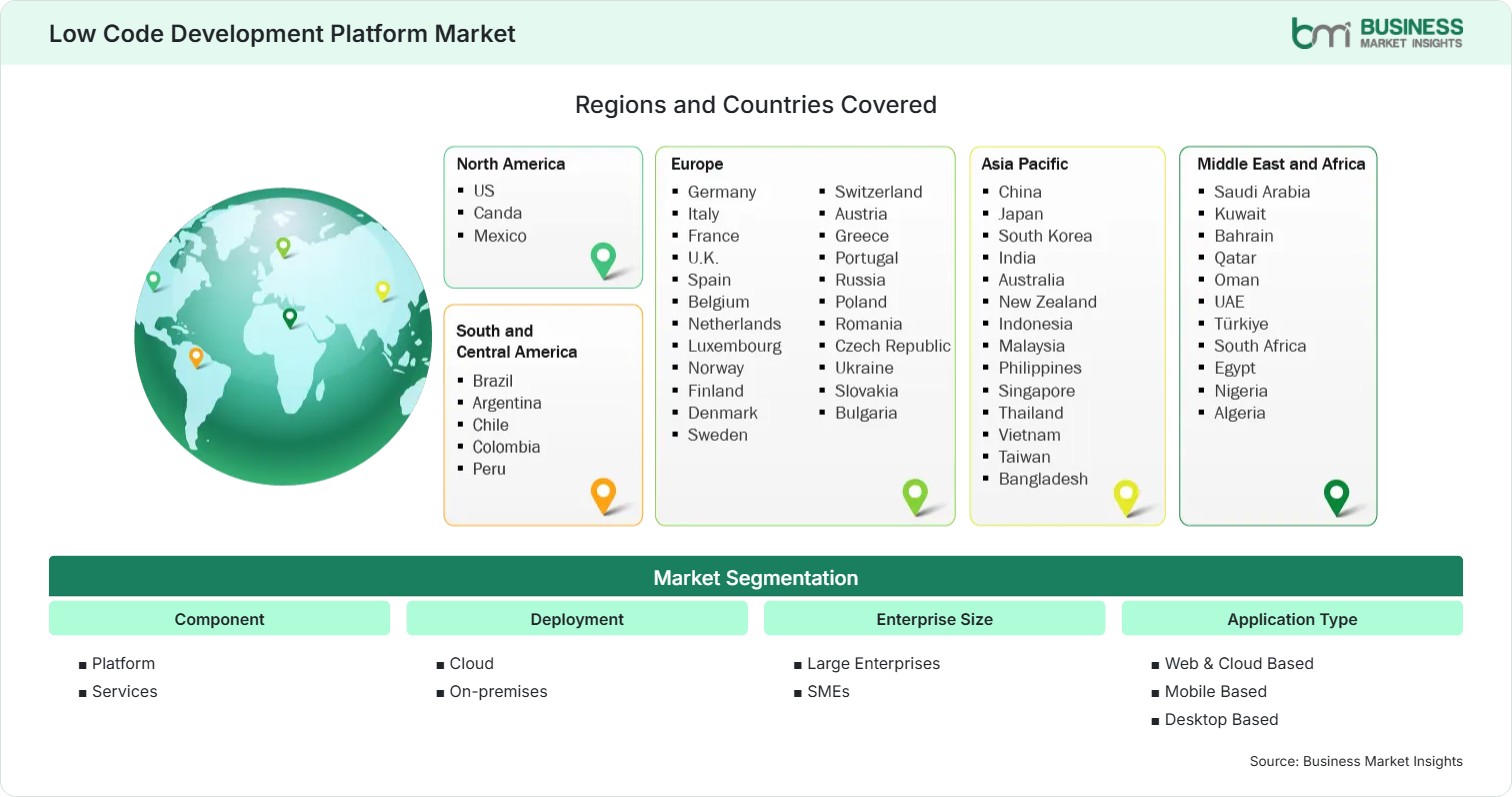
  • Component: Platform, Services
  • Deployment: Cloud, On-premises
  • Enterprise Size: Large Enterprises, SMEs
  • Application Type: Web & Cloud Based, Mobile Based, Desktop Based
  • Industry: BFSI, Healthcare, Education, IT and Telecommunication, Media & Entertainment, Manufacturing, Government, Retail, Others
US$ 40.92 Bn Market size in 2025
US$ 333.12 Bn Market Size by 2033
29.97% CAGR, 2026 - 2033
2026-2033 Forecast Period

01 AI Overview

Low Code Development Platform Market Summary

  • North America Region: North America holds a low code development platform market share of 36%–39% in 2025 and is projected to grow at a CAGR of 29%–31% during 2026–2033. Strong enterprise digitization, high cloud adoption, and extensive investment in application modernization support regional leadership. The US market is projected to grow at a CAGR of 29.5%–31.5% through 2033.
  • Fastest Growing Region: Asia Pacific accounts for 24%–27% share in 2025 and is expected to grow at a CAGR of 32%–34% during the forecast period. Rapid digital transformation, increasing SME technology adoption, and growing cloud infrastructure investments are driving regional growth.
  • Leading Segment: Platform represents 73%–76% share in 2025 and is projected to grow at a CAGR of 30.2%–32.2% through 2033. Organizations increasingly prefer comprehensive low-code platforms that accelerate application development and deployment.
  • High Growth Segment: Cloud Deployment holds 67%–70% share in 2025 and is projected to grow at a CAGR of 31%–33% during 2026–2033 due to scalability, flexibility, and reduced infrastructure management requirements.
  • Key Market Opportunity: Growing adoption of AI-powered development tools, citizen developer programs, and enterprise workflow automation initiatives is creating substantial opportunities across global markets.
  • Major Market Players: Appian Corporation, Microsoft Corporation, Salesforce.com, Inc., OutSystems Inc., Mendix Technology BV, Oracle Corporation, Pegasystems Inc., Betty Blocks, ServiceNow Inc., and Zoho Corporation Pvt. Ltd.
02 Strategic Insights

Low Code Development Platform Market: Strategic Insights

low-code-development-platform-market-market-strategic-framework
FREE PDF
Request your free sample
Request free sample
03 Stakeholder View

Key Takeaways

  • Low-code development platforms enable organizations to build, deploy, and manage applications with minimal coding, accelerating digital transformation while reducing development time and costs.
  • Cloud deployment leads adoption due to its scalability, lower infrastructure costs, rapid implementation, and seamless integration with enterprise environments.
  • Large enterprises generate significant demand as they invest in application modernization, workflow automation, and enterprise-wide digital transformation initiatives.
  • Citizen developers are expanding platform adoption by allowing business users to create applications with limited coding knowledge, reducing dependence on IT teams.
  • AI-powered capabilities are strengthening platform competitiveness through automated code generation, intelligent testing, workflow optimization, and faster application delivery.
  • Asia Pacific is the fastest-growing region, driven by rising cloud adoption, digitalization initiatives, and increasing enterprise technology investments.
  • Low code development platform market trend suggest that the growing integration of artificial intelligence, robotic process automation, and cloud-native technologies is enabling intelligent application development, improving operational agility, and accelerating enterprise digital transformation across industries.
04 Geographic Outlook

Low Code Development Platform Market Regional Highlights

North America Low Code Development Platform Market

North America accounted for a 36%–39% share in 2025 and is projected to expand at a CAGR of 29%–31% during 2026–2033. The region benefits from strong enterprise technology spending, advanced cloud infrastructure, early adoption of automation technologies, and extensive digital transformation initiatives. The Low Code Development Platform Market share remains concentrated in the US due to the presence of major technology vendors, growing demand for rapid software development, and increasing enterprise modernization projects.

  • Enterprises are increasingly utilizing low-code solutions to accelerate application deployment and reduce dependence on traditional software development cycles.
  • Financial institutions, healthcare providers, and government agencies are investing heavily in workflow automation and application modernization initiatives.
  • Organizations are adopting citizen developer strategies to address developer shortages and improve business agility.
  • AI-enabled low-code platforms are gaining popularity for automating development processes and improving productivity.
  • Legacy system modernization projects continue generating strong demand across large enterprises.

US Low Code Development Platform Market

The US represented a 31%–34% share in 2025 and is estimated to grow at a CAGR of 29.5%–31.5% through 2033. Strong cloud adoption, enterprise software investments, and increasing demand for digital business solutions support market expansion. The low code development platform market growth in the US is driven by rising adoption of process automation tools, low-code application development platforms, and AI-powered software development technologies.

  • Businesses are increasingly deploying low-code platforms to reduce application development costs and improve operational efficiency.
  • Demand for rapid digital innovation is encouraging enterprises to expand low-code adoption across departments.
  • Technology companies are integrating generative AI and automation features into development platforms.
  • Growing focus on customer experience and workflow optimization continues supporting platform investments.

Europe Low Code Development Platform Market

Europe held a 26%–29% low code development platform market share in 2025 and is expected to grow at a CAGR of 28%–30% from 2026–2033. Germany, the UK, and France represent major markets due to increasing digital transformation initiatives, strong enterprise software adoption, and growing demand for automation technologies. Germany is estimated to expand at 29%–31% CAGR, supported by Industry 4.0 programs and enterprise modernization efforts.

  • Organizations are increasingly deploying low-code platforms to support digital business transformation and workflow automation.
  • Germany is witnessing growing demand for application modernization solutions across manufacturing and industrial sectors.
  • The UK market benefits from increasing adoption of cloud-based enterprise applications and process automation tools.
  • French enterprises are utilizing low-code technologies to improve operational flexibility and accelerate innovation.
  • Regulatory compliance requirements are encouraging adoption of platforms capable of rapidly adapting business applications.

Asia Pacific Low Code Development Platform Market

Asia Pacific accounted for a 24%–27% share in 2025 and is projected to register a CAGR of 32%–34% during 2026–2033. China, India, Japan, and South Korea are leading markets due to rapid digitalization, expanding SME technology adoption, and increasing cloud infrastructure investments. China is expected to grow at 33%–35% CAGR, while India demonstrates strong growth potential with a CAGR of 34%–36% during the forecast period.

  • Businesses are increasingly adopting low-code platforms to accelerate digital transformation and application deployment.
  • China continues investing heavily in cloud computing, automation, and enterprise software modernization.
  • India is witnessing strong adoption among SMEs seeking cost-effective development solutions.
  • Growing startup ecosystems are contributing to rising demand for agile application development tools.
  • Organizations are utilizing low-code technologies to bridge software developer shortages and support innovation.

Rest of World Low Code Development Platform Market

Rest of World accounted for a 8%–11% share in 2025 and is expected to grow at a CAGR of 27%–29% through 2033. Latin America, the Middle East, and Africa are witnessing increasing adoption of cloud-based business applications, automation technologies, and enterprise digitization initiatives. Brazil, UAE, and Saudi Arabia represent important growth low code development platform market for low-code platform providers.

  • Organizations are increasingly seeking affordable solutions to accelerate application development and workflow automation.
  • Digital government programs in the Middle East are supporting platform adoption across public sector operations.
  • Brazilian enterprises are investing in business process optimization and customer-facing application development.
  • Cloud infrastructure expansion is enabling broader access to low-code technologies across emerging economies.
  • Growing awareness of digital transformation benefits continues supporting long-term market adoption.
global-market-geography
FREE PDF
Request your free sample
Request free sample
05 Segment Analysis

Low Code Development Platform Market Segmentation

Component

Component segmentation is driven by growing enterprise demand for application development tools, workflow automation capabilities, and platform integration solutions. Platform accounted for 73%–76% share in 2025 and is projected to grow at a CAGR of 30.2%–32.2% through 2033 due to increasing adoption of visual development environments, drag-and-drop interfaces, and application lifecycle management capabilities.

  • Platform: The leading segment owing to growing enterprise investments in application development, process automation, digital transformation, and citizen developer initiatives.
  • Services: Witnessing strong adoption as organizations increasingly require implementation, integration, customization, training, support, and consulting services to maximize platform effectiveness.

Deployment

Deployment preferences are influenced by scalability requirements, infrastructure costs, security considerations, and operational flexibility. Cloud accounted for 67%–70% share in 2025 and is projected to grow at a CAGR of 31%–33% through 2033 due to lower upfront investment requirements and easier deployment across distributed environments.

  • Cloud: The dominant and fastest-growing segment supported by scalability, subscription-based pricing models, remote accessibility, and continuous feature updates.
  • On-Premises: Maintains demand among organizations requiring greater control over data security, regulatory compliance, and internal IT infrastructure management.

Enterprise Size

Enterprise adoption varies according to digital maturity, software development requirements, and automation priorities. Large Enterprises accounted for 64%–67% share in 2025 and are expected to grow at a CAGR of 29%–31% through 2033 due to large-scale modernization initiatives and substantial software development requirements.

  • Large Enterprises: The leading segment in the low code development platform low code development platform market because of extensive digital transformation programs, complex workflow requirements, and ongoing investments in enterprise automation.
  • SMEs: Experiencing rapid growth as affordable cloud-based platforms enable smaller organizations to develop applications without large development teams or substantial IT budgets.

Application Type

Application type segmentation reflects the increasing use of low-code technologies across different software deployment environments. Web & Cloud Based Applications accounted for 48%–51% share in 2025 and are projected to grow at a CAGR of 31%–33% through 2033 due to increasing enterprise demand for scalable and accessible business applications.

  • Web & Cloud Based: The dominant segment supported by rising enterprise cloud adoption, remote work trends, and demand for browser-based business applications.
  • Mobile Based: Growing strongly as organizations prioritize customer engagement, workforce mobility, field service operations, and mobile-first business strategies.
  • Desktop Based: Continues to maintain relevance in industries that require local processing capabilities, specialized applications, and controlled operating environments.

Industry

Industry adoption is expanding rapidly as organizations seek faster software delivery, process automation, and digital innovation capabilities. BFSI accounted for 18%–21% share in 2025 and is projected to grow at a CAGR of 30%–32% through 2033 due to increasing demand for customer-facing applications, process automation, and regulatory compliance solutions.

  • BFSI: The leading segment owing to growing investments in digital banking, customer onboarding platforms, workflow automation, and compliance management applications.
  • Healthcare: Adoption is increasing for patient management systems, telehealth applications, workflow automation, and healthcare data management solutions.
  • Education: Institutions are utilizing low-code platforms to build student portals, learning management applications, and administrative systems.
  • IT and Telecommunication: Demand is supported by service management, operational automation, customer support, and digital transformation initiatives.
  • Media & Entertainment: Companies are deploying applications for content management, audience engagement, workflow coordination, and digital services.
  • Manufacturing: Increasing utilization for production monitoring, supply chain management, quality control, and factory automation applications.
  • Government: Adoption is expanding through citizen service portals, document management systems, and public sector digitization initiatives.
  • Retail: Retailers are leveraging low-code tools to develop customer engagement platforms, e-commerce solutions, and inventory management systems.
  • Others: Includes transportation, hospitality, energy, professional services, and other industries implementing rapid application development and automation solutions.
06 Market Forces

Low Code Development Platform Market Dynamics

Key Market Drivers

Rising Enterprise Demand for Rapid Application Development

Organizations are increasingly seeking faster ways to develop and deploy business applications in response to evolving customer expectations, competitive pressures, and operational requirements. Traditional software development approaches often involve lengthy development cycles, high costs, and significant resource commitments. Low-code platforms enable enterprises to accelerate application delivery through visual development tools, drag-and-drop interfaces, reusable components, and automated workflows. Businesses can rapidly build customer portals, internal management systems, workflow applications, and digital service platforms without extensive coding requirements. The increasing need for business agility and faster innovation cycles continues to drive strong demand for low code development platform market growth across industries.

Growing Shortage of Skilled Software Developers

The global shortage of experienced software developers remains a significant challenge for organizations pursuing digital transformation initiatives. Enterprises often struggle to recruit and retain technical talent while facing increasing demand for application development and modernization projects. Low-code platforms help address this challenge by enabling non-technical users and business teams to participate in application creation through intuitive visual development environments. This reduces dependence on specialized programming expertise while increasing overall development capacity. Businesses are leveraging low-code tools to improve productivity, shorten development timelines, and bridge resource gaps that could otherwise delay critical digital initiatives.

Increasing Digital Transformation Across Business Functions

Digital transformation has become a strategic priority across organizations seeking to improve operational efficiency, customer engagement, and decision-making capabilities. Businesses are digitizing workflows, automating manual processes, modernizing legacy applications, and integrating data across departments. Low-code platforms provide an effective foundation for these initiatives by enabling rapid creation of business applications tailored to specific operational requirements. Organizations can quickly respond to changing market conditions and evolving customer needs without extensive software development cycles. Growing investments in cloud computing, automation technologies, and enterprise software modernization continue accelerating adoption across a wide range of industries.

Key Market Opportunities

Rising Adoption by Small and Medium-Sized Enterprises

Small and medium-sized enterprises are increasingly adopting low-code technologies to accelerate digitalization while minimizing development costs. Many SMEs lack large IT teams and substantial software development budgets, making traditional application development approaches challenging. Low-code platforms provide these organizations with an affordable and scalable alternative for building business applications, automating workflows, and improving operational efficiency. The Low Code Development Platform Market forecast indicates significant expansion opportunities as cloud-based solutions make advanced development capabilities accessible to smaller businesses. Growing awareness of digital transformation benefits is expected to further accelerate SME adoption globally.

Expansion of Low-Code Solutions for Industry-Specific Workflows

Industry-specific applications are creating attractive opportunities for platform providers seeking to differentiate their offerings. Organizations increasingly require solutions tailored to the unique needs of sectors such as healthcare, banking, manufacturing, education, and government. Low-code platforms are being enhanced with pre-built templates, compliance frameworks, workflow modules, and integration capabilities designed for specific industries. These specialized solutions reduce implementation complexity and accelerate deployment. Vendors capable of delivering targeted functionality and industry expertise can strengthen customer adoption and expand their presence within vertical markets.

Increasing Demand for Legacy Application Modernization

Many organizations continue operating legacy software systems that are costly to maintain, difficult to update, and incompatible with modern digital environments. Modernization of these systems represents a significant opportunity for low-code platform providers. Organizations are utilizing low-code technologies to rebuild, extend, or replace outdated applications while minimizing development time and operational disruption. Modernized applications provide better user experiences, improved scalability, stronger integration capabilities, and enhanced business agility. The growing need to modernize aging IT infrastructure is expected to remain a major growth opportunity throughout the forecast period.

Market Restraints and Challenges

Limited Customization for Highly Complex Applications

Factor: While low-code platforms simplify application development, some highly specialized or complex enterprise applications require advanced customization beyond the capabilities of standard visual development environments. Organizations with unique business processes may encounter limitations when attempting to implement highly customized functionality.

Impact: These constraints can reduce platform suitability for certain mission-critical applications and may require additional custom coding efforts. As a result, some organizations continue relying on traditional software development approaches for highly sophisticated projects. Platform providers must continuously expand functionality and flexibility to address evolving enterprise requirements.

Data Security and Compliance Challenges in Low-Code Platforms

Factor: Organizations operating in regulated industries must comply with strict data privacy, security, and governance requirements. Low-code platforms often process sensitive business information and may integrate with multiple enterprise systems, creating additional security and compliance considerations.

Impact: Concerns regarding data protection, regulatory compliance, access control, and governance can slow adoption among highly regulated organizations. Businesses require strong security features, audit capabilities, and compliance frameworks before deploying low-code solutions at scale. Addressing these requirements remains essential for broader enterprise adoption and long-term market expansion.

07 Company Analysis

Competitive Landscape

The Low Code Development Platform Market analysis is characterized by strong competition among enterprise software providers, workflow automation vendors, cloud platform companies, and specialized low-code technology developers. Market participants are focusing on artificial intelligence integration, citizen developer enablement, workflow automation, application modernization, and cloud-native development capabilities to strengthen their market positions. Strategic partnerships, platform ecosystem expansion, and industry-specific solution development continue to influence competitive dynamics across the market. Vendors are also investing heavily in generative AI capabilities, process automation features, and advanced integration tools to improve development speed and user productivity.

Company Name

Overview

Products and Services Relevant to this Market

Appian Corporation

Enterprise software company specializing in process automation and low-code development.

Low-code application development, workflow automation, process orchestration, and business process management solutions.

Microsoft Corporation

Global technology leader with extensive enterprise software and cloud capabilities.

Power Apps, application development tools, workflow automation, cloud services, and AI-enabled low-code solutions.

Salesforce.com, Inc.

Cloud-based enterprise software provider with integrated development platforms.

Low-code development tools, customer application platforms, workflow automation, and business application solutions.

OutSystems Inc.

Specialized low-code platform provider focused on rapid enterprise application development.

Low-code development platforms, application modernization, workflow automation, and digital transformation tools.

Mendix Technology BV

Enterprise low-code development company serving multiple industries.

Application development platforms, process automation, cloud-native applications, and digital innovation solutions.

Oracle Corporation

Global enterprise technology company with comprehensive software portfolio.

Low-code development tools, database integration, cloud applications, and enterprise automation platforms.

Pegasystems Inc.

Software company focused on workflow automation and customer engagement solutions.

Low-code platforms, business process management, customer workflow solutions, and AI-driven automation tools.

Betty Blocks

No-code and low-code application development provider.

Visual application development, workflow automation, citizen developer platforms, and business application tools.

ServiceNow Inc.

Enterprise workflow automation and digital transformation company.

Low-code application development, process automation, workflow management, and enterprise service platforms.

Zoho Corporation Pvt. Ltd.

Software company offering cloud-based business productivity solutions.

Low-code application builders, workflow automation, business applications, and cloud productivity platforms.

10 Trust & Transparency

Research Methodology

The market analysis combines proprietary research with secondary data from government agencies, company disclosures, regulatory filings, industry databases and expert interviews. Market estimates are validated through data triangulation, cross-market benchmarking and analyst review.

View Full Research Methodology

11 Questions Answered

Frequently Asked Questions

What opportunities exist for low-code platform vendors?

Key opportunities include SME adoption, legacy application modernization, AI-powered development tools, industry-specific workflow solutions, citizen developer initiatives, and workflow automation projects.

Why does North America lead the market?

North America leads due to strong enterprise technology adoption, advanced cloud infrastructure, extensive digital transformation programs, and the presence of major low-code platform providers.

Which deployment segment is growing the fastest?

Cloud deployment is the fastest-growing segment due to scalability, lower implementation costs, easier maintenance, subscription-based pricing models, and growing enterprise cloud adoption.

Which component segment dominates the market?

The Platform segment dominates the market due to extensive enterprise demand for visual development environments, application lifecycle management capabilities, workflow automation tools, and business application development solutions.

What is driving growth in the low code development platform market report?

Growth is driven by increasing demand for rapid application development, growing digital transformation initiatives, rising workflow automation requirements, and the shortage of skilled software developers worldwide.

Access the Full Low Code Development Platform Market Report

Get segment-level forecasts, regional estimates, competitive benchmarking, company profiles and downloadable Excel datasets.

Access the full Low Code Development Platform Market Report
350 pages PDF & Excel | 2026-08-05