
Autonomous Vehicle Development Platform Market Outlook: Size, Share, Trends, Growth Analysis, Competitive Landscape & Forecast, 2026-2033

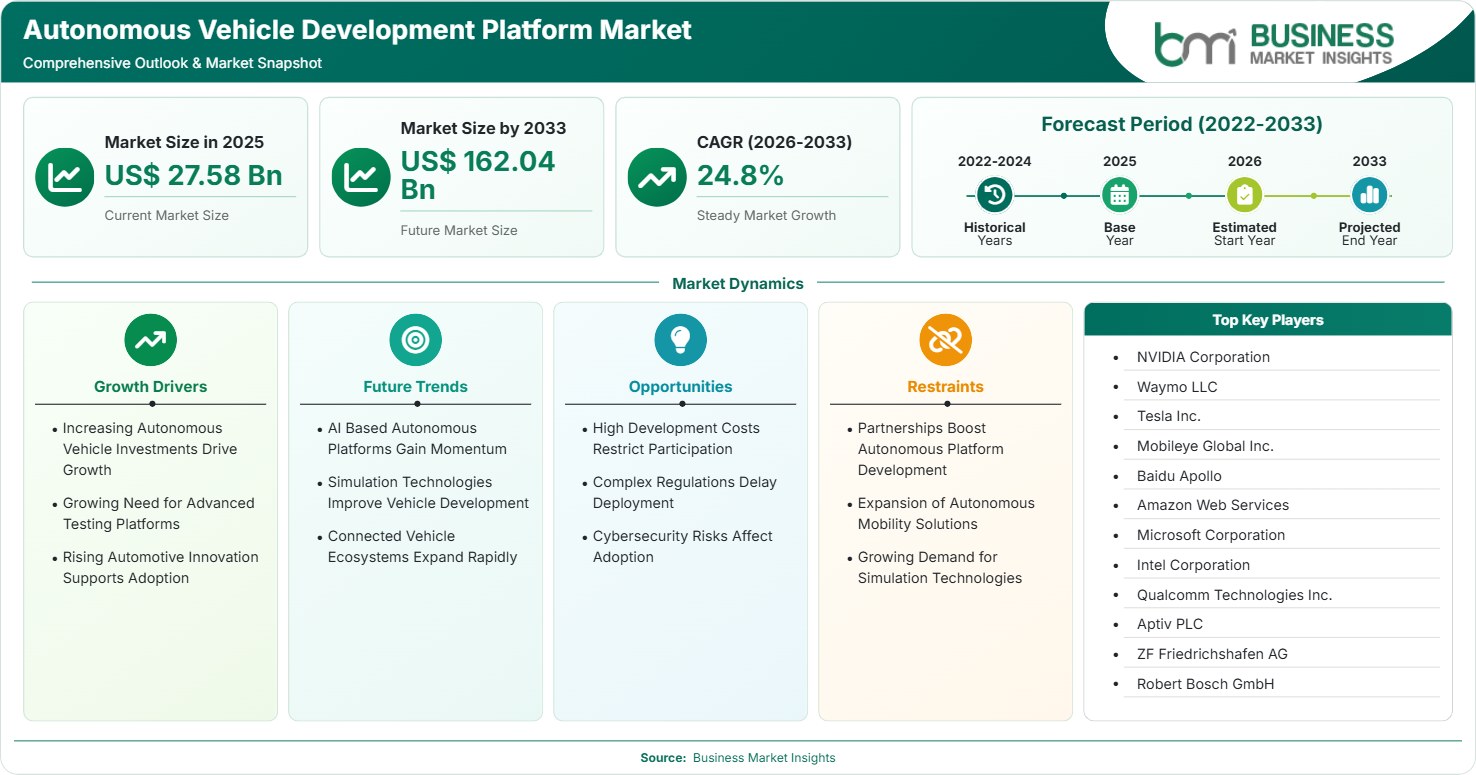
The Autonomous Vehicle Development Platform Market size was valued at US$ 27.58 billion in 2025 and is projected to reach USD 162.04 billion by 2033, growing at a CAGR of 24.8% during 2026–2033, driven by increasing autonomous driving investments, artificial intelligence advancement, sensor technology innovation, simulation capabilities, and connected mobility development are accelerating adoption while creating opportunities across automotive, logistics, transportation, and technology ecosystems.

Report Coverage
  • Vehicle Type: Passenger Car, Light Commercial Vehicle, Heavy Commercial Vehicle
  • Platform Type: Software, Services
US$ 27.58 Bn Market size in 2025
US$ 162.04 Bn Market Size by 2033
24.8% CAGR, 2026 - 2033
2026-2033 Forecast Period

01 AI Overview

Autonomous Vehicle Development Platform Market Summary

  • North America Region: North America holds a market share of 38%–41% in 2025 and is projected to expand at a CAGR of 23.8%–24.8% during 2026–2033, supported by autonomous vehicle testing infrastructure, AI research capabilities, technology investments, and strong presence of leading mobility companies. The United States leads regional demand with a CAGR of 24.0%–25.2% due to extensive autonomous vehicle development activities.
  • Fastest Growing Region: Asia Pacific accounts for 30%–33% of the global market in 2025 and is expected to grow at a CAGR of 25.5%–26.5% during 2026–2033, driven by smart mobility initiatives, automotive technology investments, urban transportation modernization, and increasing autonomous vehicle deployment programs.
  • Leading Segment: Software platforms hold a market share of 65%–68% in 2025 and are projected to register a CAGR of 25.0%–25.8% during 2026–2033, supported by artificial intelligence algorithms, autonomous driving software development, simulation platforms, and advanced perception technologies.
  • High Growth Segment: Heavy Commercial Vehicle applications represent 12%–15% of market demand in 2025 and are anticipated to expand at a CAGR of 26.5%–27.5% during 2026–2033, supported by autonomous logistics, freight optimization, industrial transportation demand, and commercial fleet automation initiatives.
  • Key Market Opportunity: The expansion of autonomous logistics, robotaxi service, connected vehicle ecosystem, AI-based mobility platform, and government-sponsored smart transportation project will provide tremendous opportunities to autonomous vehicle development platform companies.
  • Major Market Players: NVIDIA Corporation; Waymo LLC; Tesla Inc.; Mobileye Global Inc.; Baidu Apollo; Amazon Web Services, Inc.; Microsoft Corporation; Intel Corporation; Qualcomm Technologies, Inc.; Aptiv PLC; ZF Friedrichshafen AG; Robert Bosch GmbH; Continental AG; AutonomouStuff; LG Electronics Inc.; Samsung Electronics Co., Ltd.; Valeo SA; Motional; Aurora Innovation Inc.; Oxbotica.
02 Strategic Insights

Autonomous Vehicle Development Platform Market: Strategic Insights

Autonomous Vehicle Development Platform Market Strategic Framework
FREE PDF
Request your free sample
Request free sample
03 Stakeholder View

Key Takeaways

  • The ecosystem includes semiconductor manufacturers, AI software developers, cloud infrastructure providers, automotive OEMs, sensor companies, simulation providers, and mobility operators creating integrated autonomous development environments.
  • Software platforms represent the highest opportunity area as companies prioritize AI algorithms, simulation tools, perception systems, and autonomous driving software development capabilities.
  • Innovation is shifting toward generative AI, digital twins, edge computing, advanced sensor fusion, and high-performance computing architectures for autonomous decision-making.
  • North America remains a strategic investment region due to strong AI capabilities, autonomous testing infrastructure, technology partnerships, and regulatory development supporting mobility innovation.
  • Companies are increasing investments through partnerships, acquisitions, platform collaborations, and ecosystem expansion to strengthen autonomous vehicle development capabilities.
  • Growing demand for autonomous freight, robotaxis, and industrial mobility solutions is encouraging platform providers to develop scalable solutions across multiple vehicle categories.
04 Geographic Outlook

Autonomous Vehicle Development Platform Market Regional Highlights

North America Autonomous Vehicle Development Platform Market

North America accounts for 38%–41% Autonomous Vehicle Development Platform Market share in 2025 while expanding at a CAGR of 23.8%–24.8% through 2026–2033. Regional leadership is supported by strong artificial intelligence capabilities, autonomous vehicle testing programs, semiconductor innovation, and technology company investments. The United States remains the primary contributor due to advanced mobility ecosystems and extensive autonomous vehicle development activities.

  • The United States dominates regional demand through strong presence of autonomous technology companies, AI developers, and automotive innovators.
  • Technology providers are investing in simulation platforms, autonomous software, and cloud-based development environments for faster vehicle validation.
  • Automotive companies are expanding autonomous testing programs to improve safety, reliability, and commercial deployment readiness.
  • Government initiatives supporting intelligent transportation systems are encouraging investment in autonomous mobility infrastructure.
  • Canada is adopting autonomous technologies through smart transportation projects and research collaborations.

US Autonomous Vehicle Development Platform Market

The United States represents the largest national market, accounting for 34%–36% of global revenue in 2025 while growing at a CAGR of 24.0%–25.2% during 2026–2033. Strong technology infrastructure, AI expertise, autonomous testing programs, and investments from automotive and technology companies continue driving Autonomous Vehicle Development Platform market expansion across passenger and commercial mobility applications.

  • Silicon Valley remains a major autonomous technology hub with extensive AI, software, and mobility innovation activities.
  • Companies are increasing investments in autonomous simulation and validation platforms to reduce development complexity.
  • Fleet operators are exploring autonomous logistics and passenger mobility solutions to improve operational efficiency.
  • Cloud computing providers are supporting autonomous development through scalable data processing and machine learning infrastructure.

Europe Autonomous Vehicle Development Platform Market

Europe contributes 20%–23% of global revenue in 2025 while registering a CAGR of 23.0%–24.0% through 2026–2033. Regional growth is influenced by automotive engineering expertise, connected mobility initiatives, sustainability objectives, and increasing autonomous vehicle testing. Germany and the United Kingdom remain leading markets, while France demonstrates accelerated adoption through mobility innovation programs.

  • Germany leads regional development due to strong automotive manufacturing capabilities and autonomous technology investments.
  • France demonstrates growth with a CAGR of 24.0%–25.0% supported by smart mobility programs and automotive innovation.
  • The United Kingdom continues advancing autonomous vehicle research through technology partnerships and testing initiatives.
  • European automotive suppliers are investing in software-defined vehicle platforms and autonomous driving systems.
  • Regulatory frameworks supporting intelligent transportation are encouraging industry collaboration and technology development.

Asia Pacific Autonomous Vehicle Development Platform Market

Asia Pacific represents 30%–33% of global revenue in 2025 and records the fastest CAGR of 25.5%–26.5% during 2026–2033. Regional growth is driven by smart city programs, automotive technology development, manufacturing capabilities, and increasing autonomous mobility investments. China leads regional demand, while India and South Korea demonstrate strong future growth potential.

  • China dominates regional adoption through autonomous driving research, technology investments, and large-scale mobility initiatives.
  • India is expected to grow at a CAGR of 27.0%–28.0% due to expanding automotive technology development and smart transportation programs.
  • Japan and South Korea are advancing autonomous platforms through semiconductor and automotive innovation.
  • Southeast Asian markets are exploring autonomous transportation solutions for urban mobility challenges.
  • Regional automotive manufacturers are collaborating with technology companies to accelerate autonomous vehicle development.

Rest of World Autonomous Vehicle Development Platform Market

The Rest of World region accounts for 6%–9% of global revenue in 2025 while expanding at a CAGR of 22.5%–23.5% through 2026–2033. Latin America and Middle Eastern markets are exploring autonomous mobility through smart infrastructure programs, logistics automation, and transportation modernization initiatives. Adoption remains concentrated in advanced urban areas and commercial applications.

  • Brazil represents the leading Latin American Autonomous Vehicle Development Platform market, while Mexico records faster growth with a CAGR of 24.0%–25.0% through automotive technology expansion.
  • Middle Eastern countries are investing in autonomous transportation as part of smart city development strategies.
  • Logistics operators are evaluating autonomous solutions to improve freight efficiency and reduce operational costs.
  • Emerging markets are forming partnerships with global technology providers to access autonomous mobility platforms.
  • Infrastructure development and regulatory progress will influence long-term regional adoption.
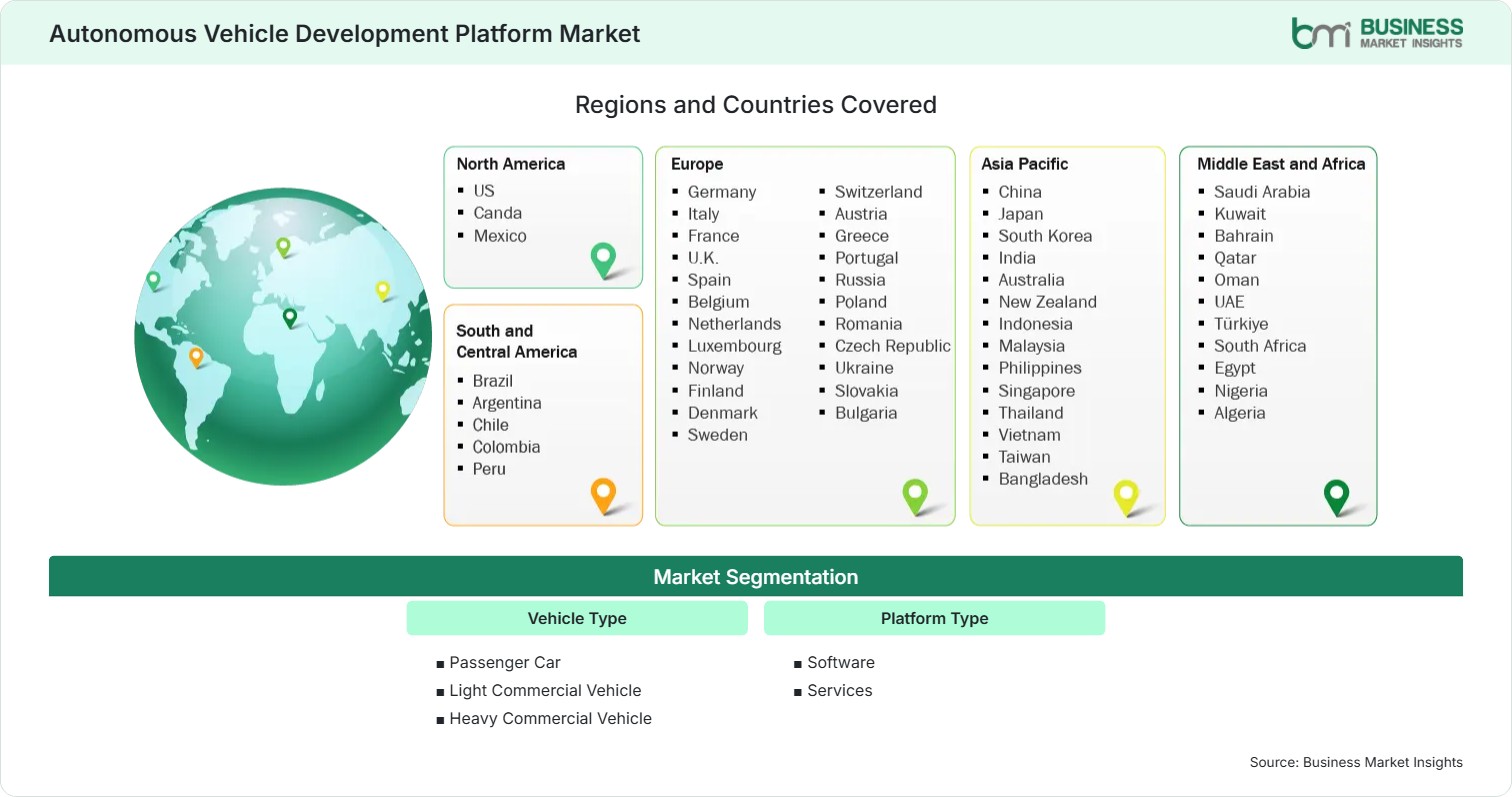
Global Market Geography
FREE PDF
Request your free sample
Request free sample
05 Segment Analysis

Autonomous Vehicle Development Platform Market Segmentation

Vehicle Type

Vehicle type segmentation reflects the adoption of autonomous development platforms across passenger and commercial mobility applications. The segment accounted for 100% of market demand in 2025 and is projected to expand at a CAGR of 24.8% during 2026–2033. Increasing autonomous testing programs, logistics automation, and connected mobility investments are influencing platform deployment across diverse vehicle categories and supporting industry expansion.

  • Passenger Car: Passenger cars represent a major application area due to rising autonomous driving research, advanced driver assistance system integration, and increasing consumer mobility technology investments.
  • Light Commercial Vehicle: Light commercial vehicles are adopting autonomous platforms for delivery services, urban logistics, and fleet optimization applications requiring efficient mobility solutions.
  • Heavy Commercial Vehicle: Heavy commercial vehicles are gaining traction through autonomous freight, mining, and industrial transportation applications focused on improving safety and operational efficiency.

Platform Type

Platform type segmentation highlights the importance of software and service-based solutions in autonomous vehicle development ecosystems. The segment represented 100% of demand in 2025 and is expected to grow at a CAGR of 24.8% through 2026–2033. Advancements in artificial intelligence, cloud computing, simulation environments, and autonomous software architectures are strengthening adoption across automotive and technology sectors.

  • Software: Software platforms dominate adoption due to demand for AI algorithms, simulation tools, perception systems, autonomous driving frameworks, and vehicle data management capabilities.
  • Services: Services are expanding through consulting, integration, testing, validation, deployment support, and specialized engineering solutions required for autonomous vehicle development.
06 Market Forces

Autonomous Vehicle Development Platform Market Dynamics

Key Market Drivers

Increasing Autonomous Vehicle Investments Drive Growth

Car makers, technology firms, and mobility service providers have started making more investments in autonomous vehicles to commercialize the technology and enhance the efficiency of transportation systems. There has been major investment in technologies such as artificial intelligence, sensors, simulation software, and high-performance computing systems that are necessary for autonomous mobility.

Organizations are working towards developing platforms that can be scaled down in order to make testing easier and development faster. There are growing partnerships between automobile makers and tech companies to help ecosystem growth. The increased investment coming from not only traditional automakers but also new mobility organizations is helping the development of autonomous development platforms.

Growing Need for Advanced Testing Platforms

There is an increasing need for more sophisticated testing and validation platforms for assessing the performance of self-driving cars in varied situations due to the increasing complexity of the systems. The use of simulation testing and validation platforms allows developers to perform analysis of millions of driving scenarios without resorting to physical testing. There is increased focus on development efficiency in the Autonomous Vehicle Development Platform Market Trends. Due to the need for extensive testing of autonomous vehicles in various environments, companies have started using innovative software development platforms to speed up the process. With increased focus on safety standards, the demand for automated testing platforms is also increasing.

Rising Automotive Innovation Supports Adoption

Innovation within the automotive industry is taking place rapidly as automakers embrace software-defined cars, connected systems, and AI-powered mobility solutions. These platforms allow firms to combine sensors, computer systems, autonomous technology, and communications capabilities of the vehicle in future automobiles. More investments in electric cars and connected mobility ecosystems will help in advancing autonomous technology innovations. Automobile manufacturers have partnered with semiconductor suppliers, cloud providers, and software companies to enhance autonomous capabilities. The innovative era is prompting more use of development platforms, as Autonomous Vehicle Development Platform market trends keep supporting quicker engineering cycles, higher intelligence of vehicles, and the scalability of deployment of autonomous systems across various transportation segments.

Key Market Opportunities

Partnerships Boost Autonomous Platform Development

Collaborations among automotive makers, tech firms, semiconductor companies, and software firms are presenting tremendous prospects for providers of development platforms for autonomous vehicles. Ecosystems of collaboration enable companies to bring together their expertise in areas like artificial intelligence, sensors, computing systems, simulation, and automotive engineering. The cloud service providers and the chipmakers are working more closely to aid the mobility firms in their operations using specific platforms and computation systems. Such partnerships will help to bolster the innovation pipelines as per the predictions of the Autonomous Vehicle Development Platform Market forecast, which suggests increased use of the development platform environment.

Expansion of Autonomous Mobility Solutions

The increase in autonomous technology in robotaxis, delivery, transport, and logistics provides additional growth opportunities for platform companies. Companies are researching autonomous technology to gain operational efficiency, cut down costs, and solve transportation problems. The rise in urban mobility and smart cities has led to greater demand for development services related to autonomous technology. Companies developing platforms that can cater to multiple vehicle categories can leverage growth in applications. Growth in commercial autonomous operations is expected to increase demand for reliable simulation, testing, and software development solutions, while Autonomous Vehicle Development Platform Market forecast continues indicating broader adoption across global transportation markets.

Growing Demand for Simulation Technologies

Simulation techniques have become more important with the need for an effective way to test complicated scenarios in the development of autonomous vehicles. Through the use of advanced simulation systems, evaluation can be done to ensure safety and enhance algorithm optimization while reducing reliance on costly physical testing. With the help of artificial intelligence simulations, digital twins, and virtual simulations, the analysis of vast amounts of data from autonomous vehicles can be achieved. Companies providing realistic, scalable, and integrated simulation platforms are positioned to benefit from rising investments in autonomous vehicle development across automotive, logistics, and mobility technology sectors, supporting positive Autonomous Vehicle Development Platform Market forecasts.

Market Restraints and Challenges

High Development Costs Restrict Participation

Factor: Autonomous vehicle development platforms require substantial investments in artificial intelligence infrastructure, high-performance computing systems, sensor technologies, simulation tools, and engineering resources.

Impact: High development costs will hinder participation by smaller firms and place further strain on firms trying to develop a competitive solution. High research and testing costs and technology updates will pose further hurdles to market entry. Firms will require substantial investments to remain competitive. These cost issues can hinder innovation by smaller firms in the technology industry.

Complex Regulations Delay Deployment

Factor: Autonomous vehicle deployment requires compliance with evolving safety standards, transportation regulations, cybersecurity requirements, and regional approval processes.

Impact: Uncertainty and inconsistency in regulations across nations could hamper and complicate the process. Extensive testing and documentation are required of firms to meet government requirements before launching their autonomous systems. Inconsistent regulations pose obstacles to global expansion and increase operational costs. The ever-changing regulatory landscape necessitates that firms have a flexible development strategy.

07 Company Analysis

Competitive Landscape

The competitive landscape includes semiconductor companies, autonomous technology developers, cloud computing providers, automotive suppliers, and mobility solution companies competing through artificial intelligence capabilities, simulation platforms, autonomous software development, and strategic ecosystem partnerships. The Autonomous Vehicle Development Platform Market analysis highlights that companies are focusing on scalable software architectures, advanced computing platforms, sensor integration, testing environments, and commercial deployment solutions to strengthen their market position.

Company Name

Overview

Products and Services relevant to this market

NVIDIA Corporation

Technology company specializing in accelerated computing and AI platforms.

Autonomous driving platforms, AI computing systems, simulation tools, software development platforms.

Waymo LLC

Autonomous technology company developing self-driving mobility solutions.

Autonomous driving software, simulation platforms, vehicle testing technologies.

Tesla Inc.

Electric vehicle manufacturer developing autonomous driving technologies.

Full self-driving systems, AI computing platforms, vehicle software solutions.

Mobileye Global Inc.

Autonomous driving technology company focused on computer vision solutions.

ADAS platforms, autonomous driving software, perception technologies.

Baidu Apollo

Technology platform providing autonomous driving development solutions.

Autonomous driving software, simulation platforms, AI mobility solutions.

Amazon Web Services, Inc.

Cloud computing provider supporting automotive technology development.

Cloud infrastructure, machine learning services, automotive development platforms.

Microsoft Corporation

Technology company providing cloud and AI solutions.

Azure cloud services, AI platforms, automotive software development support.

Intel Corporation

Semiconductor company providing computing solutions for mobility applications.

Autonomous computing platforms, processors, AI acceleration technologies.

Qualcomm Technologies, Inc.

Semiconductor company developing connected mobility technologies.

Automotive processors, autonomous driving platforms, connectivity solutions.

Aptiv PLC

Automotive technology company specializing in mobility solutions.

Autonomous driving systems, vehicle software, mobility platforms.

ZF Friedrichshafen AG

Automotive supplier developing advanced mobility technologies.

Autonomous systems, sensors, vehicle control platforms, mobility solutions.

Robert Bosch GmbH

Automotive technology supplier with global mobility expertise.

Autonomous driving components, sensors, software platforms, vehicle systems.

Continental AG

Automotive technology company developing intelligent mobility solutions.

Autonomous driving technologies, sensors, software platforms, vehicle systems.

AutonomouStuff

Autonomous technology supplier supporting development and testing.

Autonomous vehicle hardware, sensors, development platforms, testing solutions.

LG Electronics Inc.

Electronics company developing automotive technology solutions.

Vehicle components, infotainment systems, autonomous mobility technologies.

Samsung Electronics Co., Ltd.

Electronics company providing semiconductor and technology solutions.

Automotive processors, sensors, AI technologies, connected mobility solutions.

Valeo SA

Automotive supplier focused on intelligent mobility technologies.

Sensors, autonomous driving systems, driver assistance technologies.

Motional

Autonomous vehicle technology company developing driverless mobility solutions.

Autonomous vehicle software, testing platforms, robotaxi technologies.

Aurora Innovation Inc.

Autonomous technology company developing self-driving systems.

Autonomous driving software, trucking platforms, mobility solutions.

Oxbotica

Autonomous software company specializing in vehicle autonomy solutions.

Autonomous operating systems, software platforms, simulation technologies.

08 Industry Activity

Recent Developments

March 2026

NVIDIA Corporation expanded adoption of its DRIVE Hyperion autonomous vehicle platform as BYD, Geely, Isuzu, and Nissan announced plans to develop Level 4-ready vehicles using NVIDIA’s autonomous driving architecture, strengthening the global AV developer ecosystem.

December 2025

Aurora Innovation Inc. announced a commercial agreement with Detmar Logistics to deploy an expanded fleet of Aurora Driver-powered autonomous trucks for a major energy producer, enabling the autonomous transport of frac sand in the Permian Basin.

May 2025

Mobileye Global Inc. expanded its autonomous driving technology platform by announcing that a leading global automaker selected Mobileye Imaging Radar as a key component for its upcoming SAE Level 3 eyes-off, hands-off automated driving system.

March, 2025

NVIDIA Corporation introduced NVIDIA Halos, a comprehensive autonomous vehicle safety system combining AI models, software, hardware, and development tools to accelerate the creation of safe autonomous driving platforms from cloud-based development to in-vehicle deployment.

10 Trust & Transparency

Research Methodology

The market analysis combines proprietary research with secondary data from government agencies, company disclosures, regulatory filings, industry databases and expert interviews. Market estimates are validated through data triangulation, cross-market benchmarking and analyst review.

View Full Research Methodology

11 Questions Answered

Frequently Asked Questions

What industries benefit from autonomous vehicle platforms?

Automotive manufacturing, logistics, transportation, ride-hailing, industrial operations, and smart city initiatives benefit from autonomous platforms through improved efficiency, safety, and mobility automation.

Which region leads autonomous vehicle development platform adoption?

North America leads adoption due to strong AI capabilities, technology company presence, autonomous testing infrastructure, semiconductor innovation, and significant investment in mobility technologies.

Why are simulation technologies important for autonomous vehicle development?

Simulation technologies allow developers to test millions of driving scenarios virtually, improve safety validation, reduce development costs, and accelerate autonomous system deployment.

Which platform type dominates the market?

Software platforms dominate because autonomous vehicles rely heavily on artificial intelligence algorithms, perception systems, simulation environments, data processing, and autonomous driving software architectures.

What is driving the Autonomous Vehicle Development Platform Market Report findings?

Growth is driven by rising autonomous vehicle investments, artificial intelligence advancement, demand for simulation technologies, connected mobility development, and increasing collaboration between automotive and technology companies.

Access the Full Autonomous Vehicle Development Platform Market Report

Get segment-level forecasts, regional estimates, competitive benchmarking, company profiles and downloadable Excel datasets.

Access the full Autonomous Vehicle Development Platform Market Report
350 pages PDF & Excel | 2026-07-28