
Platform As A Service Market (PaaS) Market Outlook: Size, Share, Trends, Growth Analysis, Competitive Landscape & Forecast, 2026-2033

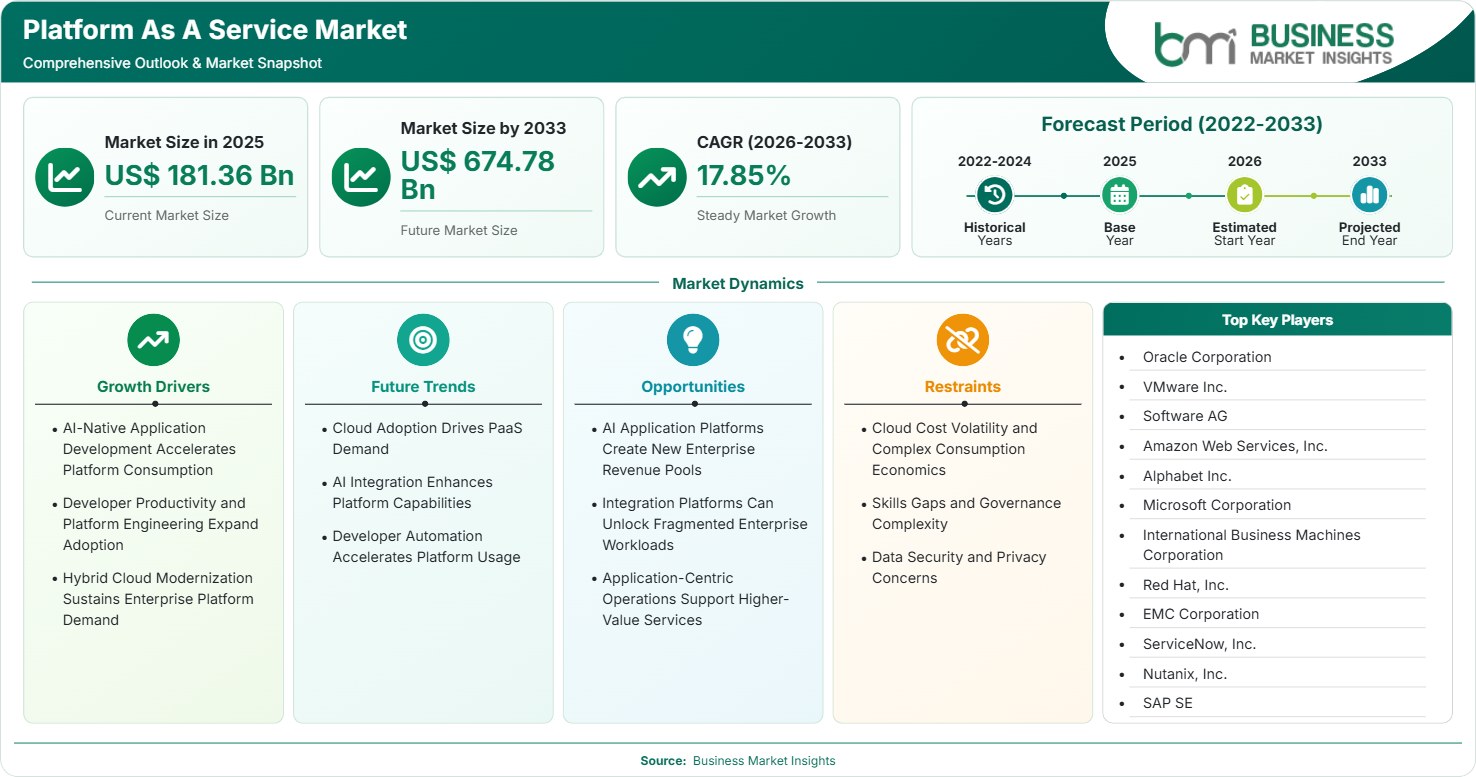
The Platform as a Service Market size was valued at US$ 181.36 Billion in 2025 and is projected to reach US$ 674.78 Billion by 2033, growing at a CAGR of 17.85% during 2026–2033, driven by cloud-native development, AI workloads, application modernization, hybrid deployment, automation, and developer productivity.

Report Coverage
  • Deployment: Public, Private, Hybrid
  • Enterprise Type: Small & Mid-size Enterprises, Large Enterprises
  • Type: Application PaaS , Integration PaaS , Database PaaS , Others
  • End-user: BFSI, Consumer Goods & Retail, Telecommunication, IT & ITeS, Manufacturing, Healthcare & Life Sciences, Energy & Utilities, Others
US$ 181.36 Bn Market size in 2025
US$ 674.78 Bn Market Size by 2033
17.85% CAGR, 2026 - 2033
2026-2033 Forecast Period

AI Overview

Platform As A Service Market Summary

  • North America Region: North America holds a 38%–42% share in 2025, growing at a CAGR of 16.8%–18.1%, influenced by AI application development, hyperscaler investment, enterprise modernization, developer platforms, hybrid-cloud adoption, automation, and strong demand. US adoption remains advanced, with a 17.0%–18.2% CAGR through 2033 across enterprise application platforms.
  • Fastest Growing Region: Asia Pacific holds a 22%–26% share of the Platform as a Service market in 2025 and records a CAGR of 19.2%–21.0%, supported by cloud migration, digital-native enterprises, AI infrastructure investment, expanding developer ecosystems, and modernization across India, China, Japan, Singapore, and Southeast Asia.
  • Leading Segment: Database PaaS holds a 45%–48% share in 2025 and grows at a CAGR of 17.0%–18.5%, supported by managed databases, analytics workloads, application modernization, AI data pipelines, automated administration, scalability, and growing demand for integrated cloud-native data services.
  • High Growth Segment: Integration PaaS records a 19.0%–22.0% CAGR through 2033 of the Platform as a Service market, driven by API orchestration, SaaS connectivity, event-driven architectures, hybrid integration, automation, data synchronization, and enterprise demand for interoperable application ecosystems across increasingly distributed technology environments.
  • Key Market Opportunity: AI-native application platforms, low-code development, managed databases, integration automation, and hybrid-cloud orchestration create investment opportunities as enterprises seek faster delivery without expanding infrastructure-management complexity.
  • Major Market Players: Oracle Corporation, VMware Inc., Software AG, Amazon Web Services, Inc., Alphabet Inc., Microsoft Corporation, International Business Machines Corporation, Red Hat, Inc., EMC Corporation, ServiceNow, Inc., Nutanix, Inc., SAP SE, ActiveState Software Inc., and AT&T Inc.
Strategic Insights

Platform As A Service Market: Strategic Insights

Platform As A Service Market Strategic Framework
FREE PDF
Request your free sample
Request free sample
Stakeholder View

Key Takeaways

  • Value is shifting from basic runtime hosting toward integrated ecosystems combining development environments, databases, APIs, security, observability, AI services, and governance. Platform vendors increasingly compete through breadth, interoperability, developer experience, and ecosystem depth.
  • Integration PaaS, AI application platforms, and managed databases provide the strongest upside because enterprises must connect legacy systems with SaaS, cloud-native applications, data platforms, and intelligent agents.
  • AI-assisted development is moving platform functionality upstream into coding, architecture, testing, deployment, monitoring, and remediation. Application-centric interfaces increasingly replace infrastructure-centric workflows.
  • Asia Pacific offers a compelling investment case because enterprises across India, China, Japan, Singapore, and Southeast Asia are simultaneously expanding cloud adoption and modernizing application estates.
  • Competitive positioning increasingly depends on combining cloud platforms with AI, integration, observability, and developer tooling. Strategic partnerships and technology consolidation are becoming central to expanding platform capabilities.
  • Vendors able to provide consistent application operations across public, private, and hybrid environments can capture customers seeking workload flexibility without sacrificing centralized governance.
Geographic Outlook

Platform As A Service Market Regional Highlights

North America Platform as a Service Market

North America accounts for a 38%–42% share in 2025 and is projected to grow at a CAGR of 16.8%–18.1% through 2033. The region benefits from hyperscaler concentration, mature enterprise-cloud adoption, extensive developer communities, AI investment, and strong platform-engineering capabilities. The Platform as a Service Market share remains supported by large financial, technology, healthcare, retail, and telecommunications customers modernizing application estates. US enterprises represent the dominant regional demand center, while Canada contributes through cloud migration and digital infrastructure investment. Platform procurement increasingly emphasizes security, observability, integration, and AI readiness.

  • AI application development is accelerating platform consumption as organizations require managed environments connecting models, databases, APIs, and production workflows without extensive infrastructure administration.
  • Mature enterprise cloud adoption supports the replacement of fragmented development infrastructure with standardized internal platforms, improving deployment consistency, governance, observability, and developer productivity across geographically distributed teams.
  • Financial services and healthcare increasingly prioritize controlled cloud platforms that combine rapid development with identity management, auditability, encryption, regulatory compliance, and workload-level governance.
  • Leading hyperscalers continue expanding managed application services, strengthening regional platform ecosystems and increasing competitive pressure on independent providers serving specialized enterprise workloads.

US Platform as a Service Market

The US represents approximately 31%–35% of global demand in 2025 and grows at a CAGR of 17.0%–18.2% through 2033. Strong enterprise software spending, hyperscaler infrastructure, AI development, and platform engineering sustain adoption. The Platform as a Service market growth outlook is strengthened by modernization of legacy applications and increased use of managed databases, serverless services, containers, APIs, and AI development tools. Large technology companies and digitally intensive enterprises are particularly active adopters, while regulated sectors increasingly require hybrid deployment and centralized policy controls.

  • US enterprises increasingly evaluate platforms according to developer experience, application observability, AI integration, security automation, and the ability to manage distributed cloud-native workloads.
  • Platform engineering teams are becoming strategic intermediaries between developers and infrastructure, creating demand for standardized self-service environments with embedded security and operational policies.
  • AI application development is strengthening demand for managed model access, vector databases, inference environments, orchestration tools, and integrated application services.

Europe Platform as a Service Market

Europe holds a 25%–29% share in 2025 and records a CAGR of 15.8%–17.4% through 2033. Germany, the United Kingdom, France, and the Netherlands remain important adoption centers, while Ireland and the Nordic markets support cloud infrastructure and digital services. Germany leads regional industrial demand, while the UK maintains strong software and financial-services adoption. The Platform as a Service market share is influenced by data sovereignty, cybersecurity, sustainability objectives, and modernization requirements. France and Germany offer high-growth opportunities as industrial enterprises deploy connected applications, analytics, automation, and AI-enabled workloads.

  • European organizations increasingly require platforms that support data residency, sovereignty, identity controls, encryption, and policy enforcement across distributed environments.
  • Industrial enterprises are adopting application platforms to connect operational technology with analytics, enterprise applications, IoT systems, and cloud-native services.
  • Germany remains a leading industrial adoption market, while France benefits from expanding cloud and AI initiatives across public and private organizations.
  • The United Kingdom continues to support strong demand from financial services, professional services, retail, media, and software companies modernizing application estates.

Asia Pacific Platform as a Service Market

Asia Pacific accounts for a 22%–26% share in 2025 and records the fastest regional CAGR at 19.2%–21.0% of the Platform as a Service market. China, Japan, India, Australia, and Singapore form major demand centers, while India and Southeast Asia provide particularly strong expansion opportunities. The region combines cloud migration, expanding digital businesses, AI adoption, and increasing investment in developer ecosystems. India is a high-growth market, supported by enterprise digitization and public-cloud expansion. Japan and Australia provide mature enterprise demand, while Southeast Asia benefits from rapidly scaling digital services, fintech, e-commerce, and telecommunications applications.

  • India is becoming a major platform-development center as enterprises modernize application estates and cloud expenditure increases across industries.
  • China combines large-scale cloud demand with AI development, industrial digitization, e-commerce platforms, and extensive domestic software ecosystems.
  • Japan provides strong opportunities for modernization because established enterprises are replacing traditional application environments while maintaining strict reliability and security requirements.
  • Singapore and Australia serve as regional technology hubs, supporting financial services, cloud-native applications, cybersecurity platforms, and cross-border digital operations.

Rest of World Platform as a Service Market

Rest of World is projected to account for 7%–11% of the market share in 2025 and grow at a CAGR of 14.7%–17.0% through 2033. In Latin America, the major drivers of demand growth will be Brazil and Mexico, where sectors such as financial services, retail, telecoms, and e-commerce boost cloud utilization. In the Middle East, the United Arab Emirates and Saudi Arabia are developing advanced ecosystems around cloud and AI. PaaS has a lower market share than in more developed geographies, yet modernization efforts create an opportunity for application management. South Africa serves as an important African technology hub, while Gulf markets see investment in digital transformation.

  • Brazil and Mexico offer strong opportunities as banks, retailers, telecommunications companies, and digital-native businesses modernize application infrastructure and expand cloud services.
  • Gulf countries are investing in AI, sovereign cloud capabilities, digital government, and smart infrastructure, creating demand for secure application development platforms.
  • South Africa remains a regional technology hub where financial services, telecommunications, and enterprises increasingly adopt managed cloud application environments.
  • Regional buyers increasingly favor hybrid architectures that combine local data-control requirements with scalable public-cloud development and analytics services.
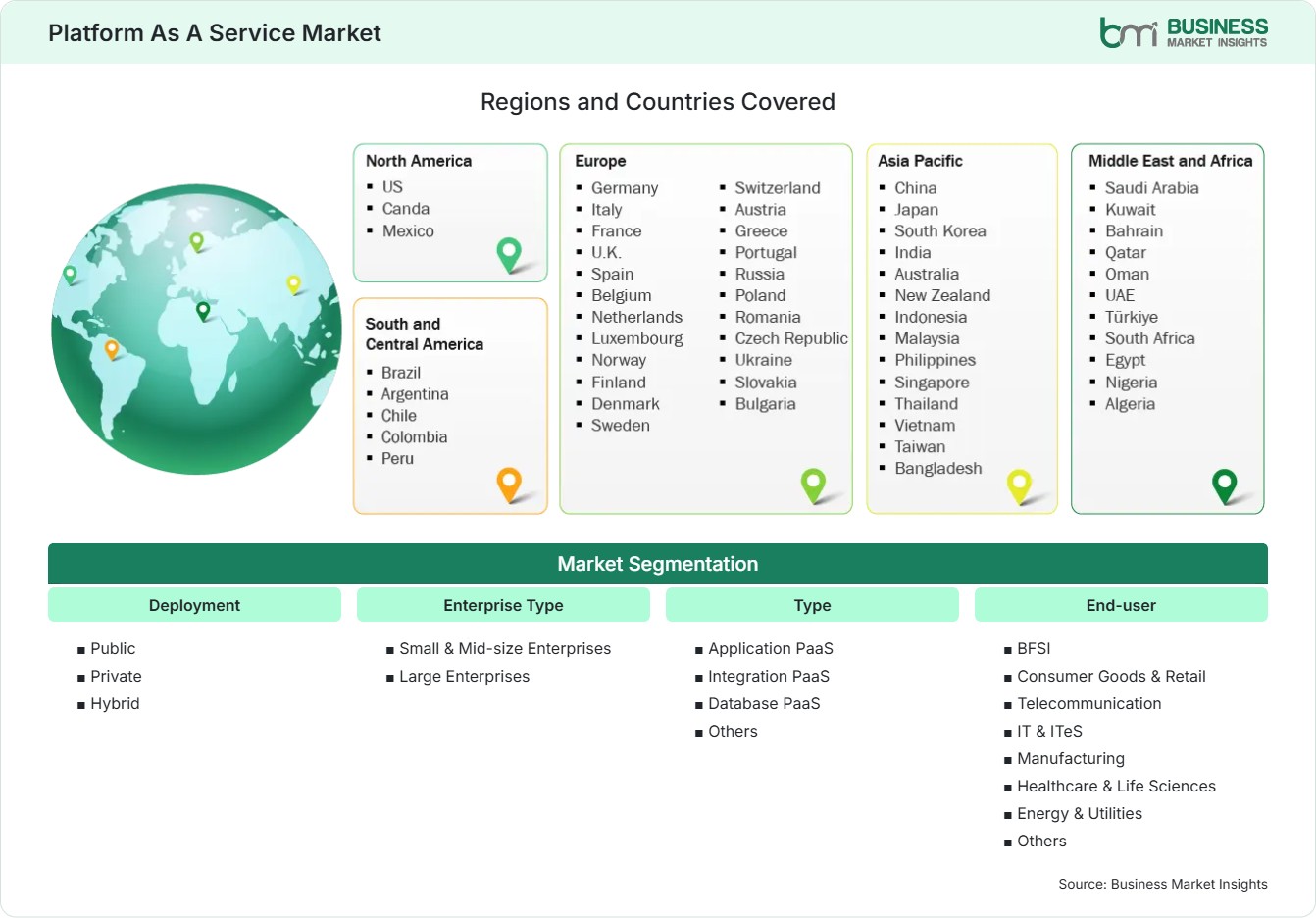
Global Market Geography
FREE PDF
Request your free sample
Request free sample
Segment Analysis

Platform As A Service Market Segmentation

Deployment

Deployment models can be distinguished by workload sensitivity, governance considerations, scalability, and infrastructure cost. Public cloud deployment is dominant in the market, with its share at 52%-56% in 2025 and a CAGR of 17.4%-18.6% from 2025 to 2034 of the total PaaS market. The hybrid cloud deployment model becomes the fastest-growing one due to companies’ concerns about flexibility, compliance, and workload mobility.

  • Public: Provides scalable managed resources, rapid provisioning, broad service catalogs, and lower infrastructure-management requirements, making it attractive for digital-native applications, development teams, and variable workloads.
  • Private: Supports organizations requiring dedicated infrastructure, stronger control, predictable governance, and customized security policies, particularly across regulated industries and sensitive enterprise applications.
  • Hybrid: Connects public-cloud services with private infrastructure, enabling workload portability, data control, disaster recovery, and gradual modernization without forcing immediate migration of legacy systems.

Enterprise Type

Large enterprises hold 67% - 71% market share in 2025 and grow at a 17.1% - 18.2% CAGR in the Platform as a Service market till 2034, as large application estates need standardization across development, integration, management, and automation. Small & Medium enterprises leverage managed platforms to gain advanced functionalities without infrastructure teams.

  • Small & Mid-size Enterprises: Use managed platforms to reduce infrastructure complexity, accelerate application delivery, access enterprise-grade services, and scale digital operations without large specialized cloud engineering teams.
  • Large Enterprises: Prioritize standardized internal platforms, multicloud governance, application modernization, security controls, data integration, and developer self-service across complex technology environments.

Type

Database PaaS continues to dominate with a 45%-48% market share in 2025 and a 17.0%-18.5% CAGR of the overall Platform as a Service market from 2025-2034. Increased data volumes, analytics, AI use cases, and database automation will further drive its adoption. Integration PaaS shows the strongest growth path as organizations integrate disparate application infrastructures.

  • Application PaaS (aPaaS): Supports application development through managed runtimes, frameworks, deployment tools, and scalable environments, reducing infrastructure configuration while improving developer productivity.
  • Integration PaaS (iPaaS): Connects SaaS, legacy applications, APIs, databases, and cloud services, supporting automation, synchronization, orchestration, and increasingly complex enterprise integration requirements.
  • Database PaaS (DPaaS): Provides managed database provisioning, scaling, backup, security, and maintenance, allowing organizations to concentrate on applications and analytics instead of routine administration.

End-user

IT and ITeS are among the prominent segments, with a market share of 31%–35% in 2025 and a CAGR of 17.8%–19.0% through 2034. The sectors of financial services, telecommunications, health care, manufacturing, retail, and energy are rapidly adopting the concept of managed application environments to accelerate modernization while controlling operational complexity.

  • BFSI: Uses platforms for digital banking, fraud analytics, customer applications, regulatory workflows, and scalable data services requiring strong security and availability.
  • Consumer Goods & Retail: Deploys platforms for e-commerce, personalization, inventory systems, customer analytics, supply-chain applications, and omnichannel engagement.
  • Telecommunication: Uses application platforms for network automation, customer systems, edge applications, service orchestration, and high-volume data processing.
  • IT & ITeS: Represents a major adopter because service providers require scalable development environments, automation, integration, analytics, and rapid deployment capabilities.
  • Manufacturing: Uses platforms to connect enterprise applications, industrial data, IoT systems, production analytics, and digital-twin environments.
  • Healthcare & Life Sciences: Requires secure application environments supporting clinical systems, research analytics, patient services, interoperability, and sensitive data governance.
  • Energy & Utilities: Applies platforms to asset monitoring, grid analytics, field services, customer applications, and operational data integration.
Market Forces

Platform As A Service Market Dynamics

Key Market Drivers

AI-Native Application Development Accelerates Platform Consumption

The evolution of artificial intelligence is continuously transforming application architectures from traditional transactional systems to model-driven, data-oriented, optimized applications. According to Microsoft, Azure offers an application platform that combines managed Kubernetes, serverless services, PaaS, integration, AI development, and managed databases for AI applications. Google Cloud also offers application-centric AI features spanning design, development, management, and operations of AI applications. This trend boosts the Platform as a Service market growth since developers require integrated environments more than individual infrastructure services. Model access, orchestration, vector databases, inference, observability, and governance are market trends being embedded into application platforms. As shown in Gartner's 2024 data, Database PaaS already constitutes 46.3% of worldwide PaaS revenue.

Developer Productivity and Platform Engineering Expand Adoption

Corporations are developing their own internal developer platforms to achieve standardized access to infrastructure, automated deployments, policy enforcement, and reduced cognitive load. Platform Engineering refers to the separation of the application development process from mundane infrastructure tasks through templates, automated deployment, observability, and security. The study conducted by Google Cloud, which included 500 IT employees at organizations employing Platform Engineering, proves this point. From a business perspective, this trend increases the value of PaaS solutions that combine self-service and governance. Growth of the market will be driven by the quality of the developer experience, automation, reusable architecture, and integrated operations, rather than by hosting capabilities alone. The Platform as a Service market trends toward application-centric management, reflecting the need to manage distributed services as coherent applications rather than isolated infrastructure resources.

Hybrid Cloud Modernization Sustains Enterprise Platform Demand

Hybrid cloud remains strategically relevant because most enterprises run legacy applications alongside their public cloud applications. Legacy applications, sensitive databases, regulated workloads, and dedicated infrastructure typically coexist with public cloud applications. PaaS provides an application modernization layer that can help standardize application development while offering flexibility in workload placement. These are useful for gradual migration, disaster recovery, data residency, and workload optimization. There is significant business value in offering these solutions to banks, healthcare organizations, manufacturing companies, and telecom companies that have complex technology environments. Differentiation from other platform offerings comes from offering Kubernetes, multicloud management, integration tools, identity management tools, and standardized developer experiences.

Key Market Opportunities

AI Application Platforms Create New Enterprise Revenue Pools

AI application platforms offer the strongest forward-looking opportunity because organizations increasingly need production environments capable of connecting models, enterprise data, APIs, workflows, and applications. Azure from Microsoft has scaled out its application platform to cater to AI applications and agents, whereas Google Cloud has created application-oriented products that simplify the underlying infrastructure. AWS App Studio has introduced prebuilt solutions and import/export capabilities to speed up application development. All of this indicates that the trend lies towards platforms where development knowledge is encapsulated in reusable services. The Platform as a Service Market forecasts thus suggest a shift toward the consumption of value-added services in the realm of AI application lifecycle management, not just execution. Vendors can monetize model orchestration, security, observability, vector data, inference management, and governance as integrated platform capabilities.

Integration Platforms Can Unlock Fragmented Enterprise Workloads

The technology landscape for enterprises today is increasingly fragmented, with SaaS apps, legacy systems, APIs, databases, event streams, and cloud services. Integration PaaS can serve as a connecting platform, helping transform such fragmentation into automated workflows. The demand for such platforms arises where there is a need for real-time data synchronization, API management, event orchestration, and process automation across multiple systems. The telecom, BFSI, retail, healthcare, and manufacturing verticals are highly suitable for applications, as their business processes span many systems. The vendors can boost their revenues by providing connectors, integration templates, API governance, workflow automation, and analytics embedded in the product.

Application-Centric Operations Support Higher-Value Services

The evolution from infrastructure-focused to application-focused management creates room for vendors that provide solutions with observability, dependency mapping, performance tuning, security, and automatic remediation. AWS developed an application map for CloudWatch in 2025 that automatically structures the application services and dependencies, thus demonstrating this trend. Application management on Google Cloud has also seen similar expansion. These applications will strategically evolve into PaaS, as developers require visibility throughout the entire application life cycle. Vendors will be able to extract more valuable workloads by integrating deployment, monitoring, cost optimization, reliability, and governance into a single platform. The new model will generate recurring revenue due to customer reliance on the platform through development and production, not just deployment.

Market Restraints and Challenges

Cloud Cost Volatility and Complex Consumption Economics

Factor: Variable consumption pricing, data-transfer charges, storage costs, and AI compute requirements can make platform expenditure difficult to forecast.

Impact: Businesses could delay migrations and distribute their workloads across multiple providers to avoid monetary risk. The situation gets worse with AI workloads when the inference stage, vector databases, high-performance computing, and data migration lead to an explosion in consumption. In this situation, FinOps competencies, workload visibility, budget management, and architectural design become prerequisites for businesses before scaling up their platform usage. Providers have to prove their worth through productivity and efficiency, without relying solely on infrastructure considerations. Cost transparency becomes a deciding factor, alongside functionality, especially for large companies with thousands of applications.

Skills Gaps and Governance Complexity

Factor: Cloud-native platforms require expertise spanning containers, APIs, security, automation, data services, observability, and AI operations.

Impact: Organizations lacking well-developed platform engineering groups will find it challenging to harness the resulting productivity improvements, leading to slower deployments and greater reliance on third-party experts. There is an additional layer of governance complexity because enterprises must strike the right balance between developer self-service and the demands of security, compliance, identity, and architecture. Too much governance gets in the way of innovation, but not enough governance poses operational risks. Research conducted at Google Cloud indicates that a key to successful platform engineering is striking the right balance between developer freedom and governance.

Company Analysis

Competitive Landscape

The Platform as a Service market analysis indicates a market increasingly shaped by hyperscaler scale, enterprise software integration, open-source ecosystems, AI capabilities, and developer-centric tooling. Competitive differentiation is moving toward complete application lifecycles, interoperability, governance, and specialized industry solutions.

Company Name

Overview

Products and Services relevant to this market

Oracle Corporation

Enterprise technology provider with extensive database, cloud infrastructure, and application capabilities serving large regulated and data-intensive organizations.

Oracle Cloud Infrastructure, Oracle Autonomous Database, application development services, integration, analytics, containers, and enterprise cloud platforms.

VMware Inc.

Enterprise virtualization and hybrid-cloud technology provider with strong capabilities for private infrastructure and multicloud application management.

VMware Cloud Foundation, Kubernetes capabilities, hybrid-cloud infrastructure, application modernization, virtualization, and developer platform services.

Software AG

German enterprise software provider specializing in integration, APIs, data management, and connected application environments.

webMethods, API management, integration services, event processing, application connectivity, and enterprise data integration capabilities.

Amazon Web Services, Inc.

Global cloud provider offering broad managed infrastructure, application, database, integration, serverless, and AI services.

AWS Elastic Beanstalk, App Runner, Lambda, Amazon RDS, App Studio, API services, containers, and developer tooling.

Alphabet Inc.

Technology group operating Google Cloud, with strong capabilities across AI, application development, Kubernetes, databases, and analytics.

Google Cloud application services, Cloud Run, GKE, Firebase, databases, Application Design Center, AI development, and integration tools.

Microsoft Corporation

Global software and cloud provider integrating application development, AI, databases, containers, integration, and developer tooling.

Azure App Service, Azure Functions, Azure Container Apps, AKS, Azure AI Foundry, databases, Logic Apps, and API Management.

International Business Machines Corporation

Enterprise technology provider focused on hybrid cloud, AI, automation, application modernization, and regulated workloads.

IBM Cloud, Red Hat OpenShift, watsonx, integration, application modernization, databases, automation, and hybrid-cloud platforms.

Red Hat, Inc.

Open-source enterprise software provider specializing in Kubernetes, hybrid cloud, containers, middleware, and application platforms.

Red Hat OpenShift, application runtimes, integration, middleware, Kubernetes, automation, and hybrid-cloud development environments.

EMC Corporation

Former enterprise infrastructure business associated with Dell Technologies and established for enterprise storage and cloud infrastructure capabilities.

Enterprise storage, infrastructure, cloud technologies, data management, and infrastructure components relevant to application platform environments.

ServiceNow, Inc.

Enterprise workflow and AI platform provider combining application development, data, automation, and intelligent workflow capabilities.

ServiceNow Platform, App Engine, AI Platform, workflow automation, data services, application development, and AI agent capabilities.

Nutanix, Inc.

Enterprise hybrid multicloud provider focused on simplifying application infrastructure and cloud operations across distributed environments.

Nutanix Cloud Platform, Kubernetes, databases, hybrid-cloud management, application services, virtualization, and multicloud operations.

SAP SE

Enterprise software company providing cloud platforms supporting business applications, integration, automation, data, and application development.

SAP Business Technology Platform, integration, application development, data management, analytics, automation, and enterprise cloud services.

ActiveState Software Inc.

Software development technology provider focused on managed language environments and developer productivity.

ActiveState Platform, language runtimes, package management, development environments, security, and reproducible software supply chains.

AT&T Inc.

Telecommunications provider developing cloud, network, edge, and enterprise digital capabilities supporting distributed application environments.

Network cloud services, edge computing, connectivity, managed infrastructure, APIs, enterprise mobility, and application-enablement services.

Trust & Transparency

Research Methodology

The market analysis combines proprietary research with secondary data from government agencies, company disclosures, regulatory filings, industry databases and expert interviews. Market estimates are validated through data triangulation, cross-market benchmarking and analyst review.

View Full Research Methodology

Questions Answered

Frequently Asked Questions

What should buyers evaluate when comparing PaaS vendors?

Buyers should assess developer experience, supported runtimes, database choices, integration capabilities, security, observability, portability, pricing transparency, AI services, compliance, ecosystem maturity, and hybrid-cloud support. The best platform depends on workload requirements rather than feature count alone, making architectural fit a critical procurement criterion.

How are AI workloads changing application-platform requirements?

AI applications require integrated access to models, data, APIs, inference environments, orchestration, security, and observability. Consequently, platforms are increasingly designed around complete application lifecycles rather than isolated compute resources, enabling organizations to move AI projects from experimentation into governed production environments.

Why are managed databases strategically important within PaaS?

Managed databases remove routine provisioning, patching, backup, scaling, and availability tasks from application teams. Gartner reported Database PaaS contributed 46.3% of worldwide PaaS revenue in 2024, demonstrating how central managed data services have become to the broader platform ecosystem.

How does PaaS influence software development team structures?

PaaS enables developers to consume standardized infrastructure capabilities through self-service interfaces, reducing repetitive operational work. This supports platform-engineering teams that build reusable templates, automation, security policies, and deployment workflows while allowing application developers to concentrate on business functionality.

What factors determine whether enterprises choose public, private, or hybrid PaaS?

Enterprises typically evaluate workload sensitivity, regulatory obligations, application latency, existing infrastructure, portability requirements, and cost. Public PaaS suits scalable workloads, private environments support tighter control, while hybrid architectures allow organizations to combine cloud elasticity with retained infrastructure and data governance.

Access the Full Platform As A Service Market Report

Get segment-level forecasts, regional estimates, competitive benchmarking, company profiles and downloadable Excel datasets.

Access the full Platform As A Service Market Report
350 pages PDF & Excel | 2026-09-23
Similar Research

Related Market Reports