
Data Science Platform Market Outlook: Size, Share, Trends, Growth Analysis, Competitive Landscape & Forecast, 2026-2033

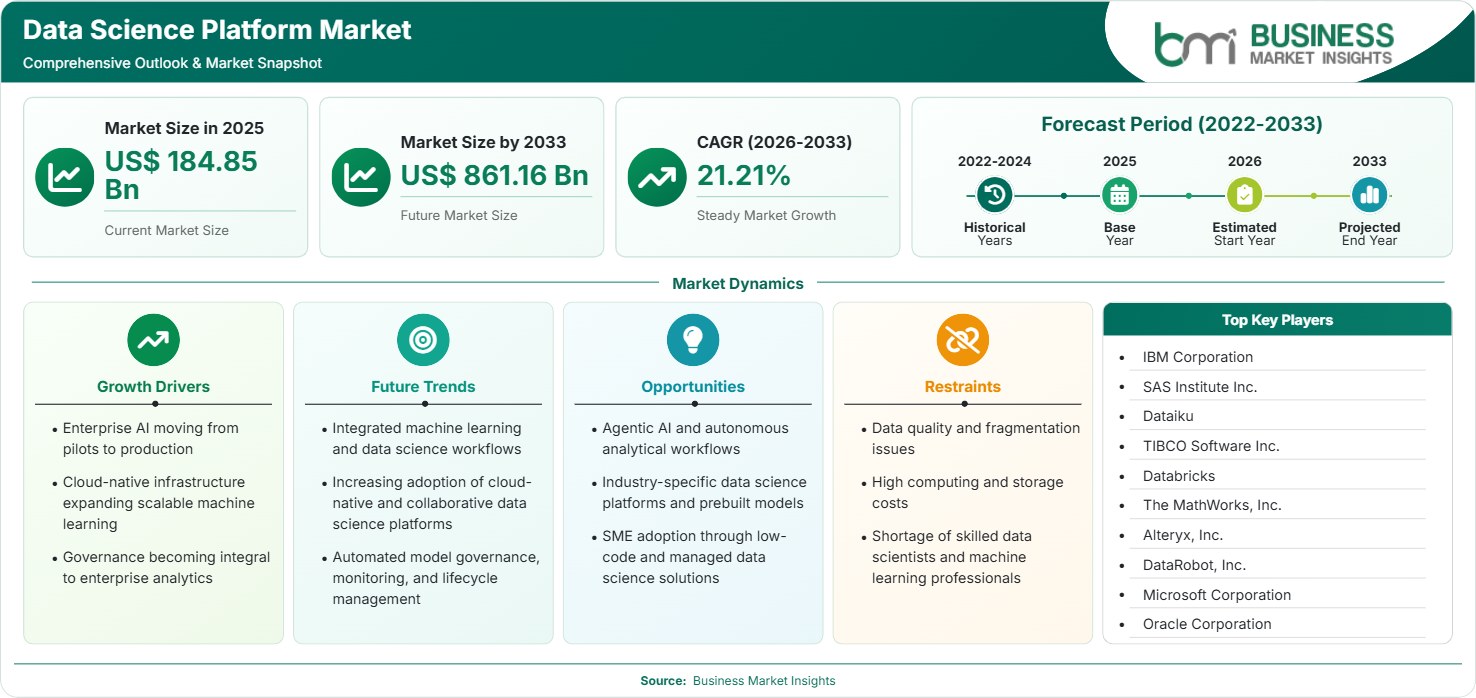
The Data Science Platform Market size was valued at US$ 184.85 Billion in 2025 and is projected to reach US$ 861.16 Billion by 2033, growing at a CAGR of 21.21% during 2026–2033, driven by AI adoption, cloud migration, automated machine learning, governed analytics, enterprise data modernization, and expanding real-time decision applications.

Report Coverage
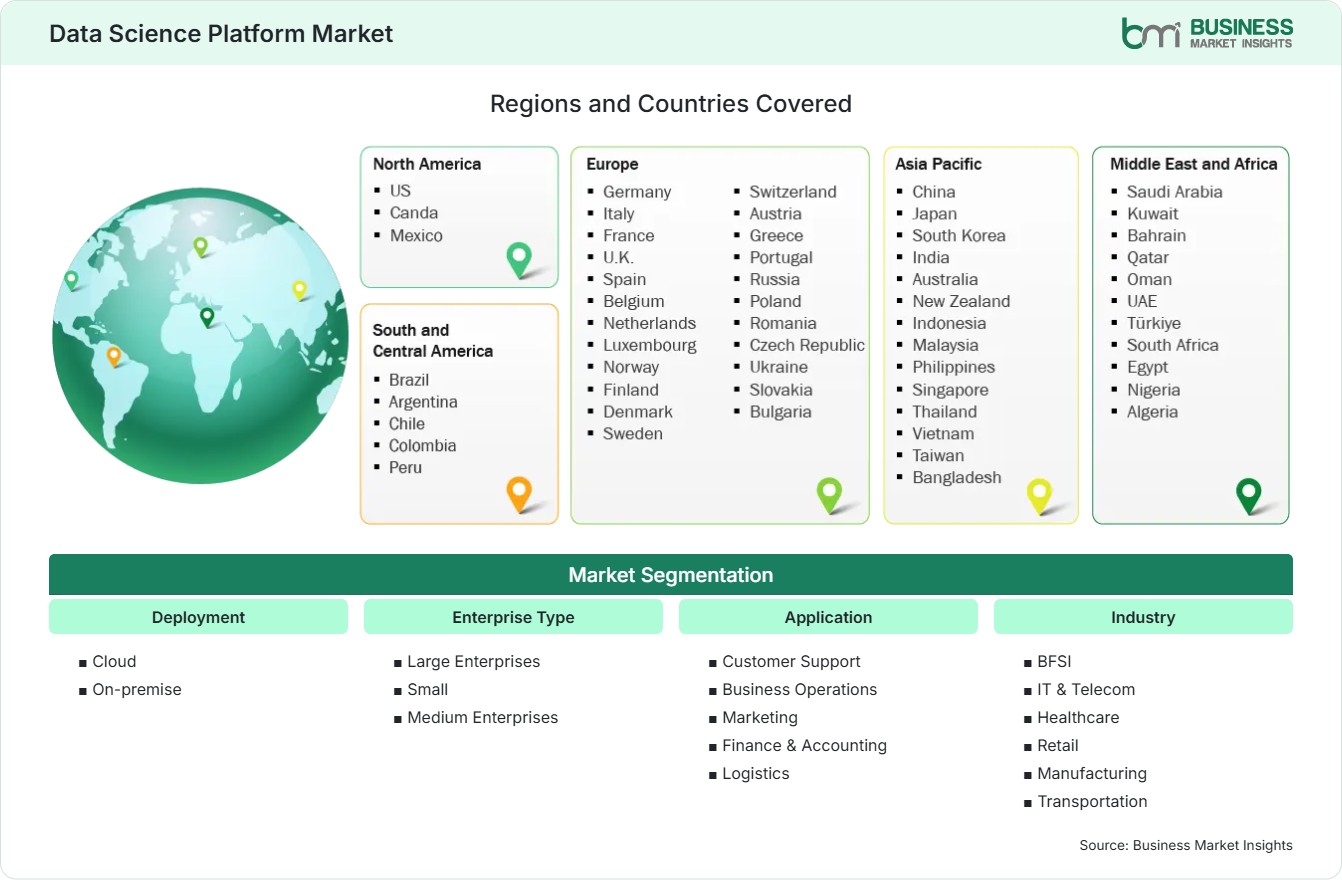
  • Deployment: Cloud, On-premise
  • Enterprise Type: Large Enterprises, Small, Medium Enterprises
  • Application: Customer Support, Business Operations, Marketing, Finance & Accounting, Logistics
  • Industry: BFSI, IT & Telecom, Healthcare, Retail, Manufacturing, Transportation
US$ 184.85 Bn Market size in 2025
US$ 861.16 Bn Market Size by 2033
21.21% CAGR, 2026 - 2033
2026-2033 Forecast Period

AI Overview

Data Science Platform Market Summary

  • North America Region: North America holds a 39%–43% share of the Data Science Platform market in 2025, with a 19%–22% CAGR during 2026–2033, driven by enterprise AI spending, cloud-native analytics, mature data infrastructure, model governance, automation, and rapid adoption across financial, technology, healthcare, and retail organizations. US enterprises increasingly integrate machine learning into operational workflows, supported by deep cloud ecosystems, advanced talent pools, and strong investment in AI infrastructure. The US market is projected to expand at a 20%–23% CAGR during 2026–2033, supported by hyperscaler investment, enterprise AI deployment, and regulatory focus on trustworthy systems.
  • Fastest Growing Region: Asia Pacific represents a 20%–24% share in 2025 and is advancing at a 24%–28% CAGR during 2026–2033, supported by cloud adoption, digitalization, expanding AI talent, government programs, and rapid enterprise analytics deployment across China, India, Japan, Singapore, and South Korea.
  • Leading Segment: Cloud deployment accounts for a 58%–62% share of the Data Science Platform market in 2025, growing at a 23%–26% CAGR during 2026–2033, supported by scalable computing, managed machine learning, distributed data access, lower infrastructure barriers, faster experimentation, and integration with enterprise cloud ecosystems.
  • High Growth Segment: Small & Medium Enterprises represent a 22%–26% share in 2025, expanding at a 25%–29% CAGR during 2026–2033, as subscription pricing, low-code tools, managed infrastructure, automated modeling, and packaged AI services reduce technical barriers for smaller organizations.
  • Key Market Opportunity: The strongest opportunity lies in governed AI platforms that combine data preparation, machine learning, generative AI, agent orchestration, monitoring, and compliance within unified workflows, enabling enterprises to convert pilots into measurable production outcomes.
  • Major Market Players: IBM Corporation, SAS Institute Inc., Dataiku, TIBCO Software Inc., Databricks, The MathWorks, Inc., Alteryx, Inc., DataRobot, Inc., Microsoft Corporation, and Oracle Corporation.
Strategic Insights

Data Science Platform Market: Strategic Insights

Data Science Platform Market Strategic Framework
FREE PDF
Request your free sample
Request free sample
Stakeholder View

Key Takeaways

  • The ecosystem is consolidating around platforms that connect data engineering, experimentation, model deployment, governance, and AI operations, increasing the strategic importance of interoperability across cloud, database, and application environments.
  • Cloud deployment and SME adoption provide the strongest expansion potential because managed infrastructure, automated workflows, and consumption-based pricing lower the cost and expertise required to operationalize advanced analytics.
  • Generative AI, agentic AI, synthetic data, automated machine learning, and natural-language interfaces are moving platforms beyond predictive modeling toward systems that can construct workflows, explain outputs, and assist decisions.
  • Asia Pacific offers an attractive investment case because enterprises are simultaneously modernizing infrastructure, expanding digital services, and developing domestic AI capabilities, creating demand for scalable and locally deployable analytics environments.
  • Competitive investment is increasingly directed toward AI governance, data management, model orchestration, and specialized decision intelligence rather than isolated analytical tools, encouraging broader platform consolidation.
  • Differentiation increasingly depends on measurable production outcomes, including model reliability, deployment speed, governance coverage, infrastructure efficiency, and the ability to integrate AI into operational applications.
Geographic Outlook

Data Science Platform Market Regional Highlights

North America Data Science Platform Market

North America accounts for 39% to 43%, while the CAGR is forecast at 19% to 22% for the period 2026 to 2033. Data Science Platform Market share is due to its well-established cloud infrastructure, significant investments in AI, established enterprise analytics teams, and a healthy vendor ecosystem. This region continues to be the highest-revenue region, as companies now rely on platforms for machine learning and AI deployment. The technology, BFSI, healthcare, retail, and manufacturing segments see increased demand for platforms.

  • Enterprise adoption is moving from experimental machine learning toward production-grade AI operations, increasing requirements for monitoring, governance, model lifecycle management, and integration with business applications across large organizations.
  • Cloud hyperscalers and specialist platform providers increasingly compete through integrated data, analytics, and AI services, creating broader procurement choices while encouraging customers to consolidate fragmented data science tooling.
  • Financial institutions are prioritizing explainability, fraud analytics, risk modeling, and real-time decisioning, making governed platform architectures strategically important for regulated analytical workloads.
  • Healthcare organizations are expanding predictive analytics and AI-assisted research while placing greater emphasis on privacy, lineage, validation, and human oversight, consistent with WHO guidance on responsible AI use.

US Data Science Platform Market

The United States accounts for 74% to 78% of total North American AI demand, amounting to 29% to 33% of global demand in 2025, while growing at 20% to 23% CAGR from 2026 to 2033. The US remains the leading innovation hub in the region due to hyperscaler infrastructure, software ecosystems, enterprise AI budgets, and talent.

  • US enterprises increasingly require platforms that connect proprietary data with foundation models, reflecting the transition from isolated analytics projects toward AI-enabled business processes.
  • Investment is expanding around agentic AI, model governance, and AI infrastructure, while data quality and operational readiness remain critical barriers to scaling successful pilots.
  • The technology sector continues to influence platform architecture through cloud-native development, lakehouse approaches, managed model serving, and developer-oriented AI tooling.

Europe Data Science Platform Market

The Europe region accounts for 23% to 27% of the market size, growing at a CAGR of 20% to 23% from 2026 to 2033. Some of the major regions in Europe are the United Kingdom, Germany, France, and the Netherlands; meanwhile, some of the rapidly adopting nations are Spain and Italy. Factors driving the adoption of AI include industrial analytics, financial services, healthcare reform, and regulatory factors. The European Union AI Act is highly significant due to its regulatory implications.

  • Germany is emphasizing industrial machine learning, predictive maintenance, digital manufacturing, and supply-chain analytics, creating demand for platforms that can operate across complex enterprise environments.
  • The United Kingdom remains a major analytics center, supported by financial services, technology investment, data-intensive professional services, and mature cloud adoption.
  • France and the Netherlands are strengthening AI ecosystems through public and private investment, creating opportunities for secure enterprise analytics and governed model deployment.
  • Regulatory requirements are increasing demand for lineage, explainability, documentation, and monitoring capabilities, making governance a purchasing criterion rather than an optional platform feature.

Asia Pacific Data Science Platform Market

The Asia Pacific accounts for 20% to 24% of market share in 2025 and holds the highest growth rate, with a CAGR of 24% to 28% from 2026 to 2033. The key markets within the region include China, Japan, India, South Korea, Singapore, and Australia, while the emerging markets in India, Southeast Asia, and others contribute incrementally. The growing needs of cloud computing, digital payment systems, connected manufacturing, healthcare digitization, and AI projects by governments are driving the need for a data science environment.

  • China remains a major demand center because industrial automation, consumer analytics, financial technology, and AI research require large-scale data processing and model development infrastructure.
  • India is expanding rapidly as enterprises modernize analytics, cloud infrastructure, customer engagement, financial services, and technology operations, creating strong demand for scalable platforms.
  • Japan and South Korea emphasize manufacturing intelligence, robotics, semiconductor analytics, and advanced engineering, supporting high-value applications requiring reliable machine learning workflows.
  • Singapore and Australia function as regional technology hubs, encouraging cloud-based analytics adoption and creating opportunities for vendors offering security, governance, and cross-border data controls.

Rest of World Data Science Platform Market

Rest of World represents a 9%–13% share in 2025 and advances at an 18%–21% CAGR during the Data Science Platform market forecasts 2026–2033. South and Central America are led by Brazil, Mexico, Chile, and Colombia, where banking, retail, telecommunications, agriculture, and logistics applications support adoption. Cloud delivery is particularly important because it reduces infrastructure requirements and allows enterprises to access advanced analytics without building extensive internal computing environments.

Demand in the Middle East and Africa is spearheaded by countries such as the UAE, Saudi Arabia, Israel, and South Africa, where AI is being rapidly adopted. There has been an increased relationship between AI investments and economic diversification, smart cities, fintech, healthcare upgrades, and industrial transformation. According to IMF research, GDP in an oil-free Gulf economy can increase by up to 2.8% through AI.

  • Brazil and Mexico are expanding enterprise analytics in financial services, retail, telecommunications, and manufacturing, while cloud-based delivery helps organizations overcome infrastructure constraints.
  • Saudi Arabia and the UAE are developing AI-centered economic strategies, increasing demand for governed platforms capable of supporting national-scale data and automation initiatives.
  • South Africa provides a regional technology hub for financial analytics, telecommunications, retail intelligence, and enterprise modernization, supporting demand for scalable analytical workflows.
  • Israel remains important for advanced AI innovation, cybersecurity analytics, and machine learning development, supporting specialized demand for high-performance data science environments.
Global Market Geography
FREE PDF
Request your free sample
Request free sample
Segment Analysis

Data Science Platform Market Segmentation

Deployment

Cloud deployment takes the lead, with a market share of 58%–62% in 2025 and a 23%–26% CAGR from 2026 to 2033, driven by elasticity, managed services, fast provisioning, and AI workload scaling. On-premises deployment remains important in scenarios where data sovereignty, latency, security, and existing infrastructure play a role in procurement decisions.

  • Cloud: Cloud platforms simplify infrastructure provisioning, support distributed collaboration, enable elastic machine learning workloads, and integrate rapidly with data warehouses, lakehouses, foundation models, and managed AI services.
  • On-premise: On-premise environments remain relevant for regulated organizations, sensitive datasets, latency-critical workloads, and enterprises requiring direct infrastructure control, particularly where legacy systems remain deeply embedded.

Enterprise Type

The Large Enterprises segment holds 72% to 76% market share in 2025 and maintains a compound annual growth rate (CAGR) of 20% to 23% from 2026 to 2033, owing to the fact that large and complex data ecosystems require proper governance and lifecycle management. The Small & Medium Enterprises segment is anticipated to have a market share of 22% to 26% and register a higher CAGR of 25% to 29%. This segment increasingly defines the Data Science Platform Market scope through accessible AI capabilities.

  • Large Enterprises: Large organizations prioritize enterprise governance, multi-team collaboration, model monitoring, security controls, integration, and standardized deployment across geographically distributed business units.
  • Small & Medium Enterprises: SMEs increasingly adopt managed platforms because subscription pricing, automation, and simplified interfaces reduce infrastructure investment while enabling customer analytics, forecasting, marketing optimization, and operational intelligence.

Application

Demand for applications spans customer support, business operations, marketing, finance and accounting, and logistics, with business operations accounting for some of the most substantial demand. Marketing and logistics are among the areas growing at the fastest pace, owing to the need for customer intelligence prediction, demand forecasting, and routing optimization.

  • Customer Support: Machine learning enables conversational assistance, customer segmentation, sentiment analysis, churn prediction, ticket prioritization, and personalized service, increasing demand for real-time analytical workflows.
  • Business Operations: Operational analytics supports forecasting, resource allocation, anomaly detection, process optimization, and performance management, making integrated data preparation and model deployment especially valuable.
  • Marketing: Marketing teams use predictive scoring, personalization, campaign optimization, attribution, and customer lifetime-value models to improve spending efficiency and automate increasingly complex decision processes.
  • Finance & Accounting: Platforms support fraud detection, financial forecasting, risk assessment, reconciliation, anomaly detection, and scenario analysis, with governance and explainability remaining important for regulated workflows.
  • Logistics: Logistics applications use demand forecasting, inventory optimization, route analytics, capacity planning, and predictive maintenance, benefiting from streaming data and increasingly automated decision models.

Industry

BFSI and IT & Telecom will continue to be the major verticals due to high data volumes and ongoing analytical needs, whereas healthcare, retail, manufacturing, and transportation will be good growth avenues. Healthcare and transportation have increased demands for real-time modeling, and manufacturing requires predictive maintenance and quality analytics. Domain-related industry governance, integration, and workflow needs are defining the Data Science Platform Market trends toward specialized templates and domain-ready models.

  • BFSI: Banks and insurers deploy analytics for fraud, credit risk, customer segmentation, underwriting, compliance, forecasting, and personalized financial services, requiring strong governance and explainability.
  • IT & Telecom: Technology providers use platforms for network optimization, customer churn, capacity planning, cybersecurity analytics, service assurance, and software intelligence across high-volume operational datasets.
  • Healthcare: Healthcare organizations apply predictive modeling, clinical analytics, resource planning, medical research, and population insights while emphasizing privacy, validation, bias management, and human oversight.
  • Retail: Retailers use demand forecasting, recommendation engines, pricing optimization, customer segmentation, inventory analytics, and marketing personalization to improve conversion and operational efficiency.
  • Manufacturing: Manufacturers apply predictive maintenance, quality analytics, production optimization, computer vision, supply-chain forecasting, and digital-twin workflows to improve asset utilization and reduce process variability.
  • Transportation: Transportation companies use route optimization, fleet analytics, demand forecasting, predictive maintenance, and operational planning, increasing demand for real-time data processing and machine learning deployment.
Market Forces

Data Science Platform Market Dynamics

Key Market Drivers

Enterprise AI Moving from Pilots to Production

Enterprise AI adoption is shifting purchasing priorities from experimentation tools toward platforms that manage the full lifecycle of data preparation, model development, deployment, monitoring, governance, and business integration. According to the IMF, about 40% of global employment is at risk of AI-induced change, highlighting the scope of transformation underway in organizations. This risk creates a need for reproducible analytics processes that help humans make decisions rather than simply proving model efficacy. There is an increasing strategic importance of platforms that integrate data scientists, engineers, business analysts, and operational experts, since deploying models into production requires cooperation across groups beyond modelers. The use of Agentic AI adds to the need for centralized management, evaluation, permissions, and observability. These requirements are accelerating Data Science Platform market growth as enterprises seek measurable productivity gains from AI investments.

Cloud-Native Infrastructure Expands Scalable Machine Learning

The adoption of the cloud is transforming the way organizations provide computing power, storage, development environments, and infrastructure for delivering models. Rather than using infrastructure solely for experimentation purposes, organizations can now provision resources for training, inference, data preprocessing, and analytics at scale. According to the IEA, global data center electricity consumption may increase to about 945 TWh by 2030, and accelerated server growth, primarily due to the adoption of AI technology, would drive electricity consumption growth at about 30% annually in the baseline scenario. These infrastructural shifts are creating a need for efficient workload orchestration, manageability of compute resources, and optimization of model delivery. This supports Data Science Platform market trends toward managed services, serverless computing, integrated storage, and elastic AI infrastructure.

Governance Becomes Integral to Enterprise Analytics

Governance is shifting from an administrative necessity to a basic capability of the platform itself as organizations adopt AI in their regulated, high-impact environments. Several key characteristics that are listed in the NIST AI RMF include validity, reliability, security, accountability, transparency, explainability, privacy, and fairness. In addition, in Europe, the introduction of the AI Act marks a major regulatory framework for high-risk artificial intelligence, effective from August 2026 onward. All these new developments necessitate that platforms have documentation around the data sets, models, decisions, permissions, evaluations, and deployment history. Therefore, the Data Science Platform Market growth increasingly relies on governance capabilities integrated into standard workflows rather than on compliance software used separately.

Key Market Opportunities

Agentic AI and Autonomous Analytical Workflows

Agentic AI creates an opportunity to extend data science platforms from passive development environments to active decision-support systems that coordinate tools, query data, execute analytical tasks, and recommend actions. In 2026, Dataiku introduced agent management and agent building. SAS made governed agent capability available throughout SAS Viya. These events suggest a movement towards platforms that support agents with permissions, evaluation processes, and business processes. Vendors can increase revenue by providing agents for use cases across finance, marketing, customer service, supply chain, and other industries. This is especially true when organizations have good data at their disposal but lack a way to turn analysis into action. Data Science Platform Market Forecasts must now include considerations of agent orchestration and governance.

Industry-Specific AI Platforms and Prebuilt Workflows

Industry specialization offers vendors an opportunity to shorten implementation cycles by packaging models, connectors, governance controls, templates, and workflows for defined business processes. The healthcare industry needs privacy-preserving analytics and evidence validation, whereas BFSI needs interpretability of the risk model and ongoing fraud detection. Predictive maintenance and quality analytics are important for manufacturing, whereas demand forecasting and personalization are critical for retail. WHO reiterates that the human-in-the-loop aspect, governance, bias management, and equity considerations are important for health AI applications, further reinforcing the need for domain-specific controls. The vendors can differentiate themselves by offering these capabilities within their platforms. This further creates an opportunity for system integrators and cloud service providers to develop vertical accelerators.

SME Democratization Through Low-Code and Managed AI

The potential for growth in the SME segment is high because many SMEs have use cases that would benefit from analytics but lack the skills and infrastructure for data engineering, machine learning, and other necessary technologies. Low-code, automated feature engineering, managed notebooks, ready-to-go models, natural language analysis, and pay-per-use are just some options that could help lower barriers to entry without requiring heavy investment in expertise. The most obvious use cases include business processes like demand planning, customer segmentation, lead scoring, fraud prevention, and inventory management. Vendors can facilitate even greater adoption by integrating analytics with existing systems, such as accounting systems, CRM, ERP, and marketing tools. Partnering with cloud providers and SaaS vendors could open up embedded distribution channels and lower customer acquisition costs.

Market Restraints and Challenges

Data Quality and Fragmented Enterprise Architectures

Factor: fragmented databases, inconsistent metadata, duplicated datasets, weak ownership, and legacy infrastructure can prevent organizations from building reliable machine learning pipelines. Impact: platform deployment can become slower, more expensive, and less predictable because data scientists spend substantial effort locating, cleaning, reconciling, and validating information before modeling begins. AI systems amplify these weaknesses because poor-quality training or retrieval data can produce unreliable outputs even when the underlying model is technically capable. Enterprises operating multiple clouds and analytical tools can also encounter duplicated pipelines, incompatible governance policies, and vendor-specific data formats. The resulting complexity reduces return on platform investments and can delay production deployment. Vendors therefore need stronger cataloging, lineage, quality monitoring, interoperability, and automated data preparation capabilities to reduce the operational burden associated with enterprise-scale analytics.

Computing Costs, Skills Gaps, and Regulatory Complexity

Factor: advanced AI workloads require specialized computing, skilled personnel, and increasingly complex compliance processes, creating cost and operational barriers for organizations without mature technology teams. Impact: enterprises may restrict experimentation, postpone production deployment, or concentrate investment on a limited number of high-value applications. The IEA’s analysis highlights rapidly increasing data-center electricity requirements associated with AI workloads, while NIST and European regulatory frameworks emphasize systematic risk management and documentation. Skills shortages compound the challenge because organizations need expertise spanning data engineering, machine learning, cloud infrastructure, security, governance, and domain operations. Platform vendors can mitigate these constraints through automation, managed services, reusable components, cost controls, and role-based interfaces, but complex deployments will continue requiring substantial organizational change and technical expertise.

Company Analysis

Competitive Landscape

The Data Science Platform Market analysis indicates a competitive environment spanning enterprise software providers, specialist AI platforms, analytics vendors, cloud ecosystems, and engineering-focused technology providers. Competition increasingly centers on lifecycle integration, governance, interoperability, generative AI capabilities, model operations, and ease of adoption.

Company Name

Overview

Products and Services relevant to this market

IBM Corporation

Global technology provider with extensive enterprise analytics, AI, cloud, and data-management capabilities serving regulated and large-scale organizations.

watsonx.ai, watsonx.data, AI governance, machine learning development, model deployment, enterprise data and analytics services.

SAS Institute Inc.

Established analytics specialist focused on enterprise decisioning, AI, advanced analytics, governance, and industry-specific solutions.

SAS Viya, machine learning, advanced analytics, model management, AI governance, decision intelligence, data management.

Dataiku

Enterprise AI platform provider focused on collaborative analytics, governed AI development, automation, and production deployment.

Dataiku Platform, AutoML, data preparation, AI agents, model management, MLOps, governance, collaborative data science.

TIBCO Software Inc.

Enterprise analytics and integration software provider supporting data visualization, analytics, integration, and decision-oriented workflows.

TIBCO Spotfire, predictive analytics, data visualization, data integration, streaming analytics, advanced analytical workflows.

Databricks

Data and AI platform company combining lakehouse architecture, data engineering, analytics, machine learning, and AI development.

Databricks Data Intelligence Platform, MLflow, Mosaic AI, notebooks, model serving, machine learning, lakehouse analytics.

The MathWorks, Inc.

Engineering and scientific computing specialist providing sophisticated numerical analysis, modeling, simulation, and AI development environments.

MATLAB, Statistics and Machine Learning Toolbox, Deep Learning Toolbox, MATLAB Copilot, data analysis and model development.

Alteryx, Inc.

Analytics automation provider emphasizing accessible data preparation, workflow automation, analytics, and enterprise decision support.

Alteryx Analytics Cloud, Designer, Auto Insights, data preparation, predictive analytics, workflow automation, AI-assisted analytics.

DataRobot, Inc.

AI platform specialist focused on automated machine learning, model operations, governance, and enterprise AI lifecycle management.

DataRobot AI Platform, AutoML, model monitoring, MLOps, AI governance, predictive modeling, generative AI capabilities.

Microsoft Corporation

Global software and cloud provider integrating data science, machine learning, AI, analytics, and development services across Azure.

Azure Machine Learning, Microsoft Fabric, Azure AI, notebooks, model deployment, MLOps, data engineering, AI governance.

Oracle Corporation

Enterprise technology provider combining cloud infrastructure, databases, analytics, machine learning, and data science capabilities.

Oracle Cloud Infrastructure Data Science, Oracle Machine Learning, AI services, model deployment, notebooks, data management, AI infrastructure.

Trust & Transparency

Research Methodology

The market analysis combines proprietary research with secondary data from government agencies, company disclosures, regulatory filings, industry databases and expert interviews. Market estimates are validated through data triangulation, cross-market benchmarking and analyst review.

View Full Research Methodology

Questions Answered

Frequently Asked Questions

How can SMEs adopt advanced data science without large technical teams?

SMEs can use cloud-hosted platforms, automated machine learning, low-code interfaces, managed model deployment, prebuilt connectors, and embedded analytics. These capabilities reduce infrastructure and specialist requirements while allowing organizations to begin with focused, measurable business use cases.

Which industries offer strong opportunities for platform providers?

BFSI, healthcare, manufacturing, retail, transportation, and IT and telecommunications provide attractive opportunities because they generate large volumes of operational data and require recurring predictive, optimization, forecasting, and decision-support workloads.

How are data science platforms supporting responsible AI?

Platforms increasingly incorporate lineage, model documentation, monitoring, explainability, access controls, evaluation, and governance workflows. These capabilities help organizations align AI development with internal policies, regulatory requirements, and frameworks such as NIST AI RMF.

What role does generative AI play in data science platforms?

Generative AI is becoming an interface and development layer for analytics. It can assist with code generation, data exploration, documentation, model interaction, workflow creation, and agent development, reducing repetitive work for technical and business users.

Why are enterprises moving from standalone data science tools to integrated platforms?

Integrated platforms connect data preparation, experimentation, model deployment, monitoring, governance, and collaboration. This reduces workflow fragmentation and helps enterprises move analytical projects into production while maintaining consistent security, lineage, and operational controls.

Access the Full Data Science Platform Market Report

Get segment-level forecasts, regional estimates, competitive benchmarking, company profiles and downloadable Excel datasets.

Access the full Data Science Platform Market Report
350 pages PDF & Excel | 2026-08-27
Similar Research

Related Market Reports