Market Summary
Executive Summary and Global Market Analysis
Observability platforms unify logs, metrics, traces, and event data to reveal how digital systems behave in real time. These tools help engineering and operations teams detect anomalies, isolate root causes, and maintain service reliability across distributed applications, infrastructure, and network environments. Their role has expanded as enterprise architectures become more dynamic, interconnected, and dependent on continuous software delivery.
Enterprise demand is advancing as cloud-native development, microservices, container orchestration, and hybrid environments increase operational complexity. Teams require deeper visibility across application layers and dependencies to shorten incident response cycles and reduce service disruption. As digital experiences become central to customer retention and internal productivity, observability capabilities are moving closer to core operational decision-making.
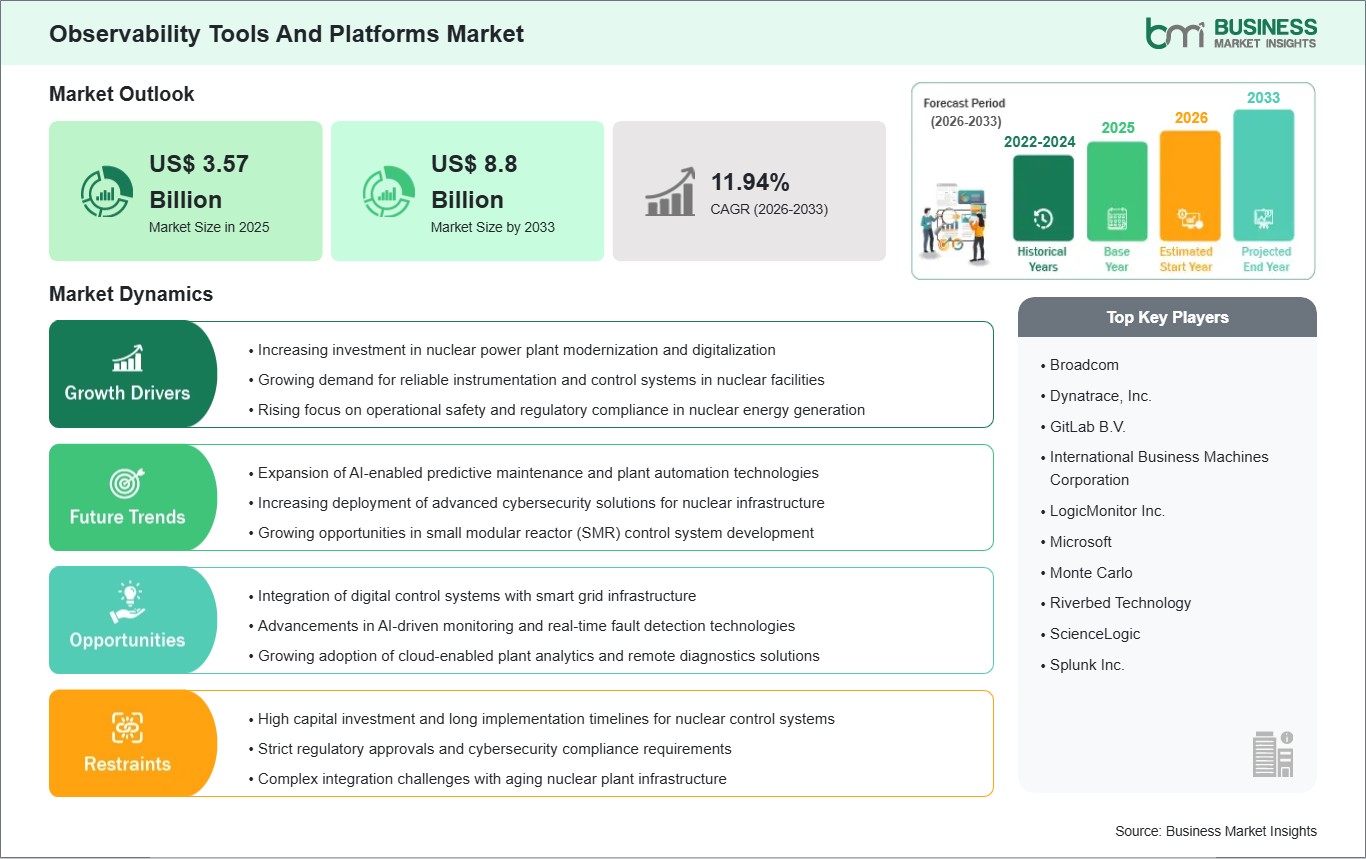
Within the market, solutions retain strong relevance because buyers often prioritize unified data ingestion, analytics, dashboards, and alerting workflows. Cloud deployment continues to align with elastic data volumes and distributed environments, while large enterprises sustain broader implementation scope due to complex estates and cross-functional monitoring needs. Industry demand remains visible across IT, financial services, healthcare, retail, manufacturing, and public sector environments.
Technology development is shifting the category beyond passive monitoring toward contextual intelligence and workflow integration. AI-assisted anomaly detection, telemetry correlation, root-cause analysis, and automation features are reshaping how teams interpret system behavior. At the same time, support for OpenTelemetry, business observability, and AI workload monitoring is expanding the functional boundary of these platforms.
Competitive conditions reflect a market shaped by platform breadth, integration depth, data architecture, and user experience rather than single-feature differentiation. Providers are refining observability portfolios through AI enhancements, broader ecosystem support, and tighter alignment with security and developer workflows. This environment encourages continuous product iteration as customers seek consolidated visibility without sacrificing analytical precision or operational flexibility.
Segment Analysis
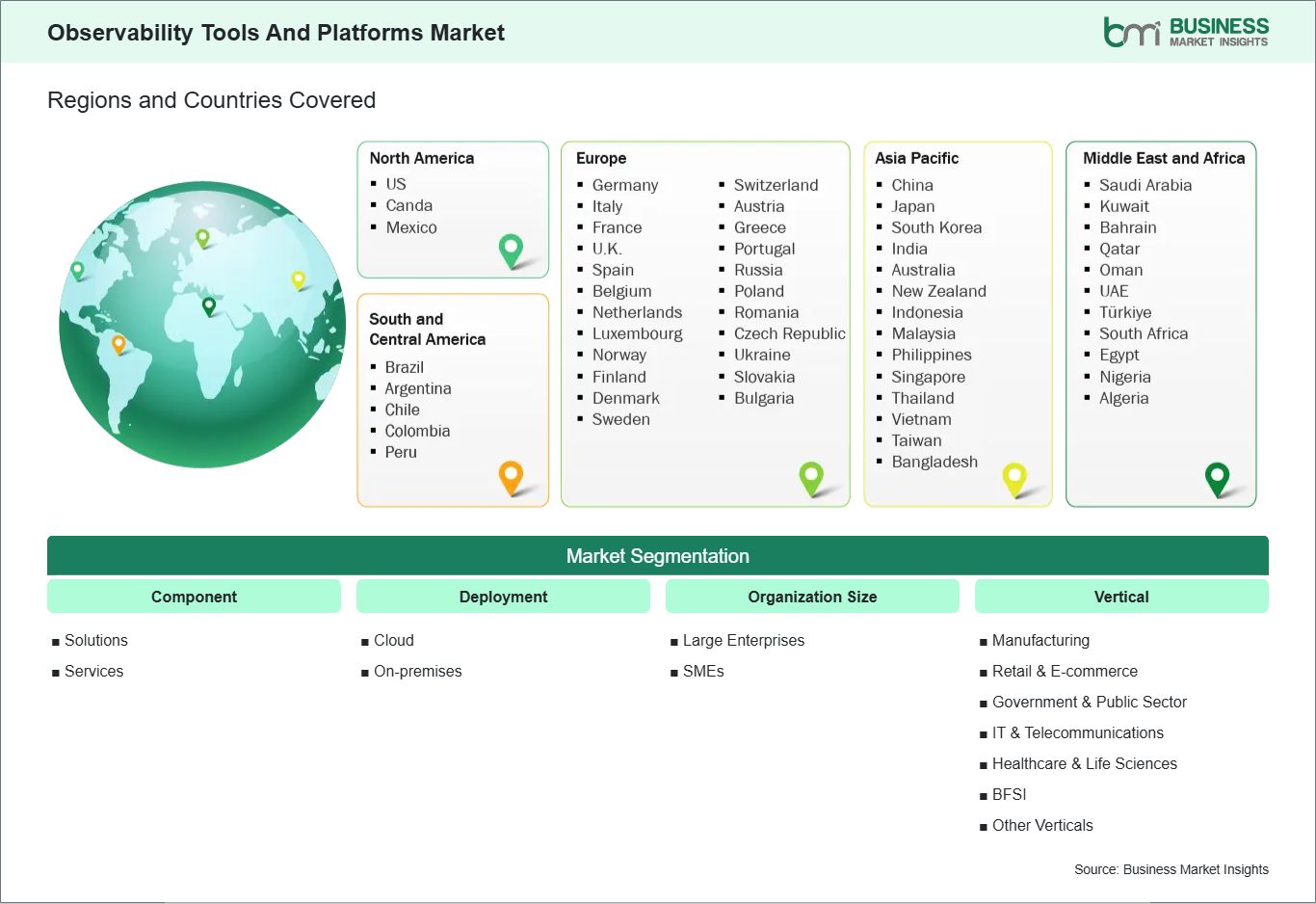
Observability Tools And Platforms Market Segmentation
The observability tools and platforms market is segmented based on component, deployment, organization size, and vertical, reflecting the increasing integration of AI-driven solution.
By Component
- Solutions – Centralize telemetry, analytics, and alert workflows across increasingly layered digital environments.
- Services – Support deployment design, optimization, integration, and operational maturity improvement
By Deployment
- Cloud – Matches scalable ingestion needs and distributed workload visibility requirements.
- On-premises – Remains relevant where control, latency, or compliance priorities shape deployment choices
By Organization Size
- Large Enterprises – Require broad observability coverage across complex applications, infrastructure, and teams.
- SMEs – Prefer streamlined platforms that simplify troubleshooting without heavy administrative overhead
By Vertical
- Manufacturing – Monitors production systems, connected assets, and operational application performance.
- Retail & E-commerce – Tracks transaction flows, digital storefront performance, and customer experience continuity.
- Government & Public Sector – Focuses on service availability, infrastructure oversight, and operational resilience.
- IT & Telecommunications – Needs high-fidelity visibility across networks, platforms, and digital service chains.
- Healthcare & Life Sciences – Supports uptime, data workflow transparency, and application reliability.
- BFSI – Prioritizes transaction integrity, latency control, and dependable digital service monitoring.
- Other Verticals – Extend usage into mixed environments with specialized operational visibility requirements
Market Forces
Observability Tools And Platforms Market Drivers and Opportunities
Rising complexity in cloud-native and distributed application environments
Modern software environments now span containers, microservices, APIs, cloud services, and third-party dependencies across multiple operating layers. This architectural shift makes isolated monitoring inadequate, creating a need for unified telemetry and contextual analysis. Organizations therefore adopt observability platforms to understand service interactions, investigate unknown failure points, and maintain stable performance across increasingly fragmented technology estates.
This shift matters because operational issues now emerge from interdependent systems rather than single infrastructure components. Observability platforms help teams correlate events across applications, infrastructure, and user journeys, making incident investigation more precise. Their relevance rises in environments where release cycles are frequent, downtime has commercial consequences, and technical teams require faster decisions under high data volume conditions.
Expansion of AI-enabled observability and business context integration
Opportunities are expanding as vendors integrate AI-assisted analytics, automated reasoning, workflow orchestration, and business context into observability environments. These capabilities enable organizations to move beyond reactive incident detection toward proactive issue identification, faster root-cause analysis, guided remediation, and intelligent service prioritization.
As observability platforms incorporate AI workload monitoring, anomaly detection, predictive analytics, and business impact assessment, their relevance is extending beyond IT and engineering teams. Organizations can increasingly correlate infrastructure, application, network, and user-experience telemetry with business-critical metrics such as transaction continuity, customer experience, service availability, and operational risk.
Future opportunities are expected to emerge around autonomous operations, cross-domain intelligence, automated remediation, and deeper alignment between technical performance and business outcomes. Vendors that enable enterprises to translate complex telemetry into actionable operational and commercial insights can position observability as a broader enterprise intelligence layer rather than solely an engineering and infrastructure monitoring tool.
Size and Share Analysis
Observability Tools And Platforms Market Size and Share Analysis
The Observability Tools And Platforms Market is projected to grow from US$ 3.57 Billion in 2025 to US$ 8.8 Billion by 2033 , registering a CAGR of 11.94% from 2026 to 2033.
Within the competitive structure, solutions account for the larger share because buyers often prioritize unified data collection, analytics depth, and incident investigation features. Cloud deployment retains stronger positioning as enterprises seek flexible scaling, faster rollout cycles, and centralized visibility across hybrid and distributed environments. Large enterprises also contribute a substantial portion of demand due to broader infrastructure footprints and more layered operational responsibilities.
From an industry application perspective, IT & Telecommunications remains a leading demand center because service continuity, network performance, and application reliability directly influence business outcomes. BFSI and Healthcare & Life Sciences also sustain strong engagement as these environments require dependable digital service delivery, fast issue identification, and tighter oversight of complex transaction or data-intensive workflows.
Report Coverage
Observability Tools And Platforms Market Report Coverage and Deliverables
The "Observability Tools And Platforms Market Size and Forecast (2022–2033)" report provides a detailed analysis of the market covering below areas:
- Observability tools and platforms market size and forecast at global, regional, and country levels for all market segments covered under the scope
- Observability tools and platforms market trends, as well as drivers, restraints, and opportunities
- Observability tools and platforms market analysis covering key trends, global and regional framework, major players, regulations, and recent developments
- Industry landscape and competition analysis covering market concentration, heat map analysis, prominent players, and recent developments for the observability tools and platforms market
- Detailed company profiles, including SWOT analysis
Geographic Insights
Observability Tools And Platforms Market Geographic Insights
The Observability Tools And Platforms market shows diverse regional adoption patterns influenced by digital infrastructure maturity, cloud transition strategies, regulatory expectations, and enterprise software modernization priorities. Across global markets, observability is gaining stronger operational relevance as organizations seek continuous visibility across applications, networks, and infrastructure supporting business-critical digital services.
North America maintains a mature market position due to early uptake of cloud-native architectures, strong enterprise software spending, and established DevOps practices. Organizations in the region typically pursue broader platform consolidation, deeper telemetry correlation, and tighter integration between observability, security, and automation workflows. Demand also benefits from the presence of major platform vendors and a large installed base of complex digital environments.
Asia Pacific presents an expansion-oriented landscape shaped by rising digital platform usage, modernization of enterprise systems, and broader deployment of cloud services across diverse industries. Regional demand is reinforced by growing software delivery activity, expanding online service ecosystems, and the need to monitor mixed environments spanning legacy systems and modern applications. Buyers often emphasize scalable deployment, faster troubleshooting, and operational efficiency improvements.
Europe shows steady progress as enterprises refine compliance-aware technology operations and strengthen resilience across hybrid infrastructures. Meanwhile, emerging markets in the Middle East, Africa, and South and Central America are building demand as public and private organizations invest in digital services, connectivity, and enterprise platforms. In these regions, observability adoption is increasingly linked to service continuity, infrastructure transparency, and modernization of operational oversight.
Industry Activity
Recent Developments
The observability tools and platforms market is evaluated by gathering qualitative and quantitative data post primary and secondary research, which includes important corporate publications, association data, and databases. A few of the key developments in the observability tools and platforms market are:
- In June 2025, Datadog, Inc. (NASDAQ: DDOG), the monitoring and security platform for cloud applications, announced new agentic AI monitoring and experimentation capabilities to give organizations end-to-end visibility, rigorous testing capabilities, and centralized governance of both in-house and third-party AI agents. Presented at DASH, Datadog’s annual observability conference, the new capabilities include AI Agent Monitoring, LLM Experiments and AI Agents Console.
- In October 2024, New Relic unveiled the New Relic Intelligent Observability Platform, transforming observability from ensuring uptime and reliability into a key driver of business growth and developer velocity for enterprises worldwide. The platform is strengthened by the New Relic AI Engine to predict and prevent issues, and streamline business and IT operations with automation. With new innovations like the New Relic AI integration with GitHub Copilot, New Relic Pathpoint Plus, and New Relic Retail Solution, New Relic Intelligent Observability bridges the gap between observability best practices and tangible business outcomes.
Trust & Transparency
Research Methodology
The market analysis combines proprietary research with secondary data from government agencies, company disclosures, regulatory filings, industry databases and expert interviews. Market estimates are validated through data triangulation, cross-market benchmarking and analyst
review.
View Full Research Methodology
Key Sources Referred:
World Bank – Global Trade Indicators World Trade Organization (WTO) (International Monetary Fund )IMF International Trade Administration (ITA) Company website Company annual reports Company investor presentations