
Data Quality Tools Market Outlook: Size, Share, Trends, Growth Analysis, Competitive Landscape & Forecast, 2026-2033

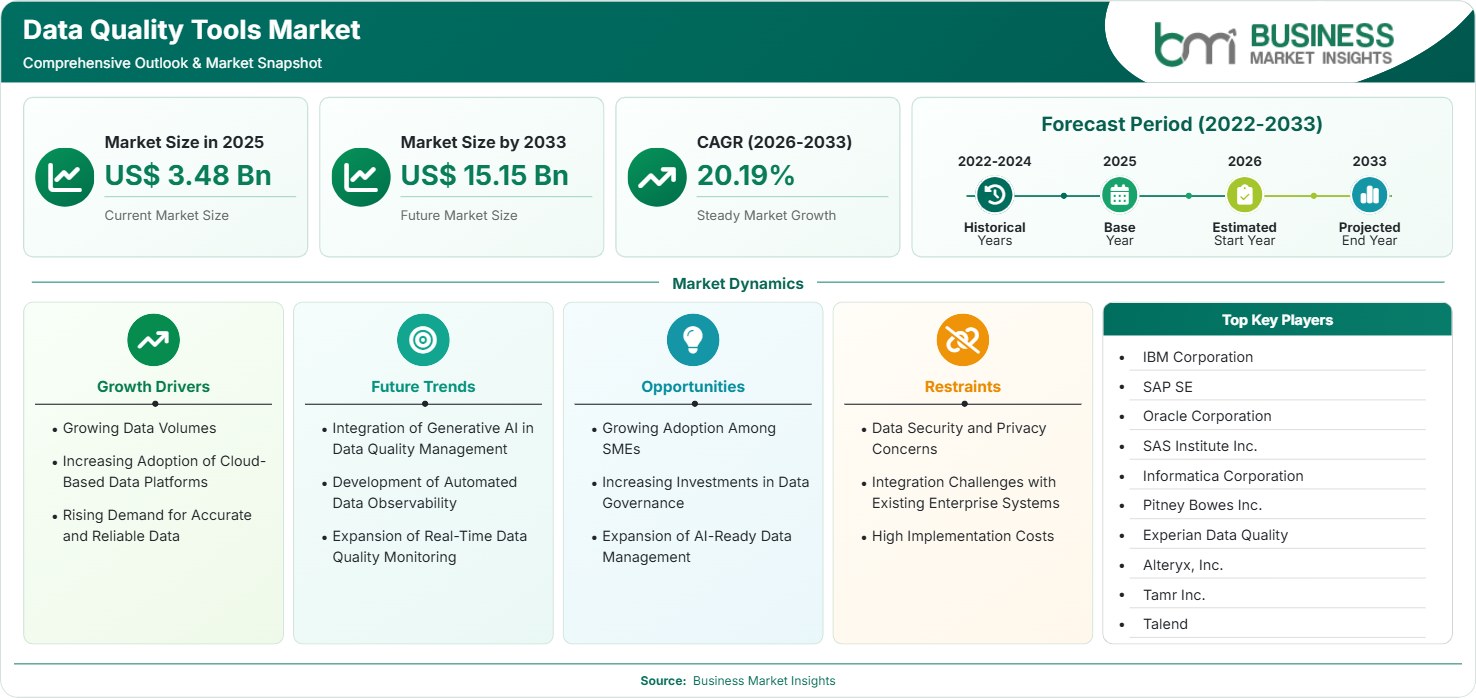
The Data Quality Tools Market size was valued at US$ 3.48 Billion in 2025 and is projected to reach US$ 15.15 Billion by 2033, growing at a CAGR of 20.19% during 2026–2033, driven by enterprise data governance initiatives, AI adoption, cloud transformation, compliance requirements, and increasing demand for accurate, consistent, and trusted business data assets.

Report Coverage
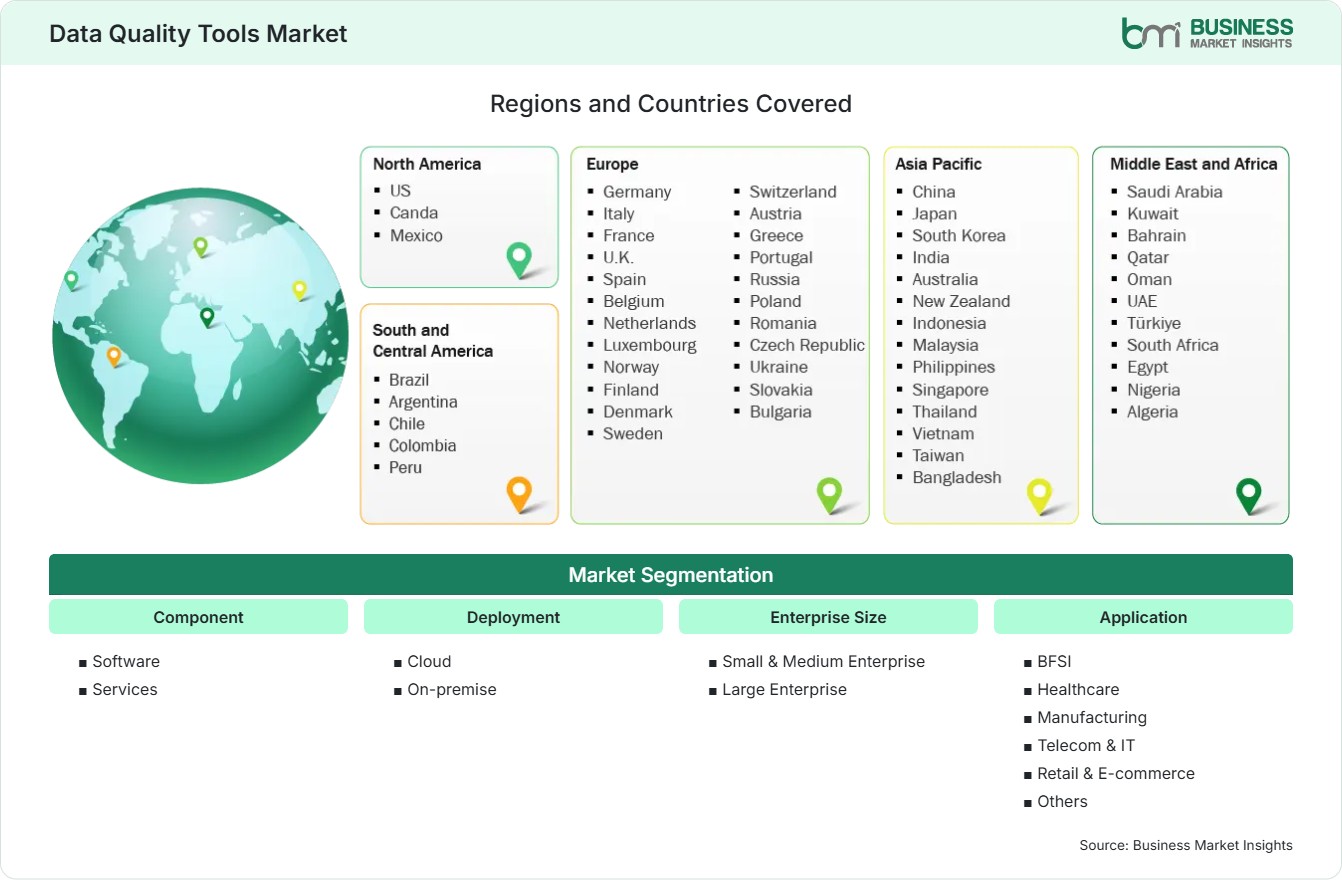
  • Component: Software, Services
  • Deployment: Cloud, On-premise
  • Enterprise Size: Small & Medium Enterprise, Large Enterprise
  • Application: BFSI, Healthcare, Manufacturing, Telecom & IT, Retail & E-commerce, Others
US$ 3.48 Bn Market size in 2025
US$ 15.15 Bn Market Size by 2033
20.19% CAGR, 2026 - 2033
2026-2033 Forecast Period

AI Overview

Data Quality Tools Market Summary

  • North America Region: North America holds a market share of 37%–40% in 2025, growing with a CAGR of 18.5%–19.8% during 2026–2033, driven by enterprise AI deployments, cloud modernization initiatives, data governance regulations, advanced analytics programs, master data management investments, and increasing demand for real-time business intelligence. The U.S. remains the largest contributor, expanding at a CAGR of 18.8%–20.1% through large-scale digital transformation initiatives.
  • Fastest Growing Region: Asia Pacific holds a market share of 23%–26% in 2025, growing with a CAGR of 22.1%–23.8% during 2026–2033, supported by rapid digitization, expanding cloud infrastructure, data-driven government initiatives, financial technology growth, e-commerce expansion, and accelerating enterprise analytics adoption.
  • Leading Segment: Software accounts for 72%–75% share in 2025, expanding at 20.5%–21.8% CAGR through 2033, supported by demand for data profiling, cleansing, enrichment, monitoring, governance automation, and AI-driven quality management capabilities.
  • High Growth Segment: Cloud deployment represents 64%–67% share in 2025, advancing at 22.5%–24.0% CAGR during 2026–2033, driven by scalability requirements, hybrid work adoption, lower ownership costs, rapid implementation, and integration with cloud-native analytics environments.
  • Key Market Opportunity: Organizations increasingly require AI-ready, trusted datasets to support generative AI, advanced analytics, predictive decision-making, and regulatory compliance, creating substantial opportunities for intelligent data quality platforms.
  • Major Market Players: IBM Corporation, SAP SE, Oracle Corporation, SAS Institute Inc., Informatica Inc., Pitney Bowes Inc., Experian Information Solutions, Inc., Alteryx, Inc., Tamr Inc., Talend SAS.
Strategic Insights

Data Quality Tools Market: Strategic Insights

Data Quality Tools Market Strategic Framework
FREE PDF
Request your free sample
Request free sample
Stakeholder View

Key Takeaways

  • The industry ecosystem increasingly integrates data quality, governance, cataloging, master data management, and analytics functions into unified enterprise information-management platforms.
  • Strong growth opportunities exist in cloud-native deployments supporting AI applications, advanced analytics environments, and real-time data-processing workloads.
  • Product innovation is shifting toward automated remediation, machine-learning-based anomaly detection, intelligent metadata discovery, and self-service data quality solutions.
  • Asia Pacific presents a compelling investment opportunity due to expanding digital economies, rapid cloud adoption, and increasing enterprise data modernization initiatives.
  • Strategic acquisitions and platform consolidations continue shaping the competitive landscape as vendors pursue broader data intelligence and governance capabilities.
  • Enterprises increasingly evaluate data quality solutions based on integration flexibility, automation capabilities, compliance support, and AI-readiness of managed datasets.
Geographic Outlook

Data Quality Tools Market Regional Highlights

North America Data Quality Tools Market

North America accounts for 37%–40% Data Quality Tools Market share in 2025 and is projected to advance at a CAGR of 18.5%–19.8% through 2033. Demand is driven by enterprise analytics investments, digital transformation initiatives, AI adoption, and regulatory compliance requirements. Organizations increasingly integrate data quality technologies with governance platforms, cloud environments, and business intelligence systems. Financial services, healthcare, retail, and technology sectors remain major adopters as trusted data becomes central to operational performance and strategic decision-making processes.

  • Large enterprises continue investing in automated data quality frameworks to improve AI outcomes, governance consistency, and enterprise-wide reporting accuracy.
  • Healthcare organizations increasingly deploy quality-monitoring tools to enhance clinical data integrity, regulatory compliance, and operational efficiency.
  • Cloud migration programs strengthen demand for scalable quality-management capabilities supporting hybrid and multi-cloud environments.
  • Financial institutions utilize advanced validation and profiling solutions to reduce risk exposure and improve regulatory reporting performance.
  • Real-time analytics adoption increases requirements for continuous monitoring and automated anomaly-detection capabilities.

US Data Quality Tools Market

The United States contributes approximately 76%–80% of North American revenue and records a CAGR of 18.8%–20.1% through the forecast period. Strong investment in AI, enterprise software modernization, cloud computing, and advanced analytics environments supports adoption. Organizations increasingly focus on trusted data foundations to improve machine-learning outcomes and customer intelligence initiatives. High regulatory scrutiny across healthcare, finance, and public-sector operations further accelerates deployment of automated quality management solutions.

  • Generative AI deployment programs increase demand for validated, consistent, and business-ready data assets across industries.
  • Financial institutions prioritize quality and governance capabilities to strengthen reporting transparency and compliance performance.
  • Technology companies expand adoption of automated monitoring tools supporting large-scale cloud and analytics environments.
  • Federal and state digital modernization initiatives contribute to enterprise-grade data governance investments.

Europe Data Quality Tools Market

Europe represents 27%–30% Data Quality Tools Market share in 2025 and is expected to expand at a CAGR of 19.0%–20.3% through 2033. Regulatory frameworks, including privacy and governance mandates, encourage organizations to prioritize trusted information management. Germany maintains the largest regional market, while Spain and Poland demonstrate stronger growth momentum. Enterprises increasingly invest in centralized governance capabilities, master data management platforms, and quality-monitoring technologies to support analytics, compliance, and digital business initiatives.

  • GDPR compliance continues influencing adoption of robust data validation, monitoring, stewardship, and governance practices.
  • Germany leads regional demand due to strong enterprise software spending and industrial digital-transformation programs.
  • Spain and Poland exhibit accelerating adoption as cloud migration and analytics investments expand across private and public sectors.
  • Retail and e-commerce organizations increasingly leverage quality platforms to improve customer intelligence and operational efficiency.
  • Manufacturing companies deploy enterprise-wide governance frameworks to support digital supply-chain transformation initiatives.

Asia Pacific Data Quality Tools Market

Asia Pacific accounts for 23%–26% Data Quality Tools Market share in 2025 and represents the fastest-growing regional market with a CAGR of 22.1%–23.8% through 2033. Rapid cloud adoption, expanding digital economies, government-led data initiatives, and increasing enterprise analytics investments support market expansion. China leads regional revenue generation, while India demonstrates the strongest growth trajectory. Organizations across banking, retail, healthcare, and telecommunications increasingly prioritize data consistency and governance to support AI deployment, customer engagement, and compliance objectives.

  • China maintains regional leadership through substantial investments in cloud infrastructure, enterprise analytics, AI initiatives, and large-scale digital transformation programs.
  • India records the highest growth momentum driven by fintech expansion, digital public infrastructure, and growing adoption of cloud-native business applications.
  • Telecommunications providers are increasing investments in quality-monitoring systems to improve customer experience and operational intelligence capabilities.
  • E-commerce companies deploy advanced profiling and cleansing technologies to optimize product information, customer records, and transaction accuracy.
  • Government digitalization programs encourage creation of trusted data environments supporting public services and economic modernization objectives.

Rest of World Data Quality Tools Market

The Rest of World region captures 8%–10% share in 2025 and is expected to expand at a CAGR of 20.0%–21.5% through 2033. South & Central America benefit from expanding digital banking ecosystems and enterprise cloud adoption. The Middle East & Africa region experiences accelerating deployment due to smart-government initiatives, digital economy programs, and modernization of enterprise information infrastructure. Brazil represents the leading market in Latin America, while the UAE and Saudi Arabia demonstrate strong investment momentum.

  • Brazil remains the largest regional adopter due to financial-services digitization and increasing demand for governance-driven enterprise data management.
  • Saudi Arabia benefits from national digital transformation initiatives supporting cloud adoption, analytics modernization, and governance frameworks.
  • The UAE continues attracting technology investments focused on trusted data ecosystems, AI readiness, and regulatory compliance practices.
  • Organizations increasingly adopt automated quality monitoring to support multi-source information environments and operational visibility.
  • Regulatory modernization across developing markets strengthens demand for data governance, stewardship, and compliance-oriented technologies.
Global Market Geography
FREE PDF
Request your free sample
Request free sample
Segment Analysis

Data Quality Tools Market Segmentation

Component

Software dominates the segment with 72%–75% share in 2025 and is projected to register a CAGR of 20.5%–21.8% through 2033. Organizations increasingly invest in automation, continuous monitoring, cleansing, profiling, and governance technologies. The Data Quality Tools Market scope continues expanding as enterprises seek scalable data quality frameworks supporting AI initiatives, advanced analytics, regulatory compliance, and real-time business intelligence environments.

  • Software: Provides profiling, cleansing, matching, enrichment, monitoring, validation, and governance capabilities enabling organizations to improve consistency, accuracy, and usability of enterprise information assets.
  • Services: Includes consulting, implementation, integration, support, managed services, and training activities that help organizations maximize platform effectiveness and user adoption.

Deployment

Cloud deployment accounts for 64%–67% share in 2025 and achieves the highest CAGR of 22.5%–24.0%. Organizations increasingly prefer scalable and subscription-based deployment models capable of supporting distributed data environments. Growing multi-cloud and hybrid-cloud strategies strengthen demand for flexible quality management technologies.

  • Cloud: Supports rapid deployment, lower infrastructure requirements, scalability, centralized governance, and integration with cloud-native analytics and AI ecosystems.
  • On-premise: Preferred among organizations requiring direct infrastructure control, industry-specific compliance management, and customized governance architectures.

Enterprise Size

Large enterprises remain the dominant adopters with 61%–64% share in 2025 and CAGR of 19.5%–20.8%. Increasing investments in governance and analytics modernization support enterprise-scale deployments. Data Quality Tools Market trends indicate growing SME adoption due to cloud accessibility and lower implementation barriers.

  • Small & Medium Enterprise: Adoption is increasing as affordable cloud offerings enable smaller businesses to improve reporting accuracy, customer intelligence, and operational efficiency.
  • Large Enterprise: Organizations require enterprise-scale governance frameworks, quality monitoring systems, and AI-ready data management across complex operational environments.

Application

BFSI represents the leading application category with 24%–27% share in 2025 and CAGR of 21.0%–22.2% through 2033. Stringent regulatory requirements and risk-management priorities continue supporting investment in quality and governance technologies.

  • BFSI: Financial institutions prioritize data accuracy, fraud detection, compliance reporting, and customer intelligence across large transactional ecosystems.
  • Healthcare: Data quality supports patient information management, clinical analytics, regulatory compliance, and operational efficiency initiatives.
  • Manufacturing: Organizations utilize quality tools to strengthen supply-chain visibility, operational analytics, and digital manufacturing strategies.
  • Telecom & IT: Service providers require accurate subscriber, network, and operational data to improve customer experience and business performance.
  • Retail & E-commerce: Businesses rely on trusted customer and product information to optimize personalization, inventory management, and digital commerce performance.
Market Forces

Data Quality Tools Market Dynamics

Key Market Drivers

Growing Data Volumes

Organizations across industries continue generating unprecedented volumes of structured and unstructured information from cloud applications, connected devices, customer interactions, enterprise resource planning systems, and digital channels. When huge amounts of data are managed without constant quality checks, there is higher probability of errors, duplications, and incomplete data sets. Data quality tools enable organizations to manage their data assets through standardization, validation, enrichment, and governance. The Data Quality Tools Market growth is driven by growing reliance of enterprises on real-time analytics, artificial intelligence, and business intelligence systems, which in turn depend on accurate data. With organizations embarking on digital transformation projects, accuracy of data is becoming more important than ever.

Increasing Adoption of Cloud-Based Data Platforms

Cloud computing has transformed enterprise data architectures by enabling scalable storage, flexible processing capabilities, and integrated analytics environments. The process of shifting applications to cloud computing architectures can be complicated by the issue of data consistency and interoperability. Data quality tools offer automated capabilities to cleanse, profile, monitor, and validate data in cloud environments. Hybrid and multi-cloud architectures add an extra layer of complexity for quality management and governance. Organizations are increasingly adopting quality platforms that are part of cloud-native analytics and data management systems. This makes the need for tools able to offer real-time visibility, automation, and governance over information sources from multiple sources more important.

Rising Demand for Accurate and Reliable Data

Executive decision-making, regulatory reporting, customer engagement, and AI initiatives increasingly depend on trustworthy information. Inaccurate data could potentially impact the accuracy of forecasts, compliance efforts, customer satisfaction, and financial results. Hence, the need to invest in those initiatives that enhance the completeness, consistency, timeliness, and accuracy of enterprise data resources is a key objective of any organization. Compliance regulations within banking, healthcare, telecommunication, and public sector industries add to the significance of having accurate records. Quality platforms allow companies to put in place governance policies and proactive monitoring systems. As organizations explore avenues of predictive analytics and intelligent automation, the demand for such technologies only keeps on rising.

Key Market Opportunities

Growing Adoption Among SMEs

Small and medium-sized enterprises are rapidly recognizing the value of accurate and governed data for competitiveness, customer engagement, and operational efficiency. Cloud-based delivery methods remove the need for major infrastructure investments and make it possible for even smaller companies to utilize quality management functionalities. There are lots of small and medium enterprises that are using such services as analytics applications, digital commerce solutions, and cloud-based enterprise solutions, hence making it necessary for them to use data validation and data governance features. More vendors are providing subscription solutions due to their budget restrictions. SMEs present a big opportunity for vendors who want to increase their market share.

Increasing Investments in Data Governance

Organizations worldwide are strengthening governance frameworks to improve transparency, accountability, security, and compliance across enterprise information assets. Data quality programs are now more inclined towards integrating quality monitoring as a key component of data governance. Organizations need systems that have the capability to enable stewardship, metadata, lineage and policy programs. The level of investments is high in industries that are subject to regulations due to the risk of compliance issues and business disruptions due to failure in governance programs. Data quality providers offering governance tools integrated with automation and analytics stand to gain from increased enterprise investment.

Expansion of AI-Ready Data Management

Artificial intelligence initiatives require high-quality, standardized, and accurately labeled datasets to generate reliable outputs. Firms implementing machine learning, predictive analytics, and generative AI solutions are becoming more and more focused on data readiness. Quality management tools are key in helping detect problems, removing discrepancies, and increasing confidence in training data. The Data Quality Tools Market Forecasts indicate an increasing focus on AI-powered governance solutions to help firms gain maximum benefit from their technology. Examples of new use cases include data stewardship automation, intelligent quality scoring, dynamic remediation, and machine learning-based anomaly detection. Providers of AI-ready data prep solutions stand to gain significant traction moving forward.

Market Restraints and Challenges

Data Security and Privacy Concerns

Factor: Enterprise datasets often contain sensitive customer, financial, healthcare, and operational information subject to strict privacy and security requirements. Impact: Deployments or adoption may be postponed if there are any worries about illegal access, compliance risk, or exposure of the regulated data. Multiple cloud services and cross-boundary transfer of data can pose additional challenges for governance. The vendors should prove their strong encryption, access control, auditing abilities, and compliance certifications to meet customer needs. The possibility to protect information without loss of usability is still an important issue.

Integration Challenges with Existing Enterprise Systems

Factor: Many organizations operate fragmented information landscapes consisting of legacy databases, ERP platforms, CRM systems, cloud applications, and third-party data sources. Impact: Integration complexity may lead to higher costs and delays in deployment, as well as diminish anticipated value for the business. Inconsistent data formats, isolated architecture, and different governance requirements tend to make operations difficult. Companies need customization and compatibility in order to provide flawless data quality operations. More and more vendors focus on API support and connectivity tools, however, integration still remains a problem.

Company Analysis

Competitive Landscape

The Data Quality Tools Market analysis shows competition increasingly focused on AI-powered automation, governance integration, cloud-native architectures, metadata intelligence, and enterprise-scale data management capabilities.

Company Name

Overview

Products and Services relevant to this market

IBM Corporation

Global technology provider delivering enterprise-grade data governance, analytics, and AI solutions.

Data quality management, governance tools, metadata management, master data management, AI-driven data intelligence.

SAP SE

Enterprise software leader integrating data quality and governance into business applications.

Data quality management, information stewardship, governance solutions, enterprise data integration services.

Oracle Corporation

Large-scale database and enterprise software company with extensive data management capabilities.

Data quality, data integration, cloud data management, master data governance, analytics tools.

SAS Institute Inc.

Analytics-focused vendor supporting governance, quality management, and advanced analytics initiatives.

Data cleansing, profiling, governance, analytics optimization, risk and compliance data solutions.

Informatica Inc.

Major provider of data management and cloud-based governance platforms.

Data quality, master data management, metadata intelligence, cloud integration, governance tools.

Pitney Bowes Inc.

Technology company supporting location intelligence and data quality management applications.

Address validation, data enrichment, verification, customer information quality solutions.

Experian Information Solutions, Inc.

Global information services provider focused on trusted customer and business data.

Data validation, enrichment, verification, customer data quality, identity management services.

Alteryx, Inc.

Analytics automation vendor enabling data preparation and quality optimization workflows.

Data preparation, analytic automation, quality monitoring, governance and reporting capabilities.

Tamr Inc.

Specialist company focused on data mastering and entity resolution technologies.

Data unification, quality enhancement, entity resolution, AI-assisted data management solutions.

Talend SAS

Data integration and quality provider supporting cloud and hybrid environments.

Data quality, integration, governance, data preparation, cloud-native management solutions.

Trust & Transparency

Research Methodology

The market analysis combines proprietary research with secondary data from government agencies, company disclosures, regulatory filings, industry databases and expert interviews. Market estimates are validated through data triangulation, cross-market benchmarking and analyst review.

View Full Research Methodology

Questions Answered

Frequently Asked Questions

What information is included in a Data Quality Tools Market Report?

A Data Quality Tools Market Report generally covers market sizing, technology trends, regional opportunities, competitive benchmarking, segmentation analysis, growth drivers, investment outlooks, and forecast assessments.

What factors influence vendor selection in this market?

Organizations typically evaluate automation capabilities, governance integration, scalability, AI readiness, compliance support, interoperability, deployment flexibility, and total cost of ownership.

How do cloud-based data quality platforms differ from on-premise solutions?

Cloud platforms offer scalability, faster deployment, lower infrastructure requirements, and easier integration with modern analytics ecosystems, while on-premise solutions provide greater infrastructure control.

Which industries are investing most heavily in data quality technologies?

BFSI, healthcare, telecommunications, retail, manufacturing, and public-sector organizations are among the largest adopters due to compliance requirements and increasing analytics dependence.

Why are data quality tools becoming critical for AI initiatives?

AI models rely on trusted, complete, and consistent datasets. Poor-quality information can reduce model accuracy, introduce bias, and negatively affect operational decision-making outcomes across organizations.

Access the Full Data Quality Tools Market Report

Get segment-level forecasts, regional estimates, competitive benchmarking, company profiles and downloadable Excel datasets.

Access the full Data Quality Tools Market Report
350 pages PDF & Excel | 2026-09-15
Similar Research

Related Market Reports