
IoT in Retail Market Size, Share, Trends & Forecast Report, 2026–2033

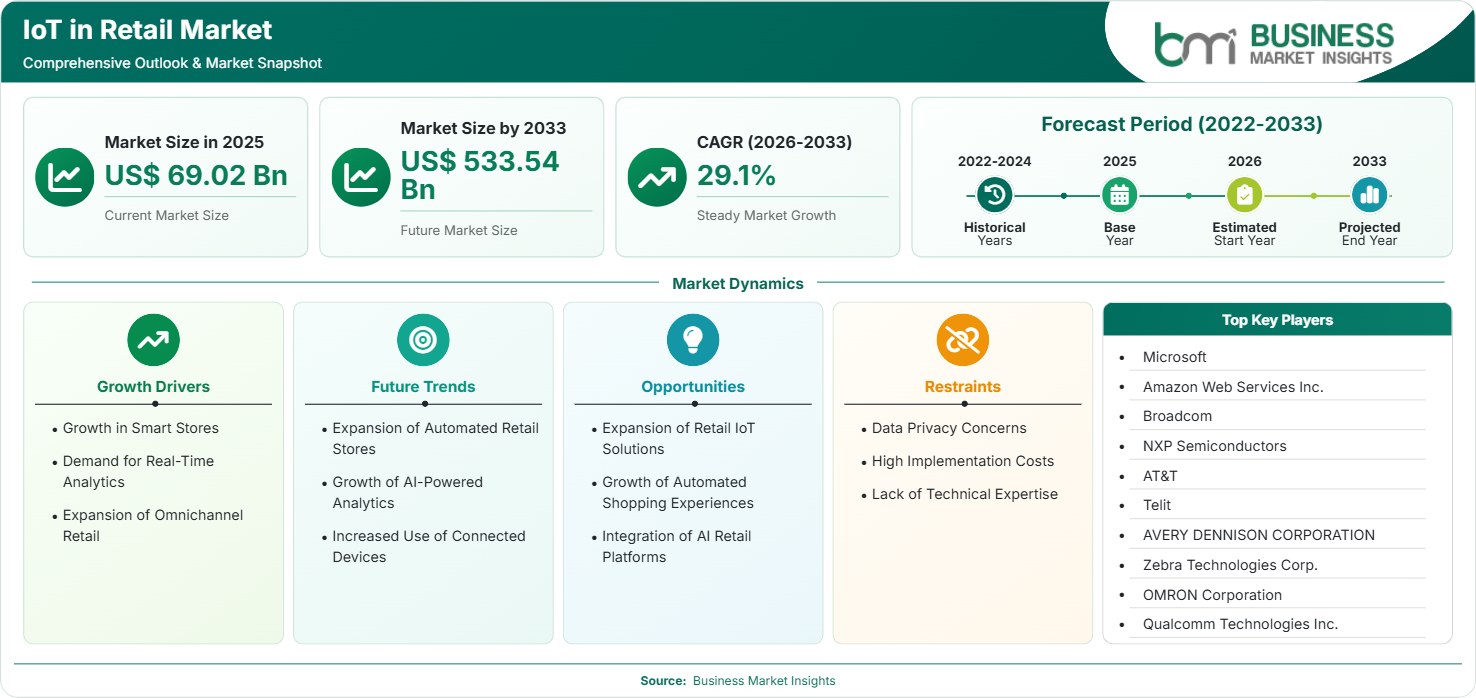
The IoT in Retail Market size was valued at US$ 69.02 Billion in 2025 and is projected to reach US$ 533.54 Billion by 2033, growing at a CAGR of 29.1% during 2026–2033, driven by smart store expansion, real-time analytics adoption, omnichannel retail growth, automated shopping experiences, AI retail platforms, and advanced connected retail solutions.

Report Coverage
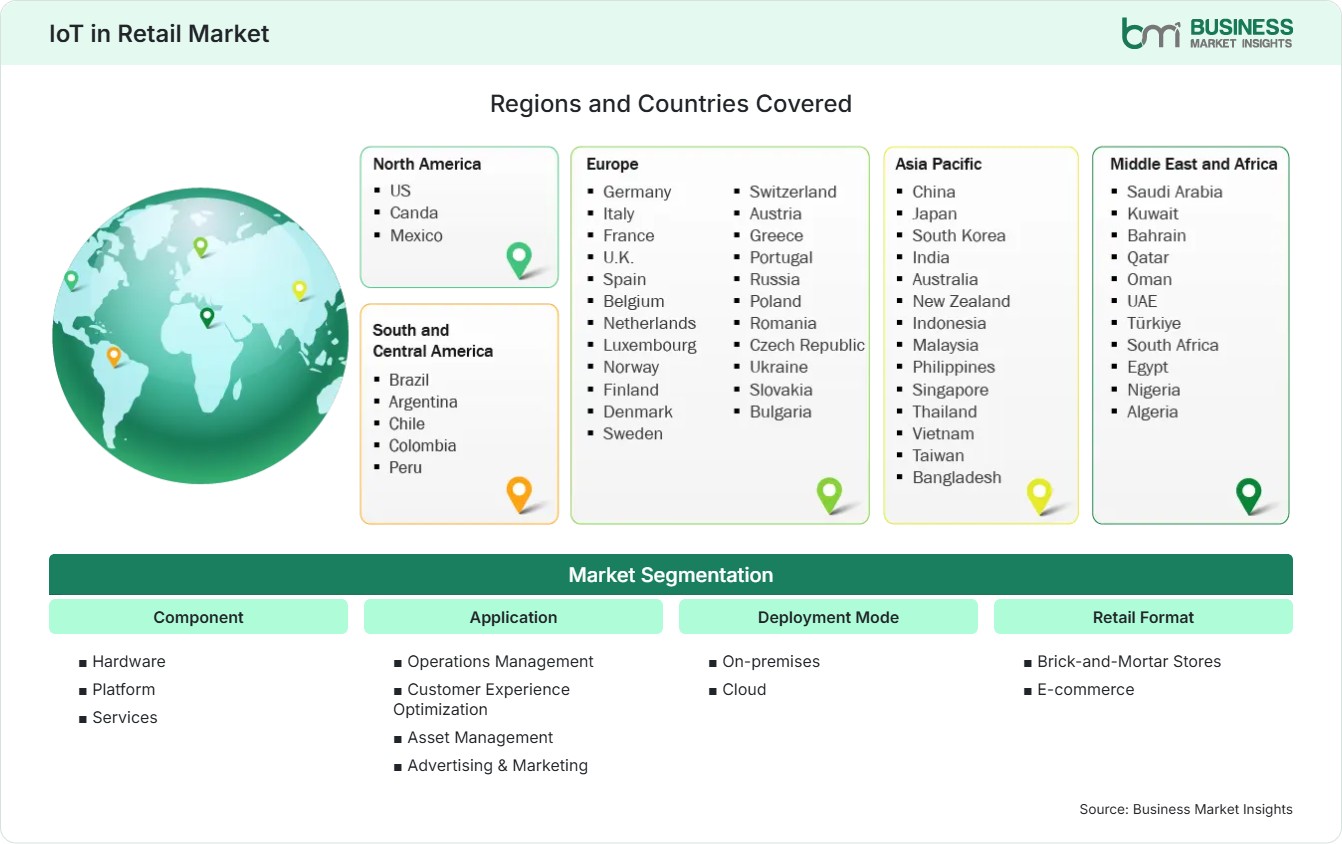
  • Component: Hardware, Platform, Services
  • Application: Operations Management, Customer Experience Optimization, Asset Management, Advertising & Marketing
  • Deployment Mode: On-premises, Cloud
  • Retail Format: Brick-and-Mortar Stores, E-commerce
US$ 69.02 Bn Market size in 2025
US$ 533.54 Bn Market Size by 2033
29.1% CAGR, 2026 - 2033
2026-2033 Forecast Period

01 AI Overview

IoT in Retail Market Summary

  • North America Region: North America holds market share of 34%–38% in 2025, growing with a CAGR of 28.5%–29.3% influenced by smart store adoption, retail digitization, AI integration, and advanced analytics deployment. The US market demonstrates growth with a CAGR of 28.8%–29.5% from 2026–2033, supported by e-commerce expansion, connected retail infrastructure, and automated customer engagement solutions.
  • Fastest Growing Region: Asia Pacific holds market share of 26%–30% in 2025, growing with a CAGR of 30.0%–30.8% influenced by expanding retail ecosystems, digital commerce growth, smart city initiatives, and increasing technology adoption among retailers.
  • Leading Segment: Hardware component holds market share of 42%–46% in 2025, growing with a CAGR of 28.7%–29.5% influenced by connected sensors, RFID technologies, smart shelves, and automated inventory management requirements.
  • High Growth Segment: Cloud deployment holds market share of 52%–56% in 2025, growing with a CAGR of 30.5%–31.2% influenced by scalable infrastructure, real-time data processing, artificial intelligence integration, and flexible retail technology adoption.
  • Key Market Opportunity: Expansion of retail IoT solutions, automated shopping experiences, and AI retail platforms creates opportunities through improved operational efficiency, personalized customer engagement, and data-driven retail decision-making.
  • Major Market Players: Microsoft, Amazon Web Services Inc., Broadcom, NXP Semiconductors, AT&T, Telit, AVERY DENNISON CORPORATION, Zebra Technologies Corp., OMRON Corporation, and Qualcomm Technologies Inc.
02 Strategic Insights

IoT in Retail Market: Strategic Insights

IoT in Retail Market Strategic Framework
FREE PDF
Request your free sample
Request free sample
03 Stakeholder View

Key Takeaways

  • The IoT retail ecosystem includes hardware providers, connectivity companies, cloud platform developers, analytics providers, retailers, and technology integrators supporting connected commerce environments.
  • Smart inventory management, automated shopping solutions, and customer experience optimization represent major growth opportunities as retailers prioritize efficiency, personalization, and operational visibility.
  • Innovation is shifting toward AI-powered retail platforms, edge computing, predictive analytics, connected sensors, and automated customer engagement technologies.
  • Asia Pacific presents strong investment opportunities due to expanding e-commerce markets, rising digital adoption, growing retail infrastructure, and increasing technology modernization initiatives.
  • Strategic partnerships, platform integrations, and technology collaborations are shaping competition as companies strengthen IoT capabilities and expand retail-focused solution portfolios.
  • Data-driven retail management is becoming a key strategic priority as businesses use connected technologies to improve customer insights, inventory accuracy, and operational performance.
04 Geographic Outlook

IoT in Retail Market Regional Highlights

North America IoT in Retail Market

North America IoT in Retail Market share accounted for a 34%–38% share in 2025 and is projected to expand at a CAGR of 28.5%–29.3% during 2026–2033. The region maintains leadership due to advanced retail infrastructure, high technology adoption, strong e-commerce penetration, and investments in connected store solutions. The US and Canada represent major markets supported by AI integration, cloud adoption, automated checkout systems, and retailer focus on personalized customer experiences.

  • Retailers are deploying IoT solutions to improve inventory accuracy, customer engagement, and operational efficiency.
  • Smart store investments are increasing through connected shelves, sensors, and automated retail technologies.
  • Cloud-based retail platforms are supporting scalable IoT deployments across large retail networks.
  • AI integration is enhancing customer personalization and predictive retail decision-making capabilities.
  • E-commerce and physical retail integration is accelerating connected technology adoption.

US IoT in Retail Market

US market represented a 30%–34% share in 2025 and is estimated to grow at a CAGR of 28.8%–29.5% between 2026–2033. The country remains a leading contributor due to advanced retail technology adoption, strong cloud infrastructure, and increasing demand for automated shopping experiences. Retailers are investing in connected solutions to improve operational efficiency and customer engagement.

  • Smart stores are expanding through adoption of sensors, RFID, and intelligent inventory systems.
  • Retail companies are integrating IoT platforms with artificial intelligence for advanced analytics.
  • Omnichannel strategies are increasing demand for connected customer experience solutions.
  • Automated checkout technologies are gaining adoption among major retail operators.

Europe IoT in Retail Market

Europe market held a 22%–26% share in 2025 and is forecast to register a CAGR of 28.0%–28.8% during 2026–2033. The region benefits from retail digitalization, sustainability initiatives, and increasing adoption of connected store technologies. Germany, the UK, France, Italy, and the Netherlands represent key markets, with Germany and the UK leading due to advanced retail ecosystems and technology investments.

  • Retailers are adopting IoT solutions to improve supply chain visibility and operational efficiency.
  • Germany is expanding smart retail adoption through automation and connected infrastructure investments.
  • European retailers are integrating IoT with sustainability and energy management initiatives.
  • Customer analytics solutions are gaining importance for personalized shopping experiences.
  • Data protection requirements are influencing secure IoT implementation strategies.

Asia Pacific IoT in Retail Market

Asia Pacific market accounted for a 26%–30% share in 2025 and is expected to grow at the fastest CAGR of 30.0%–30.8% between 2026–2033. Rapid digital commerce expansion, growing retail infrastructure, and increasing technology investments are supporting regional growth. China, India, Japan, South Korea, and Southeast Asian countries represent major markets, with India and Southeast Asia showing strong opportunities through retail modernization.

  • E-commerce expansion is increasing demand for connected retail technologies and analytics platforms.
  • Retailers are adopting IoT systems to improve inventory and supply chain management.
  • Smart city development is supporting connected retail infrastructure investments.
  • Mobile commerce growth is encouraging integration of digital customer engagement solutions.
  • Emerging retailers are adopting affordable cloud-based IoT platforms.

Rest of World IoT in Retail Market

Rest of World IoT in Retail Market represented a 6%–10% share in 2025 and is projected to grow at a CAGR of 28.2%–29.0% from 2026–2033. Latin America, Middle East, and Africa markets are developing through digital transformation, expanding retail networks, and increasing technology adoption. Brazil, Mexico, UAE, Saudi Arabia, and South Africa represent important markets driven by e-commerce growth and modernization of retail operations.

  • Latin American retailers are investing in connected systems to improve operational visibility.
  • Brazil and Mexico are adopting IoT solutions across growing retail and e-commerce sectors.
  • Middle Eastern retailers are implementing smart store technologies through digital transformation initiatives.
  • African markets are adopting connected solutions to enhance retail efficiency and accessibility.
  • Regional technology investments are supporting expansion of IoT-enabled retail environments.
Global Market Geography
FREE PDF
Request your free sample
Request free sample
05 Segment Analysis

IoT in Retail Market Segmentation

Component

Component segmentation includes hardware, platform, and services supporting connected retail operations. Hardware maintained a leading position in 2025 with a 42%–46% share and is expected to grow at a CAGR of 28.7%–29.5% from 2026–2034. Growth is supported by increasing deployment of sensors, RFID systems, smart shelves, connected devices, and retail automation infrastructure.

  • Hardware: Hardware includes sensors, RFID devices, connected equipment, and networking components enabling retail IoT operations.
  • Platform: Platforms provide data management, analytics, integration capabilities, and centralized control for connected retail systems.
  • Services: Services support implementation, consulting, maintenance, integration, and optimization of IoT retail solutions.

Application

Application segmentation covers operations management, customer experience optimization, asset management, and advertising and marketing. Operations management represents a significant application area due to retailers' focus on inventory accuracy, supply chain efficiency, and automated store processes. IoT applications are helping retailers improve decision-making through real-time data collection and operational analytics.

  • Operations Management: Supports inventory monitoring, supply chain optimization, and automated retail process management.
  • Customer Experience Optimization: Enables personalized shopping experiences through customer behavior analysis and connected technologies.
  • Asset Management: Improves tracking, monitoring, and utilization of retail equipment and assets.
  • Advertising & Marketing: Uses customer insights and connected platforms to deliver targeted promotional strategies.

Deployment Mode

Deployment mode segmentation includes on-premises and cloud solutions. Cloud deployment maintained a leading position due to scalability, lower infrastructure requirements, and flexible data management capabilities. Retailers are increasingly adopting cloud-based IoT platforms to support distributed operations, real-time analytics, and integration with artificial intelligence technologies.

  • On-premises: On-premises deployment provides direct infrastructure control and is preferred by retailers requiring localized data management.
  • Cloud: Cloud deployment enables scalable IoT operations, remote access, analytics integration, and flexible retail technology management.

Retail Format

Retail format segmentation includes brick-and-mortar stores and e-commerce platforms. Brick-and-mortar stores represent a significant segment due to increasing smart store investments, while e-commerce retailers are adopting IoT technologies to improve logistics, customer engagement, and fulfillment operations. Connected technologies are enabling integration between physical and digital retail environments.

  • Brick-and-Mortar Stores: Physical stores adopt IoT for inventory optimization, smart shelves, automated checkout, and customer engagement.
  • E-commerce: Online retailers use IoT for logistics optimization, personalized recommendations, and connected fulfillment operations.
06 Market Forces

IoT in Retail Market Dynamics

Key Market Drivers

Growth in Smart Stores

The rise of smart stores is contributing to the growth in IoT adoption through investments in connected infrastructure aimed at enhancing operational efficiency and customer experiences. The deployment of smart stores involves the use of sensors, RFID systems, automated checkout systems, and other devices to track the inventory and management of assets in such stores. The growth in the market is being driven by an increased focus on automation and real-time data for personalization, among others. The IoT in Retail Market trends show an increase in the adoption of intelligent stores that leverage analytics and cloud computing.

Demand for Real-Time Analytics

The demand for real-time analytics is rising because of the increasing need for real-time insights into customer behavior, inventory transactions, and operational efficiency. IoT-powered devices provide ongoing data that can be utilized by organizations to refine their pricing, supply chain, store layout, and marketing techniques. IoT in retail market growth is fueled by the rising adoption of data-driven decision-making based on data within retail. Market trends are characterized by the growing interlinking of IoT solutions, artificial intelligence, and advanced analytics capabilities.

Expansion of Omnichannel Retail

Expansion in omnichannel retailing has resulted in the adoption of IoT technology by organizations that link their brick-and-mortar stores, e-commerce operations, and digital customer experience services. Organizations are adopting connected technologies to coordinate their inventory management, enhance their fulfillment process, and ensure that customers have a synchronized experience across different channels. The factors fueling the growth in the market include high demand for a better shopping experience and improved management of the supply chain. Some of the trends in IoT in retail market include connected logistics, smart inventory, and customer tracking.

Key Market Opportunities

Expansion of Retail IoT Solutions

The growth of IoT solutions for retailers presents several possibilities considering the trend of retailers adopting technologies that enhance efficiency in operations, inventory, and customer experience. Sensors, smart shelves, digital payments, and automation systems are key components of the modern retail industry. Technology vendors are coming up with innovative and scalable IoT platforms that cater to multiple applications of the retail sector, ranging from store operations to supply chain management. The adoption of cloud computing and edge technologies is making it possible for retailers to adopt flexible and connected solutions. There is an opportunity for companies providing secure, compatible, and analytical IoT solutions for retailers.

Growth of Automated Shopping Experiences

The IoT in Retail Market Forecast is favorable because the trend of automated shopping offers ample prospects for connected retail technologies. The growing popularity of cashier-less shops, advanced checkout stations, and personalized retail services is increasing the demand for such technologies. This allows retailers to automate their purchasing processes, control the movements of customers, and increase the effectiveness of their service delivery. Automated shopping helps businesses become more efficient and gives a faster and more comfortable experience to customers. Furthermore, retailers are implementing connected technologies to enable self-service, payment digitization, and customer intelligence. Companies offering IoT products for automation are highly likely to prosper in this market environment.

Integration of AI Retail Platforms

The integration of AI in retail platforms offers various benefits through the incorporation of IoT data, advanced analytics, and intelligent automation tools. Artificial intelligence allows retailers to have insight into their customers’ behavior, as well as plan for inventories. IoT devices can gather essential data to assist in making personalized suggestions, forecasting demand, and automating store management. Retail technology companies are continuously designing products that incorporate IoT, artificial intelligence, and cloud to offer retail intelligence. This integration of technologies will be useful in building future-generation retail ecosystems by improving efficiency, enhancing customer experiences, and enabling data-driven business strategies.

Market Restraints and Challenges

Data Privacy Concerns

Factor: Data privacy concerns regarding the collection, storage, and processing of customer information pose challenges to IoT adoption in retail environments. Impact: Privacy risks can reduce consumer trust, increase compliance requirements, and require additional investments in cybersecurity and data protection frameworks. IoT-enabled retail systems collect extensive operational and customer data, making secure management essential. Retailers must implement encryption, access controls, and regulatory compliance measures to protect sensitive information. As connected retail environments expand, balancing personalization benefits with privacy protection remains a critical challenge influencing technology deployment decisions.

High Implementation Costs

Factor: High implementation costs associated with IoT hardware installation, platform integration, connectivity infrastructure, and technical expertise create barriers for retailers. Impact: Significant upfront investments can delay adoption, particularly among small and medium-sized retailers with limited technology budgets. Implementing IoT solutions often requires upgrades across existing systems, employee training, and ongoing maintenance support. Although cloud-based solutions are improving accessibility, cost considerations remain important for businesses evaluating digital transformation strategies. Retailers must assess long-term operational benefits against initial investments to justify IoT implementation and achieve sustainable technology adoption.

07 Company Analysis

Competitive Landscape

The IoT in Retail Market analysis highlights competition among technology providers, semiconductor companies, cloud service providers, and connectivity specialists delivering connected retail solutions. Companies are focusing on AI integration, cloud platforms, smart store technologies, data analytics, and secure connectivity solutions. Leading players are expanding partnerships and product portfolios to support retailers adopting digital transformation strategies.

Company Name

Overview

Products and Services relevant to this market

Microsoft

Technology company providing cloud and digital transformation solutions.

Azure IoT platforms, retail analytics, AI solutions, and connected retail services.

Amazon Web Services Inc.

Cloud computing provider supporting enterprise technology adoption.

IoT cloud services, analytics platforms, machine learning, and retail solutions.

Broadcom

Semiconductor and infrastructure technology company.

Connectivity components, networking technologies, and IoT hardware solutions.

NXP Semiconductors

Semiconductor company specializing in connected technologies.

Sensors, processors, RFID solutions, and secure IoT components.

AT&T

Telecommunications company providing connectivity services.

IoT connectivity, network solutions, and connected retail infrastructure.

Telit

IoT technology provider offering connectivity solutions.

IoT modules, platforms, device management, and connectivity services.

AVERY DENNISON CORPORATION

Materials and identification technology company.

RFID solutions, smart labels, inventory tracking, and retail technologies.

Zebra Technologies Corp.

Enterprise technology provider specializing in automation.

RFID systems, barcode solutions, IoT devices, and retail analytics.

OMRON Corporation

Automation technology company serving industrial and retail sectors.

Sensors, automation systems, and connected technology solutions.

Qualcomm Technologies Inc.

Semiconductor and wireless technology company.

IoT processors, connectivity platforms, and edge computing solutions.

08 Industry Activity

Recent Developments

August 2025

Zebra Technologies Corporation announced an agreement to acquire Elo Touch Solutions, a provider of touchscreen and self-service kiosk technologies, to strengthen its connected retail and frontline technology portfolio. The acquisition expands Zebra’s capabilities in customer-facing retail solutions, including interactive displays, kiosks, and point-of-sale environments that rely on connected IoT infrastructure.

February 2025

Cisco Systems, Inc. announced a strategic partnership with Mistral AI to develop AI capabilities that enhance customer experience and enterprise operations. Cisco’s retail technology portfolio uses secure networking, IoT connectivity, and edge infrastructure to support smart store environments.

January 2025

NVIDIA Corporation introduced the NVIDIA AI Blueprint for Retail Shopping Assistants at NRF 2025, providing developers with generative AI and 3D visualization tools for building intelligent retail assistants. The solution supports connected retail experiences by combining AI, data platforms, and digital store technologies.

January 2025

Zebra Technologies Corporation launched new AI-powered retail solutions at NRF 2025, including the Zebra Mobile Computing AI Suite and technologies designed to improve inventory visibility, frontline workflows, and store operations through connected devices and intelligent data capture.

10 Trust & Transparency

Research Methodology

The market analysis combines proprietary research with secondary data from government agencies, company disclosures, regulatory filings, industry databases and expert interviews. Market estimates are validated through data triangulation, cross-market benchmarking and analyst review.

View Full Research Methodology

11 Questions Answered

Frequently Asked Questions

What does the IoT in Retail Market Report indicate about future opportunities?

The report indicates opportunities in AI-powered retail platforms, automated shopping experiences, cloud-based IoT solutions, smart stores, and connected technologies supporting next-generation retail ecosystems.

How does IoT improve customer experience in retail?

IoT improves customer experience through personalized recommendations, automated checkout systems, real-time product availability information, connected shopping environments, and enhanced engagement across physical and digital channels.

Which component segment leads the market?

The hardware component segment leads due to increasing deployment of sensors, RFID technologies, connected devices, smart shelves, and retail automation infrastructure across modern retail environments.

Why are retailers investing in IoT solutions?

Retailers are investing in IoT solutions to improve inventory visibility, optimize operations, personalize customer experiences, automate processes, and gain real-time insights from connected devices and data platforms.

What factors are driving growth in the IoT in Retail Market?

The market is driven by smart store expansion, demand for real-time analytics, omnichannel retail growth, automated shopping experiences, and increasing adoption of AI-powered retail platforms.

Access the Full IoT in Retail Market Report

Get segment-level forecasts, regional estimates, competitive benchmarking, company profiles and downloadable Excel datasets.

Access the full IoT in Retail Market Report
350 pages PDF & Excel | 2026-07-31