
IoT in Elevator Market Outlook: Size, Share, Trends, Growth Analysis, Competitive Landscape & Forecast, 2026-2033

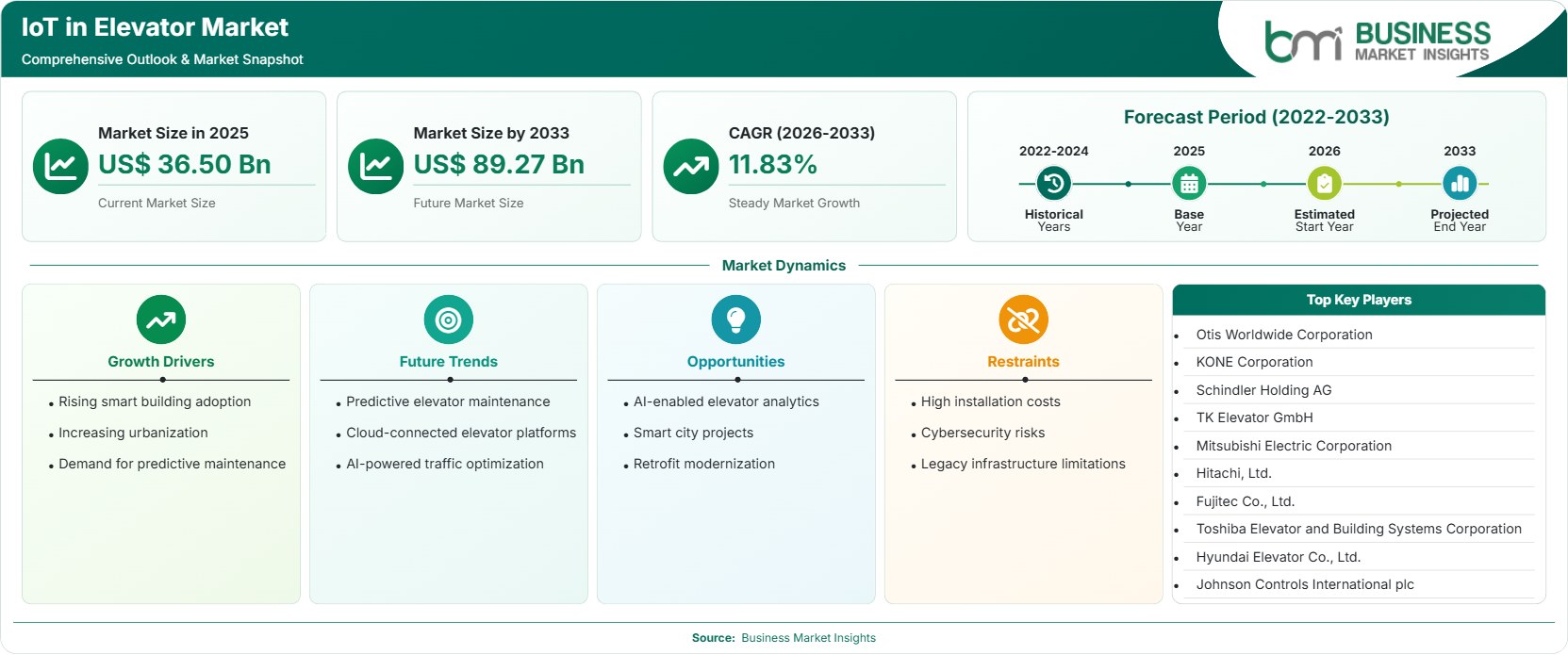
The IoT in Elevator market size was valued at US$ 36.50 billion in 2025 and is projected to reach US$ 89.27 billion by 2033, growing at a CAGR of 11.83% during 2026–2033, driven by rising smart building adoption, increasing urbanization, predictive maintenance demand, AI-enabled elevator analytics, smart city projects, and retrofit modernization initiatives.

Report Coverage
  • Components: Hardware, Software, Services
  • Application: Predictive Maintenance, Remote Monitoring
  • End User: Residential, Commercial, Industrial
US$ 36.50 Bn Market size in 2025
US$ 89.27 Bn Market Size by 2033
11.83% CAGR, 2026 - 2033
2026-2033 Forecast Period

AI Overview

IoT in Elevator Market Summary

  • North America Region: North America accounts for an estimated 34%–38% share in 2025 and is projected to grow at a CAGR of 11.2%–11.8% during 2026–2033. Smart building investments, aging elevator infrastructure, digital monitoring adoption, and modernization programs create opportunities. The U.S. market remains a major contributor with a CAGR of 11.3%–11.9%, supported by commercial building automation and predictive maintenance adoption.
  • Fastest Growing Region: Asia Pacific holds approximately 28%–32% share in 2025 and is expected to expand at a CAGR of 12.5%–13.2% through 2033. Rapid urbanization, smart city investments, new construction projects, and intelligent building technologies support regional growth opportunities.
  • Leading Segment: Hardware components represent around 45%–50% share in 2025 and are expected to grow at a CAGR of 11.5%–12.0%. Sensors, connectivity devices, controllers, and monitoring equipment drive adoption through elevator digitization.
  • High Growth Segment: Software components account for approximately 25%–30% share in 2025 and are projected to expand at a CAGR of 13.0%–13.8%. AI analytics, cloud platforms, predictive maintenance tools, and remote monitoring solutions accelerate software adoption.
  • Key Market Opportunity: AI-enabled elevator analytics, smart city developments, retrofit modernization, and connected building ecosystems create opportunities for companies developing intelligent elevator management solutions.
  • Major Market Players: Otis Worldwide Corporation, KONE Corporation, Schindler Holding AG, TK Elevator GmbH, Mitsubishi Electric Corporation, Hitachi, Ltd., Fujitec Co., Ltd., Toshiba Elevator and Building Systems Corporation, Hyundai Elevator Co., Ltd., Johnson Controls International plc.
Strategic Insights

IoT in Elevator Market: Strategic Insights

IoT in Elevator Market Strategic Framework
FREE PDF
Request your free sample
Request free sample
Stakeholder View

Key Takeaways

  • The elevator ecosystem is shifting from traditional equipment supply toward connected service models involving manufacturers, software providers, building operators, and maintenance companies.
  • Predictive maintenance, remote monitoring, and AI-based analytics represent major growth opportunities by reducing equipment downtime and improving lifecycle management.
  • Technology innovation is focused on advanced sensors, cloud connectivity, cybersecurity solutions, digital twins, and automated elevator performance optimization.
  • Asia Pacific offers strong investment potential due to urban population growth, smart city initiatives, and increasing high-rise construction activities.
  • Companies are pursuing digital partnerships, software integration, and retrofit solutions to strengthen competitive positioning in connected elevator markets.
Geographic Outlook

IoT in Elevator Market Regional Highlights

North America IoT in Elevator Market

North America represented approximately 34%–38% of the global market in 2025 and is projected to expand at a CAGR of 11.2%–11.8% during 2026–2033. The region benefits from advanced commercial infrastructure, smart building adoption, aging elevator systems requiring modernization, and strong technology integration capabilities. The IoT in Elevator market share remains significant due to demand for connected maintenance solutions and operational efficiency improvements.

  • The United States remains the largest contributor due to commercial building automation, modernization demand, and advanced IoT infrastructure adoption.
  • Canada supports market growth through smart building initiatives and increasing adoption of digital maintenance solutions.
  • Building owners are investing in connected elevator systems to improve safety, efficiency, and service reliability.
  • Predictive maintenance technologies are gaining adoption among commercial property operators and facility managers.

US IoT in Elevator Market

The United States accounted for approximately 30%–34% of global revenue in 2025 and is expected to register a CAGR of 11.3%–11.9% through 2033. The country remains a leading market due to established elevator infrastructure, increasing smart building adoption, and demand for efficient maintenance solutions. The IoT in Elevator market growth is supported by commercial modernization projects, cloud-based monitoring systems, and intelligent building management platforms.

  • Commercial buildings are adopting connected elevator solutions to enhance operational efficiency and reduce maintenance costs.
  • Retrofit modernization programs are creating demand for IoT-enabled elevator upgrades across existing infrastructure.
  • AI-based monitoring platforms are improving predictive maintenance capabilities and reducing unexpected equipment failures.

Europe IoT in Elevator Market

Europe held an estimated 25%–29% share in 2025 and is expected to grow at a CAGR of 11.0%–11.6% between IoT in Elevator Market Forecasts. The region benefits from strict building efficiency standards, urban redevelopment programs, and strong adoption of automation technologies. Germany, the United Kingdom, France, Italy, and Spain represent key markets due to modernization requirements and increasing investment in connected infrastructure.

  • Germany remains a major market due to industrial automation expertise and smart building development.
  • The United Kingdom supports growth through commercial building modernization and digital infrastructure investments.
  • France demonstrates increasing adoption of intelligent building management and energy-efficient technologies.
  • European elevator manufacturers are integrating IoT platforms into new installations and existing systems.

Asia Pacific IoT in Elevator Market

Asia Pacific accounted for approximately 28%–32% of the IoT in Elevator Market in 2025 and is expected to achieve the fastest growth with a CAGR of 12.5%–13.2% through 2033. Rapid urbanization, expanding high-rise construction, smart city initiatives, and infrastructure investments are supporting regional demand. China, Japan, India, South Korea, and Southeast Asian economies represent major growth markets.

  • China leads regional adoption due to extensive urban development, smart cities, and elevator modernization requirements.
  • India represents strong growth potential through urban expansion and increasing commercial building projects.
  • Japan supports adoption through advanced technology integration and aging infrastructure modernization.
  • South Korea demonstrates growth through smart building initiatives and connected infrastructure development.

Rest of World IoT in Elevator Market

The Rest of World region accounted for approximately 7%–10% of the IoT in Elevator Market share in 2025 and is projected to grow at a CAGR of 11.8%–12.5% during the forecast period. Latin America, the Middle East, and Africa are witnessing increasing demand due to urban development, commercial construction, and smart infrastructure investments. Modernization projects and connected building adoption are creating additional opportunities.

  • Brazil represents a growing market due to commercial construction growth and infrastructure modernization.
  • Mexico supports demand through urban development and increasing adoption of intelligent building systems.
  • Middle Eastern countries are investing in smart cities and advanced commercial infrastructure projects.
  • African markets are developing opportunities through urbanization and building technology modernization.
  • Regional operators are adopting remote monitoring solutions to improve elevator reliability and maintenance efficiency.
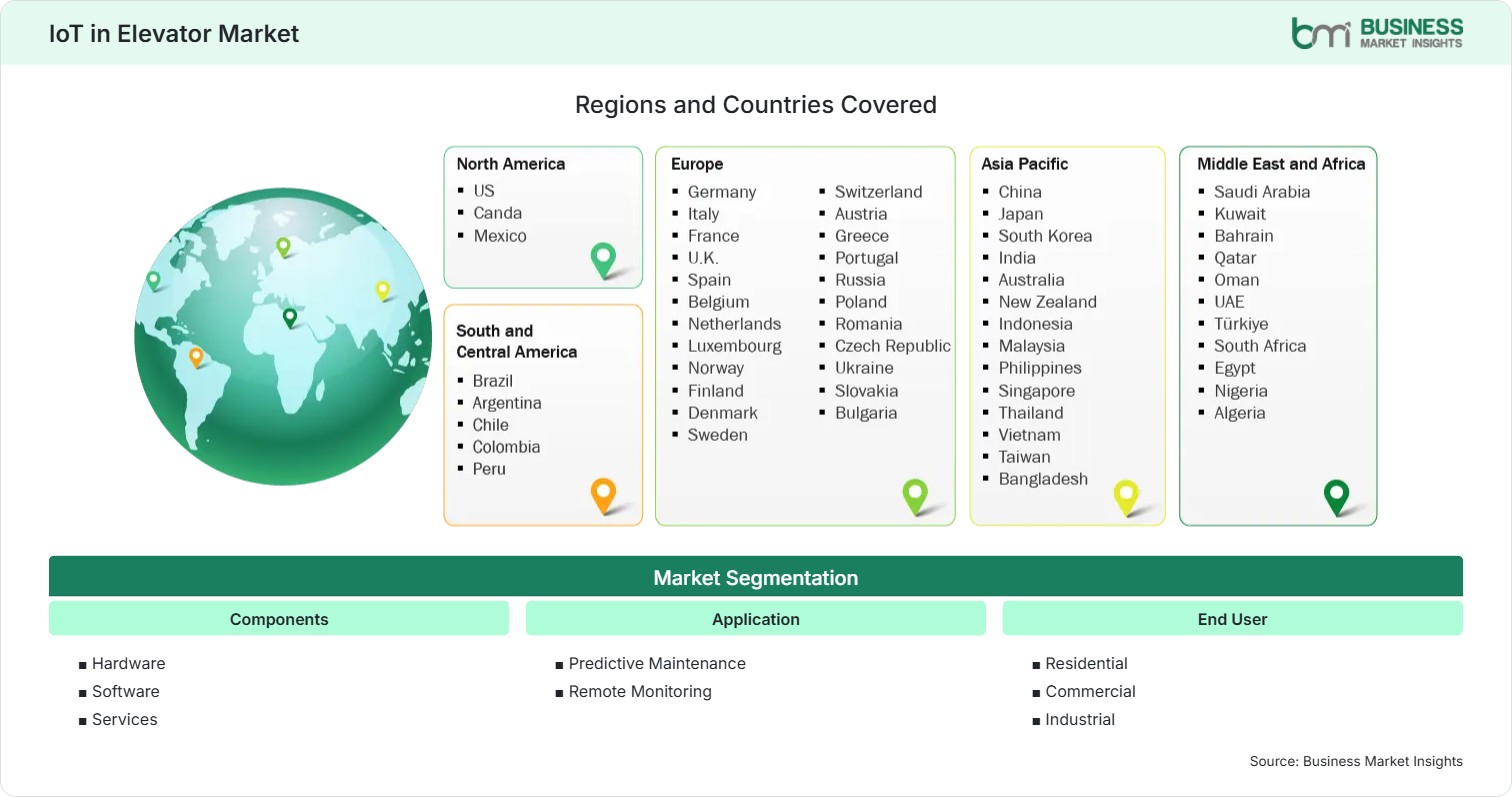
Global Market Geography
FREE PDF
Request your free sample
Request free sample
Segment Analysis

IoT in Elevator Market Segmentation

Components

The Components segment accounted for approximately 96%–98% of the IoT in Elevator Market revenue in 2025 and is projected to grow at a CAGR of 11.5%–12.1% during 2026–2033. Increasing elevator digitization, smart building adoption, and demand for efficient maintenance systems are driving component integration. Hardware enables real-time data collection, software supports analytics and decision-making, while services provide installation, monitoring, and lifecycle management. Growing demand for connected infrastructure and operational optimization is encouraging elevator manufacturers to develop integrated IoT ecosystems with advanced connectivity and automation capabilities.

  • Hardware: Hardware components support IoT-enabled elevators through sensors, controllers, connectivity modules, and monitoring devices that enable real-time equipment data collection and operational tracking.
  • Software: Software solutions are expanding through AI analytics, cloud platforms, predictive maintenance applications, and digital dashboards that improve elevator performance management and operational efficiency.
  • Services: Services are gaining importance through installation, system integration, remote monitoring, maintenance support, and lifecycle management solutions for connected elevator infrastructure.

Application

The Application segment represented approximately 45%–50% share in 2025 and is expected to expand at a CAGR of 12.0%–12.6% through 2033. Predictive maintenance and remote monitoring solutions are becoming essential as building owners seek improved reliability, reduced downtime, and lower maintenance costs. IoT-based elevator applications enable continuous performance assessment, fault detection, and proactive servicing. Increasing adoption across commercial buildings, residential complexes, and industrial facilities is accelerating deployment of connected elevator management systems.

  • Predictive Maintenance & Remote Monitoring: These solutions enable real-time elevator performance tracking, fault prediction, remote diagnostics, and proactive maintenance scheduling to reduce downtime and improve reliability.

End User

The End User segment represented approximately 98%–99% of the IoT in Elevator Market share in 2025 and is expected to grow at a CAGR of 11.6%–12.2% during 2026–2033. Increasing urban density, smart building development, and modernization of existing elevator systems are driving adoption across residential, commercial, and industrial environments. Building operators are implementing connected elevator technologies to improve passenger experience, operational efficiency, and maintenance management. Growing demand for automated infrastructure is encouraging adoption across diverse end-user categories.

  • Residential: Residential users are adopting IoT-enabled elevators through smart apartment developments, improved security features, remote monitoring, and enhanced passenger convenience.
  • Commercial: Commercial buildings represent a major adoption area due to demand for efficient operations, predictive maintenance, energy management, and improved occupant experience.
  • Industrial: Industrial facilities are integrating connected elevators to enhance equipment reliability, workplace safety, operational monitoring, and maintenance efficiency.
Market Forces

IoT in Elevator Market Dynamics

Key Market Drivers

Rising Smart Building Adoption

Increasing development of smart buildings is accelerating demand for IoT-enabled elevator systems that integrate with broader building management platforms. Property developers and facility operators are adopting connected elevator technologies to improve energy efficiency, passenger experience, safety monitoring, and operational performance. Smart buildings rely on real-time data exchange between systems, making elevator connectivity an important component of intelligent infrastructure. IoT-enabled elevators provide remote diagnostics, usage analytics, and automated maintenance capabilities that support efficient building operations. The growing transition toward digital infrastructure is supporting market growth as developers prioritize connected solutions. Current IoT in Elevator Market trends indicate increasing integration of AI, cloud computing, and automation technologies within elevator ecosystems.

Increasing Urbanization

Rapid urbanization and rising construction of high-rise buildings are increasing demand for advanced elevator systems with intelligent management capabilities. Growing urban populations require efficient vertical transportation solutions that can handle higher passenger volumes while maintaining reliability and safety. Cities investing in residential towers, commercial complexes, and mixed-use developments are increasingly adopting smart elevator technologies. IoT connectivity enables better traffic management, predictive servicing, and improved operational efficiency in densely populated environments. Emerging economies are experiencing significant construction activity, creating opportunities for elevator manufacturers and technology providers. The expansion of urban infrastructure and smart city developments is strengthening demand for connected elevator solutions across global markets.

Demand for Predictive Maintenance

Building owners and elevator operators are increasingly adopting predictive maintenance solutions to reduce equipment failures, improve uptime, and optimize maintenance costs. Traditional maintenance approaches often rely on scheduled inspections, while IoT-enabled systems use real-time equipment data to identify potential issues before failures occur. Sensors, analytics platforms, and remote monitoring technologies allow operators to monitor elevator performance continuously. Predictive maintenance improves service efficiency by enabling proactive repairs and reducing unexpected downtime. The growing focus on lifecycle cost management is encouraging adoption among commercial, residential, and industrial users. Elevator manufacturers are increasingly offering connected maintenance services as part of long-term value-added solutions.

Key Market Opportunities

AI-Enabled Elevator Analytics

Artificial intelligence integration represents a major opportunity for IoT-enabled elevator systems by improving operational insights, fault detection, and maintenance decision-making. AI-powered analytics platforms can process large volumes of elevator performance data to identify patterns, predict failures, and optimize service schedules. With such technologies, the operators will be able to cut down the downtime period and ensure passenger safety as well as saving on maintenance costs. The elevator manufacturing companies have also started focusing on incorporating machine learning abilities, digital twins, and analytics technologies in order to create connected technologies. With increasing adoption of smart infrastructure, it is expected that AI-based elevator management solutions will emerge as one of the key differentiators for technology vendors.

Smart City Project Expansion

Growing smart city initiatives worldwide are creating opportunities for IoT-enabled elevator technologies as governments invest in connected infrastructure and intelligent urban systems. Smart cities require integrated building solutions that improve efficiency, safety, and resource management. Smart elevators can play a role with their potential to monitor remotely, conduct predictive maintenance, optimize energy use, and enhance mobility management. Projects related to public infrastructure, commercial development, and urban redevelopment initiatives have created an increased demand for smarter elevator systems. Tech companies partnering with city authorities, developers, and infrastructure firms stand to gain with growing investments in smart cities. Smart cities are likely to adopt IoT-driven elevator systems more quickly.

Retrofit Modernization

Retrofit modernization is creating significant opportunities as building owners seek to upgrade existing elevators with IoT capabilities without replacing complete systems. Many installed elevator systems require modernization to improve efficiency, reliability, and connectivity. Retrofitting IoT technology allows the inclusion of sensors, monitoring software, and analysis systems within existing machinery. Retrofitting helps increase the life cycle of equipment, along with providing advantages like remote monitoring and the prediction of potential faults. Commercial buildings, housing societies, and industrial units are increasingly using retrofit solutions due to their economic superiority over replacement. Companies that provide retrofitting services can take advantage of the many elevators available in the market.

Market Restraints and Challenges

High Installation Costs

Factor: IoT-enabled elevator systems require investment in sensors, connectivity infrastructure, software platforms, installation services, and system integration capabilities.

Impact: High initial costs can limit adoption among smaller building owners and organizations with restricted modernization budgets. Commercial and residential operators may delay implementation when upfront investment requirements outweigh short-term benefits. Deployment may also be impacted by extra costs of upgrading infrastructure, acquiring expert knowledge, and software maintenance. The manufacturers must create scalable options, affordable pricing structures, and cost-effective retrofits in order to make their technologies accessible. Elimination of these barriers will help to extend the reach of IoT in developing countries and small establishments.

Cybersecurity Risks

Factor: Connected elevator systems rely on digital networks, cloud platforms, and data exchange mechanisms that create potential cybersecurity vulnerabilities.

Impact: Security concerns can restrict adoption as building operators require protection against unauthorized access, system disruption, and sensitive operational data breaches. The need for enhanced connectivity of elevators with the building management system requires robust cybersecurity measures, encryption and constant surveillance. In the absence of proper security measures, there is a possibility of loss of confidence among both end-users and facility managers. Manufacturers will have to incorporate cybersecurity measures within their IoT platforms as well as keep up with changing data protection standards.

Company Analysis

Competitive Landscape

The competitive landscape includes elevator manufacturers, building automation companies, industrial technology providers, and digital solution developers competing through IoT integration, predictive maintenance platforms, AI-based analytics, retrofit solutions, and connected service offerings. The IoT in Elevator market analysis highlights increasing competition among companies developing smart elevator ecosystems that combine hardware, software, and services to improve operational efficiency, safety, and lifecycle management.

Company Name

Overview

Products and Services relevant to this market

Otis Worldwide Corporation

Global elevator and escalator manufacturer providing connected mobility solutions.

IoT-enabled elevator monitoring, predictive maintenance platforms, digital service solutions, and connected elevator systems.

KONE Corporation

Elevator and escalator company focused on smart building mobility solutions.

Connected elevators, remote monitoring, predictive maintenance technologies, and digital building platforms.

Schindler Holding AG

Global mobility solutions provider specializing in elevators and escalators.

IoT-based monitoring systems, digital maintenance services, connected elevator technologies, and smart mobility solutions.

TK Elevator GmbH

Elevator technology company offering modernization and digital mobility solutions.

Smart elevator systems, remote monitoring platforms, predictive maintenance solutions, and modernization services.

Mitsubishi Electric Corporation

Technology company providing advanced building systems and automation solutions.

IoT elevator systems, AI-based monitoring, elevator controllers, building integration solutions, and digital services.

Hitachi, Ltd.

Technology company developing infrastructure and digital transformation solutions.

Smart elevators, remote diagnostics, IoT platforms, building management integration, and maintenance technologies.

Fujitec Co., Ltd.

Elevator manufacturer providing vertical transportation solutions globally.

Elevator monitoring systems, modernization solutions, smart controls, and maintenance services.

Toshiba Elevator and Building Systems Corporation

Elevator technology provider focused on advanced building mobility systems.

IoT-enabled elevators, remote monitoring technologies, control systems, and smart building solutions.

Hyundai Elevator Co., Ltd.

Elevator manufacturer supplying mobility and building solutions.

Smart elevators, digital maintenance platforms, connected systems, and modernization technologies.

Johnson Controls International plc

Building technology company providing intelligent infrastructure solutions.

Building automation systems, IoT platforms, predictive analytics, smart building integration, and monitoring solutions.

Industry Activity

Recent Developments

June 2026

Otis Korea was selected as the elevator supplier for the Seoul One IPARK project, supplying 42 SkyRise elevators and 11 Gen3 digital connected elevators for six residential buildings, along with six Link escalators and six Compass 360 next-generation destination dispatch systems for the large-scale Seoul complex.

April 2026

TK Elevator and Microsoft announced a strategic partnership to introduce agentic AI into elevator service and maintenance operations. The collaboration integrates Microsoft Azure AI capabilities with TK Elevator's MAX IoT platform, enabling predictive maintenance, intelligent remote diagnostics, automated service workflows, and enhanced customer support for connected elevators and escalators.

March 2026

Nippon Otis was selected to provide 11 elevators for the Tsukishima 3-chome Minami District Type 1 Urban Redevelopment Project in Tokyo, including two digitally connected Gen3 elevators equipped with Otis ONE digital technology. The IoT-enabled solution monitors equipment performance 24/7 in real time with smart remote monitoring and alert capabilities for pre-emptive issue detection and resolution.

January 2026

Otis is offering its vertical mobility solutions for low- to mid-rise buildings across its Gen3 product family for customers in Europe, the Middle East and Africa. The comprehensive platform includes eight Gen3 products with the Otis ONE IoT solution embedded. Available alongside Otis' ground-breaking Gen360 platform, the Gen3 portfolio has a range of innovative, high performance and sustainable technologies – such as the ReGen drive.

Trust & Transparency

Research Methodology

The market analysis combines proprietary research with secondary data from government agencies, company disclosures, regulatory filings, industry databases and expert interviews. Market estimates are validated through data triangulation, cross-market benchmarking and analyst review.

View Full Research Methodology

Questions Answered

Frequently Asked Questions

What does the IoT in Elevator Market Report cover?

The report covers market size, segmentation, regional analysis, competitive landscape, trends, drivers, opportunities, challenges, company developments, and forecasts through 2033.

Which region offers strong growth opportunities?

Asia Pacific provides significant opportunities due to rapid urbanization, smart city investments, high-rise construction, and increasing adoption of intelligent building technologies.

How does IoT improve elevator maintenance?

IoT enables real-time monitoring, fault detection, performance analysis, and predictive maintenance scheduling, helping operators reduce downtime and improve equipment reliability.

Which component segment is growing fastest in the market?

Software components are experiencing strong growth due to increasing demand for AI analytics, cloud platforms, remote monitoring, and predictive maintenance applications.

What factors are driving the IoT in Elevator Market growth?

The market is driven by smart building adoption, increasing urbanization, predictive maintenance demand, AI-enabled analytics, smart city projects, and elevator modernization activities.

Access the Full IoT in Elevator Market Report

Get segment-level forecasts, regional estimates, competitive benchmarking, company profiles and downloadable Excel datasets.

Access the full IoT in Elevator Market Report
350 pages PDF & Excel | 2026-07-29