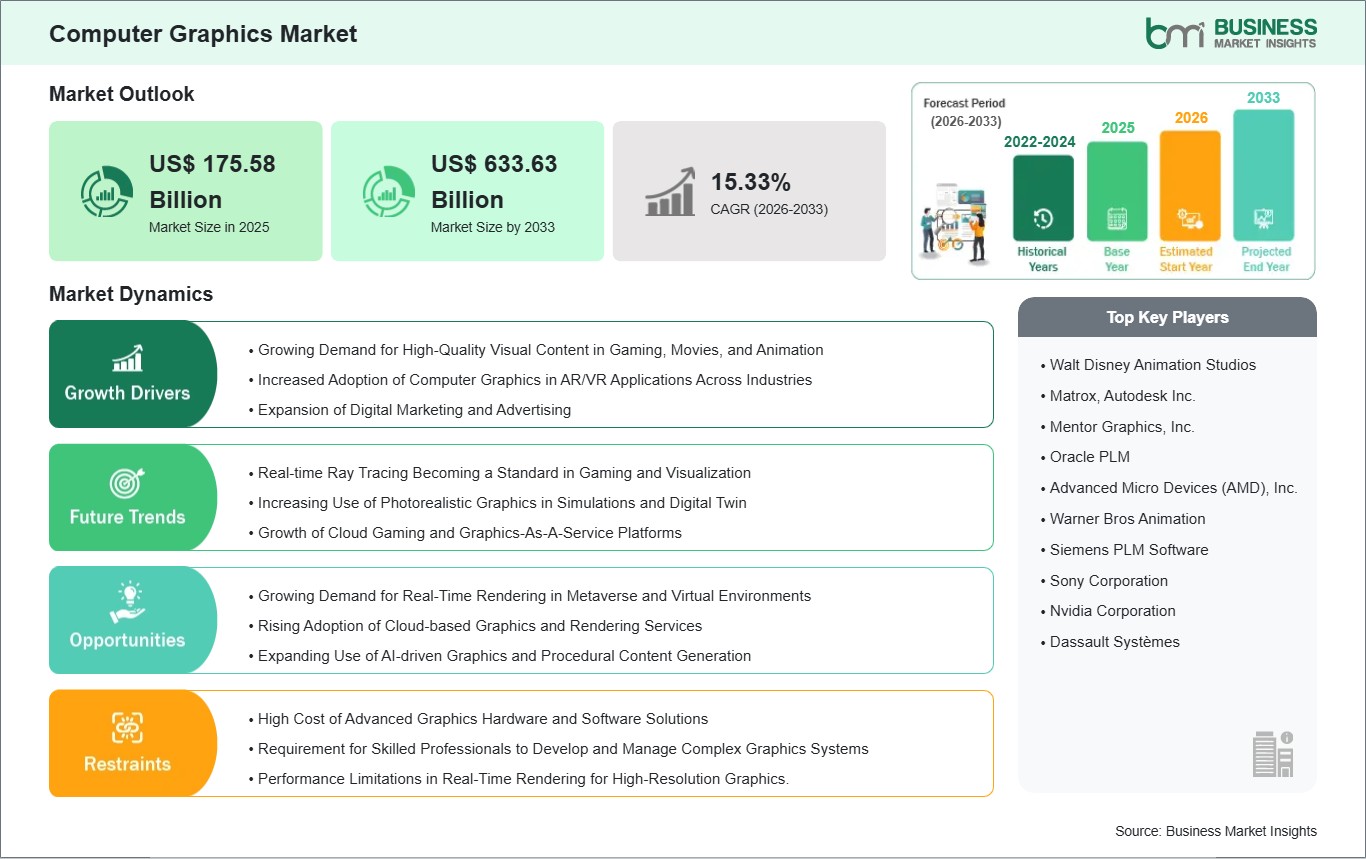
The computer graphics market size is expected to reach US$ 633.63 billion by 2033 from US$ 175.58 billion in 2025. The market is estimated to record a CAGR of 15.33% from 2026 to 2033.
Computer graphics refers to the creation, manipulation, storage, and representation of visual images and animations using computers. It is an interdisciplinary field combining computer science, mathematics, and design to enable the visual portrayal of data, scenes, and concepts. Fundamentally, computer graphics works by representing graphical information in a digital form that computers can process—using pixels for raster images or mathematical curves and shapes for vector graphics. Over time, the field has evolved from simple line drawings to advanced 3D models, realistic rendering, and interactive environments. Core techniques include rendering (generating the final image), modeling (defining shapes), animation (creating motion), and visualization (representing data visually).
Computer graphics powers everything from the icons on phone screen to immersive virtual reality games, architectural walkthroughs, scientific simulations, and digital art. It plays a crucial role in helping humans interpret complex data, visualize abstract concepts, and interact with machines in intuitive ways. As technology advances, computer graphics continues to be central to how digital visuals are produced and consumed in entertainment, education, research, and industry. It not only enhances aesthetic experiences but also improves clarity, understanding, and communication across disciplines.

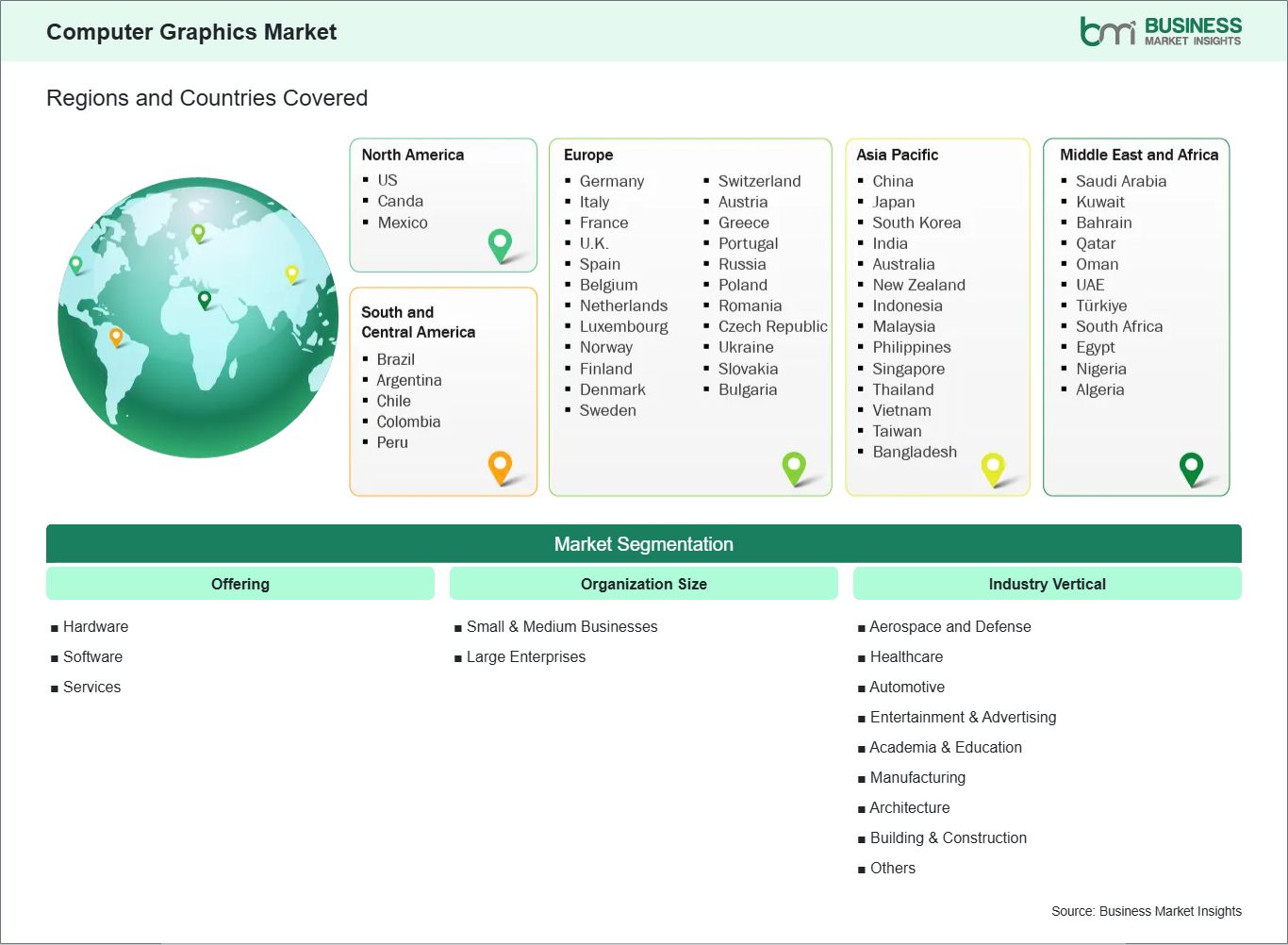
Key segments that contributed to the derivation of the computer graphics market analysis are offering, organization size, and industry vertical.
The growing demand for high-quality visual content in gaming, movies, and animation is a major driver of the computer graphics market growth, as audiences increasingly expect immersive, realistic, and visually stunning experiences. In the gaming industry, advancements in hardware and software have enabled the development of complex 3D environments, lifelike characters, and real-time rendering technologies such as ray tracing. Gamers now seek ultra-realistic graphics, smooth animations, and interactive worlds, pushing developers to invest heavily in advanced computer graphics tools and engines. Similarly, the film and animation industries rely extensively on sophisticated computer graphics to create visually compelling content, including realistic visual effects (VFX), detailed character modeling, and dynamic simulations of natural phenomena such as water, fire, and explosions. High-budget movies and animated films increasingly use CGI to enhance storytelling, reduce production limitations, and bring imaginative concepts to life, thereby increasing the adoption of cutting-edge graphics software and hardware solutions.
Additionally, the rapid expansion of streaming platforms and digital media consumption has intensified competition among content creators, compelling studios to differentiate their productions through superior visual quality. Animated series, virtual production techniques, and hybrid live-action films demand advanced rendering, motion capture, and simulation technologies, further fueling market growth. Moreover, emerging trends such as virtual reality (VR), augmented reality (AR), and metaverse-related content rely heavily on high-performance computer graphics to deliver immersive and interactive user experiences. As consumer expectations continue to rise, content creators are compelled to adopt innovative graphics technologies, driving sustained investment, technological advancement, and overall expansion of the computer graphics market.
The growing demand for real-time rendering in metaverse and virtual environments is a major factor driving new growth opportunities in the computer graphics market. As metaverse platforms continue to evolve, users increasingly expect immersive, interactive, and visually realistic digital experiences that closely mimic the physical world. Real-time rendering enables graphics to be generated instantly as users interact with virtual environments, making it essential for applications such as virtual reality (VR), augmented reality (AR), mixed reality (MR), online gaming, virtual social spaces, and digital twins. This demand pushes developers, content creators, and platform providers to invest heavily in advanced graphics technologies, including high-performance GPUs, real-time ray tracing, AI-driven rendering, and sophisticated graphics engines such as Unreal Engine and Unity. Additionally, enterprises are adopting metaverse-based solutions for training, product design, remote collaboration, and simulations, all of which rely on real-time rendering to provide accurate, responsive, and engaging experiences. For example, industries like automotive, architecture, healthcare, and manufacturing use real-time 3D visualization to simulate complex scenarios, reduce development costs, and accelerate decision-making.
The expansion of cloud computing and edge computing further amplifies this trend by enabling real-time rendering capabilities to be delivered across devices with varying hardware limitations, thereby broadening the user base. Moreover, the increasing penetration of high-speed networks such as 5G enhances real-time data transmission, reducing latency and improving visual fidelity in virtual environments. As consumer expectations for realism and interactivity continue to rise, software vendors, hardware manufacturers, and service providers are innovating to deliver more powerful, scalable, and efficient real-time rendering solutions. This continuous innovation not only fuels demand for computer graphics tools and platforms but also opens new revenue streams through subscriptions, licensing, and content creation services, significantly accelerating the overall growth of the computer graphics market.

By offering, the market is segmented into hardware, software, and services. The software segment held the largest share of the market in 2025. The adoption of computer graphics software is surged by rapid digitalization, growth of gaming and animation industries, demand for realistic visualization, advances in GPU technology, wider use in education and healthcare, affordability of software tools, and increasing need for interactive content in marketing, media, virtual reality, and simulation applications globally.
By organization size, the market is divided into small & medium businesses and large enterprises. The large enterprises segment held the largest share of the market in 2025. In large enterprises, demand for computer graphics increases due to advanced data visualization needs, digital marketing, product design, simulation, virtual training, and immersive user experiences. Growth in AI, AR/VR, gaming, and high-quality interfaces also drives reliance on sophisticated graphics technologies.
By industry vertical, the market is segmented into aerospace and defense, healthcare, automotive, entertainment & advertising, academia & education, manufacturing, architecture, building & construction, and others. The entertainment & advertising segment held the largest share of the market in 2025. The demand for computer graphics in entertainment and advertising is increasing due to advancements in technology, audience preference for visually rich content, growth of gaming and streaming platforms, realistic animations, virtual reality experiences, cost-effective digital production, social media marketing, and the need for creative, engaging brand storytelling.
| Report Attribute | Details |
|---|---|
| Market size in 2025 | US$ 175.58 Billion |
| Market Size by 2033 | US$ 633.63 Billion |
| Global CAGR (2026 - 2033) | 15.33% |
| Historical Data | 2022-2024 |
| Forecast period | 2026-2033 |
| Segments Covered | By Offering
|
| Regions and Countries Covered | North America
|
| Market leaders and key company profiles |
|
The "Computer Graphics Market Size and Forecast (2022–2033)" report provides a detailed analysis of the market covering below areas:
The geographical scope of the computer graphics market report is divided into five regions: North America, Asia Pacific, Europe, Middle East & Africa, and South & Central America. The computer graphics market in Asia Pacific is expected to grow significantly during the forecast period.
The Asia-Pacific computer graphics market is segmented into China, Japan, South Korea, India, Australia, New Zealand, Indonesia, Malaysia, the Philippines, Singapore, Thailand, Vietnam, Taiwan, Bangladesh, and the Rest of Asia. The demand factor driving the growth of the computer graphics market in the Asia Pacific region is driven by a combination of rapid technological advancement, expanding digital economies, and strong demand from diverse end-use industries. One of the most significant factors is the region’s booming entertainment and media sector, including gaming, animation, film, and streaming platforms, where high-quality visual effects and immersive graphics are essential to remain competitive. Asia Pacific is home to some of the world’s largest gaming markets, such as China, Japan, and South Korea, which continuously fuel innovation in real-time rendering, 3D modeling, and virtual reality.
Additionally, increasing investments in smart cities, infrastructure development, and urban planning have accelerated the use of computer graphics for simulation, visualization, and digital twins. The education and training sector also play a key role, as computer graphics are widely used in e-learning, virtual laboratories, and medical visualization, supporting skill development in both academic and professional settings. Another important driver is the growing adoption of advanced technologies such as artificial intelligence, augmented reality, and cloud computing, which enhance the efficiency, realism, and accessibility of graphic solutions. The presence of a large, tech-savvy population and a growing base of skilled developers further supports market growth, as does government support for digital transformation initiatives across many Asia Pacific countries. Together, these factors create a dynamic environment that encourages continuous adoption and innovation in computer graphics across the region.

The computer graphics market is evaluated by gathering qualitative and quantitative data post primary and secondary research, which includes important corporate publications, association data, and databases. A few of the key developments in the computer graphics market are:
The Computer Graphics Market is valued at US$ 175.58 Billion in 2025, it is projected to reach US$ 633.63 Billion by 2033.
As per our report Computer Graphics Market, the market size is valued at US$ 175.58 Billion in 2025, projecting it to reach US$ 633.63 Billion by 2033. This translates to a CAGR of approximately 15.33% during the forecast period.
The Computer Graphics Market report typically cover these key segments-
The historic period, base year, and forecast period can vary slightly depending on the specific market research report. However, for the Computer Graphics Market report:
The Computer Graphics Market is populated by several key players, each contributing to its growth and innovation. Some of the major players include:
The Computer Graphics Market report is valuable for diverse stakeholders, including:
Essentially, anyone involved in or considering involvement in the Computer Graphics Market value chain can benefit from the information contained in a comprehensive market report.
Please tell us your area of interest
(Market Segments/ Regions and Countries/ Companies)