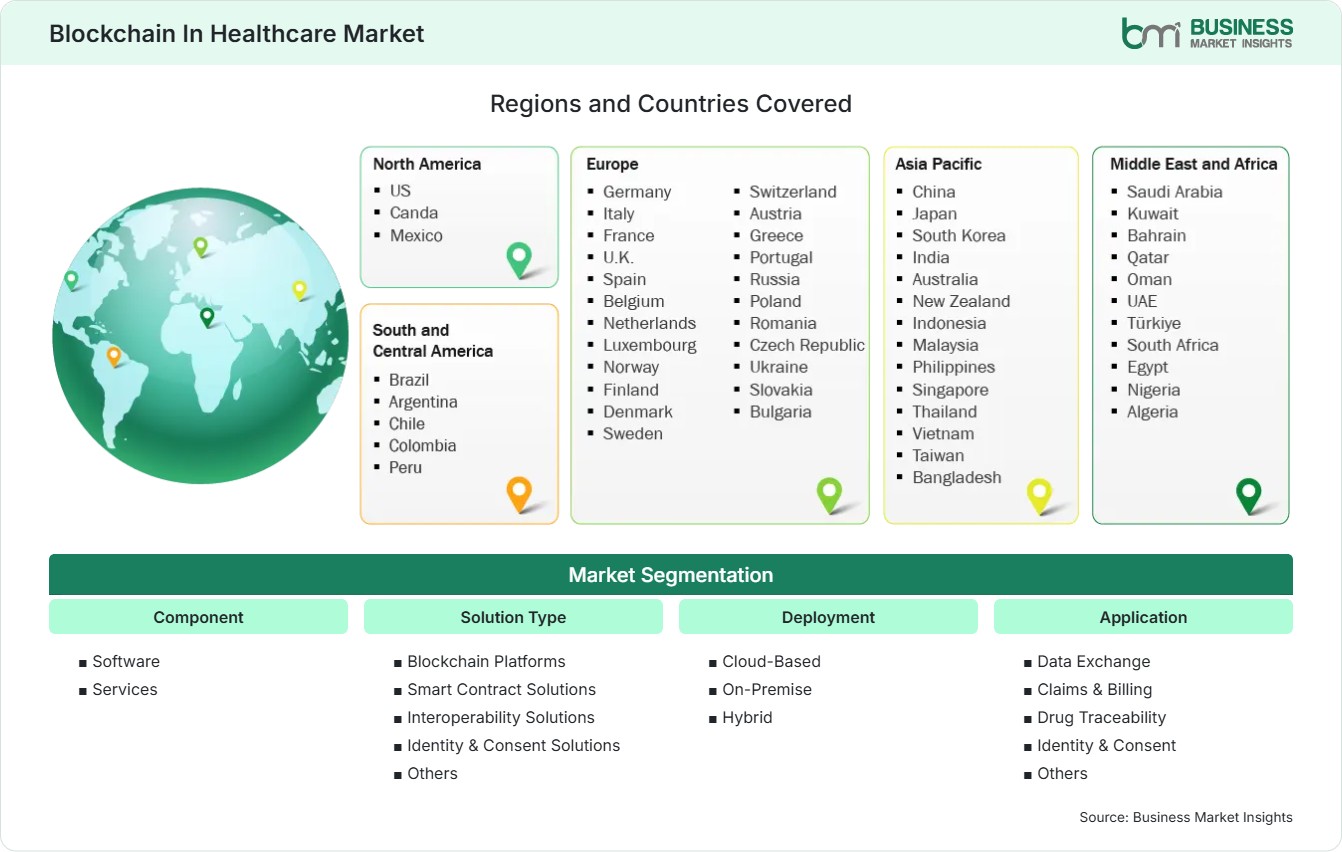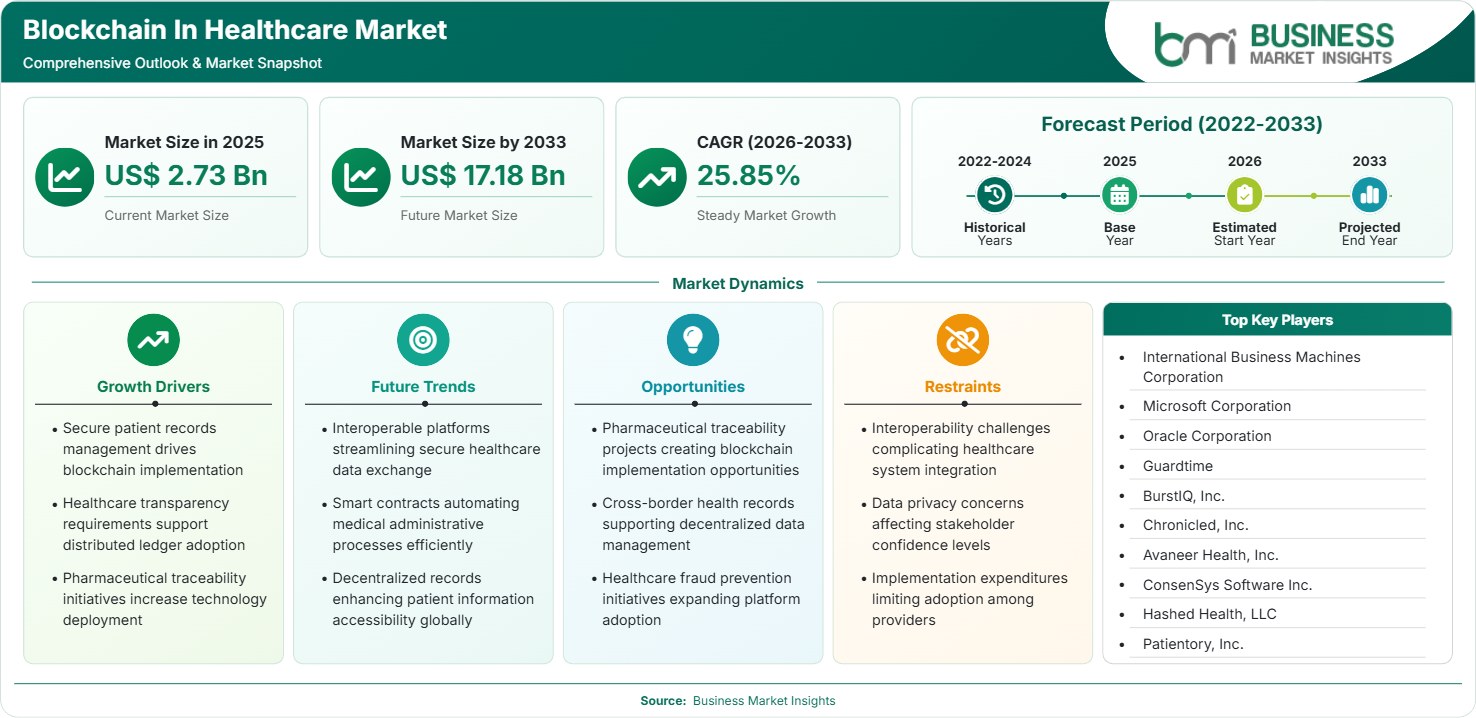
Blockchain In Healthcare Market Regional Highlights
North America Blockchain In Healthcare Market
North America accounts for a 38%–42% share in 2025 and is projected to expand at a CAGR of 24.5%–26.5% during 2026–2033. The region benefits from mature electronic health records, sophisticated payer networks, pharmaceutical traceability requirements, and strong enterprise technology spending. Blockchain in Healthcare Market adoption is concentrated around private networks, claims automation, provider data exchange, and identity management.
- Increasingly, the adoption of enterprise systems is focusing on permissioned architectures that allow integration with current healthcare information systems without involving unrestricted exposure of public data.
- As the requirements from regulatory authorities grow, pharmaceutical manufacturers and distributors are enhancing their ability to keep track of products through the use of interoperable electronic records for transactions across their complicated supply chains.
- Payers and providers are looking into the use of shared ledgers for verifying eligibility, coordinating claims, carrying out credentialing, and handling reconciliation to cut down on duplicate administrative procedures among organizations.
- Concerns regarding cybersecurity are increasing the demand for tamper-evident records, cryptographic identity, controlled access, and auditable transaction histories in sensitive healthcare settings.
US Blockchain In Healthcare Market
The U.S. represents approximately 32%–36% of the global market in 2025 and is projected to grow at a CAGR of 24.0%–26.0% through 2033. Adoption is supported by advanced health IT infrastructure, pharmaceutical serialization requirements, payer complexity, and demand for secure data exchange. Blockchain in Healthcare Market growth increasingly centers on private networks, claims, drug traceability, identity, and consent applications rather than unrestricted public blockchains.
- The electronic tracing of packages at the package level in the United States pharmaceutical supply chains results in a need for reliable records that are shared among manufacturers, wholesalers, retailers, and regulators.
- Healthcare payers are looking at automated verification and claims processing procedures in which smart contracts are able to handle eligibility, documentation, payment terms, and reconciliation for various counterparties.
- Provider organizations are becoming more and more keen on interoperability and on the controlled sharing of data, which creates opportunities for blockchain layers that accompany rather than replace the existing clinical systems.
Europe Blockchain In Healthcare Market
Europe holds a 23%–27% Blockchain in Healthcare Market share in 2025 and is expected to expand at a CAGR of 23.5%–26.0%. Adoption will be impacted by cross-border health data collaborations, privacy concerns, drug tracking, and digital identity solutions. The German market will see a CAGR of 25.0% to 28.0%, whereas the UK market will have a CAGR of 24.0% to 27.0%.
- European deployments are placing greater emphasis on privacy-preserving architectures since healthcare data governance has to meet strict requirements in the areas of consent, access, provenance, and lawful processing.
- Pharmaceutical and life sciences companies are looking at the use of distributed records for clinical research, for tracking the provenance of products, for keeping manufacturing documentation, and for coordinating the supply chain in a number of jurisdictions.
- As European healthcare systems move towards interoperable data environments and wider secondary use of health information, the importance of digital identity and patient consent applications is growing.
- The fact that different countries' systems can work together provides opportunities for a standardized blockchain infrastructure, which is able to verify transactions without having to store the sensitive clinical records in a single repository.
Asia Pacific Blockchain In Healthcare Market
Asia Pacific represents a 22%–26% Blockchain in Healthcare Market share in 2025 and is forecast to achieve the fastest regional growth at a CAGR of 27.5%–30.0%. China, Japan, India, Singapore, and South Korea are important adoption centers. Singapore could record a 29.0%–32.0% CAGR, while India may achieve 28.0%–31.0%.
- India can take advantage of opportunities resulting from the expansion of its digital health infrastructure, the introduction of interoperable health records, the establishment of digital identity, and the fast-growing network of technology-enabled healthcare delivery.
- China is on a large scale in the development of digital healthcare ecosystems, providing opportunities for permissioned data-sharing architectures that link together providers, laboratories, pharmaceutical companies, and technology platforms.
- Singapore offers a favorable setting for regulated experimentation since digital health strategies are increasingly bringing together governance, infrastructure, financing, data standards, and technology implementation.
- Japan and South Korea are well placed to achieve adoption due to their well-developed healthcare systems, their aging populations, their advanced technology infrastructure, and the growing demand for the secure exchange of medical data.
Rest of World Blockchain In Healthcare Market
The rest of the world represents approximately 11%–15% of the global Blockchain in Healthcare Market in 2025 and is projected to grow at a CAGR of 25.0%–28.0%. South and Central America are developing applications around health-data exchange, insurance administration, pharmaceutical traceability, and patient identity.
- Brazil and Mexico offer the possibility of using blockchain technology for verifying claims, ensuring traceability of pharmaceuticals, credentialing providers, and carrying out secure exchanges between the various healthcare organizations.
- In the Gulf countries, initiatives to modernize healthcare are being carried out together with programs relating to the cloud, artificial intelligence, digital identity, and data governance, thus providing favorable conditions for the use of permissioned blockchain systems.
- The African healthcare systems can make use of distributed infrastructure to improve provenance and identity, since fragmented records and limited interoperability hinder the conventional centralized systems.
- The supply chains for pharmaceuticals in Latin America provide opportunities for audit trails, which can help to strengthen product authentication, recall management, and coordination among distributors.