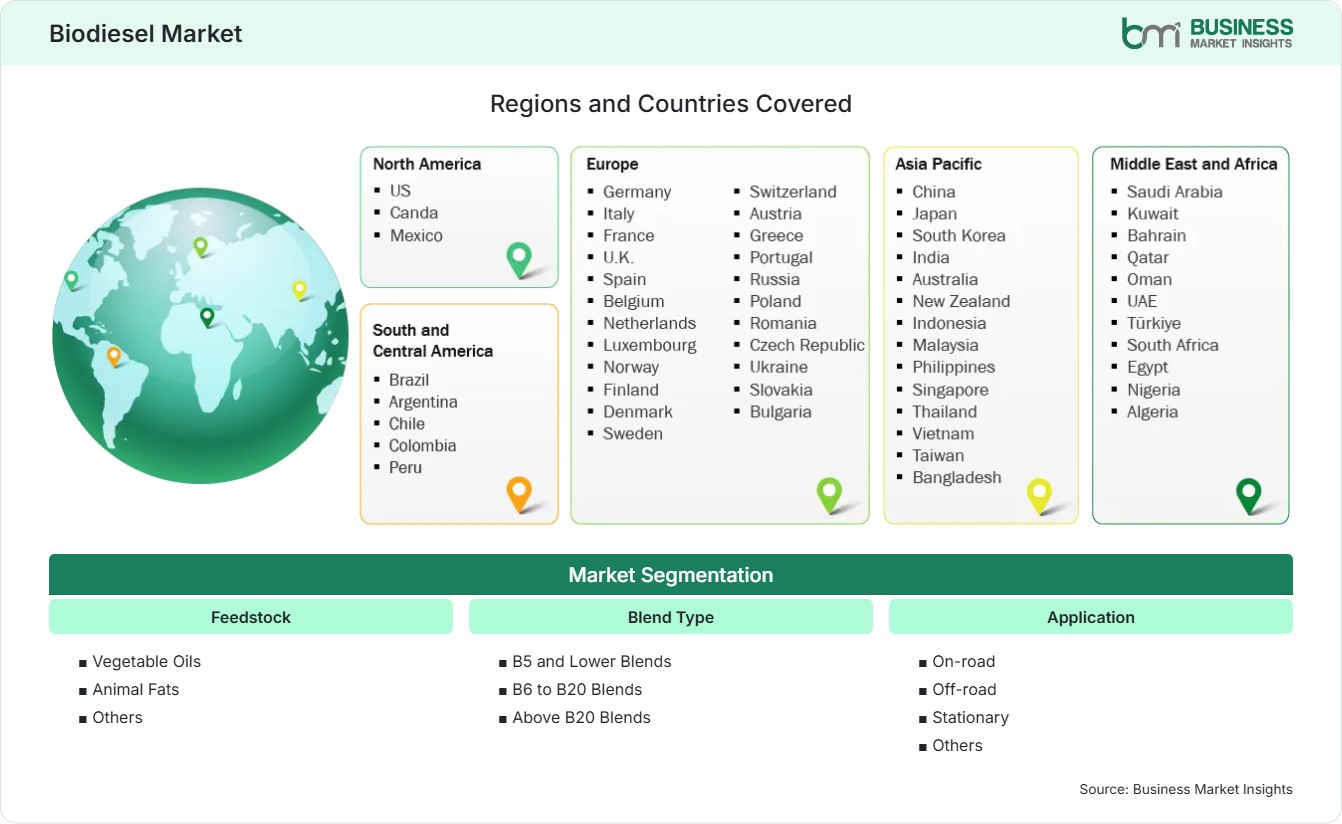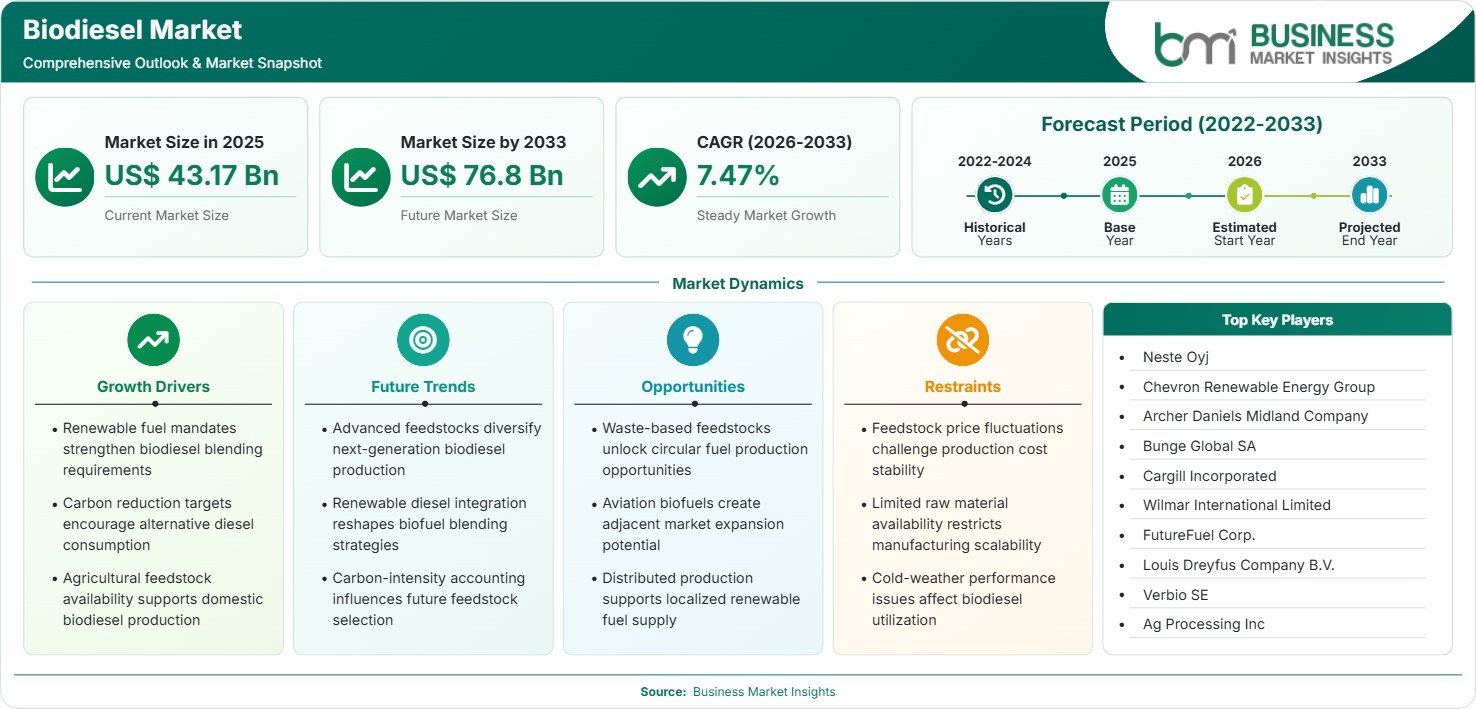
Biodiesel Market Regional Highlights
North America Biodiesel Market
North America accounts for approximately 31%–34% of global demand in 2025 and is projected to expand at a CAGR of 7.0%–7.5% through 2033. Renewable Fuel Standard implementation, state-level low-carbon fuel programs, and commercial fleet decarbonization continue supporting consumption. The region benefits from extensive soybean production, advanced processing infrastructure, and established distribution networks. Biodiesel Market share remains supported by agricultural feedstock availability and strong compliance-driven purchasing. Demand is increasingly diversified across transport fleets, construction equipment, and power-generation applications.
- The federal renewable fuel obligations help to create steady demand in the transportation fuel markets.
- The greater the use of waste oils, the better the sustainability figures become and the more diverse the sources of feedstock will be.
- Commercial vehicle operators are increasingly adopting higher blends to reduce their lifecycle emissions.
- Investments in production strategy improve both regional supply security and export competitiveness.
- The agricultural value chains are still contributing to better feedstock availability and more favourable processing economics.
US Biodiesel Market
The United States represents around 74%–79% of North American consumption and records a CAGR of 7.1%–7.6% through 2033. Strong agricultural feedstock resources, renewable fuel compliance programs, and increasing fleet sustainability targets underpin industry expansion. Demand remains concentrated in trucking, agriculture, municipal transportation, and industrial equipment segments. Production investments across soybean-processing facilities continue supporting domestic feedstock supply. Biodiesel Market growth in the country is strengthened by policy incentives encouraging low-carbon alternatives.
- The availability of soybean oil enables growth in both the amount of domestic production and in processing capacity.
- More fleet operators now look at fuel lifecycle emissions when they make buying decisions.
- State incentives promote the adoption of vehicles within public transportation and municipal vehicle fleets.
- Modernizing the infrastructure leads to more efficient blending, storage, and distribution across the country.
Europe Biodiesel Market
Europe holds a 35%–38% share in 2025 and grows at a CAGR of 6.8%–7.3% through 2033. Renewable Energy Directive implementation continues supporting demand across transportation sectors. Germany remains the leading national market with growth around 6.5%–7.0%, while Poland demonstrates faster expansion near 7.5%–8.0%. Regional producers increasingly emphasize waste-derived feedstocks to align with sustainability requirements. Strong environmental regulations, advanced collection systems, and industrial decarbonization priorities sustain long-term market development across member states.
- Rules that set renewable fuel targets through policy still drive demand at the base level.
- Paths for producing waste become important as part of strategies aimed at meeting regulatory requirements.
- Germany retains its leading position due to its extensive production and consumption infrastructure.
- Poland gains as a result of increased investment in capacity and higher demand for transport fuel.
- Industrial users are increasingly incorporating renewable fuels into their sustainability programs.
Asia Pacific Biodiesel Market
Asia Pacific represents 23%–27% Biodiesel Market share in 2025 and is anticipated to advance at a CAGR of 8.3%–8.9% during the forecast period. Indonesia and Malaysia remain dominant producers due to substantial palm-oil resources. India demonstrates high-growth potential with expansion near 8.8%–9.3%, supported by blending initiatives and energy-security priorities. Government-backed programs continue encouraging domestic production and consumption. Expanding transportation activity, industrial development, and renewable energy policies strengthen medium-term demand fundamentals across developing economies.
- The requirements for blending in Indonesia are still having an effect on consumption patterns in the region.
- Malaysia makes use of its existing supply of feedstock and its production facilities aimed at exports.
- India speeds up policy steps that support the use of renewable fuels.
- The growth in commercial transportation increases long-term consumption potential.
- Investments in infrastructure lead to more efficient storage, logistics, and fuel distribution.
Rest of World Biodiesel Market
The rest of the world contributes approximately 9%–12% Biodiesel Market share in 2025 and expands at a CAGR of 7.4%–8.0% through 2033. South and Central America benefit from agricultural feedstock resources and biofuel policy support, with Brazil leading regional deployment. Middle East and Africa markets remain comparatively smaller but demonstrate increasing interest in renewable fuel diversification and energy-transition initiatives. Investments in feedstock cultivation, fuel blending infrastructure, and industrial decarbonization projects are gradually strengthening adoption across both regions.
- Brazil is still the market-leading one, due to the existing biofuel policy frameworks.
- Argentina has the advantage of possessing production capabilities geared towards exports and available feedstock resources.
- The Gulf countries are looking into the use of renewable fuels as part of their wider energy-transition strategies.
- There is an increasing interest in decarbonizing the transport sector in South Africa.
- The prospects for regional commercialization improve step by step as a result of infrastructure investments.