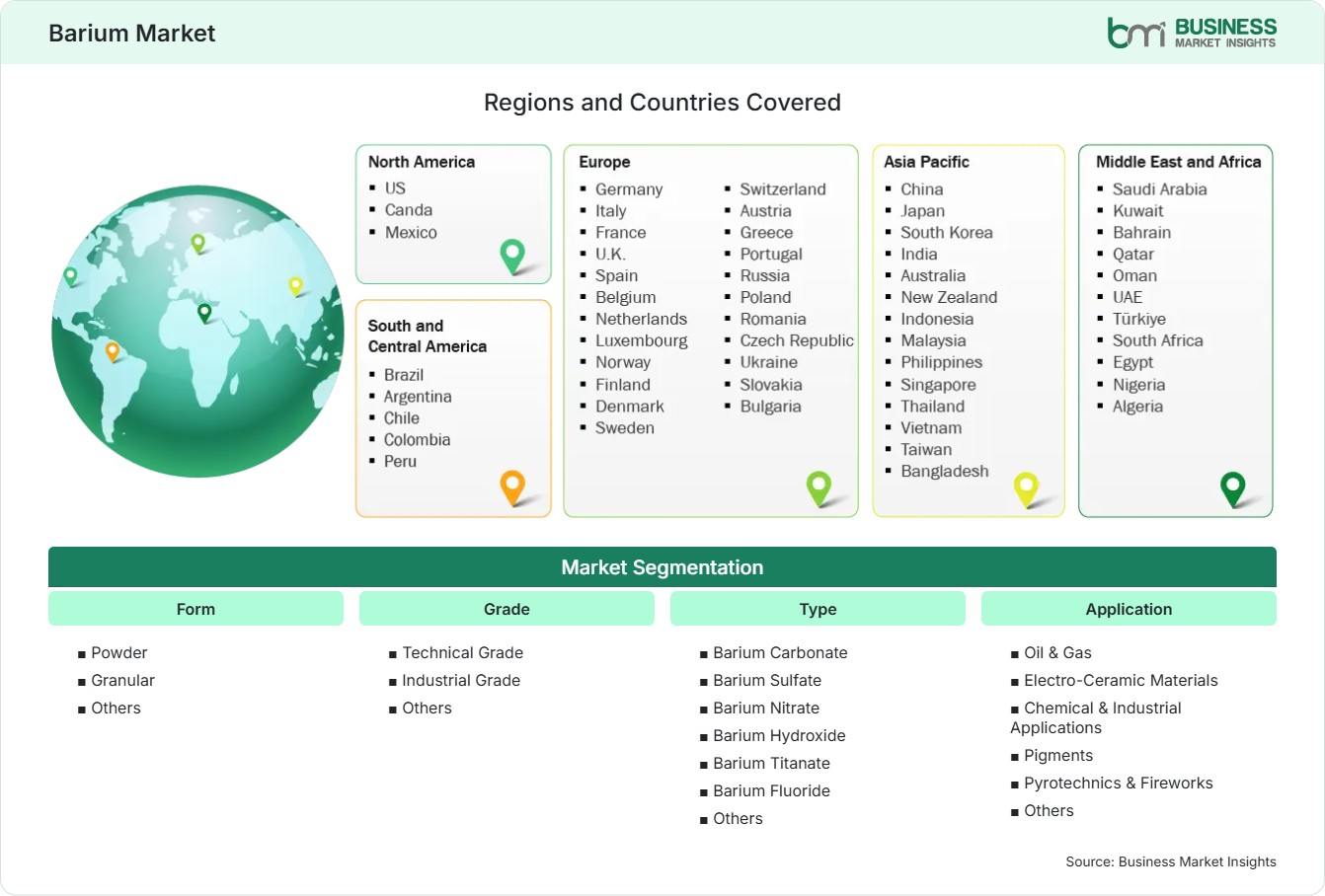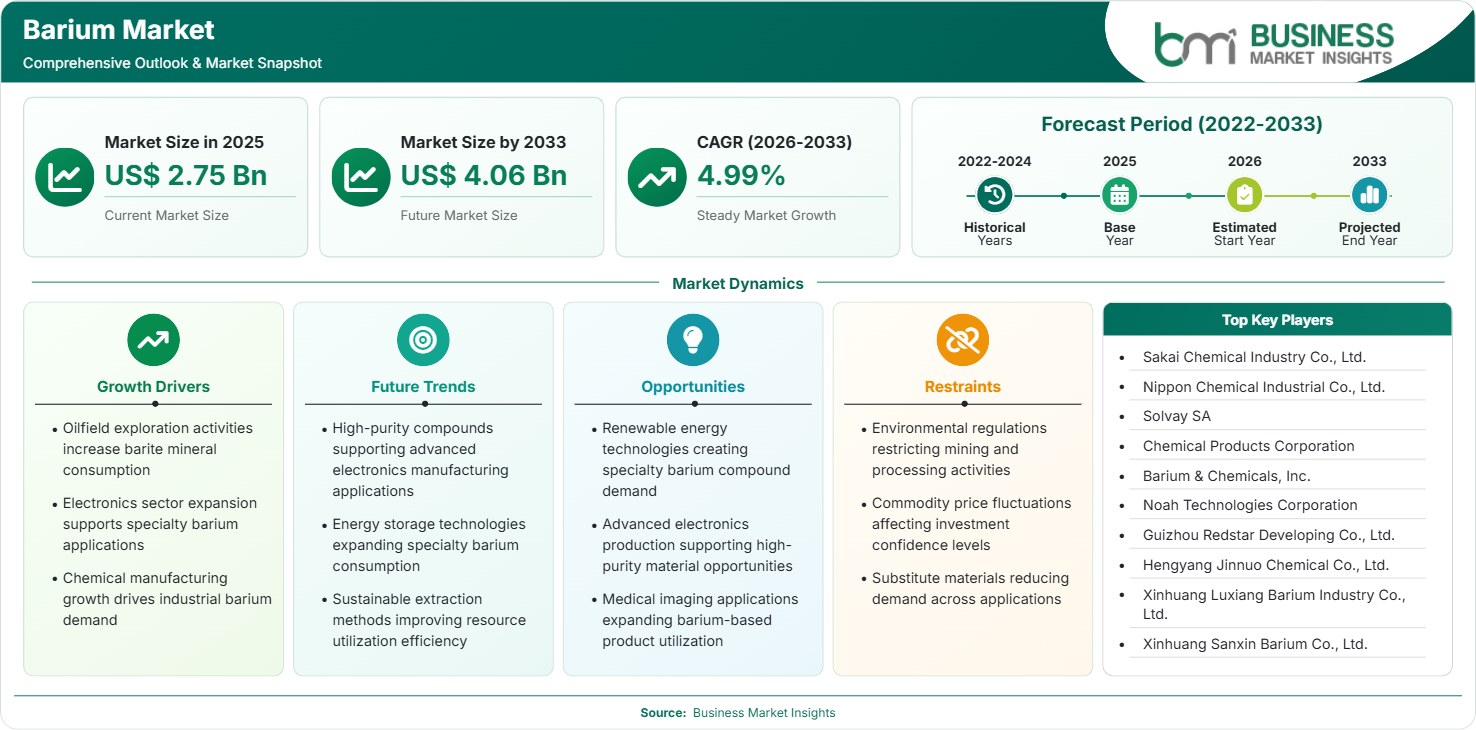
Barium Market Regional Highlights
North America Barium Market
North America accounts for a 20%–23% Barium Market share in 2025 and is projected to expand at a 4.2%–4.8% CAGR through 2033. The demand for aluminum is from oil field drilling, coatings, pigments, plastic products, specialty chemicals, ceramics, and defense. North America is the largest consumer region, thanks to its chemical production and energy infrastructure.
- Oilfield activity sustains sulfate consumption because density, chemical stability, and formulation flexibility remain important characteristics for drilling-fluid systems.
- Specialty chemical suppliers benefit from customers seeking customized particle sizes, grades, packaging configurations, and dependable domestic fulfillment.
- Electronics applications are smaller than Asian volumes but increasingly require high-purity inputs for specialized ceramic and dielectric formulations.
- Coatings, plastics, pigments, and industrial fillers provide diversified demand and reduce dependence on any single downstream industry.
US Barium Market
The U.S. represents approximately 70%–74% of North American Barium Market consumption in 2025 and is projected to grow at a 4.1%–4.7% CAGR through 2033. Demand is anchored by oil and gas, specialty chemicals, coatings, plastics, pigments, and advanced manufacturing.
- Oil and gas remains a significant demand channel, particularly for barium sulfate used in drilling-fluid formulations requiring high density and chemical stability.
- Domestic specialty producers increasingly emphasize particle-size control, custom packaging, traceability, and application-specific grades for industrial and technical buyers.
- Medical, research, aerospace, and defense applications support smaller but higher-value consumption where certification, purity, and consistency influence supplier selection.
Europe Barium Market
Europe holds a 21%–24% Barium Market share in 2025 and is forecast to expand at a 4.4%–5.0% CAGR through 2033. Germany, Italy, France, and Spain continue to be significant industrial end markets, whereas Poland and certain economies of Central Europe are better positioned as high-growth opportunities through manufacturing investments. The demand is for coatings, plastics, pigments, glass, ceramics, specialty chemicals, and electronic materials. Germany has been estimated at 4.5% to 5.1% CAGR, whereas Poland is at 5.2% to 5.8%.
- Germany benefits from advanced industrial manufacturing, specialty chemicals, automotive supply chains, and technical ceramics requiring controlled material performance.
- Italy and Spain maintain demand through ceramics, coatings, glass, pigments, and construction-related industrial applications.
- Poland offers faster growth as manufacturing investment expands and regional supply chains increasingly incorporate Central European production facilities.
- Sustainability requirements favor process optimization, lower waste generation, efficient energy use, and stronger documentation across chemical supply chains.
Asia Pacific Barium Market
Asia Pacific represents a 42%–46% Barium Market share in 2025 and is projected to grow at a 5.3%–5.9% CAGR through 2033. China has been found to be the largest producer and consumer market with abundant capacity for barium salts and well-established chemical supply chains. Japan and South Korea gain due to sophisticated electronic ceramics and MLCC production. Estimated growth rate for China ranges between 5.1%-5.7% CAGR, India 6.0%-6.7%, and South Korea 5.7%-6.3%.
- China combines large-scale barium salt production with extensive downstream ceramics, glass, pigments, and electronic-material industries.
- Japan emphasizes high-purity barium carbonate and barium titanate for electronic ceramics, with manufacturers investing in fine-particle synthesis and controlled morphology.
- South Korea and Taiwan benefit from dense electronics ecosystems, supporting demand for dielectric materials used in increasingly sophisticated component architectures.
- India provides growth potential through ceramics, glass, chemical manufacturing, oilfield activity, infrastructure development, and expanding domestic industrial capacity.
Rest of World Barium Market
Rest of World represents approximately 10%–13% of global Barium Market demand in 2025, with an estimated 5.1%–5.7% CAGR through 2033. South and Central America benefit from oilfield, coatings, ceramics, glass, and construction applications, while Brazil provides the largest industrial base. Brazil is estimated at 4.8%–5.4% CAGR, Saudi Arabia at 5.3%–5.9%, and the United Arab Emirates at 5.4%–6.0%. Demand remains more project-sensitive than in Asia.
- Brazil provides diversified demand through industrial manufacturing, ceramics, paints, plastics, construction materials, and oilfield-related applications.
- Middle Eastern drilling activity supports barium sulfate consumption where density and formulation performance are important operational requirements.
- Saudi Arabia benefits from energy-sector investment and industrial diversification, creating additional demand beyond traditional oilfield applications.
- The United Arab Emirates offers opportunities through specialty chemical distribution, industrial projects, coatings, construction materials, and regional logistics capabilities.