
Barium Carbonate Market Outlook: Size, Share, Trends, Growth Analysis, Competitive Landscape & Forecast, 2026-2033

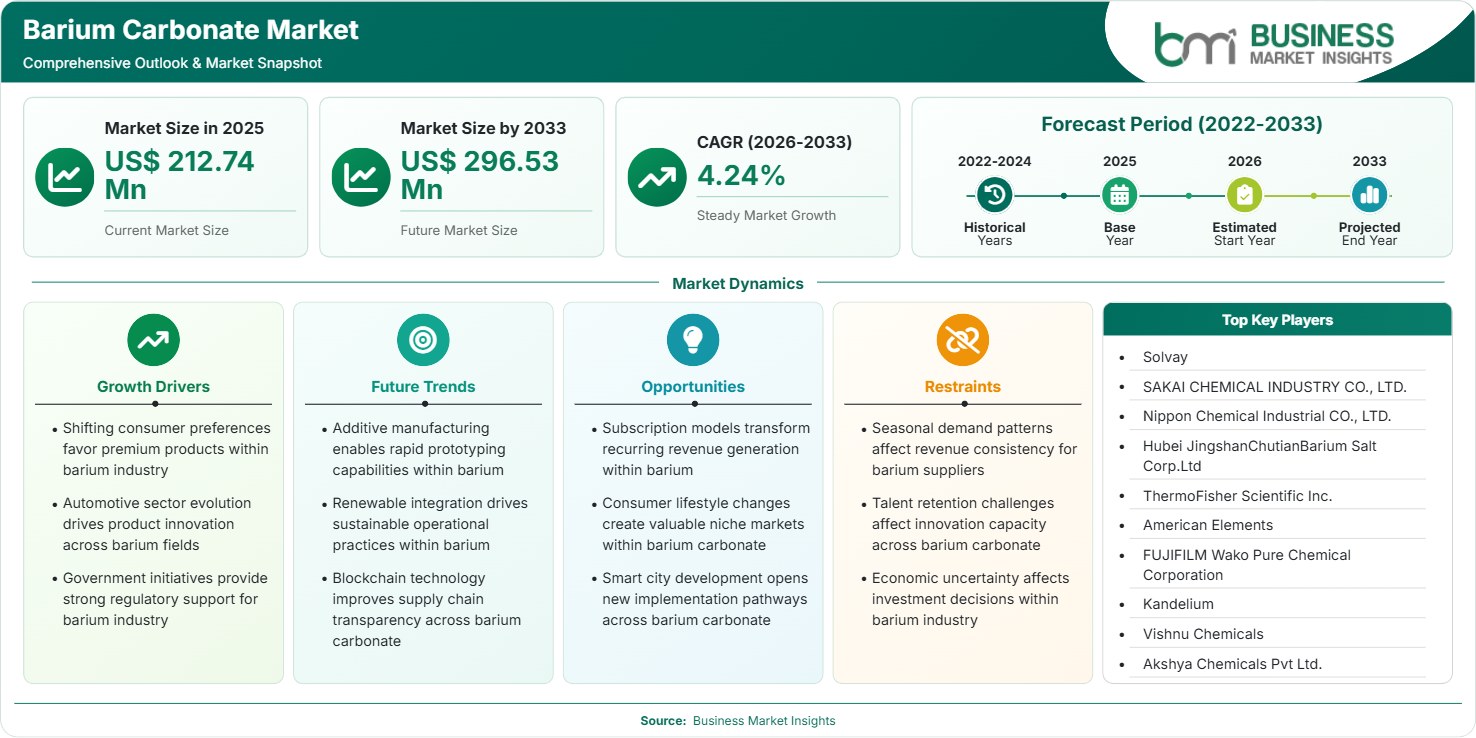
The Barium Carbonate Market size was valued at US$ 212.74 Million in 2025 and is projected to reach US$ 296.53 Million by 2033, growing at a CAGR of 4.24% during 2026–2033. Rising demand from specialty glass, electro-ceramic materials, and construction products, coupled with expanding electronics manufacturing and investments in advanced ceramic applications, continues to create attractive growth opportunities for manufacturers across both developed and emerging economies.

Report Coverage
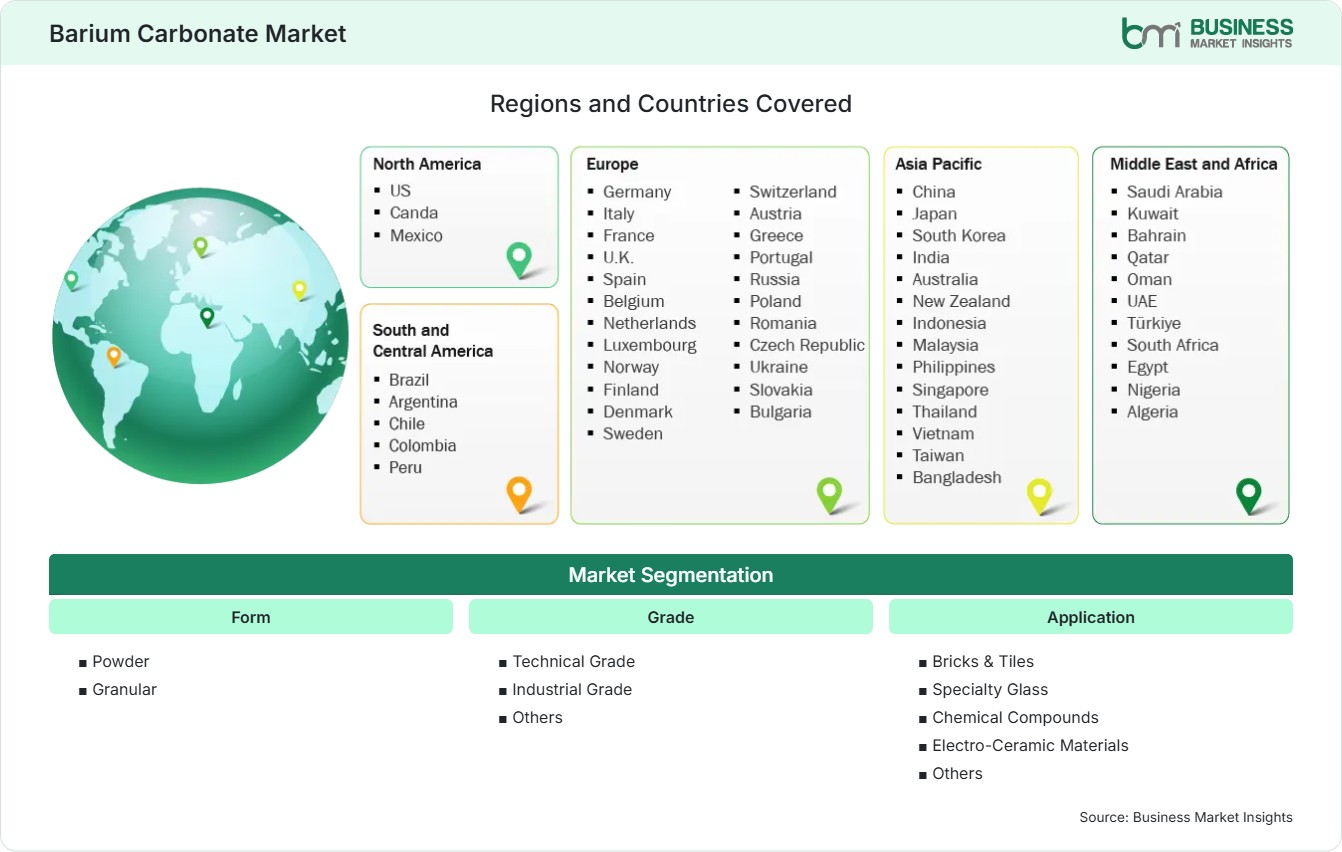
  • Form: Powder, Granular
  • Grade: Technical Grade, Industrial Grade, Others
  • Application: Bricks & Tiles, Specialty Glass, Chemical Compounds, Electro-Ceramic Materials , Others
US$ 212.74 Mn Market size in 2025
US$ 296.53 Mn Market Size by 2033
4.24% CAGR, 2026 - 2033
2026-2033 Forecast Period

01 AI Overview

Barium Carbonate Market Summary

  • North America Region: North America holds 24%–27% market share in 2025, growing with a CAGR of 3.6%–4.0% during 2026–2033. Demand is supported by specialty glass manufacturing, advanced ceramics, high-purity chemical production, and increasing investment in electronic materials supporting domestic industrial supply chains.
  • U.S. Market: The U.S. dominates regional consumption through specialty chemicals, electronics manufacturing, and advanced ceramic production, registering an estimated 3.7%–4.1% CAGR during 2026–2033.
  • Fastest Growing Region: Asia Pacific holds 41%–44% market share in 2025 while expanding at a CAGR of 5.2%–5.7% during 2026–2033. Strong manufacturing expansion, ceramic exports, electronics production, infrastructure investment, and integrated chemical value chains continue accelerating industrial consumption throughout developing Asian economies.
  • Leading Segment: Bricks & Tiles accounts for 31%–34% market share in 2025 while advancing at a CAGR of 4.0%–4.4%. Demand remains supported by urban construction, ceramic tile manufacturing, improved glaze performance, and increasing production efficiency across commercial and residential building materials.
  • High Growth Segment: Electro-Ceramic Materials represents 18%–21% market share in 2025 while recording a CAGR of 5.7%–6.2%. Expanding multilayer ceramic capacitor production, thermistor demand, electric vehicles, and advanced electronics manufacturing continue strengthening long-term application opportunities.
  • Key Market Opportunity: Growing investments in high-purity ceramic materials, electronic components, multilayer ceramic capacitors, and specialty glass manufacturing create significant opportunities for premium-grade producers serving rapidly expanding advanced manufacturing industries worldwide.
  • Major Market Players: Solvay SA, SAKAI CHEMICAL INDUSTRY CO., LTD., Nippon Chemical Industrial Co., Ltd., Hubei Jingshan Chutian Barium Salt Corporation Ltd., Thermo Fisher Scientific Inc., American Elements, FUJIFILM Wako Pure Chemical Corporation, Kandelium GmbH, Vishnu Chemicals Limited, and Akshya Chemicals Pvt. Ltd.
02 Strategic Insights

Barium Carbonate Market: Strategic Insights

Barium Carbonate Market Strategic Framework
FREE PDF
Request your free sample
Request free sample
03 Stakeholder View

Key Takeaways

  • The industry's value chain is becoming increasingly integrated, with mining companies, chemical processors, ceramic manufacturers, and specialty materials producers strengthening long-term supply partnerships to improve production resilience and raw material security.
  • Electro-ceramic materials, particularly MLCC manufacturing, present the strongest medium-term commercial opportunity as automotive electronics, renewable energy systems, and advanced communication infrastructure require greater volumes of high-purity ceramic materials.
  • Product innovation is shifting toward ultra-high-purity grades, lower impurity concentrations, environmentally optimized processing methods, and customized particle-size distribution to satisfy demanding electronic and specialty glass manufacturing applications.
  • Asia Pacific remains the most attractive investment destination owing to expanding electronics manufacturing ecosystems, ceramic production clusters, competitive production economics, and supportive industrial development policies across China, India, Vietnam, and Southeast Asia.
  • Strategic acquisitions, joint ventures, and capacity expansion projects increasingly focus on securing raw material availability, improving specialty chemical portfolios, and strengthening regional manufacturing footprints serving high-growth industrial customers.
  • Sustainability initiatives, including energy-efficient calcination technologies, circular manufacturing practices, and emission reduction investments, are becoming important competitive differentiators for producers supplying global electronics and specialty material industries.
04 Geographic Outlook

Barium Carbonate Market Regional Highlights

North America Barium Carbonate Market

North America accounts for 24%–27% of global demand in 2025 and is projected to expand at a CAGR of 3.6%–4.0% during 2026–2033. Strong consumption originates from specialty glass, electronic ceramics, and chemical manufacturing. The region benefits from stable raw material supply, stringent quality standards, and growing investments in advanced industrial materials. The Barium Carbonate Market share remains supported by domestic production capabilities and increasing demand for high-purity grades used in electronics, optical glass, and industrial ceramic applications.

  • Specialty glass manufacturers continue investing in premium raw materials that improve optical clarity, thermal resistance, and chemical durability, supporting stable demand for high-purity barium carbonate across North American manufacturing facilities.
  • Expansion of advanced ceramic production for aerospace, defense, and electronic applications encourages manufacturers to improve product purity, process consistency, and long-term supply agreements with regional chemical suppliers.
  • Environmental regulations are accelerating adoption of cleaner production technologies, energy-efficient processing equipment, and sustainable manufacturing practices that improve operational efficiency while maintaining product quality standards.
  • Continuous investments in semiconductor and electronic component manufacturing create additional demand for electro-ceramic materials, strengthening downstream consumption across high-value industrial applications.
  • Strategic partnerships between chemical manufacturers and industrial consumers enhance supply chain resilience, reduce import dependence, and support localized sourcing for specialty material production.

US Barium Carbonate Market

The United States contributes 72%–76% of North American Barium Carbonate Market consumption and is forecast to grow at a CAGR of 3.7%–4.1% through 2033. Strong demand from specialty chemicals, electronic ceramics, research laboratories, and specialty glass production supports steady market expansion. Federal incentives encouraging domestic manufacturing and semiconductor investments continue strengthening industrial demand while increasing consumption of premium-grade inorganic compounds for advanced manufacturing applications.

  • Domestic specialty glass manufacturers continue expanding production capacity for optical, laboratory, and industrial glass products requiring consistent high-purity inorganic chemical inputs.
  • Rapid investment in semiconductor fabrication and electronic component manufacturing supports increased utilization of electro-ceramic materials across advanced technology industries.
  • Research institutions and industrial laboratories maintain stable demand for analytical-grade compounds used in material science, chemical synthesis, and advanced manufacturing research.
  • Industrial modernization programs encourage adoption of environmentally efficient processing technologies, improving manufacturing productivity while reducing operational emissions.

Europe Barium Carbonate Market

Europe represents 22%–25% of global Barium Carbonate Market consumption in 2025 and is anticipated to register a CAGR of 3.4%–3.8% through 2033. Demand is supported by advanced ceramics, specialty chemicals, and premium glass manufacturing across Western Europe. Germany remains the leading market owing to its strong industrial base, while Poland demonstrates the fastest regional expansion with an estimated CAGR of 4.4%–4.8%, supported by manufacturing investments and expanding ceramic production capacity.

  • Germany continues leading regional consumption through its advanced specialty chemical, industrial ceramics, and precision manufacturing sectors requiring high-quality inorganic compounds.
  • Poland is emerging as the fastest-growing European market because of increasing construction activity, ceramic exports, and investments in modern manufacturing facilities.
  • Sustainability regulations across the European Union encourage cleaner chemical production methods, resource efficiency, and lower industrial emissions throughout the specialty chemicals sector.
  • Investments in renewable energy technologies and electronic manufacturing increase demand for electro-ceramic materials supporting advanced industrial applications.
  • Strong collaboration between research organizations and manufacturers accelerates innovation in high-performance ceramic formulations and specialty material development.

Asia Pacific Barium Carbonate Market

Asia Pacific commands 41%–44% of worldwide demand in 2025 and is forecast to expand at a CAGR of 5.2%–5.7% during 2026–2033. China remains the leading producer and consumer due to its integrated chemical and ceramics industries, while India records the fastest growth with a CAGR of 6.0%–6.5% driven by infrastructure development, electronics manufacturing, and expanding domestic specialty chemical production. The Barium Carbonate Market growth across the region continues benefiting from strong industrialization and export-oriented manufacturing.

  • China maintains regional leadership through integrated mining resources, extensive ceramic manufacturing capacity, and large-scale specialty chemical production supporting domestic and export demand.
  • India experiences rapid expansion owing to infrastructure investments, increasing ceramic tile production, and government initiatives encouraging domestic specialty chemical manufacturing.
  • Japan and South Korea continue emphasizing high-purity electronic materials supporting multilayer ceramic capacitor production, thermistors, and advanced industrial electronics.
  • Southeast Asian economies attract foreign investments in construction materials, industrial chemicals, and electronic manufacturing, strengthening long-term regional consumption.
  • Expanding electric vehicle production and renewable energy infrastructure further stimulate demand for advanced electro-ceramic materials across Asia Pacific.

Rest of World Barium Carbonate Market

The Rest of World region accounts for 9%–11% of global Barium Carbonate Market consumption and is projected to grow at a CAGR of 4.1%–4.5% during the forecast period. South & Central America benefits from expanding construction materials manufacturing, while the Middle East & Africa experiences increasing investment in industrial diversification, specialty chemicals, and infrastructure development.

Brazil remains the largest South & Central American market, whereas Saudi Arabia records the fastest regional growth with a CAGR of 4.8%–5.2%, supported by industrial expansion, downstream chemical investments, and government-led manufacturing diversification initiatives.

  • Brazil continues leading regional demand through ceramic tile manufacturing, industrial chemical processing, and growing construction activities supporting stable consumption.
  • Saudi Arabia accelerates investments in specialty chemical manufacturing as part of broader industrial diversification strategies, creating additional opportunities for advanced inorganic compounds.
  • Infrastructure development across the Gulf Cooperation Council stimulates demand for ceramic products, specialty glass, and industrial construction materials.
  • Mining and chemical processing investments across selected African economies gradually strengthen regional production capabilities while reducing dependence on imported specialty chemicals.
  • Increasing industrialization and modernization initiatives across emerging economies continue supporting long-term demand for specialty inorganic materials.
Global Market Geography
FREE PDF
Request your free sample
Request free sample
05 Segment Analysis

Barium Carbonate Market Segmentation

Form

The Form segment accounted for 100% of the overall market, with Powder remaining dominant. The segment is estimated to register a CAGR of 4.24%–4.50% through 2033 as manufacturers increasingly tailor particle characteristics for ceramics, specialty glass, and chemical synthesis. The Barium Carbonate Market scope continues expanding with application-specific formulations improving processing efficiency and end-product quality.

  • Powder: Fine particle distribution enables superior mixing, faster chemical reactions, and consistent sintering performance, making it the preferred choice for specialty glass, ceramic materials, chemical compounds, and electronic component manufacturing.
  • Granular: Granular products improve handling efficiency, reduce dust generation during transportation, and offer controlled dissolution characteristics, making them suitable for selected industrial processing environments requiring safer material management.

Grade

The Grade segment demonstrates increasing preference for high-purity materials as advanced manufacturing applications demand improved chemical consistency. Industrial and technical users prioritize grades based on impurity levels, application requirements, and production efficiency. This segment accounted for the entire Barium Carbonate Market and is projected to expand at a CAGR of 4.2%–4.6% through the forecast period.

  • Technical Grade: Widely utilized in ceramic products, construction materials, and industrial chemicals where reliable performance, cost efficiency, and consistent quality remain primary purchasing considerations.
  • Industrial Grade: Supports large-volume manufacturing applications including bricks, tiles, specialty chemicals, and glass production requiring dependable raw materials with optimized production economics.

Application

Application diversity continues strengthening long-term industry expansion, with Bricks & Tiles accounting for 31%–34% market share in 2025 and advancing at a CAGR of 4.0%–4.4%. Rising infrastructure investments, premium ceramic products, and electronics manufacturing contribute to balanced demand across established and emerging industrial applications. The Barium Carbonate Market trends increasingly favor higher-value electronic and specialty material applications.

  • Bricks & Tiles: Improves ceramic strength, surface finish, and manufacturing consistency while preventing efflorescence, supporting widespread adoption across residential, commercial, and infrastructure construction projects.
  • Specialty Glass: Enhances optical clarity, chemical durability, thermal stability, and refractive characteristics required in laboratory, optical, and industrial glass manufacturing.
  • Chemical Compounds: Functions as an important intermediate in producing high-value barium derivatives supporting specialty chemical manufacturing, industrial processing, and laboratory applications.
  • Electro-Ceramic Materials (MLCC, Thermistors): High-purity material enables reliable dielectric performance, thermal stability, and electrical characteristics essential for multilayer ceramic capacitors, thermistors, sensors, and advanced electronic components.
06 Market Forces

Barium Carbonate Market Dynamics

Key Market Drivers

Growing Demand from Advanced Ceramic and Electronic Components

The rapid expansion of advanced electronics manufacturing continues to strengthen demand for high-purity inorganic materials used in electro-ceramic applications. Multilayer ceramic capacitors (MLCCs), thermistors, piezoelectric devices, and electronic substrates require consistent raw material quality to achieve reliable electrical performance and thermal stability. Increasing production of electric vehicles, renewable energy equipment, industrial automation systems, and communication infrastructure is expanding the consumption of electronic ceramics worldwide. The Barium Carbonate Market growth is further supported by investments in semiconductor manufacturing facilities across Asia Pacific, North America, and Europe. According to industry manufacturing indicators from organizations including SEMI and the International Energy Agency (IEA), accelerating electrification and digitalization continue driving sustained demand for advanced ceramic materials, encouraging producers to increase production capacity and improve material purity for next-generation electronic applications.

Infrastructure Expansion Supporting Ceramic Building Materials

Urban growth and infrastructure development around the globe continue to drive up demand for ceramic tiles, sanitary ware, and building materials. Barium carbonate continues to be an important material used to prevent efflorescence, improve glazing, and increase the durability of ceramics. The development of housing, commercial buildings, and infrastructural development in the Asia Pacific, the Middle East, and certain Latin American countries is fueling the need for ceramic materials produced from inorganic chemicals. Programs supporting affordable housing, transportation infrastructure, and smart cities are encouraging capacity expansion among ceramic manufacturers. Continued adoption of premium architectural materials and decorative ceramic products also increases the need for consistent raw material quality, supporting long-term consumption across both mature and developing construction markets while strengthening upstream chemical production investments.

Rising Consumption in Specialty Glass Manufacturing

Specialty glass manufacturers increasingly utilize barium carbonate to enhance refractive index, optical clarity, chemical resistance, and mechanical durability across industrial and scientific applications. There is an increasing need for laboratory equipment, optical devices, displays, radiation protection glass, and technical glass components that serve the healthcare, electronics, and industrial sectors. Increased investments in the fields of medical diagnosis, precision engineering, alternative energy solutions, and industrial automation will continue to drive the production of value-added specialty glasses. While manufacturers continue improving their processes and imposing stricter impurity requirements to meet changing quality demands, this trend prompts chemical companies to improve their production technology capabilities as well as develop enduring relationships with specialty glass manufacturers worldwide.

Key Market Opportunities

Expansion of High-Purity Materials for Electronics Manufacturing

The growth in global investments in semiconductor manufacturing, packaging, and passive electronics leads to great prospects for manufacturers of high-purity barium carbonate. Ceramic materials used in modern electronic devices must have uniform particle sizes and negligible impurities. The increase in electric vehicle manufacture, renewable energy storage technologies, telecommunication, and automation devices will fuel the demand for electro-ceramics. Barium Carbonate Market Forecasts indicate that manufacturers investing in research, purification technologies, and customized formulations will be better positioned to serve premium customers. Strategic partnerships with electronic component manufacturers, combined with localized production capabilities, are expected to strengthen supply chain resilience and create higher-margin business opportunities over the coming decade.

Increasing Investments in Sustainable Chemical Manufacturing

Governments and industrial manufacturers are prioritizing sustainable production technologies that reduce emissions, improve resource efficiency, and minimize industrial waste. Investment in energy-efficient calcination plants, recycling facilities, digital technology for process monitoring, and sustainable production will make producers competitive while meeting increasingly demanding requirements of environmental legislation. The role of certifications related to sustainability is becoming increasingly vital in the procurement process in the specialties of the chemical, construction material, and electronics sectors. Manufacturers who rely on renewable energy, emissions reduction, and circular manufacturing process will manage to build stronger relationships with their consumers and make the company run more efficiently. Additionally, such investments will help producers manufacture premium products that are demanded by environmentally conscious consumers worldwide.

Emerging Industrial Manufacturing Hubs in Developing Economies

Rapid industrialization across India, Vietnam, Indonesia, Saudi Arabia, and several African economies is encouraging investments in specialty chemicals, ceramics, and advanced manufacturing. Government initiatives promoting domestic production, industrial parks, export-oriented manufacturing, and infrastructure development are increasing regional demand for industrial raw materials. With multinational companies diversifying their supply chains beyond traditional production locations, there is an opportunity for regional chemical manufacturers to set up integrated manufacturing plants near their customers. The establishment of infrastructure and a capable labor force will help enhance the market prospects. Companies setting up manufacturing facilities are expected to have competitive advantages in their hands.

Market Restraints and Challenges

Stringent Environmental Regulations and Compliance Costs

Environmental compliance remains a significant challenge for producers handling barium compounds because manufacturing operations require strict control of emissions, waste streams, and occupational safety standards.

Factor: Increasing environmental regulations across North America, Europe, and parts of Asia require continuous investment in pollution control equipment, wastewater treatment, workplace monitoring, and regulatory reporting.

Impact: These additional costs associated with compliance tend to result in increased costs of operation, especially for small and medium-scale manufacturers. The inability of companies to upgrade their manufacturing plants can affect their competitiveness and growth potential, making them more vulnerable to consumer pressure for sustainable suppliers of products.

Raw Material Price Volatility and Supply Chain Risks

Factor: Geopolitical uncertainty, mining disruptions, freight cost variability, and regional trade restrictions periodically affect raw material availability and procurement costs.

Impact: Companies face challenges with profitability, production planning, and long-term pricing decisions, especially when supplying consumers under fixed-price contracts. The uncertainty of the supply chain also pushes the downstream businesses to adopt diverse procurement methods and keep more stock on hand, thereby increasing their costs while lowering their flexibility in procurement. Companies with vertically integrated supply chains are better placed to deal with this challenge.

07 Company Analysis

Competitive Landscape

The competitive environment remains moderately consolidated, with global chemical manufacturers, specialty inorganic material suppliers, and regional producers emphasizing product purity, process efficiency, and application-specific formulations. Barium Carbonate Market analysis indicates that investments in high-purity grades for electronic ceramics, specialty glass, and advanced industrial applications are becoming key competitive differentiators. Companies are also strengthening regional manufacturing footprints, expanding export capabilities, and investing in sustainable production technologies to address evolving customer requirements.

Company Name

Overview

Products and Services Relevant to this Market

Solvay SA

Global specialty chemicals manufacturer with extensive expertise in inorganic chemicals, sustainable production technologies, and industrial material innovation serving multiple end-use industries.

High-purity barium chemicals, specialty inorganic compounds, industrial chemicals, advanced materials, and customized solutions for glass, ceramics, and chemical processing.

SAKAI CHEMICAL INDUSTRY CO., LTD.

Japanese specialty chemical producer recognized for high-quality inorganic materials supporting electronics, ceramics, pigments, and advanced industrial manufacturing.

Barium carbonate, ceramic raw materials, electronic materials, specialty chemicals, pigments, and industrial inorganic compounds.

Nippon Chemical Industrial Co., Ltd.

Established Japanese manufacturer specializing in advanced inorganic chemicals and electronic-grade materials for high-performance industrial applications.

Electronic-grade barium carbonate, ceramic materials, specialty inorganic chemicals, functional materials, and industrial compounds.

Hubei Jingshan Chutian Barium Salt Corporation Ltd.

Major Chinese producer with integrated manufacturing capabilities supplying domestic and international customers across multiple industrial sectors.

Barium carbonate, barium nitrate, barium chloride, specialty barium salts, and industrial chemical products.

Thermo Fisher Scientific Inc.

Global scientific solutions provider supplying laboratory-grade inorganic chemicals and analytical reagents for research and industrial laboratories.

High-purity barium carbonate reagents, laboratory chemicals, analytical standards, research materials, and specialty chemical products.

American Elements

U.S.-based advanced materials manufacturer supplying high-purity chemicals and engineered materials to research and industrial markets worldwide.

Ultra-high-purity barium carbonate, nanomaterials, advanced ceramic materials, specialty compounds, and custom material solutions.

FUJIFILM Wako Pure Chemical Corporation

Leading supplier of laboratory reagents and specialty chemicals supporting pharmaceutical, research, and industrial manufacturing sectors.

Reagent-grade barium carbonate, laboratory chemicals, analytical reagents, electronic materials, and specialty chemical products.

Kandelium GmbH

German specialty manufacturer focused on barium and strontium chemical production for industrial and electronics applications.

Barium carbonate, strontium carbonate, specialty inorganic chemicals, ceramic materials, and glass industry raw materials.

Vishnu Chemicals Limited

Indian specialty chemicals producer with integrated barium chemistry operations serving domestic and export markets across diverse industrial sectors.

Industrial-grade barium carbonate, precipitated barium sulfate, chromium chemicals, specialty inorganic compounds, and ceramic industry materials.

Akshya Chemicals Pvt. Ltd.

Indian chemical supplier providing specialty inorganic chemicals and industrial raw materials to construction, ceramic, and chemical manufacturers.

Barium carbonate, industrial chemicals, specialty inorganic compounds, ceramic additives, and customized chemical supply solutions.

10 Trust & Transparency

Research Methodology

The market analysis combines proprietary research with secondary data from government agencies, company disclosures, regulatory filings, industry databases and expert interviews. Market estimates are validated through data triangulation, cross-market benchmarking and analyst review.

View Full Research Methodology

11 Questions Answered

Frequently Asked Questions

Why should businesses invest in the Barium Carbonate Market Report?

The report provides strategic insights into market size, regional opportunities, competitive positioning, application trends, technological developments, and forecast analysis, enabling manufacturers, investors, distributors, and procurement teams to make informed business decisions.

Which companies are leading the industry?

Major participants include Solvay SA, SAKAI CHEMICAL INDUSTRY CO., LTD., Nippon Chemical Industrial Co., Ltd., Hubei Jingshan Chutian Barium Salt Corporation Ltd., Thermo Fisher Scientific Inc., American Elements, FUJIFILM Wako Pure Chemical Corporation, Kandelium GmbH, Vishnu Chemicals Limited, and Akshya Chemicals Pvt. Ltd.

Which application segment offers the greatest long-term opportunity?

Electro-ceramic materials are expected to provide the strongest long-term opportunity as electric vehicles, telecommunications infrastructure, renewable energy systems, and advanced consumer electronics continue expanding worldwide.

Which region dominates the market?

Asia Pacific leads global demand due to its large ceramic manufacturing base, integrated chemical industry, electronics production, and strong infrastructure investments, with China remaining the largest producer and consumer.

What is driving demand in the Barium Carbonate Market?

The principal growth drivers include increasing demand from specialty glass, ceramic tiles, electro-ceramic materials, MLCC manufacturing, thermistors, and industrial chemical production, supported by expanding electronics manufacturing and infrastructure development worldwide.

Access the Full Barium Carbonate Market Report

Get segment-level forecasts, regional estimates, competitive benchmarking, company profiles and downloadable Excel datasets.

Access the full Barium Carbonate Market Report
350 pages PDF & Excel | 2026-08-18