
Barium Chloride Market Outlook: Size, Share, Trends, Growth Analysis, Competitive Landscape & Forecast, 2026-2033

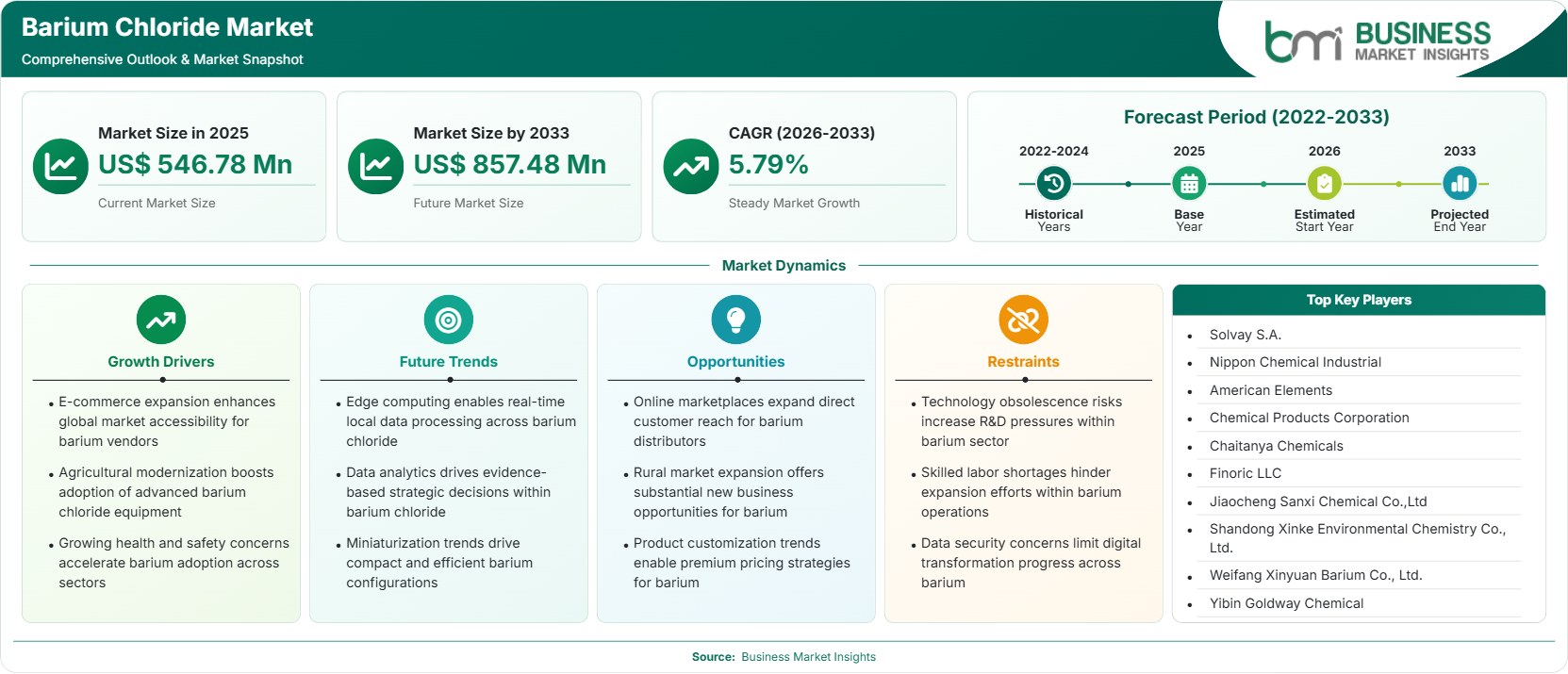
The Barium Chloride Market size was valued at US$ 546.78 Million in 2025 and is projected to reach US$ 857.48 Million by 2033, growing at a CAGR of 5.79% during 2026–2033, supported by steel processing demand, wastewater treatment applications, specialty chemical manufacturing, pigment production expansion, and industrial purification requirements across developing economies.

Report Coverage
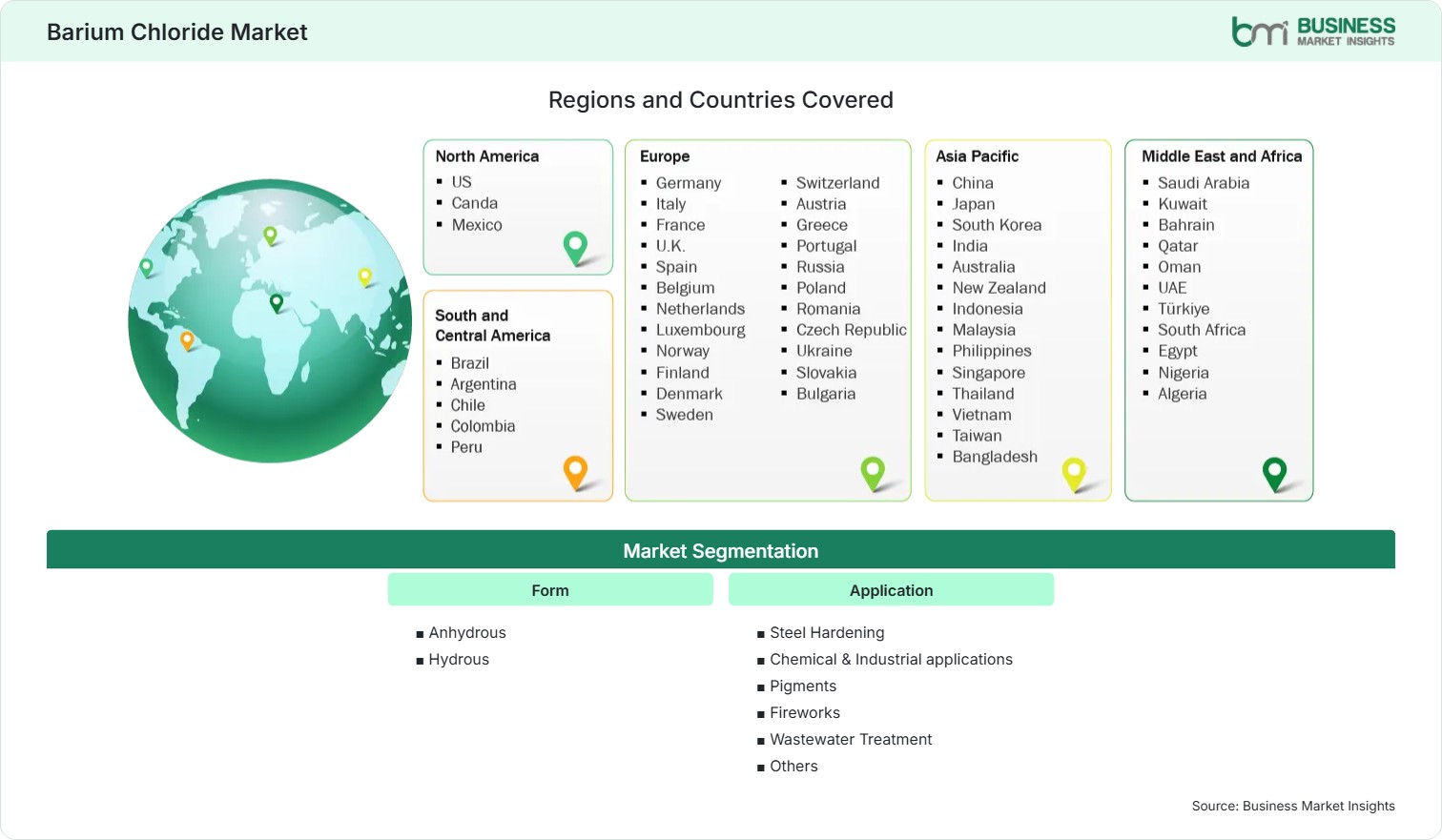
  • Form: Anhydrous, Hydrous
  • Application: Steel Hardening, Chemical & Industrial applications , Pigments, Fireworks, Wastewater Treatment, Others
US$ 546.78 Mn Market size in 2025
US$ 857.48 Mn Market Size by 2033
5.79% CAGR, 2026 - 2033
2026-2033 Forecast Period

AI Overview

Barium Chloride Market Summary

  • North America Region: North America holds a market share of 22%–25% in 2025, growing with a CAGR of 4.8%–5.3% during 2026–2033. Growth is influenced by wastewater treatment investments, specialty chemical manufacturing, industrial process optimization, steel hardening demand, environmental compliance requirements, and infrastructure modernization initiatives. The U.S. represents the largest regional market, advancing at a CAGR of 4.9%–5.4%.
  • Fastest Growing Region: Asia Pacific holds a market share of 42%–46% in 2025, growing with a CAGR of 6.4%–6.9% during 2026–2033. Expansion stems from industrialization, chemical processing growth, steel production capacity additions, pigment manufacturing demand, water treatment infrastructure investment, and favorable manufacturing economics.
  • Leading Segment: Hydrous (Dihydrate) holds a market share of 58%–62% in 2025, growing with a CAGR of 5.7%–6.2% during 2026–2033. Demand is driven by ease of handling, broad industrial applicability, cost efficiency, chemical processing requirements, and wastewater treatment usage.
  • High Growth Segment: Wastewater Treatment holds a market share of 14%–18% in 2025, growing with a CAGR of 6.8%–7.3% during 2026–2033. Adoption is supported by stricter discharge regulations, industrial water recycling initiatives, sustainability investments, and sulfate removal requirements.
  • Key Market Opportunity: Growing investments in industrial water management, advanced treatment facilities, circular manufacturing practices, and specialty chemical production create new opportunities for producers targeting high-purity industrial-grade applications.
  • Major Market Players: Solvay SA, Nippon Chemical Industrial Co., Ltd., Sakai Chemical Industry Co., Ltd., Vishnu Chemicals Limited, Noah Technologies Corporation, GFS Chemicals, Inc., Santa Cruz Biotechnology, Inc., Merck KGaA, Shanxi Jiaocheng Tianlong Chemical Industry Co., Ltd., Yongda Chemical Co., Ltd.
Strategic Insights

Barium Chloride Market: Strategic Insights

Barium Chloride Market Strategic Framework
FREE PDF
Request your free sample
Request free sample
Stakeholder View

Key Takeaways

  • The industry value chain is closely tied to barium mineral extraction, refining, specialty chemical production, and industrial distribution networks serving steel, water treatment, and chemical processing sectors.
  • Water treatment applications present one of the strongest growth opportunities due to tightening environmental regulations and increasing industrial wastewater recycling requirements.
  • Product purity improvements and customized industrial grades are becoming central innovation priorities, particularly for specialty chemical and advanced manufacturing applications.
  • Asia Pacific offers the most attractive investment environment due to its large industrial base, chemical production capacity, and expanding infrastructure projects.
  • Strategic partnerships between chemical suppliers and downstream industrial users are strengthening long-term procurement stability and market competitiveness.
  • Sustainability-focused process optimization and waste minimization initiatives are gaining importance as regulators impose stricter environmental performance standards.
Geographic Outlook

Barium Chloride Market Regional Highlights

North America Barium Chloride Market

North America accounted for approximately 22%–25% of global revenue in 2025 and is projected to grow at a CAGR of 4.8%–5.3% through 2033. Regional demand is supported by industrial chemical applications, wastewater treatment activities, and specialty manufacturing operations. The Barium Chloride Market share remains stable due to established industrial infrastructure and regulatory compliance requirements. Increasing emphasis on water management solutions and process optimization supports consumption across several sectors. Producers are also focusing on consistent supply chains and higher-purity grades to satisfy evolving industrial specifications.

  • Wastewater treatment investments continue supporting sulfate removal applications across municipal and industrial facilities.
  • Specialty chemical manufacturing drives demand for reliable and high-purity industrial-grade materials.
  • Environmental regulations encourage greater adoption of advanced water treatment chemicals.
  • Industrial modernization projects improve long-term consumption prospects across manufacturing facilities.
  • Infrastructure maintenance and process optimization initiatives sustain regional demand growth.

US Barium Chloride Market

The United States represents approximately 74%–78% of regional demand and is expected to register a CAGR of 4.9%–5.4% through 2033. Demand is concentrated in chemical processing, pigments, steel treatment, and environmental applications. Industrial facilities increasingly prioritize process efficiency and regulatory compliance. Strong presence of specialty chemical producers and established distribution channels support market stability and long-term procurement practices throughout key manufacturing regions.

  • Chemical processing facilities remain important consumers of industrial-grade barium chloride products.
  • Water quality management initiatives support continued utilization in treatment applications.
  • Domestic manufacturing activity contributes to stable industrial consumption patterns.
  • Distribution network maturity improves product availability across multiple industries.

Europe Barium Chloride Market

Europe held approximately 20%–23% of global revenue in 2025 and is forecast to expand at a CAGR of 4.5%–5.0% through 2033. Germany remains the leading national market due to its strong industrial and chemical manufacturing base, while Poland exhibits faster expansion with a CAGR between 5.8% and 6.3%. Demand is shaped by environmental regulations, advanced manufacturing activities, and investments in sustainable industrial operations. Producers continue focusing on efficiency, quality certification, and compliance-oriented product development to remain competitive.

  • Germany leads regional consumption driven by chemical and industrial processing sectors.
  • Poland benefits from growing manufacturing activity and infrastructure investment.
  • Sustainability objectives encourage adoption of efficient treatment and purification processes.
  • Industrial users demand consistent quality and compliance with environmental standards.
  • Specialty chemical applications create niche opportunities for premium-grade products.

Asia Pacific Barium Chloride Market

Asia Pacific represented approximately 42%–46% of global demand in 2025 and is anticipated to record a CAGR of 6.4%–6.9%, making it the fastest-growing region. China dominates regional consumption through its extensive chemical manufacturing ecosystem, while India records a CAGR of 6.8%–7.4%. Strong industrialization, steel production growth, pigment manufacturing, and water treatment investments support expanding demand. The Market share continues increasing across the region as industrial capacity additions and infrastructure developments strengthen downstream chemical consumption patterns.

  • China remains the largest consumer due to extensive industrial and chemical manufacturing operations.
  • India benefits from infrastructure expansion and broader industrial development programs.
  • Water treatment investments create additional demand across municipal and industrial sectors.
  • Pigment production growth supports sustained consumption across manufacturing industries.
  • Regional supply chain integration improves accessibility and production efficiency.

Rest of World Barium Chloride Market

Rest of World contributed around 10%-13% of revenues in 2025 and is estimated to grow at a CAGR of 5.3%-5.8% through 2033. Industrial diversity and mining-related chemical requirements drive growth in South and Central America. Investments in water infrastructure and industries in the Middle East and Africa have been on the rise. Brazil remains the dominant player in Latin America, while Saudi Arabia shows signs of growth driven by industrial diversity and chemical production capabilities.

  • Industrial water treatment projects support demand across resource-intensive industries.
  • Brazil leads regional consumption linked to manufacturing and chemical activities.
  • Gulf economies invest in industrial diversification and water infrastructure projects.
  • Growing urbanization increases focus on wastewater treatment solutions.
  • Chemical processing expansion strengthens long-term demand prospects.
Global Market Geography
FREE PDF
Request your free sample
Request free sample
Segment Analysis

Barium Chloride Market Segmentation

Form

Hydrous (Dihydrate) accounted for 58%–62% market share in 2025 and is projected to grow at a CAGR of 5.7%–6.2% through 2033. Barium Chloride Market scope within this segment is supported by broad usability, easier storage characteristics, operational convenience, and widespread acceptance across industrial applications including water treatment, pigments, and specialty chemical production.

  • Anhydrous: Preferred where low moisture content is essential for manufacturing processes requiring precise chemical reactions and enhanced product purity standards.
  • Hydrous (Dihydrate): Widely utilized across industrial sectors due to handling convenience, cost-effectiveness, and suitability for multiple chemical and treatment processes.

Application

Chemical & Industrial Applications accounted for approximately 34%–38% market share in 2025 and are expected to grow at a CAGR of 5.5%–6.0% through 2033. Barium Chloride Market trends indicate strong usage in purification, heat treatment salts, and production of other barium compounds required across manufacturing sectors.

  • Steel Hardening: Supports metallurgical processes requiring controlled treatment conditions and improved material performance characteristics.
  • Chemical & Industrial applications (Brine purification, Heat Treatment Salts, other Barium salts): Critical for purification processes, specialty compound production, and industrial manufacturing workflows.
  • Pigments: Used in specialty pigment production where chemical stability and formulation consistency remain important performance factors.
  • Fireworks: Supports pyrotechnic formulations requiring specific chemical properties for color generation and combustion performance.
  • Wastewater Treatment: Increasingly utilized to remove sulfates and improve treatment effectiveness in industrial water management systems.
Market Forces

Barium Chloride Market Dynamics

Key Market Drivers

Growing Industrial Water Treatment Requirements

There is immense pressure on industries to perform efficient wastewater treatment and meet stringent environmental regulations. The use of barium chloride has become crucial in eliminating sulfur from industrial processes. Government organizations are promoting efficient wastewater management and investing in advanced wastewater treatment techniques. Growth in the market is connected to the environmental considerations that have been made. There is high demand for barium chloride in areas with growing industries that need modernized wastewater treatment plants. Long-term consumption is supported by sustainability goals, regulatory enforcement, and broader adoption of industrial water recycling practices.

Expansion of Chemical Manufacturing Activities

Downstream chemical industry growth will continue to favor the use of barium chloride in purification applications and specialty compounds manufacturing. Industries need reliable inputs that can deliver products of the desired quality. Industrial diversification in emerging markets will be another positive factor driving demand. Specialty chemicals manufacturing, pigment production, and treatment formulation will depend on the availability of high-quality inputs. There is an opportunity for producers, driven by increased investment, to improve manufacturing capacity and efficiency. With increased industrial output, demand for intermediate chemicals in manufacturing processes is anticipated to remain steady.

Rising Demand from Steel Processing Industries

In steel processing, barium chloride is used in hardening and heat treatment, both of which involve quality control and material performance. The steel demand is continually driven by infrastructure development, manufacturing, and investments across industries worldwide. As manufacturers work to enhance their metallurgical processes, the use of specialty chemicals becomes increasingly significant. In addition, industrial companies are working towards refining their manufacturing processes to gain a competitive edge. All these aspects result in consistent demand from the metallurgical industry.

Key Market Opportunities

Development of High-Purity Specialty Grades

There is a growing demand for high-purity substances in specialty chemicals, electronics, and advanced industrial manufacturing processes. Suppliers that can offer their materials in a customized form with very specific quality standards will gain access to more lucrative market segments. The investments in technology and quality management allow companies to market their products as superior products. Traceability and technical support have become an essential part of buyers’ decisions. Barium Chloride Market forecasts indicate little growth in application segments where performance requirements exceed typical industrial standards. Companies specializing in differentiated products can have enhanced margins and stronger customer relationships.

Infrastructure-Led Industrial Expansion in Emerging Economies

Industrialization in Asia, the Middle East, and selected parts of Africa is driving increased demand for chemicals used in manufacturing and refining processes. Infrastructure development increases demand for steel manufacturing, water treatment systems, and industrial manufacturing capacity. Manufacturers can take advantage of distribution closer to the market and regional manufacturing facilities. The development of industrial complexes requires a consistent supply of chemicals to support sustainable growth in the region. Early establishment in these regions will ensure strong customer relations and opportunities for demand growth.

Integration into Circular Water Management Systems

Many sectors have adopted closed-loop water management systems to improve sustainability and efficiency and reduce resource use. The removal of sulfate and the efficiency of its treatment are key aspects of such systems. Barium chloride may help improve processes within the advanced water treatment framework. Growing knowledge of resource conservation underscores the need for treatment equipment capable of achieving recycling and reuse goals. This creates room for producers of technologically sound products that fit into new-age water management solutions. As environmental priorities strengthen, demand related to circular treatment systems is likely to expand.

Market Restraints and Challenges

Stringent Handling and Toxicity Concerns

Factor: Barium chloride requires careful handling due to toxicity considerations and occupational health requirements. Impact: Compliance costs increase as manufacturers and end users invest in safety measures, training programs, storage controls, and regulatory reporting obligations. Stringent workplace standards can raise operating expenditures across the supply chain. Customers operating in highly regulated sectors may conduct extensive qualification procedures before procurement. These factors may slow adoption in certain applications and create additional administrative burdens for producers seeking market expansion while maintaining full regulatory compliance.

Raw Material and Energy Cost Volatility

Factor: Variations in raw material availability, mining economics, transportation expenses, and energy prices can affect production costs. Impact: Profitability and pricing stability may be challenged, particularly during periods of supply disruption or elevated operating expenses. Manufacturers often need to balance competitive pricing with margin preservation. Cost fluctuations can also influence purchasing decisions among industrial customers. Long-term supply agreements, diversified sourcing strategies, and operational efficiency programs are increasingly important for managing these risks and maintaining market competitiveness.

Company Analysis

Competitive Landscape

Barium Chloride Market analysis reveals competition centered on product purity, manufacturing capability, distribution reach, industrial-grade customization, and long-term customer relationships.

Company Name

Overview

Products and Services relevant to this market

Solvay SA

Global specialty chemicals producer with extensive industrial chemical expertise and international distribution capabilities.

Barium derivatives, specialty chemicals, industrial solutions, process optimization products.

Nippon Chemical Industrial Co., Ltd.

Japanese chemical manufacturer serving specialty and industrial chemical markets.

Barium compounds, industrial chemicals, performance material solutions.

Sakai Chemical Industry Co., Ltd.

Established producer focused on inorganic chemicals and specialty materials.

Barium chemicals, pigments, functional industrial materials.

Vishnu Chemicals Limited

Indian manufacturer with diversified inorganic chemical product portfolio.

Barium compounds, industrial chemicals, specialty processing materials.

Noah Technologies Corporation

Producer and supplier of specialty inorganic chemical materials.

High-purity barium chemicals, laboratory and industrial-grade products.

GFS Chemicals, Inc.

U.S.-based specialty chemical manufacturer and distributor.

Industrial reagents, barium chloride, research and production chemicals.

Santa Cruz Biotechnology, Inc.

Supplier of laboratory and specialty chemical products.

Research-grade compounds, specialty chemicals, barium materials.

Merck KGaA

Global science and technology company serving industrial and laboratory markets.

High-purity chemicals, specialty reagents, industrial compounds.

Shanxi Jiaocheng Tianlong Chemical Industry Co., Ltd.

Major Chinese producer of barium-based chemical products.

Barium chloride, barium salts, industrial chemical solutions.

Yongda Chemical Co., Ltd.

Industrial chemical producer serving domestic and export markets.

Barium compounds, treatment chemicals, manufacturing intermediates.

Trust & Transparency

Research Methodology

The market analysis combines proprietary research with secondary data from government agencies, company disclosures, regulatory filings, industry databases and expert interviews. Market estimates are validated through data triangulation, cross-market benchmarking and analyst review.

View Full Research Methodology

Questions Answered

Frequently Asked Questions

Which application area offers the strongest future opportunity?

Wastewater treatment presents attractive long-term potential due to growing sustainability initiatives, resource conservation goals, industrial water reuse programs, and regulatory compliance requirements.

What information does a Barium Chloride Market Report provide?

A market report typically evaluates industry structure, demand drivers, segmentation performance, competitive positioning, regional trends, technological developments, and long-term business opportunities.

How do environmental regulations influence demand?

Stricter wastewater discharge requirements encourage industries to adopt effective sulfate-removal solutions, supporting broader utilization across treatment and compliance-focused applications.

Which region leads global consumption?

Asia Pacific leads consumption due to its large chemical manufacturing base, significant steel production capacity, expanding infrastructure projects, and increasing industrial wastewater treatment investments.

What are the primary uses of barium chloride?

Barium chloride is primarily used in wastewater treatment, steel hardening, pigment manufacturing, chemical processing, brine purification, and production of other barium-based compounds.

Access the Full Barium Chloride Market Report

Get segment-level forecasts, regional estimates, competitive benchmarking, company profiles and downloadable Excel datasets.

Access the full Barium Chloride Market Report
350 pages PDF & Excel | 2026-08-17
Similar Research

Related Market Reports